
Introduction
Every durable road begins with a strong foundation, and that foundation is the subgrade. No matter how advanced the pavement materials or construction techniques become, the overall performance of a road depends heavily on the quality of Subgrade Preparation. A poorly prepared subgrade can lead to settlement, rutting, cracking, potholes, and costly maintenance, while a well-prepared subgrade provides long-term structural stability and improves pavement performance.
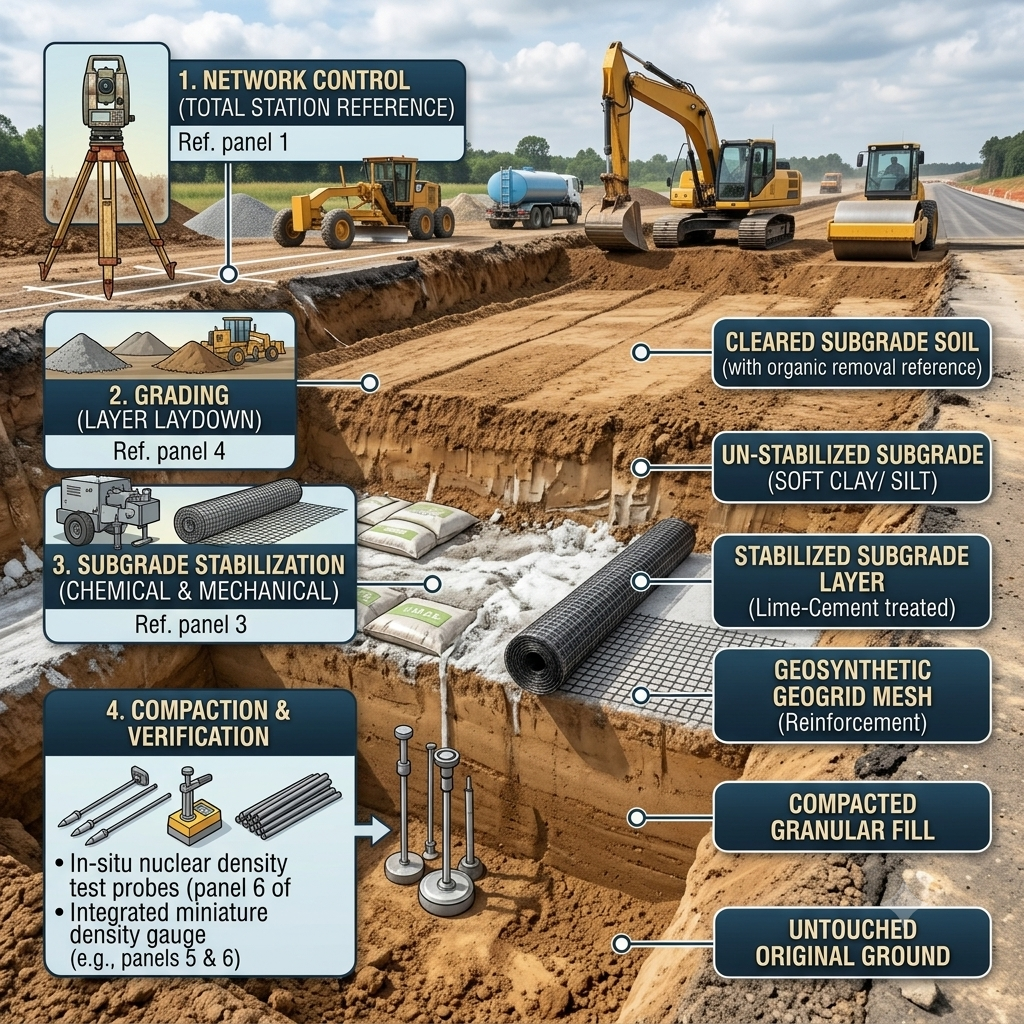
In highway engineering, Subgrade Preparation involves shaping, improving, compacting, and testing the natural soil to create a stable platform for the pavement layers. This process requires careful planning, proper moisture control, suitable compaction equipment, and rigorous quality testing. Engineers must also consider soil type, groundwater conditions, traffic loading, and environmental factors before approving the subgrade for construction.
Whether you are a civil engineer, contractor, engineering student, or construction professional, understanding the principles and procedures of Subgrade Preparation will help you build safer, stronger, and more durable roads. This guide explains every stage of the process using practical engineering concepts, field examples, and industry best practices.
What Is Subgrade Preparation?
Subgrade Preparation is the process of preparing the natural ground or improved soil to support the pavement structure. It creates a firm, uniform, and stable foundation capable of carrying traffic loads and distributing stresses to the underlying soil.
The subgrade forms the lowest structural layer of a pavement system. Every layer above it—including the sub-base, base course, and surface course—depends on its strength and uniformity.
A properly prepared subgrade should provide:
- High bearing capacity
- Uniform support
- Adequate drainage
- Proper compaction
- Long-term stability
- Resistance to deformation
If the subgrade fails, the entire pavement structure becomes vulnerable to damage, regardless of the quality of the upper layers.
Why Is Subgrade Preparation Important?
Subgrade preparation directly affects the service life and performance of a road. Engineers invest significant time and resources in this stage because correcting subgrade failures after pavement construction is expensive and disruptive.
Key Benefits
- Improves pavement durability.
- Reduces settlement.
- Prevents rutting and cracking.
- Enhances load distribution.
- Minimizes maintenance costs.
- Increases pavement service life.
- Supports heavy traffic loads safely.
- Improves overall ride quality.
Practical Example
Imagine constructing a highway over soft clay without proper subgrade preparation. Within a short period, heavy truck traffic may cause uneven settlement, surface depressions, and longitudinal cracks. By stabilizing the soil, controlling moisture, and achieving the required compaction before paving, engineers can significantly reduce these risks and improve long-term performance.
Functions of a Road Subgrade
The subgrade serves as the foundation of the pavement structure and performs several essential functions.
1. Supports Pavement Layers
The subgrade carries the weight of all pavement layers above it while providing uniform support across the roadway.
2. Distributes Traffic Loads
Vehicle loads pass through the asphalt or concrete surface, base course, and sub-base before reaching the subgrade. A strong subgrade spreads these loads safely into the natural ground.
3. Controls Pavement Deformation
Properly compacted soil minimizes settlement and reduces the likelihood of surface distortion.
4. Maintains Pavement Stability
Stable subgrade conditions help maintain pavement geometry and prevent differential settlement.
5. Assists Drainage
Well-prepared subgrades work with drainage systems to reduce moisture accumulation, protecting the pavement from water-related damage.
Engineering Principles Behind Subgrade Preparation
High-quality Subgrade Preparation relies on several fundamental engineering principles.
Bearing Capacity
The soil must possess sufficient strength to support anticipated traffic loads without excessive deformation.
Compaction
Compaction increases soil density by reducing air voids. Higher density improves strength, stiffness, and resistance to settlement.
Moisture Control
Every soil type has an optimum moisture content that allows maximum compaction. Engineers adjust water content before compaction to achieve the desired density.
Load Distribution
A uniform subgrade distributes loads evenly and prevents localized stress concentrations that can cause pavement failure.
Drainage
Proper drainage protects the subgrade from excessive moisture, which can weaken soil and reduce bearing capacity.
Step-by-Step Subgrade Preparation Process
Step 1: Site Clearing and Grubbing
Subgrade preparation begins with clearing the construction site.
Workers remove:
- Trees
- Shrubs
- Grass
- Roots
- Stumps
- Rocks
- Debris
- Existing unwanted structures
Why This Step Matters
Organic materials decompose over time and create voids beneath the pavement. Removing them ensures a stable and uniform foundation.
Best Practice
Dispose of cleared vegetation responsibly and preserve reusable topsoil for future landscaping and erosion control.
Step 2: Stripping Topsoil
After clearing, contractors strip the upper layer of topsoil.
Topsoil contains:
- Organic matter
- Plant roots
- Humus
- Loose material
These materials lack the strength required for pavement support.
Engineering Objective
Removing topsoil exposes stronger underlying soil that can be compacted effectively.
Practical Recommendation
Stockpile stripped topsoil separately for environmental restoration rather than mixing it with structural fill material.
Step 3: Excavation and Embankment
Engineers shape the roadway to match the design profile through cutting and filling operations.
Excavation (Cut Sections)
Excess soil is removed from elevated ground to achieve the required formation level.
Embankment (Fill Sections)
Selected fill material is placed in low-lying areas to raise the roadway to the design elevation.
Layer Placement
Fill material should be placed in thin layers and compacted individually. Thick uncompacted layers can trap air and lead to future settlement.
Engineering Considerations
- Soil type
- Moisture content
- Layer thickness
- Compaction equipment
- Slope stability
Step 4: Moisture Conditioning
Moisture conditioning adjusts the water content of the soil before compaction.
Why It Is Necessary
Soil that is too dry cannot achieve maximum density. Soil that is too wet loses strength and becomes difficult to compact.
Moisture Adjustment Methods
- Sprinkle water on dry soil.
- Mix wet soil with drier material.
- Aerate overly wet soil.
- Allow natural drying when required.
Engineering Principle
Compaction performed near the optimum moisture content produces the highest dry density and improves long-term performance.
Step 5: Compaction
Compaction is one of the most critical activities in Subgrade Preparation.
It compresses soil particles, increases density, and enhances the load-bearing capacity of the foundation.
Common Compaction Equipment
- Smooth wheel roller
- Vibratory roller
- Sheep foot roller
- Pneumatic tire roller
- Plate compactor (small areas)
Factors Affecting Compaction
- Soil type
- Moisture content
- Roller type
- Number of roller passes
- Layer thickness
- Compaction speed
Benefits of Proper Compaction
- Higher bearing capacity
- Reduced settlement
- Improved pavement life
- Better resistance to rutting
- Lower maintenance costs
Step 6: Final Grading and Leveling
After achieving the required compaction, engineers perform final grading to produce a smooth and uniform formation level.
Motor graders shape the subgrade according to the approved design profile.
Objectives
- Maintain proper cross slope.
- Achieve correct elevation.
- Ensure surface uniformity.
- Facilitate drainage.
- Prepare for sub-base construction.
Surface Inspection
Before placing the next pavement layer, engineers inspect the subgrade for:
- Soft spots
- Depressions
- Loose material
- Standing water
- Surface irregularities
Any deficiencies must be corrected before construction continues.
Typical Pavement Structure Diagram
                TRAFFIC LOAD
                     ↓
=========================================
 Asphalt / Concrete Surface Course
=========================================
 Binder Course (Flexible Pavement)
=========================================
 Base Course
=========================================
 Granular Sub-base
=========================================
 Compacted Subgrade
=========================================
 Natural Ground (Foundation Soil)
The diagram illustrates how the Subgrade supports all pavement layers above it and transfers traffic loads safely into the natural ground.
Practical Field Example
During the construction of a four-lane highway, engineers discovered that a section of the proposed alignment contained highly plastic clay with a low California Bearing Ratio (CBR). Instead of proceeding with pavement construction, the project team stabilized the soil with lime, adjusted the moisture content, and compacted the treated layer to the specified density. Follow-up testing confirmed a significant improvement in strength, allowing the pavement structure to perform as intended. This proactive approach reduced the likelihood of future settlement and extended the expected service life of the highway.
Key Takeaways
Subgrade Preparation forms the backbone of every successful road project. Proper site clearing, removal of unsuitable topsoil, controlled earthworks, moisture conditioning, thorough compaction, and precise grading create a stable foundation that supports the entire pavement structure. Applying sound engineering principles during these early stages improves pavement durability, reduces maintenance costs, and enhances long-term road performance. A well-prepared subgrade provides the strength and consistency required for safe and reliable transportation infrastructure.
Step 7: Quality Control Testing
Quality control plays a vital role in Subgrade Preparation because every pavement layer depends on a stable and uniform foundation. Engineers perform field and laboratory tests throughout construction to verify that the prepared subgrade meets the specified design requirements.
Consistent testing helps identify weak areas before the next pavement layer is placed, reducing the risk of premature pavement failure.
Common Field Tests
1. Field Density Test
The Field Density Test measures the in-place density of compacted soil. Engineers compare the results with the laboratory maximum dry density obtained from the Proctor Test.
Purpose
- Verify compaction quality
- Detect under-compacted areas
- Ensure compliance with project specifications
2. Moisture Content Test
Soil moisture significantly influences compaction efficiency.
Engineers measure the moisture content before and during compaction to maintain the soil near its Optimum Moisture Content (OMC).
Importance
- Improves compaction efficiency
- Prevents overwatering
- Reduces weak zones
- Maintains uniform soil strength
3. California Bearing Ratio (CBR) Test
The CBR Test evaluates the load-bearing capacity of subgrade soil.
High CBR values indicate stronger soil, while low values suggest the need for stabilization or pavement redesign.
Applications
- Pavement thickness design
- Soil classification
- Subgrade evaluation
4. Plate Load Test
Engineers use the Plate Load Test on projects that require additional confirmation of soil bearing capacity.
The test measures soil deformation under controlled loading conditions.
5. Proctor Compaction Test
The Proctor Test determines:
- Maximum Dry Density (MDD)
- Optimum Moisture Content (OMC)
These values become the benchmark for field compaction.
Typical Subgrade Testing Workflow
Site Preparation
       │
       ▼
Moisture Conditioning
       │
       ▼
Compaction
       │
       ▼
Field Density Test
       │
       ▼
CBR Verification
       │
       ▼
Engineer Approval
       │
       ▼
Sub-base Construction
Common Problems During Subgrade Preparation
Even experienced construction teams encounter challenges while preparing subgrades. Early identification and corrective action help maintain construction quality.
1. Soft Spots
Causes
- Excess moisture
- Organic soil
- Poor drainage
- Inadequate compaction
Solution
- Remove unsuitable material.
- Replace with approved fill.
- Improve drainage.
- Recompact the affected area.
2. Poor Compaction
Causes
- Incorrect roller selection
- Insufficient roller passes
- Improper moisture content
- Thick soil layers
Solution
- Adjust moisture content.
- Reduce lift thickness.
- Increase compaction effort.
- Select suitable equipment.
3. Excessive Moisture
Heavy rainfall or high groundwater levels often weaken the subgrade.
Solution
- Install temporary drainage.
- Allow natural drying.
- Blend with dry material.
- Stabilize soil if required.
4. Expansive Clay
Expansive soils swell when wet and shrink during dry conditions, causing pavement movement.
Solution
- Lime stabilization
- Cement stabilization
- Geotextile reinforcement
- Soil replacement
5. Uneven Surface Levels
An uneven formation creates variable pavement thickness and poor ride quality.
Solution
- Perform final grading.
- Verify elevations with surveying equipment.
- Correct low and high spots before approval.
Materials Used for Subgrade Improvement
Depending on site conditions, engineers may improve weak soils using different materials.
Common Stabilizing Materials
- Lime
- Cement
- Fly ash
- Granular borrow soil
- Crushed stone
- Sand
- Geotextiles
- Geogrids
Each material offers specific advantages based on soil type and project requirements.
Equipment Used in Subgrade Preparation
Efficient equipment selection improves construction quality and productivity.
Earthwork Equipment
- Excavators
- Bulldozers
- Motor graders
- Dump trucks
Compaction Equipment
- Vibratory rollers
- Smooth drum rollers
- Sheep foot rollers
- Pneumatic tire rollers
- Plate compactors
Survey Equipment
- Total Station
- GPS equipment
- Automatic Level
- Laser Level
Testing Equipment
- Sand Cone Apparatus
- Nuclear Density Gauge (where permitted)
- CBR Testing Equipment
- Moisture Meter
Best Practices for Successful Subgrade Preparation
Successful highway projects consistently follow proven engineering practices.
Recommended Practices
- Complete detailed soil investigations before construction.
- Remove all unsuitable and organic materials.
- Place fill material in thin, uniform layers.
- Maintain soil near its Optimum Moisture Content.
- Compact each layer before placing the next.
- Conduct regular field density and moisture tests.
- Provide adequate surface and subsurface drainage.
- Correct weak areas immediately.
- Protect the prepared subgrade from construction traffic until the next layer is placed.
- Keep accurate quality control records throughout the project.
These practices improve pavement durability and reduce lifecycle maintenance costs.
Practical Recommendations
Civil Engineers
- Review geotechnical reports carefully before approving earthworks.
- Verify test results before accepting completed sections.
- Monitor moisture conditions daily.
- Coordinate closely with surveyors and quality control teams.
Contractors
- Calibrate compaction equipment regularly.
- Avoid placing fill during unsuitable weather conditions.
- Train equipment operators in proper compaction techniques.
- Protect completed work from water accumulation.
Engineering Students
- Understand the relationship between soil properties and pavement performance.
- Learn common laboratory and field testing procedures.
- Visit construction sites to observe compaction and testing operations.
- Study pavement failures caused by inadequate subgrade preparation.
General Discussion of IRC, AASHTO, and ICE Guidance
Leading engineering organizations such as the Indian Roads Congress (IRC), the American Association of State Highway and Transportation Officials (AASHTO), and the Institution of Civil Engineers (ICE) emphasize the importance of a strong and uniform subgrade.
Although project specifications differ by region, their guidance generally recommends:
- Conducting comprehensive geotechnical investigations before design.
- Designing pavements based on expected traffic loading and subgrade strength.
- Achieving specified compaction levels for all earthworks.
- Maintaining proper moisture during compaction.
- Implementing effective drainage systems to protect the subgrade.
- Performing continuous quality control throughout construction.
- Using approved materials that meet project specifications.
- Maintaining detailed documentation and inspection records.
Following these engineering principles improves pavement performance, enhances safety, and reduces long-term maintenance costs.
Frequently Asked Questions (FAQs)
1. What is subgrade preparation in road construction?
Subgrade preparation is the process of clearing, shaping, improving, compacting, and testing the natural ground to create a stable foundation for pavement layers.
2. Why is subgrade preparation important?
It provides uniform support, improves pavement strength, minimizes settlement, reduces cracking, and extends the service life of the road.
3. Which test is most commonly used to evaluate subgrade strength?
The California Bearing Ratio (CBR) Test is one of the most widely used methods for assessing subgrade strength and determining pavement thickness.
4. What happens if the subgrade is poorly compacted?
Poor compaction can lead to rutting, uneven settlement, pavement cracking, potholes, and premature structural failure.
5. How does moisture affect compaction?
Soil achieves maximum density near its Optimum Moisture Content (OMC). Excessive or insufficient moisture reduces compaction efficiency and weakens the foundation.
6. Which equipment is commonly used for subgrade compaction?
Vibratory rollers, smooth drum rollers, sheep foot rollers, pneumatic tire rollers, and plate compactors are commonly used depending on soil type and project requirements.
7. How can weak subgrade soil be improved?
Engineers may improve weak soil through lime stabilization, cement stabilization, soil replacement, geotextile reinforcement, or better drainage systems.
8. What role does drainage play in subgrade performance?
Effective drainage prevents water accumulation, preserves soil strength, reduces erosion, and protects the pavement from moisture-related damage.
9. What are the signs of subgrade failure?
Common signs include rutting, pavement settlement, longitudinal cracking, potholes, soft spots, and uneven road surfaces.
10. Which engineering standards guide subgrade preparation?
Highway agencies often follow recommendations from organizations such as IRC, AASHTO, and ICE, along with local project specifications and national standards.
Conclusion
Subgrade Preparation forms the foundation of every successful pavement structure and remains one of the most critical stages in road construction. Careful site clearing, proper earthwork, moisture control, systematic compaction, and comprehensive quality testing work together to create a stable platform that supports traffic loads throughout the pavement’s service life. Engineers who follow sound geotechnical principles and recognized construction practices can significantly reduce the risk of settlement, rutting, cracking, and premature pavement failure. Equally important, contractors must use approved materials, maintain proper compaction procedures, and protect the prepared subgrade from moisture and construction damage. Engineering students should understand that the quality of every pavement layer depends on the strength of the foundation beneath it. By applying industry best practices and guidance consistent with IRC, AASHTO, and ICE recommendations, Subgrade Preparation ensures stronger, safer, more durable, and cost-effective roads that continue to serve communities for decades.
