
Introduction
Embankment Soil Selection is one of the most critical decisions in highway and road construction. A well-designed pavement cannot perform satisfactorily if it rests on a poorly constructed embankment. The embankment forms the foundation that supports the pavement, distributes traffic loads, and maintains the required road elevation above the surrounding ground. Selecting the right soil improves stability, minimizes settlement, reduces maintenance costs, and extends the service life of the road.
Civil engineers evaluate soil properties, field conditions, drainage requirements, and traffic loads before choosing embankment material. Contractors rely on proper soil selection to achieve the required compaction and construction quality, while engineering students must understand how soil characteristics influence the long-term performance of transportation infrastructure.
This guide explains Embankment Soil Selection using practical engineering principles, field applications, and internationally accepted highway engineering practices. It also highlights the factors that influence soil selection, the characteristics of suitable embankment materials, and best practices followed in modern road projects.
What is Embankment Soil Selection?
Embankment Soil Selection is the process of choosing suitable earth material for constructing highway, railway, or infrastructure embankments. Engineers assess the engineering properties of available soils to ensure that the embankment can safely support pavement layers and withstand environmental and traffic loads throughout its design life.
An embankment raises the roadway above natural ground level where the existing terrain lies below the required formation level. It also helps improve drainage, reduce flooding risks, and provide a stable platform for pavement construction.
A properly selected embankment soil should:
- Carry traffic loads safely.
- Resist excessive settlement.
- Allow effective compaction.
- Maintain long-term stability.
- Minimize shrinkage and swelling.
- Resist erosion.
- Support pavement performance.
Selecting unsuitable soil can result in differential settlement, slope failures, pavement cracking, rutting, and increased maintenance costs.
Why Embankment Soil Selection is Important
The embankment acts as the structural base of the entire roadway. Every pavement layer depends on the stability of the embankment beneath it. Even the highest-quality asphalt or concrete pavement cannot compensate for weak foundation material.
Major Benefits
Improves Structural Stability
Strong embankment material distributes vehicle loads evenly and reduces stress on the underlying natural soil.
Reduces Future Settlement
Properly selected and compacted soil minimizes long-term settlement that could damage the pavement structure.
Enhances Drainage
Suitable soils allow water to drain efficiently and reduce moisture-related problems.
Extends Pavement Life
Stable embankments help maintain pavement shape and reduce structural deterioration.
Lowers Maintenance Costs
High-quality embankment materials reduce repairs caused by settlement, erosion, or slope instability.
Increases Road Safety
Stable embankments provide uniform support, reducing surface irregularities that affect vehicle control.
Engineering Principles of Embankment Construction
Civil engineers follow several fundamental principles when selecting embankment soils.
1. Strength
The soil must possess adequate shear strength to support traffic loads without failure.
2. Stability
The embankment should remain stable during construction and throughout its service life, even under varying weather conditions.
3. Compaction
Good embankment soil should achieve high dry density through proper compaction, reducing air voids and increasing strength.
4. Drainage
The selected material should limit water retention and facilitate proper drainage to protect the embankment.
5. Durability
The soil should maintain its engineering properties despite repeated wetting, drying, and traffic loading.
6. Uniformity
Engineers prefer soils with consistent characteristics to avoid differential settlement and uneven pavement support.
Types of Soils Used for Embankments
Different soil types offer varying levels of performance. Engineers select the material based on project requirements, availability, and site conditions.
Granular Soils
Granular soils include mixtures of sand and gravel with minimal fines.
Advantages
- Excellent drainage
- High bearing capacity
- Easy compaction
- Low compressibility
- Good long-term performance
Typical Applications
- Highway embankments
- Expressways
- Airport runways
- Industrial roads
Granular soils are among the most preferred embankment materials because they provide excellent stability and durability.
Sandy Soils
Well-graded sandy soils perform well when properly compacted.
Advantages
- Good drainage
- Easy handling
- Moderate strength
- Fast construction
Limitations
- Loose sand may require additional compaction.
- Fine sand can become unstable under saturated conditions.
Gravelly Soils
Gravelly soils provide outstanding structural support due to their large particle size.
Advantages
- High strength
- Excellent load distribution
- Low settlement
- Superior drainage
Common Uses
- High embankments
- Heavy traffic corridors
- Bridge approaches
Silty Soils
Silty soils contain fine particles that retain more water than sand.
Advantages
- Moderate workability
- Easy excavation
Disadvantages
- Poor drainage
- Moisture sensitivity
- Reduced strength when wet
Engineers generally use silty soils only after careful evaluation and appropriate moisture control.
Clayey Soils
Clay soils exhibit high plasticity and significant volume changes due to moisture fluctuations.
Challenges
- High shrinkage and swelling
- Low permeability
- Difficult compaction
- Reduced bearing capacity under wet conditions
When clay is the only available material, engineers often improve it through stabilization techniques such as lime or cement treatment.
Rock Fill Materials
Rock fragments provide excellent stability for high embankments and mountainous terrain.
Benefits
- Very high strength
- Excellent drainage
- Low settlement
- Long service life
Rock fill requires proper grading and placement to achieve adequate interlocking and stability.
Essential Properties of Good Embankment Soil
A suitable embankment material should satisfy several engineering requirements.
Adequate Shear Strength
The soil should resist sliding and slope failure under traffic and environmental loads.
Good Compaction Characteristics
The material should achieve the specified dry density at or near optimum moisture content.
Low Compressibility
Low-compressibility soils reduce long-term settlement and improve pavement performance.
Controlled Plasticity
Moderate or low plasticity helps minimize shrinkage and swelling.
Good Drainage
Permeable soils reduce water accumulation and improve embankment stability.
Resistance to Erosion
The selected soil should withstand rainfall and surface runoff without excessive erosion.
Availability
Locally available materials often reduce transportation costs and improve project economy, provided they meet engineering specifications.
Field Identification of Suitable Soil
Engineers perform preliminary field evaluations before laboratory testing.
Visual Inspection
Observe:
- Particle size
- Color
- Moisture condition
- Organic content
- Uniformity
Hand Feel Test
Rub the soil between your fingers to estimate:
- Sand content
- Clay content
- Plasticity
Ribbon Test
Roll moist soil into a ribbon to estimate plasticity and clay content.
Dry Strength Test
Break a dried soil sample by hand to estimate its strength.
Field Recommendation
Field identification provides valuable initial information but should always be verified through laboratory testing before final material approval.
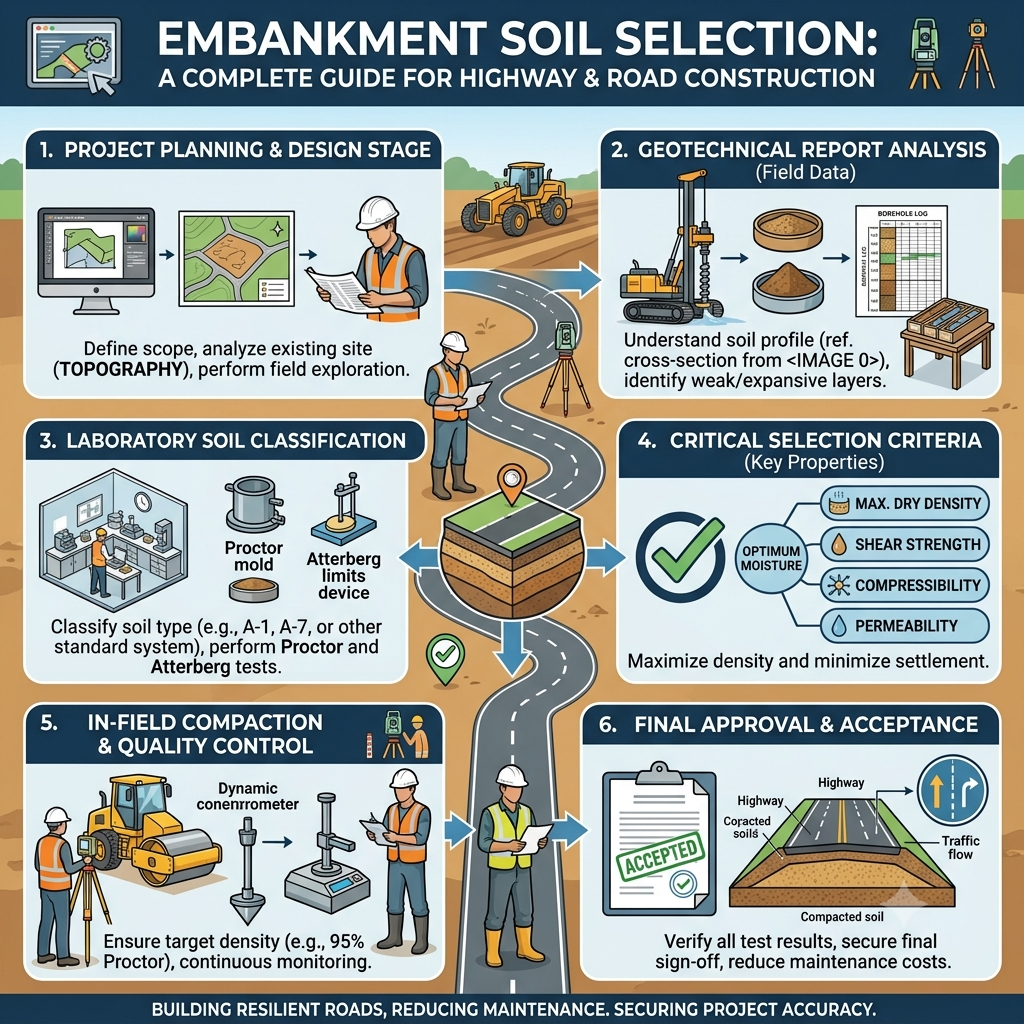
Practical Engineering Diagram
Typical Highway Embankment Cross-Section
                 Road Surface
        ==========================
             Base Course
        --------------------------
            Sub-base Course
        --------------------------
             Compacted Fill
           /                  \
          /                    \
         /                      \
        /                        \
-------/--------------------------\-------
      Natural Ground Level
Soil Selection Decision Flow
Borrow Area
      │
      ▼
Visual Inspection
      │
      ▼
Field Identification
      │
      ▼
Laboratory Testing
      │
      ▼
Engineering Evaluation
      │
      ▼
Approved for Embankment
Key Takeaways
Successful Embankment Soil Selection begins with understanding soil behavior, engineering properties, and field conditions. Granular and gravelly soils generally provide the best performance because they offer high strength, excellent drainage, and easy compaction. Engineers must evaluate shear strength, plasticity, compressibility, drainage characteristics, and availability before selecting embankment material. Careful field identification combined with laboratory verification creates a stable foundation that supports the pavement throughout its design life while reducing maintenance costs and improving road safety.
Step-by-Step Embankment Soil Selection Procedure
Selecting the right embankment soil requires a systematic engineering approach. Every step contributes to the stability, durability, and long-term performance of the highway embankment.
Step 1: Conduct a Site Investigation
Begin by studying the project site and identifying available soil sources. Engineers assess the topography, groundwater conditions, existing soil profile, and nearby borrow areas.
Key Activities
- Review geological maps.
- Inspect natural ground conditions.
- Locate suitable borrow pits.
- Identify drainage patterns.
- Record groundwater levels.
Step 2: Collect Representative Soil Samples
Collect soil samples from different depths and locations to ensure accurate laboratory results.
Sampling Methods
- Disturbed samples for classification tests.
- Undisturbed samples for strength and compressibility tests.
- Bulk samples for compaction testing.
Proper sampling ensures reliable engineering decisions and reduces the risk of unexpected field problems.
Step 3: Perform Laboratory Testing
Laboratory tests determine whether the selected soil satisfies project specifications.
Common Laboratory Tests
Soil Classification
- Grain Size Analysis
- Hydrometer Analysis
Plasticity Tests
- Liquid Limit (LL)
- Plastic Limit (PL)
- Plasticity Index (PI)
Compaction Tests
- Standard Proctor Test
- Modified Proctor Test
Strength Tests
- California Bearing Ratio (CBR)
- Direct Shear Test
- Triaxial Compression Test
Compressibility Tests
- Consolidation Test
The test results help engineers determine whether the soil requires improvement before use.
Step 4: Compare Results with Project Requirements
Engineers compare laboratory data with the project specifications and design requirements.
They evaluate:
- Bearing capacity
- Moisture sensitivity
- Plasticity
- Density
- Drainage characteristics
- Long-term stability
If the soil fails to meet the required standards, engineers select another material or improve the existing soil through stabilization.
Step 5: Approve the Material
The supervising engineer approves only those soils that satisfy technical specifications, quality standards, and project requirements.
Approved material is then transported to the construction site for embankment construction.
Field Testing During Construction
Continuous field testing ensures that the embankment performs as designed.
Moisture Content Test
Engineers measure moisture content before compaction to achieve optimum density.
Field Density Test
The Field Density Test verifies whether the compacted soil reaches the specified density.
Common methods include:
- Sand Cone Method
- Nuclear Density Gauge
- Rubber Balloon Method
Plate Load Test (When Required)
This test evaluates the load-bearing capacity of the compacted embankment.
Surface Level Survey
Survey teams continuously check embankment levels, slopes, and layer thickness to maintain design accuracy.
Regular testing prevents defects from progressing to later construction stages.
Soil Improvement Techniques
Sometimes locally available soil does not meet engineering requirements. Instead of importing expensive materials, engineers improve existing soil.
Mechanical Stabilization
Mechanical stabilization involves blending two or more soils to improve grading and compaction.
Example:
Mixing sand with clay reduces plasticity and improves drainage.
Lime Stabilization
Lime treatment works particularly well for highly plastic clay soils.
Benefits
- Reduces plasticity.
- Increases strength.
- Improves workability.
- Minimizes shrinkage and swelling.
Cement Stabilization
Cement increases the strength and durability of weak soils.
Engineers commonly use cement stabilization for:
- Highway embankments
- Industrial roads
- Airport pavements
Fly Ash Stabilization
Fly ash improves engineering properties while promoting sustainable construction.
Advantages include:
- Reduced construction cost
- Improved workability
- Increased strength
- Better environmental performance
Geosynthetics
Modern highway projects often incorporate geosynthetics such as:
- Geotextiles
- Geogrids
- Geocells
These materials improve:
- Soil reinforcement
- Load distribution
- Separation
- Filtration
- Drainage
Practical Field Recommendations
Civil Engineers
- Approve borrow materials only after laboratory verification.
- Monitor moisture content before every compaction operation.
- Inspect embankment layers regularly.
- Verify compaction test results before placing the next layer.
- Maintain detailed quality control records.
Site Engineers
- Spread soil in uniform layers.
- Control layer thickness according to project specifications.
- Avoid construction during heavy rainfall.
- Protect completed embankments from erosion.
- Ensure proper drainage throughout construction.
Contractors
- Use calibrated compaction equipment.
- Maintain optimum moisture content.
- Avoid mixing approved and unsuitable materials.
- Prevent contamination from organic matter.
- Train equipment operators on proper rolling patterns.
For Engineering Students
- Understand soil classification systems.
- Learn laboratory testing procedures.
- Visit active highway projects.
- Study pavement failures caused by poor embankment construction.
- Develop practical knowledge of field quality control.
Common Mistakes to Avoid
Many embankment failures result from avoidable construction errors.
Avoid the following mistakes:
- Using organic or highly compressible soils.
- Ignoring laboratory test results.
- Placing excessively thick fill layers.
- Compacting soil at unsuitable moisture content.
- Neglecting drainage provisions.
- Failing to protect slopes against erosion.
- Using poorly graded material.
- Skipping field density tests.
- Allowing uncontrolled vehicle movement on unfinished embankments.
Preventing these errors significantly improves embankment performance and reduces maintenance costs.
Best Practices for Embankment Soil Selection
Successful highway projects consistently follow these best practices:
- Conduct detailed geotechnical investigations before construction.
- Select well-graded soils whenever available.
- Verify every borrow source through laboratory testing.
- Compact each layer to the specified density.
- Maintain optimum moisture content during compaction.
- Provide effective surface and subsurface drainage.
- Protect embankment slopes with vegetation or erosion-control systems.
- Maintain comprehensive quality assurance documentation.
- Inspect completed embankments before pavement construction.
- Monitor settlement during and after construction.
General Discussion of IRC, AASHTO, and ICE Practices
Leading highway engineering organizations such as IRC (Indian Roads Congress), AASHTO (American Association of State Highway and Transportation Officials), and the Institution of Civil Engineers (ICE) emphasize the importance of proper embankment soil selection for long-term pavement performance.
Although individual specifications vary, these organizations generally recommend:
- Performing detailed geotechnical investigations before construction.
- Selecting soils with suitable strength, stability, and drainage characteristics.
- Conducting laboratory and field quality control testing throughout construction.
- Achieving specified compaction levels for every embankment layer.
- Designing proper drainage systems to protect the embankment.
- Avoiding highly organic, expansive, or unstable soils unless improved through approved stabilization methods.
- Following documented quality assurance procedures and maintaining construction records.
These engineering principles support durable, safe, and economical highway infrastructure.
Frequently Asked Questions (FAQs)
1. What is embankment soil selection?
Embankment soil selection is the process of evaluating and choosing suitable soil for constructing stable and durable highway embankments based on engineering properties such as strength, plasticity, compaction, and drainage.
2. Which soil is best for highway embankments?
Well-graded granular soils, gravelly soils, and crushed rock generally provide the best performance because they offer high strength, good drainage, and low compressibility.
3. Why should engineers avoid organic soil in embankments?
Organic soils decompose over time, lose strength, and cause excessive settlement, making them unsuitable for supporting pavement structures.
4. What is the role of compaction in embankment construction?
Compaction increases soil density, improves bearing capacity, reduces settlement, and enhances long-term stability.
5. Which laboratory test is most important for embankment design?
No single test is sufficient. Engineers commonly use Grain Size Analysis, Atterberg Limits, Proctor Compaction, and California Bearing Ratio (CBR) tests together to evaluate suitability.
6. Can clay soil be used for embankments?
Yes, but engineers usually improve clay through stabilization techniques such as lime or cement treatment before using it in embankment construction.
7. Why is drainage important for embankments?
Good drainage prevents water accumulation, reduces pore water pressure, minimizes erosion, and protects the embankment from strength loss.
8. How often should field density tests be conducted?
The testing frequency depends on project specifications, but engineers typically perform field density tests on each compacted layer to verify compliance.
9. What is a borrow area?
A borrow area is a designated location where suitable soil or rock is excavated and transported for embankment construction.
10. How do geosynthetics improve embankments?
Geosynthetics reinforce weak soils, improve load distribution, enhance drainage, and reduce long-term settlement.
Conclusion
Embankment Soil Selection forms the backbone of every successful highway and road construction project. Choosing the right soil improves structural stability, minimizes settlement, enhances drainage, and extends pavement service life. Engineers must combine field investigations, laboratory testing, and sound engineering judgment to identify materials that meet project specifications and site conditions. Proper compaction, moisture control, soil stabilization, and continuous quality assurance further strengthen embankment performance. By following recognized engineering principles and best practices commonly reflected in IRC, AASHTO, and ICE guidance, engineers and contractors can construct durable embankments that withstand heavy traffic and environmental challenges. A well-executed Embankment Soil Selection process not only improves road safety and reliability but also reduces maintenance costs and supports sustainable transportation infrastructure for future generations.
