
Introduction
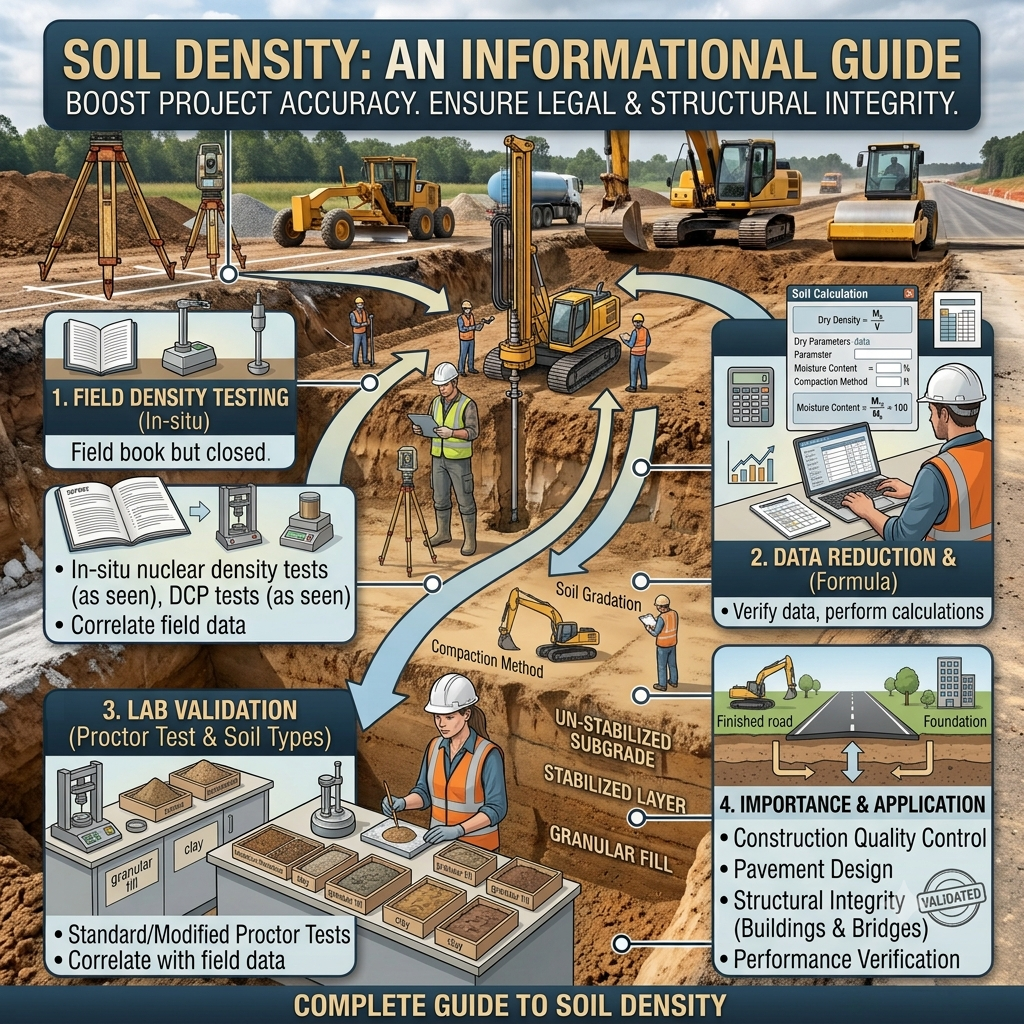
Soil Density is one of the most important engineering properties in civil engineering, geotechnical engineering, road construction, and foundation design. Every structure, from a residential house to a multi-lane highway, depends on the strength and stability of the soil beneath it. Engineers use soil density to evaluate whether the ground can safely support structural loads without excessive settlement or failure.
In practical construction, soil density directly influences bearing capacity, compaction quality, permeability, slope stability, and pavement performance. A well-compacted soil layer provides a strong foundation for buildings, bridges, embankments, and highways, while poorly compacted soil can lead to cracks, uneven settlement, and costly repairs.
Understanding SD helps civil engineers, contractors, surveyors, and engineering students make informed decisions during site investigation, earthwork, and quality control. This guide explains the concept in simple engineering terms, supported by practical examples, formulas, field applications, and best practices commonly followed in highway and construction projects.
What is Soil Density?
Soil Density refers to the mass of soil contained within a unit volume. The volume includes soil particles as well as the air and water present in the voids. Engineers use this property to assess the compactness and strength of soil before constructing foundations, roads, dams, retaining walls, and other civil engineering structures.
Higher soil density generally indicates that soil particles are packed more closely together, resulting in greater strength and reduced compressibility. Lower density often indicates loose soil with larger void spaces, which may require additional compaction before construction.
Simple Definition
Soil Density is the mass of soil per unit volume, including solids and voids.
It is commonly expressed in:
- kg/m³
- kN/m³
- g/cm³
Why SD is Important
Soil density influences almost every stage of a construction project. During site investigations, engineers evaluate soil density to determine whether the existing ground can safely support structural loads. During construction, field density tests verify that compacted soil meets design specifications.
Major Benefits of Proper
- Increases soil strength.
- Improves bearing capacity.
- Reduces settlement.
- Enhances pavement performance.
- Minimizes water infiltration.
- Increases slope stability.
- Extends the service life of roads and foundations.
- Improves overall construction quality.
Practical Example
Imagine two road embankments built with the same soil. The first embankment is compacted to the required density, while the second receives poor compaction.
After several months of heavy traffic:
- The properly compacted embankment remains stable.
- The poorly compacted embankment develops settlement, rutting, and surface cracks.
Types of Soil Density
Engineers classify soil density into several categories based on moisture content and field conditions.
1. Bulk Density
Bulk density represents the total mass of soil, including water, divided by its total volume.
Formula
Bulk Density = Total Mass of Soil ÷ Total Volume
Bulk density includes:
- Soil particles
- Water
- Air voids
Applications
- Earthwork
- Agriculture
- Preliminary soil investigations
- Construction quality control
2. Dry Density
Dry density considers only the mass of dry soil particles and excludes the weight of water.
It is one of the most important parameters used during field compaction.
Formula
Dry Density = Dry Mass of Soil ÷ Total Volume
Importance
Engineers compare field dry density with laboratory maximum dry density obtained from the Proctor Test.
Proper dry density ensures:
- Stable foundations
- Strong embankments
- Durable highways
- Reduced settlement
3. Saturated Density
Saturated density occurs when all soil voids are completely filled with water.
In this condition:
- No air remains in the voids.
- Moisture content reaches its maximum practical value.
Engineering Significance
Saturated density becomes important when designing:
- Dams
- Canal embankments
- Bridge foundations
- Retaining structures
- Flood-prone highways
4. Relative Density
Relative density describes how dense a granular soil is compared to its loosest and densest possible states.
It is commonly used for:
- Sand
- Gravel
- Cohesionless soils
Practical Uses
- Foundation design
- Liquefaction assessment
- Pavement engineering
- Geotechnical investigations
Higher relative density indicates stronger and more stable granular soil.
Factors Affecting SD
Several factors influence the density achieved in the field. Understanding these variables helps engineers optimize compaction and improve construction quality.
1. Moisture Content
Moisture has a significant effect on compaction.
- Too little water prevents particles from rearranging efficiently.
- Too much water fills the voids and reduces achievable density.
The highest dry density occurs near the Optimum Moisture Content (OMC).
2. Soil Type
Different soils respond differently to compaction.
Granular Soils
Examples:
- Sand
- Gravel
Characteristics:
- Easy to compact
- High permeability
- Good drainage
Cohesive Soils
Examples:
- Clay
- Silt
Characteristics:
- Require careful moisture control
- Lower permeability
- Higher plasticity
3. Compaction Energy
Equipment commonly used includes:
- Smooth wheel rollers
- Vibratory rollers
- Sheep foot rollers
- Pneumatic rollers
- Plate compactors
4. Particle Size Distribution
Well-graded soils contain a wide range of particle sizes.
Smaller particles fill the spaces between larger particles, resulting in:
- Higher density
- Lower void ratio
- Greater stability
5. Organic Matter
Organic materials reduce soil density because they are lightweight and compressible.
Engineers generally remove organic topsoil before constructing:
- Highways
- Buildings
- Airports
- Industrial facilities
Soil Density Formula
The basic engineering relationship is:
ρ = M / V
Where:
- ρ = Soil Density
- M = Mass of Soil
- V = Total Volume
For dry density:
ρd = Md / V
Where:
- ρd = Dry Density
- Md = Dry Mass of Soil
- V = Total Volume
These formulas form the basis for laboratory calculations and field quality control.
Engineering Applications of Soil Density
Soil density plays a vital role in many civil engineering projects.
Highway Construction
Engineers check field density to ensure embankments and pavement layers meet design requirements.
Building Foundations
Adequate soil density reduces differential settlement and increases structural stability.
Earth Dams
Properly compacted embankments improve strength and reduce seepage.
Airport Runways
Dense subgrade layers provide the support needed for repeated aircraft loading.
Retaining Structures
Engineers evaluate soil density to estimate lateral earth pressure and foundation performance.
Diagram
Relationship Between Soil Components
              Soil Volume
      ┌────────────────────────┐
      │        Air             │
      ├────────────────────────┤
      │       Water            │
      ├────────────────────────┤
      │    Soil Particles      │
      └────────────────────────┘

Total Volume = Solids + Water + Air
Effect of Compaction
Before Compaction

○     ○        ○
    ○      ○
  ○      ○

Large Air Voids
Low Density

          ↓ Compaction

After Compaction

● ● ● ● ●
● ● ● ● ●
● ● ● ● ●

Small Air Voids
High Density
Practical Field Example
During the construction of a highway embankment, the project specification requires the compacted fill to achieve at least 95% of the Maximum Dry Density (MDD) determined by the Modified Proctor Test. After each layer is compacted, the site engineer performs a field density test. If the measured dry density falls below the specified requirement, the contractor adjusts the moisture content, recompacts the layer, and repeats the test until compliance is achieved. This systematic approach ensures that the embankment provides a stable and durable foundation for the pavement structure.
Key Takeaways
Soil Density is a fundamental engineering property that affects the strength, stability, and long-term performance of every construction project. Understanding the different types of SD, the factors influencing compaction, and the basic engineering formulas enables engineers to make informed decisions during design and construction. Accurate density control helps prevent settlement, increases bearing capacity, and improves the durability of highways, buildings, dams, and other infrastructure. A strong foundation always begins with properly compacted soil.
Methods of Measuring SD
Field and laboratory testing help engineers verify whether compacted soil meets project specifications. Selecting the appropriate testing method depends on soil type, project requirements, equipment availability, and accuracy needs.
1. Sand Cone Test
The Sand Cone Test is one of the most widely used field methods for determining in-place dry density of compacted soil. Highway agencies and contractors frequently use this test during embankment construction, subgrade preparation, and pavement works.
Principle
The test measures the volume of a small excavated hole by filling it with calibrated dry sand. Engineers compare the excavated soil mass with the measured hole volume to calculate field density.
Equipment Required
- Sand cone apparatus
- Calibration container
- Standard dry sand
- Metal tray
- Digging tools
- Weighing balance
- Moisture containers
Procedure
- Prepare a level test surface.
- Excavate a small hole.
- Collect and weigh the removed soil.
- Fill the hole with calibrated sand.
- Measure the quantity of sand used.
- Determine hole volume.
- Calculate bulk density and dry density.
Advantages
- Reliable field results
- Simple equipment
- Suitable for most compacted soils
- Commonly accepted in road construction projects
Limitations
- Time-consuming
- Unsuitable for highly saturated soils
- Accuracy depends on careful execution
2. Core Cutter Method
The Core Cutter Method provides a quick and economical way to determine field density in cohesive soils.
Principle
A steel cylinder of known volume is driven into the ground. The extracted soil sample is weighed, and density is calculated directly from its mass and volume.
Suitable Soils
- Clay
- Silty clay
- Fine-grained soils
Advantages
- Fast testing
- Low equipment cost
- Easy field operation
Limitations
- Not suitable for gravelly soils
- Difficult in hard or stony ground
3. Nuclear Density Gauge
Modern highway projects often use a Nuclear Density Gauge because it provides rapid and non-destructive measurements.
Working Principle
The equipment emits low-level radioactive energy through the soil. The detector measures the returning radiation, allowing the instrument to estimate density and moisture content.
Advantages
- Immediate results
- High accuracy
- Minimal excavation
- Simultaneous moisture measurement
Limitations
- High equipment cost
- Requires licensed operators
- Strict radiation safety procedures
4. Rubber Balloon Method
The Rubber Balloon Method measures the volume of an excavated hole using a water-filled rubber membrane.
Applications
- Road embankments
- Earth dams
- Foundation backfill
- Quality control testing
Benefits
- Reasonably accurate
- Portable equipment
- Useful where sand cone testing is difficult
Soil Density Testing Flow Diagram
Field Compaction
        │
        ▼
Select Test Method
        │
 ┌──────┼───────────────┐
 │      │               │
 ▼      ▼               ▼
Sand  Core Cutter   Nuclear Gauge
Cone
 │
 ▼
Calculate Dry Density
 │
 ▼
Compare with Required Density
 │
 ▼
Pass ✔      or      Recompact ✖
Field Compaction and Quality Control
Compaction is the process of reducing air voids within the soil by applying mechanical energy. Proper compaction increases density, improves strength, and enhances long-term performance.
Quality control ensures every compacted layer satisfies project specifications before the next layer is placed.
Factors Influencing Field Compaction
Moisture Content
Engineers compact soil near its Optimum Moisture Content (OMC) to achieve maximum dry density.
Layer Thickness
Thin soil layers compact more effectively than thick layers.
Typical lift thickness ranges from 150 mm to 300 mm, depending on equipment and soil type.
Roller Selection
Different rollers suit different soil conditions.
- Vibratory Roller – Sand and gravel
- Sheep Foot Roller – Clay soils
- Smooth Drum Roller – Finishing layers
- Pneumatic Roller – Asphalt and granular materials
Number of Roller Passes
Increasing roller passes generally improves density until maximum compaction is achieved.
Quality Control During Construction
Field engineers continuously monitor construction quality through:
- Moisture content testing
- Field density testing
- Visual inspection
- Layer thickness measurement
- Compaction records
- Laboratory verification
Every compacted layer should receive approval before placing the next layer.
Practical Engineering Applications
Highway Construction
Soil density directly affects pavement performance.
Proper compaction reduces:
- Rutting
- Settlement
- Cracking
- Maintenance costs
Building Foundations
Dense foundation soil distributes structural loads more evenly and minimizes differential settlement.
Railway Embankments
Compacted embankments improve track stability and reduce maintenance.
Earth Dams
High soil density minimizes seepage and increases embankment stability.
Airport Runways
Well-compacted subgrade layers support repeated aircraft loading while maintaining surface smoothness.
Best Practices for Achieving Proper Soil Density
Successful projects follow proven field practices, including:
- Conduct detailed geotechnical investigations before construction.
- Remove organic and unsuitable materials from the site.
- Compact soil near the Optimum Moisture Content.
- Place fill in uniform layers.
- Select compaction equipment according to soil type.
- Perform field density tests regularly.
- Maintain accurate quality control records.
- Calibrate testing equipment periodically.
- Train construction personnel in proper compaction techniques.
- Protect compacted layers from excessive moisture before covering.
Common Mistakes to Avoid
Many construction failures result from poor compaction practices. Common mistakes include:
- Compacting soil that is too dry or too wet.
- Using unsuitable fill material.
- Placing excessively thick soil layers.
- Ignoring field density test results.
- Using incorrect roller types.
- Skipping quality control inspections.
- Allowing construction traffic on uncompacted layers.
- Failing to maintain proper drainage during earthwork.
Avoiding these mistakes significantly improves pavement performance and structural stability.
Practical Recommendations
Civil Engineers
- Review laboratory compaction results before field operations.
- Verify field density after each compacted layer.
- Monitor moisture content throughout construction.
- Coordinate closely with laboratory technicians and site supervisors.
Contractors
- Use calibrated compaction equipment.
- Maintain consistent layer thickness.
- Keep moisture within the specified range.
- Correct deficiencies immediately after testing.
Engineering Students
- Understand the relationship between moisture content and dry density.
- Learn both laboratory and field testing procedures.
- Participate in field density testing during internships.
- Study real construction projects to strengthen practical knowledge.
General Discussion of IRC, AASHTO, and ICE Practices
International highway and geotechnical standards emphasize that soil density is fundamental to the safety and durability of civil engineering works.
In general, guidance published by organizations such as IRC (Indian Roads Congress), AASHTO (American Association of State Highway and Transportation Officials), and ICE (Institution of Civil Engineers) encourages engineers to:
- Conduct detailed soil investigations before construction.
- Determine maximum dry density through standardized laboratory testing.
- Achieve specified field compaction levels for embankments and pavement layers.
- Control moisture during compaction operations.
- Verify construction quality through regular field testing.
- Maintain complete documentation for quality assurance.
These engineering principles help deliver reliable and long-lasting infrastructure across a wide range of construction projects.
Frequently Asked Questions (FAQs)
1. What is soil density in civil engineering?
Soil density is the mass of soil contained within a unit volume, including soil particles, air voids, and water. Engineers use it to evaluate soil strength, compaction quality, and foundation performance.
2. Why is soil density important in road construction?
Proper soil density provides a stable subgrade, improves load distribution, minimizes settlement, and increases the service life of pavements.
3. What is the difference between bulk density and dry density?
Bulk density includes the mass of water within the soil, while dry density considers only the dry mass of soil solids.
4. Which field test is commonly used to measure soil density?
The Sand Cone Test remains one of the most common methods, although Nuclear Density Gauges are increasingly used on large infrastructure projects.
5. What is Optimum Moisture Content (OMC)?
OMC is the moisture content at which a soil achieves its maximum dry density under a specified compaction effort.
6. How does poor compaction affect a project?
Poor compaction can cause settlement, pavement cracking, rutting, reduced bearing capacity, and premature structural failure.
7. Which roller is suitable for clay soils?
A sheep foot roller provides excellent compaction for cohesive soils such as clay because it kneads the soil effectively.
8. Can soil density affect foundation design?
Yes. Engineers use soil density to estimate bearing capacity, settlement characteristics, and foundation stability.
9. How often should field density tests be performed?
The frequency depends on project specifications, but engineers typically perform tests on each compacted layer at designated intervals to ensure consistent quality.
10. Why is quality control essential during soil compaction?
Quality control verifies that each layer meets the required density and moisture specifications, reducing the risk of future failures and extending the service life of the structure.
Conclusion
Soil Density plays a critical role in the success of every civil engineering project, from highway embankments and airport runways to building foundations and earth dams. Proper density improves bearing capacity, reduces settlement, enhances pavement performance, and increases the overall durability of infrastructure. Achieving the required density requires careful soil investigation, appropriate moisture control, suitable compaction equipment, and continuous field testing. Engineers, contractors, and students who understand the principles of Soil Density can make informed decisions that improve construction quality and reduce long-term maintenance costs. By following recognized engineering practices and maintaining strict quality control throughout construction, projects can achieve safer, stronger, and more sustainable foundations that perform reliably throughout their design life.

Kamran Malik is a passionate civil engineering writer and researcher who specializes in construction, transportation, structural engineering, and infrastructure topics. Through his articles on CivilEngineerings.com, he simplifies complex engineering concepts and shares practical insights, industry trends, and educational resources for students, professionals, and engineering enthusiasts.