
Introduction
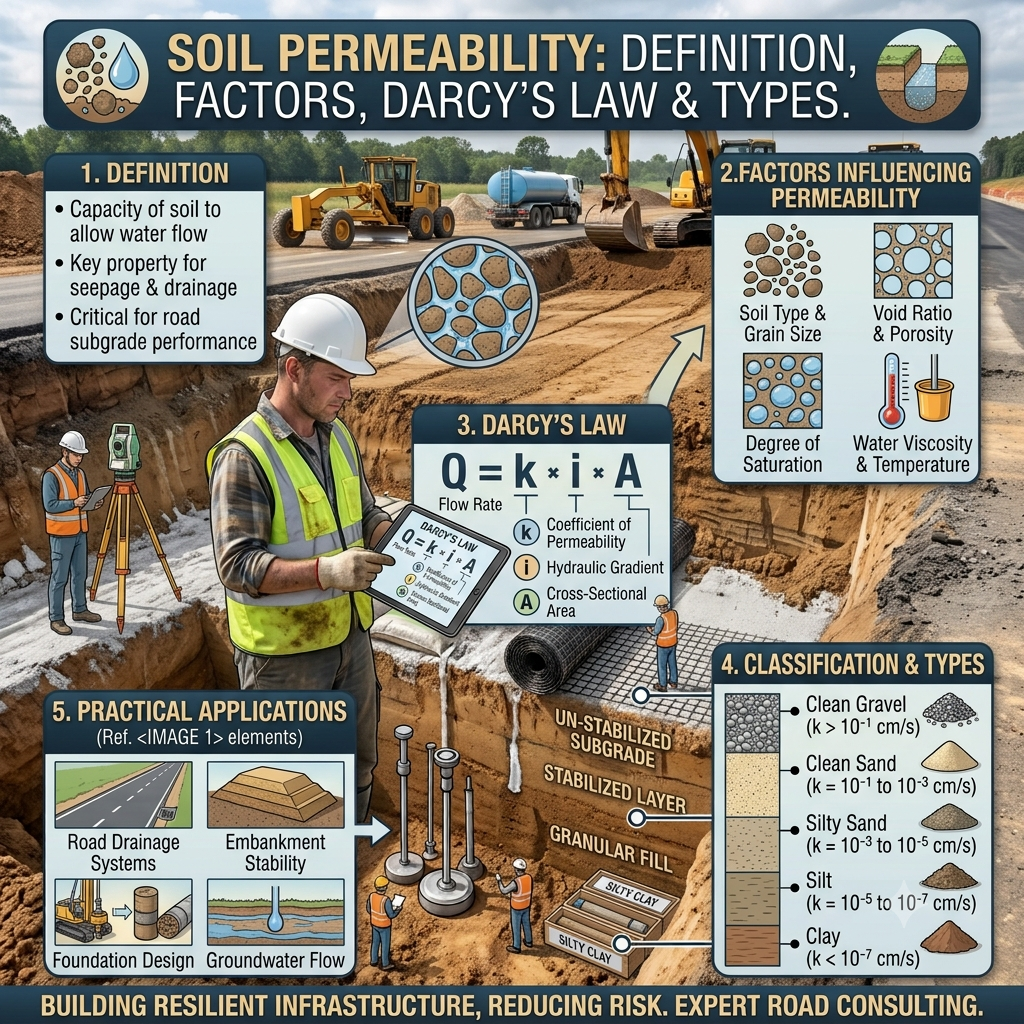
Soil Permeability is one of the most important engineering properties of soil because it controls how water moves through the ground. Every civil engineering project—from highways and buildings to bridges, earth dams, retaining walls, and drainage systems—depends on a clear understanding of soil permeability. Engineers use permeability data to design stable foundations, prevent waterlogging, control seepage, and improve pavement performance.
A soil with high permeability allows water to pass through quickly, while a soil with low permeability restricts water movement. This simple characteristic greatly influences foundation stability, slope performance, groundwater flow, and the durability of road pavements.
For civil engineers, contractors, and engineering students, understanding Soil Permeability is essential for selecting suitable construction methods and avoiding costly failures. Accurate permeability assessment helps engineers design effective drainage systems, reduce settlement, and extend the service life of infrastructure.
This comprehensive guide explains soil permeability, the factors affecting it, Darcy’s Law, permeability coefficients, soil classifications, engineering applications, and practical field recommendations using simple language and real-world engineering concepts.
What is Soil Permeability?
Soil Permeability is the ability of soil to allow water to flow through its interconnected void spaces under the influence of hydraulic pressure or gravity.
In simple terms, permeability measures how easily water travels through soil.
Every soil contains tiny spaces called voids. When these voids connect with one another, they create channels through which water can move. The size, shape, and continuity of these channels determine the soil’s permeability.
Definition
Soil Permeability is the property of soil that permits water to pass through its pore spaces under a hydraulic gradient.
The movement of water through soil is known as seepage, and engineers analyze this flow when designing foundations, highways, embankments, retaining structures, and drainage systems.
Why Soil Permeability Matters in Civil Engineering
Permeability directly affects the safety, durability, and performance of civil engineering structures. Incorrect assumptions about soil permeability can lead to settlement, pavement failure, excessive seepage, slope instability, and foundation problems.
Importance in Civil Engineering
Soil permeability helps engineers:
- Design efficient drainage systems.
- Evaluate groundwater movement.
- Control seepage in earth dams.
- Design stable foundations.
- Improve pavement drainage.
- Prevent waterlogging.
- Reduce hydrostatic pressure.
- Increase the service life of highways.
Importance in Road Engineering
For highway engineers, permeability plays a critical role because trapped water weakens pavement layers.
Proper drainage prevents:
- Rutting
- Pumping
- Potholes
- Frost damage
- Base course deterioration
- Subgrade weakening
A well-drained pavement generally lasts much longer than one exposed to continuous moisture.
Engineering Principles of Water Flow Through Soil
Water moves through soil because of differences in hydraulic head. Gravity and pressure create a hydraulic gradient that forces water from areas of higher energy to lower energy.
The speed of water movement depends on:
- Soil particle size
- Pore connectivity
- Water viscosity
- Hydraulic gradient
- Soil density
Simple Engineering Principle
Larger soil pores allow faster water movement.
Smaller soil pores restrict water flow.
This explains why gravel drains rapidly while clay retains water for extended periods.
Darcy’s Law
Darcy’s Law forms the foundation of seepage analysis in geotechnical engineering.
French engineer Henry Darcy developed this relationship after conducting experiments on water flow through sand filters.
Darcy’s Law Formula
[
Q = k \times i \times A
]
Where:
- Q = Rate of water flow
- k = Coefficient of permeability
- i = Hydraulic gradient
- A = Cross-sectional area
Interpretation
According to Darcy’s Law:
- Increasing permeability increases water flow.
- Increasing hydraulic gradient increases seepage.
- Larger flow areas allow greater discharge.
This equation is widely used in:
- Earth dam design
- Groundwater analysis
- Pavement drainage
- Foundation engineering
- Seepage calculations
Coefficient of Permeability (k)
The coefficient of permeability indicates how easily water moves through soil.
It is commonly expressed in:
- m/s
- cm/s
Higher values indicate greater permeability.
Typical Values
| Soil Type | Approximate Permeability |
|---|---|
| Gravel | Very High |
| Coarse Sand | High |
| Fine Sand | Moderate |
| Silt | Low |
| Clay | Very Low |
Engineering Significance
Engineers use the coefficient of permeability to:
- Design drainage systems.
- Estimate seepage.
- Select foundation types.
- Analyze groundwater flow.
- Design filters.
- Evaluate pavement performance.
Factors Affecting Soil Permeability
Several factors influence how easily water flows through soil.
1. Soil Particle Size
Particle size has the greatest influence on permeability.
Large particles create larger voids.
Large voids permit faster water movement.
Example
- Gravel → High permeability
- Sand → Moderate permeability
- Clay → Very low permeability
2. Void Ratio
Void ratio represents the amount of empty space within soil.
Higher void ratios create more flow channels.
Lower void ratios reduce water movement.
Loose soils usually have higher permeability than dense soils of the same type.
3. Soil Structure
Natural soil structure significantly influences permeability.
Granular soils have interconnected pores.
Clay soils contain microscopic pores that greatly restrict water movement.
Cemented soils may also reduce permeability.
4. Degree of Saturation
Partially saturated soils contain trapped air within the pores.
Air blocks water flow and reduces permeability.
Fully saturated soils generally allow more consistent seepage.
5. Water Temperature
Warm water has lower viscosity than cold water.
Lower viscosity allows water to move more easily through soil.
Consequently, permeability increases slightly with temperature.
6. Soil Compaction
Compaction reduces void spaces.
Reduced void spaces decrease permeability.
This principle is especially important in highway embankments and earth dam construction.
Proper compaction increases strength while limiting unwanted seepage.
7. Mineral Composition
Clay minerals absorb water differently.
For example:
- Bentonite has extremely low permeability.
- Kaolinite permits comparatively greater water movement.
Mineralogy therefore affects both permeability and swelling behavior.
Types of Soil Based on Permeability
Engineers often classify soils according to their ability to transmit water.
Highly Permeable Soils
Examples:
- Gravel
- Crushed stone
- Coarse sand
Applications:
- Drainage layers
- Filter materials
- Road sub-base
- French drains
Moderately Permeable Soils
Examples:
- Medium sand
- Fine sand
Applications:
- Pavement foundations
- Controlled drainage systems
Low Permeability Soils
Examples:
- Silt
- Silty clay
Applications:
- Embankments
- Fill materials
- Landscaping
Impermeable or Very Low Permeability Soils
Examples:
- Clay
- Bentonite
Applications:
- Earth dam cores
- Landfill liners
- Cutoff walls
- Pond linings
Practical Engineering Examples
Example 1: Highway Construction
During highway construction, engineers avoid placing highly permeable materials directly beneath pavement without adequate drainage control. Proper filter layers and edge drains help protect the pavement structure from water damage.
Example 2: Earth Dam
An earth dam typically uses a low-permeability clay core to reduce seepage, while more permeable materials are placed on the outer shells to provide stability and drainage.
Example 3: Building Foundations
If a building site consists of highly permeable gravel, groundwater may reach excavation levels quickly. Engineers often install temporary dewatering systems before constructing the foundation.
Field Diagram of Water Flow Through Soil
           Water Level
~~~~~~~~~~~~~~~~~~~~~~~~~~~~
          ↓ Hydraulic Head

==============================
   Gravel (High Permeability)
↓↓↓↓↓↓↓↓↓↓↓↓↓↓↓↓↓↓↓↓↓↓↓↓↓↓↓↓↓

==============================
    Sand (Medium Permeability)
↓↓↓↓↓↓↓↓↓↓↓↓↓↓↓↓↓

==============================
     Clay (Low Permeability)
↓↓↓

==============================
Relationship Between Particle Size and Permeability
Gravel  ─────────────► Very High

Sand    ─────────► High

Silt    ─────► Low

Clay    ─► Very Low
These simplified diagrams illustrate why coarse-grained soils transmit water much more rapidly than fine-grained soils.
Key Takeaways
Soil Permeability governs how water moves through soil and strongly influences the design of foundations, pavements, drainage systems, and earth structures. Particle size, void ratio, soil structure, saturation, temperature, compaction, and mineral composition all affect permeability. Darcy’s Law provides the fundamental relationship for estimating seepage, while the coefficient of permeability helps engineers compare different soil types. Understanding these principles enables engineers to make informed design decisions, improve infrastructure durability, and reduce water-related failures in civil engineering projects.
Laboratory and Field Tests for Soil Permeability
Engineers determine Soil Permeability through laboratory and field testing. Reliable test results help engineers design drainage systems, select suitable foundation types, evaluate seepage, and improve pavement performance.
Each testing method suits a particular soil type and project requirement.
1. Constant Head Permeability Test
The Constant Head Test is suitable for coarse-grained soils such as gravel and sand because water flows through these soils at a relatively high rate.
Test Procedure
- Prepare a saturated soil specimen.
- Place the specimen inside a permeameter.
- Maintain a constant water head throughout the test.
- Measure the volume of water collected over a fixed period.
- Calculate the coefficient of permeability using Darcy’s Law.
Applications
- Gravel deposits
- Sand layers
- Drainage materials
- Highway sub-base evaluation
2. Falling Head Permeability Test
Fine-grained soils transmit water slowly. Engineers therefore use the Falling Head Test for silts and clays.
Test Procedure
- Saturate the soil specimen.
- Fill the standpipe with water.
- Record the water level at regular intervals.
- Calculate permeability from the drop in water level over time.
Applications
- Clay soils
- Silty soils
- Earth dam cores
- Foundation investigations
3. Pumping Test
Large construction projects often require field-scale groundwater investigations.
During a pumping test, water is pumped from a borehole while engineers monitor groundwater levels in nearby observation wells.
Applications
- Highway projects
- Large building foundations
- Tunnels
- Bridge construction
- Dewatering system design
4. Packer Test
Engineers perform packer tests in fractured rock formations to measure water movement through joints and cracks.
Applications
- Dam foundations
- Tunnel projects
- Rock slope investigations
- Hydropower developments
Applications of Soil Permeability in Civil Engineering
Understanding soil permeability allows engineers to solve practical construction challenges while improving safety and durability.
1. Highway Engineering
Road pavements experience repeated traffic loading and weather exposure. Water trapped within pavement layers weakens the subgrade and accelerates deterioration.
Engineers use permeability data to design:
- Pavement drainage systems
- Edge drains
- Filter layers
- Granular sub-base materials
- Long-lasting road foundations
Proper drainage significantly reduces rutting, potholes, stripping, pumping, and pavement cracking.
2. Foundation Engineering
Foundation engineers evaluate soil permeability before selecting foundation types.
Highly permeable soils may require groundwater control during excavation, while low-permeability soils often demand careful drainage planning to reduce hydrostatic pressure.
Permeability studies help engineers:
- Design shallow foundations
- Plan deep foundations
- Estimate settlement behavior
- Design dewatering systems
3. Earth Dams
Earth dams depend on permeability control for safe performance.
Engineers usually construct:
- Clay cores with very low permeability
- Granular filters with controlled permeability
- Drainage blankets
- Rockfill shells
This arrangement controls seepage while maintaining structural stability.
4. Retaining Walls
Water accumulation behind retaining walls increases lateral earth pressure.
Proper drainage systems reduce this pressure and improve wall stability.
Common drainage components include:
- Weep holes
- Granular backfill
- Drainage pipes
- Geotextile filters
5. Landfills
Environmental engineers use low-permeability clay liners and geomembranes to prevent contaminated leachate from entering groundwater.
This protects surrounding soil and water resources.
6. Agricultural Drainage
Farm drainage systems rely on soil permeability to maintain suitable moisture levels for crops.
Engineers use permeability values when designing:
- Tile drains
- Surface drains
- Irrigation systems
- Water conservation projects
Methods to Increase Soil Permeability
Certain engineering projects require rapid water movement.
Engineers can improve permeability through several methods.
Common Techniques
- Replacing clay with granular material
- Installing drainage blankets
- Using gravel filters
- Constructing French drains
- Installing geocomposite drainage systems
- Reducing excessive soil compaction where appropriate
These methods improve groundwater movement and drainage efficiency.
Methods to Reduce Soil Permeability
Many projects require controlled seepage rather than rapid drainage.
Common Techniques
- Soil compaction
- Lime stabilization
- Cement stabilization
- Bentonite mixing
- Clay liners
- Grouting
- Geomembrane installation
These methods reduce water movement and improve seepage control.
Common Engineering Mistakes
Several construction failures result from neglecting soil permeability during planning and design.
Avoid these common mistakes:
- Ignoring groundwater investigations.
- Selecting unsuitable pavement materials.
- Omitting drainage systems.
- Underestimating seepage in embankments.
- Poor compaction control.
- Using incorrect filter materials.
- Skipping permeability testing.
- Failing to maintain drainage structures after construction.
Early investigation and proper quality control help prevent these costly errors.
Best Practices for Soil Permeability Assessment
Successful civil engineering projects follow proven practices to evaluate and manage permeability effectively.
- Perform geotechnical investigations before design.
- Select testing methods suitable for the soil type.
- Collect representative soil samples.
- Maintain proper sample saturation during laboratory testing.
- Verify laboratory results with field observations.
- Design drainage systems alongside structural elements.
- Monitor groundwater conditions during construction.
- Document all permeability test results for future reference.
These practices improve design accuracy and reduce long-term maintenance costs.
Field Recommendations
Civil Engineers
- Review permeability reports before finalizing foundation or pavement designs.
- Coordinate drainage design with geotechnical findings.
- Consider seasonal groundwater fluctuations during design.
- Inspect field conditions regularly to verify design assumptions.
Contractors
- Protect drainage layers from contamination during construction.
- Compact soil according to project specifications.
- Install filter materials correctly.
- Keep drainage channels free from debris.
Engineering Students
- Understand Darcy’s Law and its practical applications.
- Learn both laboratory and field permeability tests.
- Visit active construction sites to observe drainage systems.
- Study case histories involving seepage and foundation failures.
Practical exposure strengthens theoretical knowledge and prepares students for real engineering challenges.
General Discussion of IRC, AASHTO, and ICE Practices
International engineering organizations emphasize the importance of permeability evaluation in infrastructure design.
In general, IRC, AASHTO, and ICE guidance encourages engineers to:
- Conduct detailed geotechnical investigations before construction.
- Evaluate groundwater conditions throughout the project corridor.
- Design drainage systems as an integral part of pavement and foundation design.
- Use appropriate filter materials to prevent soil migration.
- Control seepage in embankments, retaining structures, and earth dams.
- Implement quality assurance during laboratory and field testing.
- Monitor drainage performance throughout the service life of the infrastructure.
These engineering principles support durable, safe, and sustainable civil engineering projects.
Frequently Asked Questions (FAQs)
1. What is Soil Permeability?
Soil Permeability is the ability of soil to transmit water through its interconnected pore spaces under a hydraulic gradient.
2. Which soil has the highest permeability?
Gravel has the highest permeability because its large particles create wide, interconnected voids that allow rapid water movement.
3. Why is Soil Permeability important in road construction?
It helps engineers design effective pavement drainage systems, protect the subgrade from water damage, and increase pavement service life.
4. What is Darcy’s Law?
Darcy’s Law is the fundamental equation used to calculate water flow through saturated soil based on permeability, hydraulic gradient, and flow area.
5. Which laboratory tests determine Soil Permeability?
The Constant Head Test and Falling Head Test are the most commonly used laboratory methods for measuring soil permeability.
6. How does compaction affect permeability?
Compaction reduces pore spaces within the soil, which decreases water movement and lowers permeability.
7. Can Soil Permeability be improved?
Yes. Engineers can increase permeability by using granular materials, drainage blankets, gravel filters, and geocomposite drainage systems.
8. Which civil engineering structures require permeability analysis?
Highways, foundations, retaining walls, tunnels, earth dams, landfills, airports, canals, and drainage systems all require permeability evaluation.
9. What is the coefficient of permeability?
The coefficient of permeability (k) is a numerical value that represents the ease with which water flows through a particular soil.
10. Why is permeability testing necessary before construction?
Testing helps engineers select suitable designs, estimate seepage, improve drainage, reduce structural risks, and prevent costly failures.
Conclusion
Soil Permeability plays a fundamental role in the planning, design, and construction of safe and durable civil engineering projects. It influences groundwater movement, seepage control, drainage performance, pavement stability, and foundation behavior. Engineers rely on laboratory tests, field investigations, and Darcy’s Law to evaluate how water moves through different soil types and to develop practical design solutions. Proper assessment of Soil Permeability allows engineers to select suitable construction materials, improve drainage systems, control erosion, and minimize long-term maintenance costs. Whether designing highways, earth dams, retaining walls, or building foundations, understanding soil permeability remains essential for achieving reliable, economical, and sustainable infrastructure that performs effectively throughout its design life.

Kamran Malik is a passionate civil engineering writer and researcher who specializes in construction, transportation, structural engineering, and infrastructure topics. Through his articles on CivilEngineerings.com, he simplifies complex engineering concepts and shares practical insights, industry trends, and educational resources for students, professionals, and engineering enthusiasts.
http://Nova%20Jackpot
Man liekas pievilcīgs Nova Jackpot casino!|
Nova Jackpot šķiet interesanta tiešsaistes kazino platforma.|
Interesants online kazino, īpaši tiem, kam patīk spēļu automāti!|
Nova Jackpot kazino var piedāvāt ērtu spēlēšanas pieredzi!|
Saprotams dizains, nav grūti orientēties.|
Patīkami, ka Nova Jackpot kazino nav pārāk sarežģīts!|
Tiem, kam interesē kazino automātus, Nova Jackpot casino var būt vērts apskatīt.|
Bonusi Nova Jackpot platformā var būt viens no interesantākajiem punktiem!|
Pirms reģistrēšanās būtu labi iepazīties ar spēles noteikumiem!|
Manuprāt Nova Jackpot varētu būt ērta un interesanta vieta!