
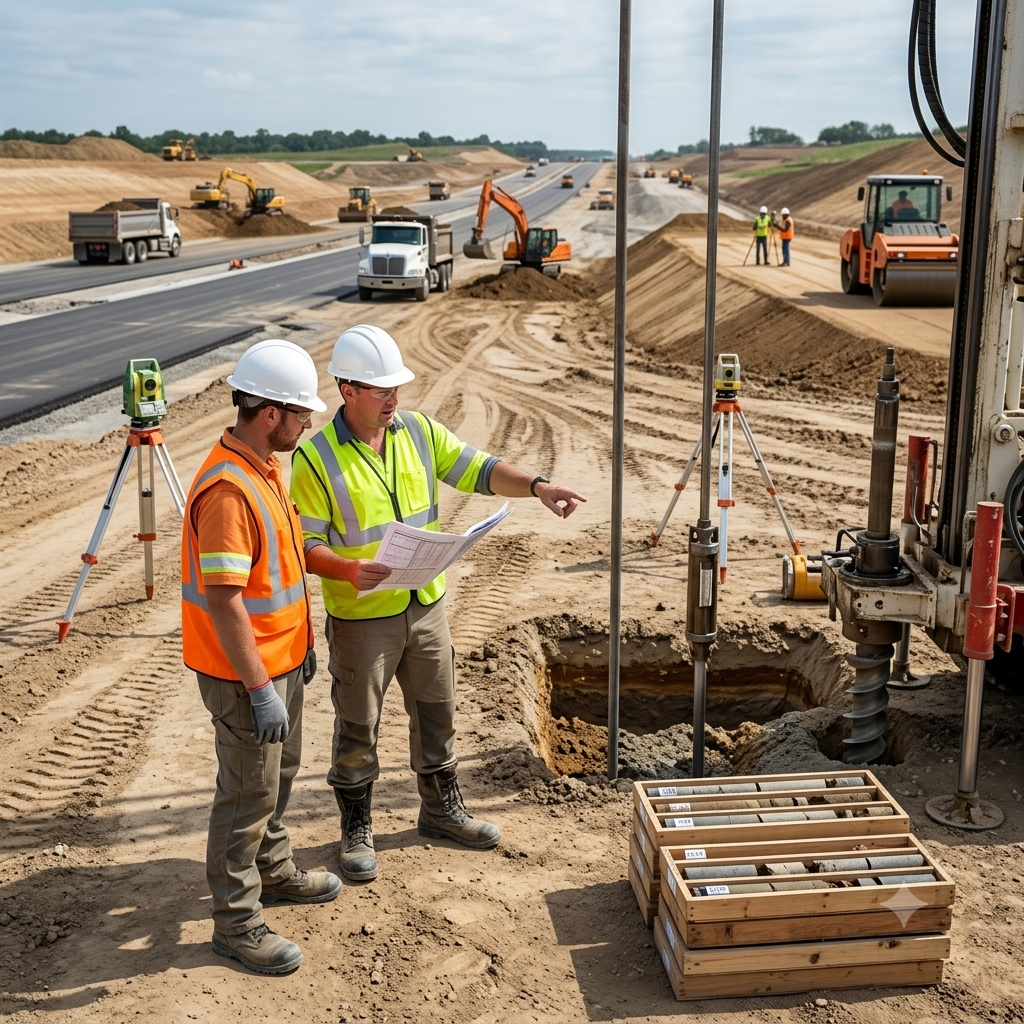
Introduction
Every structure transfers its load to the ground through its foundation. Whether it is a residential building, highway bridge, retaining wall, industrial plant, or transmission tower, the soil beneath the foundation must safely support these loads without excessive settlement or failure. This ability of the soil is known as Bearing Capacity, one of the most fundamental concepts in geotechnical engineering and foundation design.
Understanding it allows civil engineers to select suitable foundation types, determine safe foundation dimensions, and prevent costly structural failures. A strong foundation starts with accurate soil investigation and reliable bearing capacity calculations. Engineers use this information to design safe, durable, and economical structures that perform well throughout their service life.
This guide explains the concept of Bearing Capacity, its engineering principles, influencing factors, theoretical background, and practical applications using clear explanations and real-world examples. Whether you are an engineering student, site engineer, contractor, or design consultant, this article provides the essential knowledge needed to understand and apply BC in modern construction projects.
What is Bearing Capacity?
Bearing Capacity refers to the maximum pressure that soil can safely withstand from a foundation without experiencing shear failure or excessive settlement.
In simple terms, it represents the load-carrying ability of the ground. Every type of soil—whether sand, clay, gravel, or rock—has a different capacity to support structural loads. Engineers determine this capacity before designing any foundation to ensure structural safety and long-term stability.
For example, dense gravel can support much higher loads than loose clay. Therefore, the foundation size and type depend greatly on the bearing capacity of the underlying soil.
Engineering Definition
This is the maximum intensity of loading that soil can resist while maintaining stability and acceptable settlement.
Why BC is Important
Bearing capacity forms the basis of safe foundation design. Ignoring soil strength can lead to structural distress, uneven settlement, and even collapse.
- Design safe foundations.
- Prevent differential settlement.
- Reduce construction costs.
- Optimize foundation dimensions.
- Improve structural durability.
- Increase project safety.
- Minimize future maintenance.
Types of Bearing Capacity
Civil engineers use several forms of bearing capacity during foundation design.
1. Ultimate BC
Ultimate Bearing Capacity is the maximum pressure that causes complete shear failure of the supporting soil.
Beyond this limit, the soil can no longer support additional load, resulting in sudden foundation failure.
Characteristics
- Represents failure condition.
- Used during foundation design calculations.
- Includes soil cohesion and surcharge effects.
2. Safe BC
Safe Bearing Capacity is the ultimate bearing capacity divided by an appropriate factor of safety.
This value provides a safe working limit for foundation design.
Formula
Safe Bearing Capacity = Ultimate Bearing Capacity / Factor of Safety
A factor of safety between 2.5 and 3.5 is commonly adopted depending on project conditions and applicable design standards.
3. Allowable BC
Allowable Bearing Capacity considers both shear failure and permissible settlement.
Engineers usually adopt the lower value obtained from:
- Shear strength criteria
- Settlement analysis
This value becomes the actual design bearing pressure.
4. Net Bearing Capacity
Net Bearing Capacity represents the additional pressure that the soil can safely support after deducting the overburden pressure already acting at the foundation level.
It helps engineers evaluate the effective load that a foundation can impose on the soil.
5. Gross Bearing Capacity
Gross Bearing Capacity includes both the structural load and the existing overburden pressure.
This value represents the total pressure acting beneath the foundation.
Factors Affecting Bearing Capacity
Several engineering and environmental factors influence the bearing capacity of soil.
1. Soil Type
Different soils possess different strengths.
General order of bearing capacity:
- Hard rock
- Dense gravel
- Dense sand
- Medium sand
- Stiff clay
- Soft clay
- Organic soil
Dense granular soils usually provide higher bearing capacities than soft cohesive soils.
2. Soil Density
Compacted soils contain fewer voids and provide greater resistance to foundation loads.
Loose soils often experience larger settlements under identical loading conditions.
3. Moisture Content
Water significantly influences soil behavior.
High moisture content can:
- Reduce shear strength.
- Increase compressibility.
- Lower bearing capacity.
- Cause excessive settlement.
Proper site drainage helps maintain soil strength.
4. Foundation Depth
Bearing capacity generally increases with foundation depth because deeper soil layers experience greater confinement and improved stability.
However, engineers evaluate each project individually through geotechnical investigation.
5. Foundation Shape and Size
Foundation geometry affects stress distribution.
Common foundation shapes include:
- Square
- Rectangular
- Circular
- Strip
Each shape has different bearing capacity factors.
6. Groundwater Table
A high groundwater table reduces effective stress within the soil.
Lower effective stress decreases shear strength and ultimately reduces bearing capacity.
Proper groundwater control during construction improves foundation performance.
7. Soil Stratification
Natural soil deposits rarely consist of uniform layers.
Weak underlying layers may govern the overall bearing capacity even when upper layers appear strong.
Therefore, engineers investigate soil profiles thoroughly before design.
Terzaghi’s Bearing Capacity Theory
Karl Terzaghi introduced the first practical bearing capacity theory, which remains the foundation of modern shallow foundation design.
His equation relates the ultimate bearing capacity to soil properties and foundation dimensions.
Terzaghi’s General Equation
qu = cNc + qNq + 0.5γBNγ
Where:
- qu = Ultimate Bearing Capacity
- c = Cohesion of soil
- q = Surcharge pressure
- γ = Unit weight of soil
- B = Foundation width
- Nc, Nq, Nγ = Bearing capacity factors
Although modern design methods include additional correction factors, Terzaghi’s theory remains one of the most important concepts taught in geotechnical engineering.
Bearing Capacity Failure Mechanisms
When soil cannot safely resist foundation loads, failure occurs. Engineers recognize three primary failure modes.
General Shear Failure
Characteristics:
- Dense sand or stiff clay
- Sudden failure
- Well-defined failure surfaces
- Significant ground heaving
Local Shear Failure
Characteristics:
- Medium dense soils
- Partial development of failure surfaces
- Moderate settlement
- Progressive failure
Punching Shear Failure
Characteristics:
- Loose sand
- Soft clay
- Large settlements
- Minimal surface heaving
- Foundation penetrates into the soil
Understanding these failure mechanisms helps engineers select suitable foundation systems and improve site safety.
Bearing Capacity Diagram
The following simplified diagram illustrates how structural loads transfer from the foundation into the supporting soil.
                Building Load
                     │
                     ▼
          ┌─────────────────┐
          │    Footing      │
          └─────────────────┘
        ↙        ↓         ↘
   Load Distribution Through Soil
────────────────────────────────────
        Compacted Foundation Soil
────────────────────────────────────
      Natural Soil / Bearing Strata
As the load spreads downward, the supporting soil must possess sufficient bearing capacity to resist the applied pressure without excessive settlement or shear failure.
Practical Engineering Example
Consider a proposed highway bridge supported by isolated spread footings. A geotechnical investigation identifies dense sandy soil with adequate shear strength and low compressibility. Laboratory tests and field investigations indicate that the soil can safely support the anticipated structural loads within the allowable settlement limits.
Based on these findings, engineers design shallow spread footings instead of expensive deep foundations. This decision reduces construction costs, shortens the construction schedule, and maintains structural safety. If the investigation had revealed soft clay with low bearing capacity, the design team would likely have selected pile foundations or ground improvement techniques before construction.
Key Takeaways
Bearing Capacity is one of the most important parameters in geotechnical and foundation engineering. It determines how much load the ground can safely support while maintaining stability and acceptable settlement. Soil type, density, groundwater conditions, foundation geometry, and loading all influence bearing capacity. By understanding its different forms, applying Terzaghi’s theory, and recognizing potential failure mechanisms, engineers can design safe, economical, and durable foundations for buildings, bridges, highways, and other civil engineering structures.
Methods of Determining Bearing Capacity
Engineers determine Bearing Capacity through field investigations, laboratory testing, empirical methods, and analytical calculations. Selecting the appropriate method depends on soil type, project size, structural loads, and site conditions.
Accurate evaluation reduces uncertainty and ensures a safe and economical foundation design.
1. Plate Load Test
The Plate Load Test directly measures the load-bearing behavior of soil at the construction site. Engineers place a rigid steel plate on the prepared ground surface and apply incremental loads using hydraulic jacks. Settlement readings are recorded at each load stage until the required pressure or failure condition is reached.
Advantages
- Provides actual field performance.
- Suitable for shallow foundation design.
- Measures settlement and bearing capacity simultaneously.
- Offers reliable data for small structures.
Limitations
- Tests only a limited soil area.
- Requires specialized equipment.
- Becomes expensive for large projects.
- Produces limited information for deep foundations.
2. Standard Penetration Test (SPT)
The Standard Penetration Test (SPT) is one of the most widely used in-situ tests during geotechnical investigations.
Engineers drive a split-spoon sampler into the soil using a standard hammer and record the number of blows required to penetrate the soil over a specified distance. This value is known as the SPT N-value.
Engineering Applications
- Estimating bearing capacity.
- Evaluating soil density.
- Assessing foundation suitability.
- Designing shallow and deep foundations.
- Correlating soil strength with empirical design methods.
A higher N-value generally indicates stronger soil with greater load-carrying capacity.
3. Cone Penetration Test (CPT)
The Cone Penetration Test provides continuous information about soil resistance without requiring borehole drilling.
A steel cone is pushed into the ground at a constant rate while sensors measure:
- Cone resistance
- Sleeve friction
- Pore water pressure (when applicable)
Advantages
- Continuous soil profile.
- Fast testing process.
- High accuracy.
- Minimal soil disturbance.
- Excellent repeatability.
CPT has become increasingly popular in modern highway, bridge, and industrial foundation projects.
4. Laboratory Soil Testing
Laboratory testing complements field investigations by determining engineering properties under controlled conditions.
Common laboratory tests include:
- Grain Size Analysis
- Atterberg Limits
- Proctor Compaction Test
- California Bearing Ratio (CBR)
- Direct Shear Test
- Triaxial Compression Test
- Consolidation Test
- Moisture Content Test
These tests provide the data required for foundation analysis, pavement design, and settlement evaluation.
Methods to Improve Bearing Capacity
Some construction sites contain weak soils that cannot safely support structural loads. In such cases, engineers improve the soil before constructing the foundation.
Soil Compaction
Mechanical compaction increases soil density and reduces air voids.
Benefits
- Increases shear strength.
- Reduces settlement.
- Improves stability.
- Enhances bearing capacity.
Common equipment includes:
- Vibratory rollers
- Plate compactors
- Sheep foot rollers
- Pneumatic rollers
Soil Stabilization
Engineers improve weak soils by mixing stabilizing agents such as:
- Lime
- Cement
- Fly ash
- Bitumen
Stabilization increases strength and reduces moisture sensitivity.
This technique is widely used in highway embankments and pavement foundations.
Ground Improvement Techniques
Large infrastructure projects often require advanced ground improvement methods.
Examples include:
- Stone columns
- Vibro compaction
- Dynamic compaction
- Geotextiles
- Geogrids
- Soil nailing
- Deep soil mixing
These methods improve load distribution and reduce settlement.
Deep Foundations
When shallow soils possess very low bearing capacity, engineers transfer structural loads to stronger soil or rock layers using deep foundations.
Common deep foundation systems include:
- Driven piles
- Bored piles
- Drilled shafts
- Caissons
Deep foundations provide reliable support for bridges, high-rise buildings, marine structures, and heavy industrial facilities.
Common Foundation Failures Caused by Low Bearing Capacity
Poor assessment of Bearing Capacity often leads to structural problems that are expensive and difficult to repair.
Differential Settlement
Unequal settlement causes:
- Wall cracks
- Floor distortion
- Door and window misalignment
- Structural damage
Excessive Settlement
Uniform settlement beyond acceptable limits may result in:
- Utility damage
- Pavement deformation
- Reduced structural serviceability
- Increased maintenance costs
Shear Failure
When applied pressure exceeds the soil’s ultimate bearing capacity, sudden shear failure may occur.
Consequences include:
- Foundation instability
- Structural collapse
- Severe safety hazards
Tilting of Structures
Weak supporting soil can cause:
- Building inclination
- Bridge pier movement
- Retaining wall rotation
Proper geotechnical investigation minimizes these risks.
Best Practices for Bearing Capacity Assessment
Professional engineers follow established procedures to achieve reliable foundation performance.
- Conduct detailed geotechnical investigations before design.
- Perform both field and laboratory testing.
- Consider seasonal groundwater fluctuations.
- Evaluate settlement in addition to shear strength.
- Use appropriate factors of safety.
- Verify field conditions during construction.
- Follow project specifications and design standards.
- Monitor foundation performance where required.
- Maintain complete geotechnical documentation.
- Review design assumptions whenever site conditions change.
Practical Field Recommendations
Civil Engineers
- Never rely solely on assumed soil properties.
- Compare laboratory results with field observations.
- Verify foundation levels before excavation.
- Review groundwater conditions throughout construction.
- Select the foundation type according to actual soil conditions rather than convenience.
Contractors
- Avoid disturbing the prepared foundation surface.
- Protect excavations from rainwater accumulation.
- Compact backfill according to project specifications.
- Follow approved excavation depths.
- Report unexpected soil conditions immediately.
Engineering Students
- Understand the relationship between soil mechanics and foundation design.
- Practice interpreting borehole logs.
- Learn common field tests such as SPT and CPT.
- Visit active construction sites whenever possible.
- Study real foundation failure case histories to strengthen engineering judgment.
General Discussion on IRC, AASHTO, and ICE Practices
Leading engineering organizations such as the Indian Roads Congress (IRC), the American Association of State Highway and Transportation Officials (AASHTO), and the Institution of Civil Engineers (ICE) emphasize the importance of proper geotechnical investigations before foundation design.
Their guidance generally recommends:
- Conducting comprehensive soil investigations.
- Determining bearing capacity using reliable field and laboratory methods.
- Designing foundations according to anticipated structural loads.
- Evaluating settlement alongside shear failure.
- Maintaining quality assurance during construction.
- Adopting appropriate safety factors based on project conditions.
- Providing adequate drainage around foundations.
- Monitoring performance where long-term settlement may occur.
These engineering principles contribute to safer, more durable, and cost-effective infrastructure.
Frequently Asked Questions (FAQs)
1. What is Bearing Capacity in civil engineering?
Bearing Capacity is the maximum pressure that soil can safely support without experiencing shear failure or excessive settlement.
2. Why is Bearing Capacity important?
It helps engineers design safe foundations, prevent structural failures, reduce settlement, and optimize construction costs.
3. Which factors affect Bearing Capacity?
Major factors include soil type, density, moisture content, groundwater level, foundation depth, foundation shape, and loading conditions.
4. What is the difference between Ultimate and Safe Bearing Capacity?
Ultimate Bearing Capacity represents the failure load of the soil, while Safe Bearing Capacity applies a factor of safety to ensure secure foundation performance.
5. Which field test is commonly used to estimate Bearing Capacity?
The Standard Penetration Test (SPT), Cone Penetration Test (CPT), and Plate Load Test are among the most commonly used field investigations.
6. How can weak soil be improved?
Engineers improve weak soil through compaction, stabilization, stone columns, geotextiles, geogrids, deep soil mixing, and pile foundations.
7. Can groundwater reduce Bearing Capacity?
Yes. A high groundwater table reduces effective stress within the soil, decreasing shear strength and lowering bearing capacity.
8. Which foundation suits low Bearing Capacity soil?
Pile foundations, drilled shafts, and other deep foundation systems transfer loads to stronger soil or rock layers below weak surface soils.
9. Does Bearing Capacity affect highway construction?
Yes. Highway bridges, retaining walls, culverts, embankments, and pavement foundations all rely on accurate bearing capacity assessments for long-term stability.
10. Who calculates Bearing Capacity?
Qualified geotechnical and civil engineers determine bearing capacity using field investigations, laboratory testing, analytical methods, and engineering judgment.
Conclusion
Bearing Capacity forms the cornerstone of safe and economical foundation engineering. Every successful civil engineering project begins with a thorough understanding of the soil’s ability to support structural loads. Accurate geotechnical investigations, reliable field and laboratory testing, and proper engineering analysis enable designers to select the most suitable foundation system while minimizing settlement and preventing structural failure. Whether designing residential buildings, bridges, highways, or industrial facilities, engineers must evaluate Bearing Capacity alongside groundwater conditions, soil characteristics, and loading requirements. By following recognized engineering practices and maintaining strict quality control throughout investigation, design, and construction, professionals can deliver durable infrastructure that performs safely and efficiently throughout its intended service life.
