A road may be structurally sound, but without clear traffic signs and markings, even a well-designed highway can become confusing and unsafe. Drivers depend on signs, pavement markings, symbols, and road delineation to understand speed limits, lane use, priorities, hazards, directions, and restrictions. These traffic-control elements turn engineering decisions into information that road users can understand within seconds.
Traffic signs and markings are therefore a fundamental part of highway engineering and road safety. They help regulate traffic, warn motorists about changing conditions, guide vehicles through intersections, separate opposing traffic, and improve road-user behavior. Their effectiveness depends not only on the sign or marking itself but also on placement, visibility, uniformity, retroreflectivity, maintenance, and consistency with the road’s geometry.
This article explains the principles, classifications, materials, design considerations, installation practices, and maintenance requirements associated with traffic signs and pavement markings. It also discusses IRC, AASHTO, and ICE-related guidance, practical examples, common mistakes, and recommendations for students, engineers, and contractors.
What Are Traffic Signs and Markings?
Traffic signs and markings are road safety and traffic-control devices installed on or alongside highways, streets, intersections, and other transportation facilities.
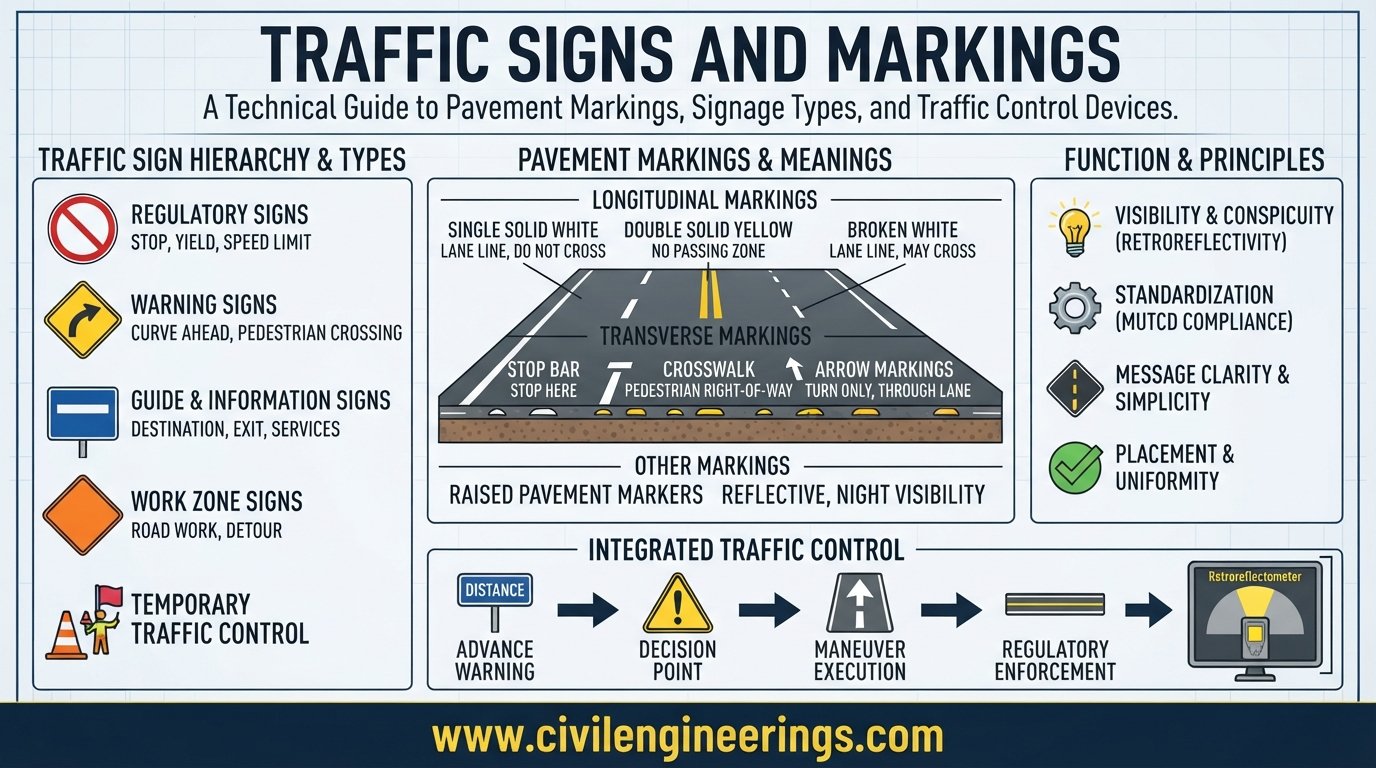
Traffic signs generally communicate information through words, symbols, colors, shapes, and arrows. Pavement markings communicate through lines, symbols, letters, numbers, and patterns applied directly to the road surface.
Together, they perform three fundamental functions:
- Regulation: Controlling or restricting road-user behavior.
- Warning: Alerting drivers to hazards or unusual conditions.
- Guidance: Providing route, lane, direction, and destination information.
Effective traffic control requires consistency. A driver should be able to recognize the meaning of a sign or marking quickly without having to interpret a complicated message.
Importance of Traffic Signs and Markings in Highway Engineering
Traffic-control devices are not decorative additions to a road project. They form an essential part of the overall highway safety system.
Improving Road Safety
Signs and markings help drivers identify hazards before they reach them. Warning signs can alert road users to sharp curves, intersections, pedestrian crossings, railway crossings, steep grades, merging traffic, or road construction.
Pavement markings reinforce these warnings by controlling vehicle paths and separating conflicting movements.
Managing Traffic Flow
Proper lane markings make the intended movement of traffic easier to understand. Direction arrows, lane lines, turn restrictions, and stop lines help organize vehicles at intersections and multilane roads.
A well-marked roadway can reduce unnecessary lane changes and driver uncertainty.
Supporting Driver Decision-Making
Drivers have limited time to process information, especially at higher speeds. Traffic signs provide information at appropriate locations so motorists can prepare for upcoming decisions.
For example, an advance direction sign placed sufficiently before an intersection allows a driver to select the appropriate lane without sudden maneuvering.
Reducing Conflicts Between Road Users
Signs and markings establish expectations among motorists, cyclists, pedestrians, and other road users. Crosswalk markings, bicycle lane markings, pedestrian signs, stop lines, and turn-control signs can reduce conflicts when properly designed.


Classification of Traffic Signs
Although terminology varies between national standards, traffic signs are commonly grouped according to their primary function.
Regulatory Signs
Regulatory signs communicate legal requirements, restrictions, prohibitions, or traffic-control rules.
Common examples include:
- Stop signs
- Give Way or Yield signs
- Speed-limit signs
- No-entry signs
- No-parking signs
- No-overtaking signs
- Weight-restriction signs
- One-way signs
- Turn restrictions
- Mandatory movement signs
Drivers must comply with applicable regulatory signs because they generally represent enforceable traffic rules.
Warning Signs
Warning signs alert road users to hazards or conditions requiring increased attention.
Typical examples include signs for:
- Sharp curves
- Reverse curves
- Intersections
- Pedestrian crossings
- School zones
- Railway crossings
- Road narrowing
- Steep gradients
- Slippery surfaces
- Construction areas
- Animal crossings
The objective is not simply to identify the hazard but to give the driver enough advance information to respond safely.
Informatory and Guide Signs
Guide signs provide information that helps road users navigate the transportation network.
They may identify:
- Destinations
- Route numbers
- Distances
- Airports
- Hospitals
- Tourist locations
- Service facilities
- Parking areas
- Alternative routes
Good guide signing reduces driver hesitation and supports smooth traffic operations.
Temporary Traffic-Control Signs
Construction and maintenance projects require temporary signs that communicate changing road conditions.
Examples include:
- Road-work signs
- Lane-closure signs
- Detour signs
- Temporary speed restrictions
- Flagger or traffic-controller signs
- Diversion signs
Temporary traffic management requires special attention because drivers may encounter unexpected lane shifts, workers, equipment, and reduced sight distance.
Classification of Pavement Markings
Pavement markings provide visual guidance directly on the road surface.
Center Lines
Center lines separate opposing traffic streams on two-way roads.
Depending on the roadway and applicable standard, center markings may include:
- Broken lines
- Solid lines
- Double solid lines
- Combinations of solid and broken lines
Their configuration communicates whether overtaking or crossing the line is permitted or restricted.
Lane Lines
Lane lines separate traffic traveling in the same direction.
They are particularly important on multilane highways because they help drivers maintain lane discipline and understand available lane paths.
Edge Lines
Edge lines identify the boundary of the traveled roadway.
They are especially valuable at night, during poor weather, and on roads where the pavement edge is difficult to distinguish from shoulders or surrounding terrain.
Stop and Give-Way Markings
Stop lines identify the position where a vehicle should stop at an intersection, pedestrian crossing, railway crossing, or other controlled location.
Give-way markings indicate where drivers must yield according to the applicable traffic-control arrangement.
Pedestrian Crossing Markings
Crosswalk markings designate areas intended for pedestrian crossing.
Their design and placement should correspond with pedestrian demand, traffic speed, sight distance, accessibility, lighting, and intersection geometry.
Direction Arrows and Word Markings
Arrows communicate permitted or required movements.
Examples include:
- Left-turn arrows
- Right-turn arrows
- Through arrows
- Combination arrows
- Lane-use arrows
Words such as STOP, SLOW, or other approved road messages may also supplement signs where permitted by the governing standard.
Principles of Traffic Sign Design
Traffic signs must be understandable, visible, and consistent.
Sign Shape and Color
Shape and color provide immediate recognition. Regulatory, warning, and guide signs generally use distinct visual conventions.
Engineers should follow the applicable national standard rather than selecting colors or shapes based on personal preference.
Lettering and Symbol Design
Text should remain readable at the intended approach speed and viewing distance.
A sign with excessive wording may fail even when its physical dimensions are adequate. Symbols can often communicate information faster than lengthy text.
Sign Size
Sign dimensions depend on factors such as:
- Road classification
- Operating speed
- Mounting position
- Viewing distance
- Traffic environment
- Number of messages
- Applicable standards
Higher-speed roads generally require larger and more conspicuous signs.
Sign Placement
Placement should provide sufficient time for drivers to perceive, comprehend, decide, and act.
Engineers should consider:
- Driver eye height
- Horizontal and vertical alignment
- Intersection location
- Sight distance
- Obstructions
- Roadside hazards
- Pedestrian movement
- Sign clutter
A technically correct sign can still be ineffective if vegetation, utility poles, advertising boards, or other infrastructure blocks it.
Principles of Pavement Marking Design
Pavement markings must remain visible under normal traffic and environmental conditions.
Retroreflectivity
Retroreflectivity allows vehicle headlights to illuminate markings and return light toward the driver.
It is particularly important during nighttime driving.
Performance can decline because of:
- Traffic wear
- Dirt
- Weather
- Surface deterioration
- Snowplowing in applicable regions
- Poor application
- Aging materials
Line Width and Pattern
Line width, segment length, gap length, and marking pattern should follow the governing road-marking standard.
Consistency is important because drivers interpret line patterns as instructions.
Color Selection
Different colors can communicate different traffic functions. White and yellow are widely used in many road systems, but exact applications depend on the applicable national standard.
Engineers should avoid introducing non-standard colors merely for visual emphasis.

Materials Used for Traffic Signs and Road Markings
Material selection strongly affects durability and lifecycle performance.
Traffic Sign Materials
Typical sign assemblies include:
- Aluminum or other approved sign substrates
- Retroreflective sheeting
- Protective coatings
- Steel or aluminum supports
- Mounting hardware
Retroreflective sheeting is particularly important because signs need to remain visible during nighttime conditions.
Road Marking Paint
Conventional traffic paint remains common because it is relatively easy to apply and renew.
Its service life depends on:
- Traffic volume
- Pavement texture
- Climate
- Surface preparation
- Application thickness
- Material quality
Thermoplastic Markings
Thermoplastic materials are widely used where improved durability is required.
They are suitable for many applications such as:
- Lane markings
- Arrows
- Crosswalks
- Stop lines
- Symbols
Cold-Plastic and Other Durable Materials
Methyl methacrylate and other durable marking systems may be used for locations requiring longer service life or enhanced performance.
The engineer should select material based on lifecycle cost rather than initial price alone.
Traffic Sign and Marking Installation Process
Correct installation is as important as correct design.
Site Investigation
Before installation, inspect:
- Existing signs
- Existing markings
- Road geometry
- Traffic movements
- Sight distance
- Utilities
- Drainage
- Pedestrian activity
- Existing roadside furniture
Setting Out
Survey teams should establish sign and marking locations from approved drawings.
Incorrect setting out can cause problems such as:
- Poor sight distance
- Conflicting signs
- Incorrect lane guidance
- Misaligned arrows
- Improper stop-line positions
Surface Preparation
For pavement markings, the surface should be clean and suitably dry according to the material manufacturer’s requirements.
Dust, oil, loose particles, moisture, and other contaminants can reduce adhesion.
Application
Contractors should control:
- Material temperature
- Application thickness
- Line width
- Bead application where required
- Alignment
- Curing or drying time
- Traffic protection
Inspection and Acceptance
Quality-control inspections should verify dimensions, location, appearance, material performance, and nighttime visibility where applicable.
Traffic Signs and Markings at Intersections
Intersections require particularly careful traffic-control design because multiple traffic streams interact in a limited space.
Stop-Controlled Intersections
A stop sign should work together with the stop line and appropriate approach markings.
The stop line should clearly identify where vehicles are expected to stop.
Signalized Intersections
Signal installations may require:
- Stop lines
- Lane arrows
- Pedestrian crossings
- Lane-use signs
- Advance warning signs
- Turn-control signs
Markings should correspond with the signal phasing and lane configuration.
Roundabouts
Roundabouts commonly require directional signs, yield or give-way control, lane arrows, splitter-island markings, pedestrian facilities, and appropriate delineation.
Poor signing can lead to wrong-way movements or late lane changes.
Traffic Signs and Markings in Work Zones
Road construction creates temporary hazards that require special traffic management.
Work-Zone Signing
Drivers should receive information before entering the affected area. Advance warning may communicate lane closures, speed reductions, diversions, or workers ahead.
Channelization
Cones, drums, barriers, temporary markings, and other devices guide traffic through the work zone.
Temporary Pavement Markings
When permanent markings are removed or covered, temporary markings should provide clear guidance.
The transition between temporary and permanent traffic arrangements deserves particular attention.
Engineering Factors Affecting Visibility
Visibility should be evaluated during both design and operation.
Stopping Sight Distance
A basic stopping sight distance relationship can be expressed as:
where:
- = stopping sight distance
- = vehicle speed
- = perception-reaction time
- = gravitational acceleration
- = coefficient of longitudinal friction
Traffic signs should generally be positioned so that drivers have adequate time to perceive the message and respond within the available road geometry.
Nighttime Visibility
Nighttime inspection can reveal problems that daytime inspection misses.
A sign may look perfectly clear under sunlight while having poor nighttime performance because of damaged or degraded retroreflective sheeting.
Similarly, pavement markings can become difficult to see after repeated traffic wear.
Common Traffic Signs and Markings Mistakes
Several recurring mistakes reduce road safety.
Excessive Sign Clutter
Too many signs competing for driver attention can reduce comprehension.
Engineers should eliminate unnecessary or duplicate signs wherever appropriate.
Incorrect Sign Placement
A sign placed too close to a decision point may give drivers insufficient reaction time.
Poor Pavement-Marking Alignment
Inconsistent lane lines and arrows can cause sudden lane changes.
Inadequate Maintenance
Faded markings and damaged signs should not remain in service simply because the road itself is operational.
Ignoring Nighttime Conditions
Design reviews should consider nighttime visibility, headlights, glare, weather, and retroreflective performance.
Mixing Standards Without Coordination
Using sign dimensions, colors, symbols, or marking conventions from different standards without checking compatibility can create confusion.
Quality Control and Maintenance
Traffic-control devices require continuous asset management.
Inspection Program
Routine inspections should identify:
- Faded markings
- Damaged signs
- Missing signs
- Obstructed signs
- Incorrect sign orientation
- Vegetation interference
- Loose supports
- Poor retroreflectivity
- Worn pavement symbols
Pavement Marking Maintenance
Maintenance timing can be based on condition, traffic exposure, material performance, and safety requirements.
A marking should be renewed before its visibility deteriorates to an unacceptable level.
Sign Maintenance
Signs should be cleaned, repaired, replaced, or repositioned when their performance declines.
A damaged sign support can also create a roadside safety hazard.
IRC, AASHTO, and ICE References
Traffic signs and markings should always be designed according to the standards and regulations applicable to the project location.
IRC Guidance
For projects in India, relevant Indian Roads Congress (IRC) publications provide guidance on road signs, pavement markings, highway design, traffic engineering, and road safety. Engineers should use the current editions and applicable national requirements.
AASHTO Guidance
In the United States and projects influenced by U.S. practice, AASHTO publications provide guidance on geometric design, roadside safety, and transportation infrastructure. Traffic-control devices should also be coordinated with the applicable MUTCD requirements.
ICE Guidance
The Institution of Civil Engineers (ICE) provides professional engineering knowledge and guidance relevant to transportation infrastructure, project delivery, sustainability, and engineering practice.
The important principle is not to combine standards mechanically. Select the governing standard at the beginning of the project and ensure drawings, specifications, construction, and inspection follow the same framework.
Practical Recommendations for Students, Engineers, and Contractors
For Civil Engineering Students
Students should learn to connect traffic-control theory with actual highway geometry.
Study:
- Traffic sign categories
- Pavement-marking conventions
- Sight distance
- Traffic flow
- Intersection control
- Road safety principles
- Sign placement
- Retroreflectivity
During site visits, compare design drawings with actual installations.
For Highway Engineers
Engineers should evaluate traffic-control devices as part of the complete road system.
Before approving a design, check:
- Road function and classification.
- Design and operating speeds.
- Traffic composition.
- Sight distance.
- Intersection geometry.
- Pedestrian and cyclist requirements.
- Nighttime visibility.
- Sign and marking consistency.
- Maintenance requirements.
- Applicable standards.
For Contractors
Contractors should not treat signs and markings as final cosmetic work.
Maintain strict control over:
- Setting out
- Material certificates
- Surface preparation
- Application conditions
- Line dimensions
- Sign orientation
- Mounting height
- Reflective materials
- Traffic protection
- Final inspection
Small construction errors can create significant operational problems after the road opens.
Frequently Asked Questions About Traffic Signs and Markings
1. What are traffic signs and markings?
Traffic signs and markings are traffic-control devices used to regulate, warn, guide, and inform road users. Signs are generally installed beside or above the roadway, while markings are applied to the pavement.
2. What are the main types of traffic signs?
The major functional categories are regulatory signs, warning signs, and guide or informatory signs. Temporary work-zone signs form another important category for construction and maintenance activities.
3. Why are pavement markings important?
Pavement markings define lanes, separate traffic movements, identify road edges, control stopping positions, and provide visual guidance, especially where drivers need immediate information.
4. What is retroreflectivity?
Retroreflectivity is the ability of a sign or road marking to return incident light toward its source. It helps drivers see traffic-control devices at night when illuminated by vehicle headlights.
5. Which materials are commonly used for road markings?
Common materials include traffic paint, thermoplastic, cold-plastic systems, and other specialized durable marking materials. Selection depends on traffic, climate, pavement conditions, and lifecycle requirements.
6. How should traffic signs be positioned?
Sign positioning depends on road speed, sight distance, sign function, roadway geometry, roadside conditions, and the applicable standard. The driver must have enough time to perceive and respond to the information.
7. Why do road markings fade quickly?
Heavy traffic, poor surface preparation, unsuitable materials, pavement texture, weather, inadequate application, and insufficient maintenance can accelerate marking deterioration.
8. Are traffic signs more important than road markings?
Neither should be considered independently. Signs provide information and control, while markings reinforce traffic paths and restrictions. Effective highway safety usually requires coordinated use of both.
9. What standards should engineers use for traffic signs and markings?
The governing national or project-specific standard should be identified first. Depending on the country, engineers may work with IRC, AASHTO/MUTCD, ICE-related guidance, or other recognized standards and regulations.
10. How can engineers improve traffic-sign performance?
Engineers can improve performance through correct placement, standardized design, adequate visibility, appropriate retroreflective materials, nighttime inspections, effective maintenance, and elimination of unnecessary sign clutter.
Conclusion
Traffic signs and markings provide the visual language of the road. They tell drivers where to travel, when to stop, which movements are permitted, what hazards lie ahead, and how the roadway is organized. Their value extends far beyond paint and roadside boards; they directly influence driver behavior, traffic operations, road safety, and the overall usability of transportation infrastructure.
Successful implementation requires more than selecting a standard sign or applying a line to pavement. Highway professionals must consider operating speed, sight distance, road geometry, traffic composition, human factors, nighttime visibility, material durability, construction quality, and maintenance. Signs and markings should also work together rather than communicate conflicting information.
For students, understanding these principles builds a strong foundation in traffic engineering. For engineers and consultants, careful design and inspection can prevent operational problems. Contractors play an equally important role by ensuring accurate installation and material quality. When design, construction, and maintenance follow a coordinated engineering approach, traffic-control devices become a powerful and cost-effective component of a safer, more efficient road network.

Kamran Malik is a passionate civil engineering writer and researcher who specializes in construction, transportation, structural engineering, and infrastructure topics. Through his articles on CivilEngineerings.com, he simplifies complex engineering concepts and shares practical insights, industry trends, and educational resources for students, professionals, and engineering enthusiasts.