
Roads are essential for economic growth, mobility, trade, and access to essential services. However, conventional road construction can consume large quantities of aggregates, bitumen, cement, water, fuel, and land while generating construction waste and greenhouse-gas emissions. The challenge for modern highway engineering is therefore not simply to build stronger roads, but to build roads that deliver required performance with fewer environmental and resource impacts.
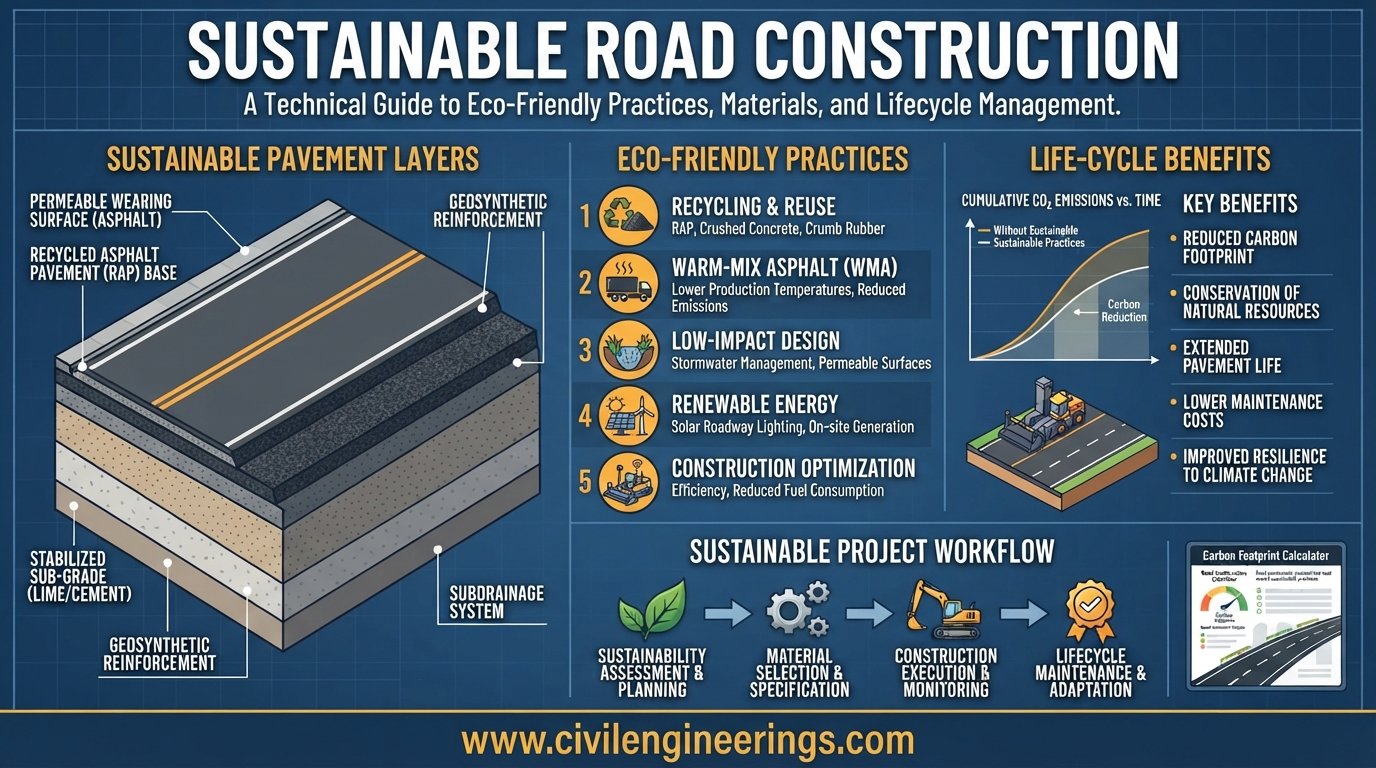
Sustainable Road Construction combines engineering performance, environmental responsibility, economic efficiency, resource conservation, and long-term resilience throughout the road’s life cycle. It can involve recycled pavement materials, warm-mix asphalt, locally sourced aggregates, energy-efficient equipment, optimized pavement design, efficient drainage, climate-resilient materials, and preventive maintenance.
This article explains the major principles, materials, technologies, design considerations, construction practices, benefits, limitations, and practical implementation strategies associated with sustainable roads. It also discusses life-cycle thinking, carbon reduction, recycling, stormwater management, and relevant IRC, AASHTO, and ICE guidance so that students, engineers, contractors, consultants, and infrastructure professionals can apply sustainability concepts to real highway projects.
What Is Sustainable Road Construction?
Sustainable road construction is an approach to planning, designing, constructing, maintaining, rehabilitating, and eventually recycling roads while balancing engineering performance, environmental protection, economic value, and social needs.
A sustainable pavement should not be judged only by how much recycled material it contains. A pavement that uses recycled aggregate but fails prematurely may require repeated reconstruction and ultimately create greater environmental and financial impacts.
The better approach is to consider the entire life cycle:
Planning → Design → Material Selection → Construction → Operation → Maintenance → Rehabilitation → Recycling
Life-cycle thinking is particularly important because road-related carbon emissions arise from multiple sources, including construction activities, material production, transportation, maintenance, lighting, and the effects associated with increased road use. The Institution of Civil Engineers highlights these different sources when discussing carbon reduction in road projects. (Institution of Civil Engineers (ICE))


Key Objectives
The main objectives include:
- Reducing embodied carbon and energy consumption
- Conserving natural aggregates and other raw materials
- Increasing pavement recycling
- Reducing construction and demolition waste
- Minimizing transportation requirements
- Improving pavement durability and service life
- Managing stormwater effectively
- Reducing construction emissions
- Improving climate resilience
- Controlling whole-life costs
- Protecting surrounding ecosystems and communities
The most sustainable solution is therefore usually the one that provides the required performance with the lowest reasonable life-cycle resource and environmental burden, rather than the one that simply uses the newest technology.
Why Sustainable Road Construction Matters
Road infrastructure has a substantial material and energy footprint. Large projects may require millions of tonnes of aggregates, significant quantities of bituminous binder or cement, extensive earthworks, heavy construction equipment, and long-distance transportation.
Sustainability addresses these impacts at their source.
Environmental Benefits
Using reclaimed asphalt pavement (RAP), recycled aggregates, industrial by-products, and suitable construction and demolition materials can reduce dependence on virgin resources. FHWA promotes pavement recycling because it can conserve natural resources, reduce waste, and provide economic and engineering benefits when properly designed and controlled. (Federal Highway Administration)
Other environmental benefits include:
- Lower quarrying requirements
- Reduced landfill disposal
- Lower fuel consumption
- Reduced greenhouse-gas emissions
- Conservation of water and energy
- Reduced disturbance to natural habitats
- Better stormwater management
Economic Benefits
Sustainability can also improve project economics.
Recycling existing pavement can reduce the demand for virgin aggregate and binder. Local materials can lower haulage distances. Preventive maintenance can extend pavement life and delay expensive reconstruction.
However, engineers should compare alternatives using whole-life cost, rather than relying only on initial construction cost.
A simple life-cycle cost concept can be represented as:
LCC = Initial Cost + Maintenance Cost + Rehabilitation Cost + User Cost + Residual Cost
Actual pavement-economic analysis should account for discount rates, analysis periods, traffic impacts, maintenance strategies, and agency-specific procedures.
Social and Operational Benefits
Sustainable roads can contribute to:
- Safer and smoother travel
- Reduced construction disruption
- Improved accessibility
- Better pedestrian and cycling environments
- Reduced flooding
- Improved roadside environmental quality
- More resilient transportation networks
Sustainability therefore extends beyond environmental performance.
Major Sustainable Road Construction Materials
Material selection has a major influence on pavement sustainability.
Reclaimed Asphalt Pavement
RAP is one of the most established recycling materials in asphalt pavement construction. Milled asphalt can be processed and incorporated into new asphalt mixtures or used in various recycling techniques.
FHWA notes that RAP can reduce the need for virgin aggregate and asphalt binder while conserving resources and reducing waste. (Federal Highway Administration)
RAP can be used through:
- Hot-mix recycling
- Cold recycling
- Hot in-place recycling
- Cold in-place recycling
- Full-depth reclamation
- Recycled asphalt mixtures
The RAP percentage should never be selected simply to achieve a sustainability target. Engineers must evaluate aggregate gradation, recovered binder properties, mixture stiffness, cracking resistance, moisture susceptibility, and project-specific performance requirements.
Recycled Aggregates
Recycled concrete aggregate and other approved recycled materials can replace a portion of virgin aggregate in suitable pavement layers.
Potential sources include:
- Demolished concrete
- Crushed masonry
- Existing pavement
- Processed construction materials
- Selected industrial by-products
Material processing and quality control remain essential because recycled materials can vary considerably in gradation, absorption, contamination, and strength.
Warm Mix Asphalt
Warm Mix Asphalt (WMA) allows asphalt mixtures to be produced and placed at lower temperatures than conventional hot-mix asphalt.
Lower production temperatures can reduce fuel consumption, emissions, fumes, and odors. FHWA identifies reduced energy demand and lower life-cycle impacts as important benefits of WMA. (Federal Highway Administration)
WMA can also improve workability and facilitate compaction under appropriate conditions.
Recycled and Supplementary Materials in Concrete
For rigid pavements, sustainability may involve the controlled use of supplementary cementitious materials and recycled aggregates where permitted by project specifications.
Examples include:
- Fly ash
- Ground granulated blast-furnace slag
- Silica fume
- Recycled concrete aggregate
- Other approved supplementary materials
The suitability of each material depends on local availability, climate, structural requirements, durability criteria, and applicable specifications.
Waste Plastic and Other Alternative Materials
Waste plastic has been investigated and used in selected asphalt applications. However, engineers should distinguish between validated engineering applications and experimental products.
Plastic type, dosage, processing method, mixing temperature, compatibility, and long-term performance all influence results. The technology should therefore be adopted only where supported by appropriate testing, specifications, and field evidence.
Sustainable Pavement Design Strategies
Sustainability begins before construction equipment reaches the site.
Optimize Pavement Thickness
Overdesign increases material consumption, while underdesign leads to premature deterioration.
Engineers should optimize:
- Traffic loading
- Subgrade strength
- Drainage
- Material properties
- Climate
- Reliability
- Design life
- Maintenance strategy
A properly designed pavement can provide long service with fewer rehabilitation interventions.
Design for Long Service Life
A durable road is often a sustainable road.
Important factors include:
- Adequate drainage
- Proper compaction
- Appropriate layer thickness
- Good aggregate quality
- Correct binder selection
- Moisture control
- Effective joints in concrete pavement
- Timely maintenance
The sustainability benefit of durability can be significant because every avoided rehabilitation cycle reduces future material, equipment, transport, and labor requirements.
Use Pavement Recycling
Recycling existing pavement can substantially reduce the need to remove and replace large quantities of material.
Full-depth reclamation, for example, can process existing pavement layers in place and stabilize the reclaimed material rather than transporting all material away and importing new aggregate.
FHWA recognizes hot recycling, cold recycling, hot in-place recycling, and full-depth reclamation as established pavement recycling approaches. (Federal Highway Administration)
Sustainable Construction Techniques


Energy-Efficient Asphalt Production
Asphalt plants can reduce energy use through:
- Warm-mix technologies
- Efficient burners
- Moisture control
- Improved aggregate stockpile management
- Plant insulation
- Automated temperature control
- Reduced idling
- Preventive equipment maintenance
The objective is to produce a mixture that satisfies performance requirements without unnecessary energy consumption.
Efficient Earthwork
Earthwork can represent a major component of road construction.
Sustainable earthwork practices include:
- Balancing cut and fill
- Reusing suitable excavated material
- Optimizing haul routes
- Reducing unnecessary excavation
- Using digital terrain models
- Improving equipment utilization
- Minimizing truck waiting time
A cut-and-fill balance can reduce both material disposal and imported fill.
In-Place Recycling
In-place recycling is particularly valuable where the existing pavement contains suitable materials.
Instead of:
Mill → Transport → Dispose → Quarry → Transport → Construct
the project may use:
Reclaim → Process → Stabilize → Recompact → Overlay
This can reduce haulage, material consumption, and construction disruption.
Permeable and Sustainable Drainage Systems
Road sustainability also involves water.
Permeable pavement systems can allow water to infiltrate through pavement layers and reduce surface runoff under appropriate soil and groundwater conditions. Sustainable drainage can incorporate:
- Permeable pavement
- Infiltration trenches
- Swales
- Vegetated channels
- Detention systems
- Bioretention areas
- Rain gardens
However, permeable pavement should not be selected automatically. Soil permeability, groundwater conditions, traffic loading, clogging potential, maintenance, and rainfall characteristics must be assessed.
Carbon Reduction in Road Projects
Carbon management should be integrated into the engineering process.
A simplified embodied-carbon calculation can be expressed as:
Embodied Carbon = Σ(Material Quantity × Emission Factor)
For example, if a project uses 10,000 tonnes of a material and its applicable emission factor is 0.04 tCO₂e/tonne:
Carbon = 10,000 × 0.04 = 400 tCO₂e
Actual project calculations should use reliable, project-appropriate emission factors and account for transportation, processing, construction energy, and other relevant stages.
Main Sources of Road Construction Carbon
Common sources include:
- Cement production
- Bitumen production
- Aggregate production
- Steel
- Asphalt plant fuel
- Concrete batching
- Heavy construction equipment
- Material transportation
- Waste disposal
- Maintenance and rehabilitation
The best reduction strategy is often a combination of measures rather than a single material substitution.
Sustainable Road Construction in Different Project Stages
Planning Stage
At planning stage, assess:
- Existing pavement condition
- Material availability
- Traffic demand
- Environmental constraints
- Climate hazards
- Drainage requirements
- Construction access
- Future maintenance requirements
Early decisions can have a greater sustainability impact than later construction adjustments.
Design Stage
The design team should compare alternatives using both engineering and life-cycle criteria.
For example, compare:
Alternative A: New pavement using entirely virgin materials.
Alternative B: Existing pavement recycling + RAP + WMA + optimized overlay.
The second option may reduce virgin material demand, transportation, and energy consumption while achieving equivalent performance if properly engineered.
Construction Stage
Contractors should focus on:
- Accurate material batching
- Temperature control
- Proper compaction
- Equipment efficiency
- Waste minimization
- Dust control
- Material storage
- Spill prevention
- Construction traffic management
Quality control remains essential. A sustainable material that is poorly compacted can become an expensive failure.
Maintenance Stage
Preventive maintenance is an important sustainability strategy.
Treating minor deterioration before structural failure can reduce the quantity of material and energy required for future rehabilitation.
Useful practices include:
- Crack sealing
- Surface treatments
- Patching
- Drainage maintenance
- Thin overlays
- Periodic condition surveys
- Structural monitoring
Climate-Resilient Sustainable Roads
Sustainability and resilience should be considered together.
A road that has low embodied carbon but repeatedly fails during flooding is not necessarily sustainable.
Engineers should assess:
- Extreme rainfall
- Flooding
- Heat waves
- Freeze-thaw cycles
- Drought
- Erosion
- Landslides
- Coastal hazards where applicable
Resilient drainage, appropriate pavement materials, stable slopes, adequate culverts, erosion protection, and suitable pavement design can improve long-term performance.
IRC publications increasingly address green and resilient highway technologies. IRC’s current publication information includes guidance on full-depth recycling and reclamation, construction and demolition waste, disaster-resilient green highways, and recycling of bituminous pavements. (Indian Register of Cos.)
Quality Control for Sustainable Road Construction
Sustainability cannot replace conventional quality assurance.
Important tests may include:
- Aggregate gradation
- Aggregate crushing and abrasion characteristics
- Bitumen properties
- Asphalt content
- Marshall or volumetric properties where applicable
- Air voids
- Density
- Moisture susceptibility
- Concrete strength
- Slump/workability
- Thickness
- Surface regularity
- Deflection
- Drainage performance
For RAP mixtures, engineers should characterize the reclaimed material before determining an appropriate mixture design.
FHWA guidance emphasizes that successful pavement recycling must balance economic performance, environmental responsibility, and engineering performance. (Federal Highway Administration)
IRC, AASHTO, and ICE References
Sustainable road construction should always comply with the project’s governing specifications and local regulatory requirements. International guidance can support engineering decisions but should not automatically replace national or contract-specific requirements.
Indian Roads Congress
Relevant IRC resources include:
- IRC:120-2015 — Recommended Practice for Recycling of Bituminous Pavements
- IRC:121-2017 — Guidelines for Use of Construction and Demolition Waste in Road Sector
- IRC:SP:98-2019 — Guidelines for Use of Waste Plastic in Hot Bituminous Mixes
- IRC:SP:133-2022 — Guidelines on Reducing Carbon Footprint of Road Projects
- IRC:138-2023 — Guidelines for Highway Engineers on Disaster Resilient Green Highways
- IRC:142-2025 — Guidelines on Full Depth Recycling/Reclamation Technology for Pavements Using Cementitious Binders
IRC’s published material specifically discusses recycling, green highway technologies, porous/pervious pavement, waste materials, and carbon reduction. (Indian Register of Cos.)
AASHTO
AASHTO publications and specifications can be consulted for applicable pavement design, materials, testing, construction, and transportation engineering requirements. The precise document depends on pavement type, project jurisdiction, design methodology, and contract requirements.
Institution of Civil Engineers
ICE provides broader professional guidance on infrastructure carbon, whole-life thinking, and sustainable engineering. Its discussion of road-building carbon emphasizes that emissions occur across construction, materials, maintenance, land-use effects, and operational stages. (Institution of Civil Engineers (ICE))
Practical Recommendations for Students, Engineers, and Contractors
For Civil Engineering Students
Students should learn to connect sustainability with conventional pavement engineering.
Focus on:
- Pavement design
- Materials testing
- Life-cycle assessment
- Recycling technologies
- Carbon calculations
- Drainage
- Climate resilience
- Construction quality control
Do not treat sustainability as a separate subject. It should become part of normal engineering decision-making.
For Highway Engineers and Consultants
Engineers should:
- Establish sustainability objectives during planning.
- Evaluate existing pavement before deciding on reconstruction.
- Compare recycling and new-construction alternatives.
- Consider whole-life cost.
- Quantify material and energy savings where practical.
- Evaluate carbon emissions.
- Specify recycled materials based on performance.
- Design drainage for current and anticipated climate risks.
- Include measurable sustainability requirements in specifications.
- Monitor actual field performance after construction.
For Contractors
Contractors can improve sustainability through better execution.
Prioritize:
- Proper equipment maintenance
- Reduced idling
- Accurate material handling
- Efficient haul routes
- Correct asphalt temperatures
- Effective compaction
- Waste segregation
- Reuse of suitable excavated material
- Dust and runoff control
- Preventive maintenance of construction machinery
Good construction management often provides sustainability benefits without requiring expensive technology.
Common Challenges and Limitations
Sustainable road construction is not free from challenges.
Higher Initial Cost
Some sustainable technologies require specialized equipment, testing, training, or material processing. The solution is to evaluate whole-life value, rather than rejecting a technology solely because its initial cost is higher.
Material Variability
Recycled materials may have greater variability than virgin materials. Strong material characterization and quality control are therefore essential.
Limited Local Supply
Some regions may lack processing facilities or consistent sources of recycled aggregates and RAP.
Lack of Experience
Contractors and agencies may hesitate to adopt unfamiliar technologies. Pilot projects, technical training, specifications, and performance monitoring can reduce this barrier.
Sustainability Claims Without Evidence
A material should not be considered sustainable simply because it is marketed as “green.” Engineers should request technical data, environmental information, durability evidence, and appropriate test results.
FAQs About Sustainable Road Construction
1. What is sustainable road construction?
Sustainable road construction is the planning, design, construction, maintenance, and rehabilitation of roads in a way that balances pavement performance, environmental protection, economic efficiency, resource conservation, and social needs.
2. What materials are commonly used in sustainable roads?
Common options include RAP, recycled aggregates, construction and demolition waste where permitted, warm-mix asphalt, supplementary cementitious materials, and selected alternative materials supported by engineering evidence.
3. Is recycled asphalt pavement suitable for highways?
Yes. Properly processed and designed RAP can be used in asphalt mixtures. Its percentage and application should be determined through material characterization, mixture design, specifications, and performance requirements. FHWA continues to provide technical guidance on RAP use. (Federal Highway Administration)
4. How does warm-mix asphalt improve sustainability?
WMA reduces the temperature required for asphalt production and placement. This can reduce fuel consumption and associated emissions while maintaining appropriate mixture performance when properly designed and constructed. (Federal Highway Administration)
5. Does sustainable construction reduce road quality?
Not necessarily. Sustainability should be achieved while maintaining or improving required engineering performance. Poor-quality construction is not sustainable regardless of the materials used.
6. What is the role of pavement recycling?
Pavement recycling allows existing road materials to be recovered and reused. It can reduce virgin aggregate demand, waste generation, transportation, and material-related environmental impacts.
7. How can road projects reduce carbon emissions?
Major opportunities include pavement recycling, WMA, efficient earthwork, local materials, optimized pavement design, efficient equipment, reduced haulage, durable pavement systems, and preventive maintenance.
8. What is the difference between sustainable and resilient roads?
Sustainability focuses broadly on environmental, economic, and social performance over the life cycle. Resilience focuses on the ability of infrastructure to withstand, adapt to, and recover from hazards such as flooding, extreme heat, or other disruptions. Good road projects should address both.
9. Can permeable pavement be used on highways?
Permeable pavement is more commonly suited to selected applications such as parking areas, low-speed facilities, shoulders, pedestrian areas, or other locations where structural and drainage conditions are appropriate. Its use on heavily trafficked highways requires careful structural, hydraulic, and maintenance assessment.
10. Which standards should engineers follow?
Engineers should follow the standards specified by the project owner and jurisdiction. Depending on location, this may include applicable IRC, AASHTO, ASTM, national highway specifications, and contract documents. International guidance should supplement—not replace—the governing requirements.
Conclusion
Sustainable Road Construction is not simply about replacing conventional materials with recycled products. It represents a broader engineering philosophy in which material efficiency, pavement durability, energy consumption, carbon emissions, drainage, resilience, construction quality, maintenance, and whole-life cost are considered together.
The most effective sustainable road may use RAP and warm-mix asphalt, recycle the existing pavement through full-depth reclamation, optimize pavement thickness, use locally available materials, improve drainage, reduce equipment fuel consumption, and implement preventive maintenance. The correct combination depends on traffic, climate, soil, material availability, pavement condition, project budget, and applicable standards.
For civil engineering students, the key lesson is to connect sustainability with fundamental pavement engineering. For engineers and consultants, life-cycle assessment and performance-based decisions should guide technology selection. Contractors can contribute through efficient equipment operation, accurate material handling, proper compaction, waste reduction, and rigorous quality control.
When sustainability is integrated from planning through maintenance and eventual recycling, road infrastructure can become more resource-efficient, durable, economical, and resilient without compromising engineering performance.
