
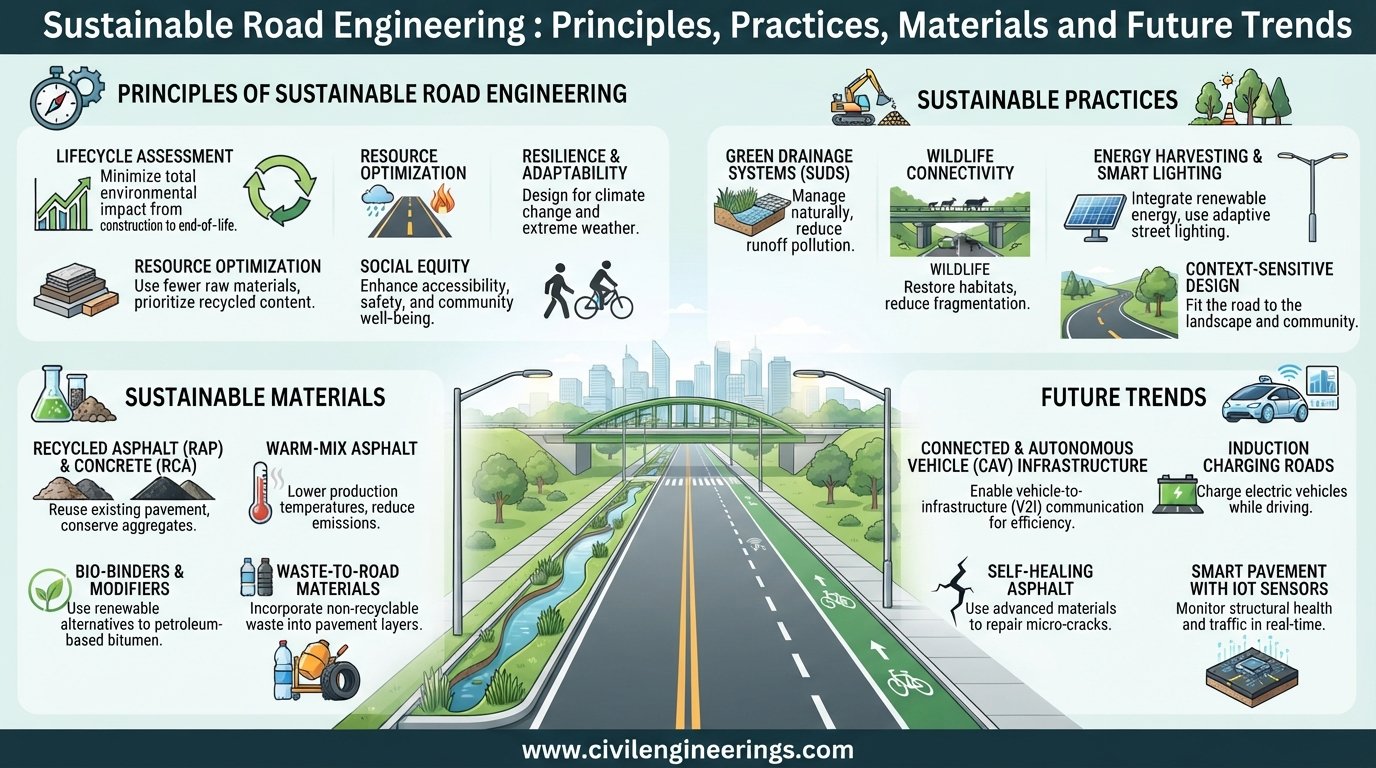
Roads are more than layers of asphalt, concrete, aggregates, and soil. They are long-term infrastructure assets that influence mobility, economic development, land use, energy consumption, environmental quality, and community well-being. As traffic volumes increase and climate risks become more serious, traditional approaches to highway development are no longer enough.
Sustainable Road Engineering provides a broader approach to planning, designing, constructing, maintaining, and eventually rehabilitating roads while balancing environmental, economic, technical, and social objectives.
A sustainable road is not simply a road built with recycled materials. It should perform safely for its intended service life, use resources efficiently, minimize unnecessary emissions and waste, withstand climate-related stresses, and provide value to road users and communities.
For civil engineering students, highway engineers, contractors, consultants, and government agencies, sustainability is becoming an important part of modern pavement engineering and transportation infrastructure planning. This guide explains the major principles of sustainable road engineering, low-carbon materials, pavement recycling, drainage, construction practices, life-cycle assessment, climate resilience, maintenance strategies, and practical implementation methods.
What Is Sustainable Road Engineering?
Sustainable Road Engineering is the application of engineering principles to develop road infrastructure that meets present transportation needs without creating unnecessary environmental, economic, or social burdens for future generations.
It considers the complete road life cycle rather than focusing only on initial construction.
That life cycle can include:
- Route planning and feasibility
- Corridor selection
- Geometric design
- Earthworks
- Pavement design
- Material production
- Transportation of materials
- Construction
- Road operation
- Maintenance
- Rehabilitation
- Recycling
- End-of-life management
The concept therefore extends beyond green road construction. A pavement that has low initial carbon emissions but fails prematurely may not be sustainable. Similarly, a very durable pavement that requires excessive quantities of energy-intensive materials may not provide the best overall environmental performance.
A balanced engineering decision considers performance, cost, resource consumption, resilience, safety, and environmental impact together.
ICE guidance on infrastructure carbon management emphasizes measuring impacts across the infrastructure life cycle instead of limiting assessment to the construction stage.
Why Sustainable Road Engineering Matters
Road infrastructure consumes large quantities of aggregates, bituminous materials, cement, water, fuel, steel, and other resources. Construction equipment also consumes substantial amounts of diesel and electricity.
The environmental footprint does not stop when construction ends. Lighting, traffic congestion, maintenance operations, pavement deterioration, vehicle fuel consumption, drainage failures, and repeated reconstruction can all contribute to the overall impact of a road system.
A sustainable approach attempts to improve the complete performance of the transportation asset.
Environmental Benefits
Sustainable highway practices can reduce:
- Greenhouse gas emissions
- Construction waste
- Raw material extraction
- Water consumption
- Fuel consumption
- Construction-related dust
- Noise and disturbance
- Land degradation
- Unnecessary vegetation removal
Using reclaimed asphalt pavement, recycled aggregates, optimized pavement thickness, lower-temperature asphalt technologies, and efficient construction logistics can reduce resource requirements.
Economic Benefits
Sustainability and economy are not opposing objectives.
A pavement that lasts longer and requires fewer major interventions can reduce whole-life expenditure. Preventive maintenance can also delay expensive rehabilitation.
For example, a road agency may compare two pavement alternatives:
Alternative A
- Lower initial construction cost
- Shorter service life
- Frequent maintenance
Alternative B
- Slightly higher initial cost
- Longer service life
- Lower maintenance frequency
The second alternative may provide better value when analyzed over the complete design period.
Social Benefits
Sustainable roads should also serve people.
Social sustainability can involve:
- Safer intersections
- Pedestrian facilities
- Cycling infrastructure
- Public transport integration
- Reduced community disruption
- Better accessibility
- Improved roadside safety
- Reliable travel times
A technically excellent highway that creates unacceptable community impacts cannot be considered fully sustainable.
Key Principles of Sustainable Road Engineering
1. Life-Cycle Thinking
Engineers should evaluate the road from planning through end-of-life.
Instead of asking:
“How much will this road cost to build?”
the better question is:
“What will this road cost society throughout its useful life?”
A simplified whole-life cost concept can be expressed as:
LCC = Initial Cost + Maintenance Cost + Rehabilitation Cost + User/Operational Costs − Residual Value
Actual life-cycle calculations should account for discount rates, intervention timing, traffic effects, salvage value, and agency-specific economic assumptions.
2. Resource Efficiency
Efficient design means achieving required performance without unnecessary consumption of materials.
Examples include:
- Optimizing pavement layer thickness
- Reusing excavated materials where technically suitable
- Recycling existing pavement
- Reducing haul distances
- Selecting locally available aggregates
- Avoiding overdesign
- Using digital quantity control
Material optimization should never compromise structural capacity or safety.
3. Carbon Management
Road projects should identify major carbon sources early.
Typical sources include:
- Cement production
- Bitumen production
- Aggregate processing
- Asphalt plant operations
- Concrete production
- Heavy construction equipment
- Material transportation
- Earthworks
- Lighting
- Maintenance operations
A simplified embodied-carbon calculation is:
Embodied Carbon = Material Quantity × Emission Factor
For several materials:
Total CO₂e = Σ (Quantity × Emission Factor)
This is a simplified engineering assessment. Real projects should use verified environmental product data, appropriate system boundaries, transport assumptions, construction energy, and life-cycle stages.
ICE’s whole-life carbon work recommends consistent measurement and benchmarking throughout the infrastructure life cycle.
4. Durability and Long Service Life
Durability is one of the most important principles of sustainable pavement engineering.
Every premature failure means additional:
- Aggregate production
- Asphalt or cement consumption
- Transportation
- Construction energy
- Traffic disruption
- Maintenance expenditure
Therefore, proper drainage, material quality, compaction, pavement thickness, subgrade preparation, and construction control are sustainability measures as well as conventional engineering requirements.
5. Climate Resilience
A sustainable road must be capable of performing under future environmental conditions.
Design considerations may include:
- Extreme rainfall
- Flooding
- Higher temperatures
- Freeze-thaw cycles
- Drought
- Erosion
- Landslides
- Wildfire exposure
- Coastal flooding
- Changing groundwater conditions
Climate resilience should be integrated during route selection and geometric, pavement, drainage, and slope design rather than added after construction.
Sustainable Pavement Materials and Technologies
Material selection is one of the most practical ways to improve road sustainability.
Reclaimed Asphalt Pavement
Reclaimed Asphalt Pavement, commonly called RAP, consists of processed material recovered from existing asphalt pavement.
Depending on project specifications and mixture requirements, RAP can be incorporated into new asphalt mixtures.
Benefits may include:
- Reduced virgin aggregate demand
- Reduced asphalt binder demand
- Lower material transportation
- Reduced waste
- Conservation of natural resources
RAP percentage should not be selected simply because a higher percentage appears more sustainable. Engineers must consider aggregate properties, aged binder characteristics, mixture performance, cracking resistance, rutting resistance, and applicable specifications.
Cold In-Place Recycling
Cold In-Place Recycling, or CIR, processes existing asphalt pavement near the project site and reuses the reclaimed material in the rehabilitation structure.
This can significantly reduce hauling and the demand for virgin materials.
Recent U.S. highway work demonstrates how pavement recycling can reduce material movement and construction impacts when appropriate site conditions and engineering controls exist.
Full-Depth Reclamation
Full-Depth Reclamation, or FDR, pulverizes and stabilizes existing pavement and underlying layers to create a renewed base structure.
It can be attractive where:
- Existing pavement materials are suitable
- Structural rehabilitation is required
- Hauling new aggregates would be expensive
- Local recycling is feasible
Proper laboratory testing and field verification remain essential.
Warm-Mix Asphalt
Warm-Mix Asphalt technologies allow asphalt mixtures to be produced and placed at lower temperatures than conventional hot-mix asphalt under suitable conditions.
Potential benefits include:
- Lower plant fuel consumption
- Reduced emissions
- Improved working conditions
- Longer paving seasons in some climates
- Potentially reduced aging during production
The technology must still satisfy mixture performance and project specifications.
Recycled and Alternative Aggregates
Potential sources include:
- Recycled concrete aggregate
- Reclaimed asphalt aggregate
- Industrial by-products where permitted
- Locally processed materials
- Suitable construction and demolition materials
Material acceptance should always be based on engineering properties rather than sustainability claims alone.
Sustainable Road Drainage
Drainage is often underestimated in discussions about sustainable highway design.
Water is one of the most destructive factors affecting pavement systems. Poor drainage can weaken subgrade materials, accelerate stripping, cause erosion, damage shoulders, and shorten pavement life.
Sustainable drainage strategies may include:
- Proper crossfall
- Adequate side drains
- Filter drains
- Culverts
- Detention systems
- Infiltration features
- Vegetated drainage channels
- Permeable surfaces where appropriate
- Erosion-control measures
The objective is not simply to remove water quickly. Engineers should manage runoff safely while protecting downstream environments.
Example: Pavement Drainage Principle
If rainfall enters a pavement system and cannot escape efficiently, moisture may increase within granular layers and reduce support.
Therefore:
Better Drainage → Lower Moisture Damage → Better Structural Performance → Longer Pavement Life
The actual relationship depends on soil type, pavement structure, groundwater, climate, permeability, and drainage design.
Sustainable Road Construction Practices
Sustainability must continue from design into field execution.
Reduce Material Haulage
Transportation can become a major source of construction emissions.
Contractors can reduce haulage by:
- Using approved local sources
- Recycling existing pavement
- Optimizing delivery routes
- Coordinating material deliveries
- Avoiding empty return trips
- Using digital logistics planning
Improve Equipment Efficiency
Construction companies can reduce fuel use through:
- Proper equipment sizing
- Preventive maintenance
- Reduced idling
- Efficient site planning
- Operator training
- Modern fuel-efficient machinery
- Electrification where practical
Control Construction Waste
A waste-management plan should identify opportunities for:
- Reuse
- Recycling
- Material recovery
- Controlled disposal
- Packaging reduction
Site engineers should track waste quantities instead of relying solely on general statements such as “materials will be recycled.”
Improve Quality Control
Poor workmanship creates sustainability problems.
For example, inadequate compaction can lead to premature pavement failure. The project then consumes additional materials during rehabilitation.
Quality control should cover:
- Aggregate gradation
- Moisture content
- Density
- Asphalt temperature
- Binder properties
- Concrete strength
- Layer thickness
- Surface tolerances
- Drainage performance
Sustainable Highway Design Strategies
Sustainability begins before construction.
Route Selection
Route alternatives should be compared for:
- Earthwork quantities
- Environmental sensitivity
- Land acquisition
- Water crossings
- Habitat disturbance
- Construction access
- Travel demand
- Community effects
- Future maintenance requirements
A slightly longer route can sometimes have lower overall environmental and construction impacts if it reduces major earthworks or avoids environmentally sensitive areas.
Geometric Design
Horizontal alignment, vertical alignment, gradients, sight distance, intersections, and cross-sections influence both construction quantities and vehicle operations.
Earthwork balance is particularly important.
A route that minimizes unnecessary cut-and-fill operations can reduce:
- Excavation
- Borrow material
- Disposal
- Truck movements
- Fuel use
Pavement Design
Sustainable pavement design should consider:
- Traffic loading
- Climate
- Subgrade strength
- Drainage
- Material availability
- Expected service life
- Maintenance strategy
- Rehabilitation options
Modern pavement engineering increasingly considers environmental and societal factors alongside structural and economic performance. AASHTO’s current pavement guidance explicitly incorporates economic, environmental, and societal considerations within pavement design, construction, and management.
Life-Cycle Assessment in Sustainable Roads
Life-Cycle Assessment, or LCA, evaluates environmental impacts across defined stages of an asset’s life.
For a highway project, the assessment may include:
Raw Materials → Manufacturing → Transportation → Construction → Use → Maintenance → Rehabilitation → End of Life
A simplified carbon comparison might look like this:
| Activity | Main Impact |
|---|---|
| Aggregate production | Energy and resource consumption |
| Cement production | High embodied carbon |
| Asphalt production | Energy and binder impacts |
| Material transport | Fuel consumption |
| Earthworks | Diesel and land disturbance |
| Maintenance | Repeated material and equipment use |
| End-of-life | Waste or recycling opportunity |
The important point is that engineers should compare alternatives using the same assessment boundary.
For example, comparing the manufacturing carbon of two pavement materials while ignoring their different service lives may produce a misleading conclusion.
Sustainable Road Maintenance and Asset Management
The most sustainable road is often the road that is maintained correctly before major deterioration occurs.
Preventive maintenance techniques may include:
- Crack sealing
- Surface treatments
- Patching
- Seal coats
- Thin overlays
- Drainage maintenance
- Shoulder maintenance
- Joint maintenance for concrete pavement
The exact treatment depends on pavement condition and failure mechanism.
A road agency should establish a pavement management system that combines:
- Pavement condition surveys
- Traffic data
- Structural evaluations
- Maintenance history
- Climate information
- Cost data
- Remaining service life
Early intervention can preserve an existing asset rather than waiting until full reconstruction becomes necessary.
Smart Technology in Sustainable Road Engineering
Digital engineering can improve sustainability by reducing uncertainty.
Useful technologies include:
- Drone surveys
- LiDAR
- GIS
- Building Information Modelling
- Digital terrain models
- Automated pavement condition surveys
- Intelligent compaction
- Machine-control systems
- Digital material tracking
- AI-assisted pavement assessment
For example, drone-based surveys can rapidly capture construction progress and identify deviations from design.
Intelligent compaction systems can help contractors identify areas where additional rolling may be necessary, improving uniformity and reducing unnecessary passes.
Digital quantity tracking can also improve material management.
Sustainable Road Engineering Standards and References
Sustainability should be integrated with established engineering standards rather than treated as a separate concept.
IRC
The Indian Roads Congress (IRC) publishes guidance covering highway geometric design, pavement materials, pavement design, maintenance, traffic engineering, drainage, and other road engineering subjects.
Engineers working under Indian or similar regional conditions should select the applicable IRC codes and guidelines according to the road class, traffic, materials, climate, and project requirements.
AASHTO
The American Association of State Highway and Transportation Officials (AASHTO) provides extensive guidance on pavement design, materials, construction, maintenance, asset management, and transportation infrastructure.
Current AASHTO pavement guidance covers structural design and management while also addressing environmental and societal considerations.
AASHTO publications also increasingly address pavement recycling, interlocking pavements, embodied carbon, and other sustainability-related topics.
ICE
The Institution of Civil Engineers (ICE) has developed extensive guidance and professional resources concerning whole-life carbon, infrastructure sustainability, resilience, and decarbonisation.
PAS 2080:2023 is particularly relevant to whole-life carbon management in infrastructure. ICE describes it as a framework for managing carbon from the earliest project decisions through the asset life cycle.
These references should complement, not replace, the contract documents, national standards, environmental regulations, and project-specific specifications applicable to a particular road project.
Practical Recommendations for Students, Engineers and Contractors
For Civil Engineering Students
Students should develop sustainability knowledge alongside traditional highway engineering.
Focus on:
- Pavement design
- Highway materials
- Pavement recycling
- Drainage
- Life-cycle cost analysis
- Life-cycle assessment
- GIS and digital surveying
- Climate-resilient design
- Construction quality control
Do not study sustainability as a separate subject. Learn how it changes conventional engineering decisions.
For Highway Engineers and Consultants
Engineers should introduce sustainability during feasibility and preliminary design rather than waiting until construction.
Recommended actions include:
- Establish measurable sustainability objectives
- Compare route alternatives
- Quantify major material quantities
- Identify recycling opportunities
- Assess whole-life cost
- Estimate embodied carbon
- Consider climate resilience
- Optimize pavement design
- Plan preventive maintenance
- Document sustainability assumptions
One of the most important lessons from whole-life carbon practice is that early decisions can have a disproportionate influence on the eventual environmental performance of an infrastructure asset.
For Contractors
Contractors can convert sustainable design into measurable site performance.
Practical actions include:
- Minimize equipment idling
- Maintain machinery properly
- Reduce unnecessary haulage
- Reuse suitable excavated materials
- Separate recyclable waste
- Control asphalt temperature
- Optimize plant operations
- Monitor fuel consumption
- Use intelligent compaction where available
- Maintain accurate material records
Sustainability becomes much more credible when contractors can demonstrate actual reductions in material waste, fuel consumption, haulage distance, or construction emissions.
Common Challenges in Sustainable Road Engineering
Sustainable road projects can face several challenges.
Higher Initial Cost
Some sustainable technologies require specialized equipment or additional testing.
However, initial cost alone should not determine the final decision. Whole-life cost and performance should be considered.
Lack of Local Materials
A technically attractive recycled material may not be available in sufficient quantity.
Transportation distance can then reduce its environmental advantage.
Limited Technical Data
New materials may have limited long-term field performance data.
Engineers should therefore use laboratory testing, pilot sections, specifications, and performance monitoring before large-scale adoption.
Conflicting Objectives
Reducing carbon does not automatically solve every sustainability issue.
A project may reduce embodied carbon while creating drainage, biodiversity, safety, or community problems.
ICE has recently highlighted the importance of avoiding “carbon tunnel vision” and considering broader environmental and social outcomes rather than focusing on carbon alone.
Future of Sustainable Road Engineering
The future of road engineering will likely combine conventional engineering knowledge with digital technology, low-carbon materials, circular economy principles, and climate adaptation.
Important developments include:
- Higher-quality pavement recycling
- Low-carbon asphalt
- Lower-carbon concrete
- Alternative binders
- Permeable pavement systems
- Renewable-energy integration
- Electric construction equipment
- Connected infrastructure
- AI-based pavement management
- Digital twins
- Automated condition assessment
- Carbon-based procurement
- Climate-resilient highway design
Innovation should still follow a fundamental engineering principle:
Performance comes first, but performance must be achieved with fewer unnecessary environmental and social impacts.
Recent AASHTO publications show increasing attention to recycling and lower-carbon pavement materials, while ICE continues to promote whole-life carbon management and infrastructure decarbonisation.
Frequently Asked Questions
What is Sustainable Road Engineering?
Sustainable Road Engineering is the planning, design, construction, maintenance, and rehabilitation of roads using approaches that balance technical performance, environmental protection, economic efficiency, resource conservation, safety, and social needs.
Why is sustainability important in road construction?
Road construction consumes large quantities of aggregates, asphalt, cement, water, fuel, and energy. Sustainable practices can reduce resource consumption, waste, emissions, construction disruption, and whole-life costs.
What are sustainable pavement materials?
Examples include reclaimed asphalt pavement, recycled aggregates, recycled concrete materials, warm-mix asphalt, lower-carbon binders, and other approved alternative materials. Their suitability depends on project specifications and engineering performance.
Is recycled asphalt suitable for highways?
Yes, properly processed and designed reclaimed asphalt pavement can be incorporated into highway pavement mixtures. The appropriate percentage depends on material quality, aged binder properties, mixture design, climate, traffic, and specifications.
How does drainage contribute to sustainable roads?
Effective drainage protects pavement layers and subgrade from excess moisture. Better drainage can reduce premature deterioration and extend pavement service life.
What is life-cycle assessment in road engineering?
Life-Cycle Assessment evaluates environmental impacts associated with a road across defined stages such as material production, transportation, construction, operation, maintenance, rehabilitation, and end of life.
How can contractors make road construction more sustainable?
Contractors can reduce fuel consumption, material waste, haulage distances, equipment idling, unnecessary plant operation, and disposal while improving quality control and maximizing approved material reuse.
What is the role of pavement recycling?
Pavement recycling allows existing road materials to be reused instead of completely removing and replacing them. Depending on the technique, it can conserve aggregates, reduce hauling, reduce waste, and lower construction impacts.
Does sustainable road engineering increase project costs?
Not necessarily. Some sustainable solutions may have higher initial costs, but reduced maintenance, longer service life, material savings, and lower operational impacts can improve whole-life value.
What standards are useful for sustainable road projects?
Relevant references may include applicable IRC publications, AASHTO pavement and transportation guidance, ICE sustainability and whole-life carbon resources, national specifications, environmental regulations, and project-specific standards.
Conclusion
Sustainable Road Engineering is changing the way modern highways are planned, designed, constructed, maintained, and rehabilitated. It does not mean replacing sound engineering with environmental preferences. Instead, it expands the engineering decision-making process so that safety, durability, cost, resource efficiency, carbon emissions, climate resilience, and social outcomes are considered together.
The most effective sustainable road is one that performs reliably for its intended service life while minimizing unnecessary consumption of materials, energy, land, and financial resources.
For engineers, this means considering sustainability during route selection, geometric design, pavement design, drainage planning, material selection, construction, and maintenance. Contractors, it means converting sustainability targets into measurable site practices. For students, it means learning how conventional highway engineering connects with life-cycle thinking and climate resilience.
As transportation agencies increasingly adopt recycling, low-carbon materials, digital asset management, and whole-life carbon assessment, Sustainable Road Engineering will become an increasingly important part of professional highway practice.
The future highway engineer will not simply ask whether a road can be built. The better question will be whether it can be built, operated, maintained, and renewed responsibly over its entire life.

We are dedicated to providing quality Luxury airport transfers, including comfortable and reliable Rolls Royce Airport transfer services. We service all over Dubai city.