
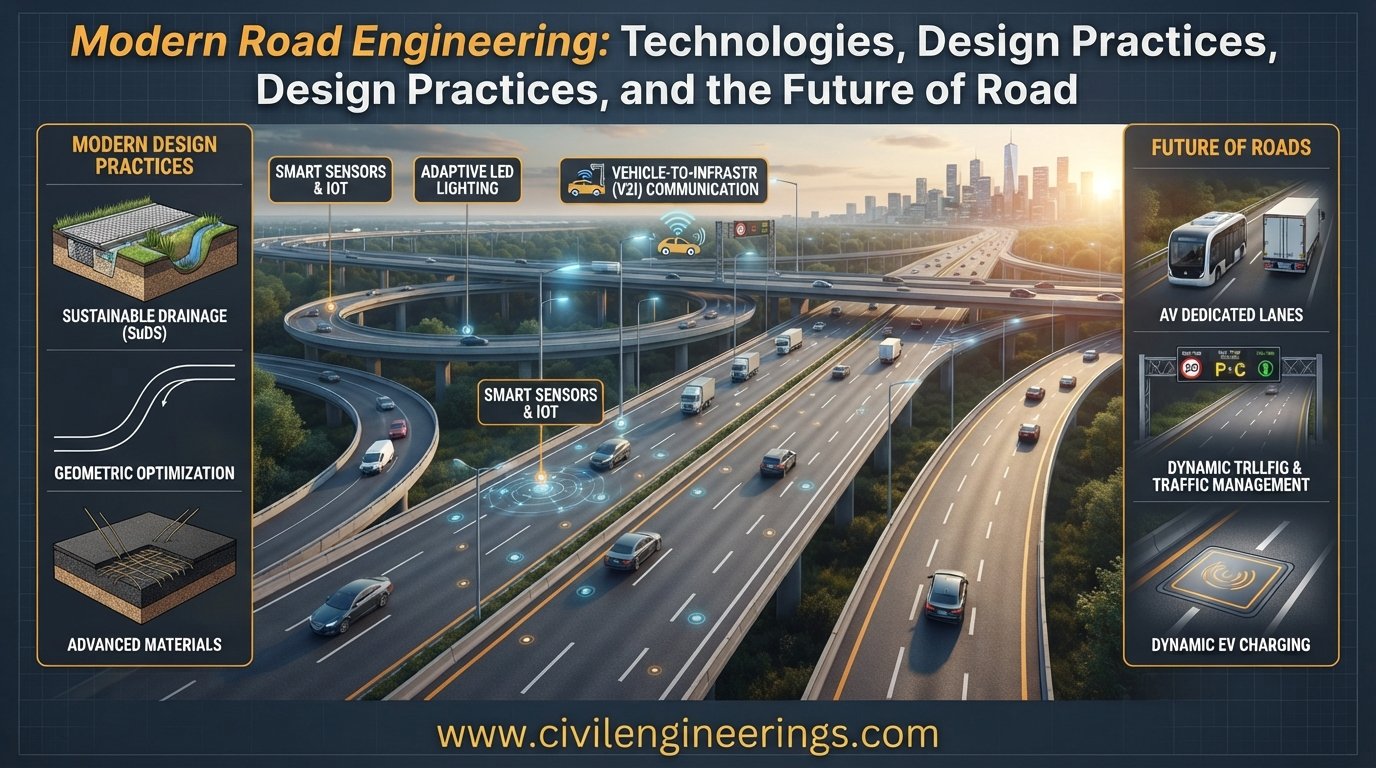
Roads are no longer designed simply as layers of soil, aggregate, and asphalt intended to carry vehicles from one location to another. Modern transportation demands infrastructure that is safer, more durable, environmentally responsible, digitally connected, and capable of responding to changing traffic and climate conditions. This shift has transformed conventional highway engineering into a broader discipline where civil engineering works alongside data science, automation, telecommunications, materials science, and environmental engineering.
Modern Road Engineering combines proven engineering principles with technologies such as intelligent transportation systems (ITS), GIS, BIM, drones, artificial intelligence, smart sensors, digital twins, advanced pavement materials, and automated construction equipment. The objective is not to make every road futuristic. It is to make every project more predictable, resilient, efficient, and easier to manage throughout its life cycle.
This guide explains the major principles, technologies, construction practices, pavement innovations, safety systems, sustainability measures, and future trends shaping modern road infrastructure. It also provides practical guidance for students, engineers, consultants, contractors, and infrastructure professionals.
What Is Modern Road Engineering?
Modern Road Engineering is the application of advanced engineering methods, materials, digital technologies, transportation systems, and sustainable practices to plan, design, construct, operate, maintain, and rehabilitate road infrastructure.
Traditional highway engineering remains the foundation. Geometric design, pavement design, drainage, earthwork, traffic analysis, material testing, road safety, and construction quality control are still essential. The difference is that modern practice increasingly connects these disciplines through digital data and real-time monitoring.
A modern road project can therefore be viewed as an integrated system:
Planning → Survey → Design → Construction → Monitoring → Maintenance → Rehabilitation
Information generated at one stage should support decisions at the next.
For example, a drone survey can generate terrain data for a digital terrain model. That model can support corridor planning and geometric design. The resulting design can be coordinated through BIM, used for quantity estimation, and later connected to an asset-management database.
This life-cycle approach is one of the most important characteristics of modern transportation engineering.


Key Principles of Modern Road Engineering
Modern road design does not mean replacing established engineering procedures with technology. Technology becomes valuable only when it improves an engineering decision.
Safety by Design
Road safety should begin during planning rather than after accidents occur.
Engineers consider:
- Design speed
- Sight distance
- Horizontal and vertical alignment
- Intersection geometry
- Lane and shoulder width
- Median treatment
- Roadside hazards
- Pedestrian and cyclist facilities
- Traffic signs and markings
- Lighting
- Crash barriers
- Work-zone arrangements
A modern project also considers how users actually behave. Safety audits, collision analysis, speed studies, and human-factors principles can reveal risks that may not be obvious from drawings alone.
Life-Cycle Thinking
The lowest construction cost is not necessarily the lowest project cost.
A pavement that costs less initially but requires frequent rehabilitation may become more expensive over its service life. Modern road engineering therefore evaluates:
Initial Cost + Maintenance Cost + Rehabilitation Cost + User Cost + Residual Value
Life-cycle cost analysis helps agencies compare alternatives on a longer time horizon.
Resilience and Adaptability
Roads must withstand more than normal traffic.
Design teams increasingly consider:
- Extreme rainfall
- Flooding
- Temperature variation
- Drought
- Erosion
- Landslides
- Heavy axle loading
- Coastal exposure
- Freeze-thaw cycles where applicable
Resilient infrastructure aims to maintain an acceptable level of service even when conditions become unfavorable.
Data-Driven Decision Making
Modern transportation systems generate enormous quantities of information from traffic counters, GPS devices, cameras, pavement surveys, weather stations, weigh-in-motion systems, and IoT sensors.
The engineering challenge is not simply collecting data. It is converting reliable data into useful decisions.
Modern Technologies Used in Road Engineering
Digital technology has become an important part of the highway project life cycle. Recent research describes intelligent transportation infrastructure as an integration of technologies including AI, big data, BIM, GIS, remote sensing, digital twins, IoT, UAVs, robotics, AR, and VR across planning, design, construction, and maintenance. (OUP Academic)
Geographic Information System (GIS)
GIS helps engineers analyze spatial information.
Typical applications include:
- Route selection
- Land-use analysis
- Existing road-network mapping
- Utility mapping
- Drainage analysis
- Environmental assessment
- Traffic-network analysis
- Right-of-way studies
- Disaster-risk mapping
Instead of examining isolated drawings, engineers can overlay terrain, property boundaries, hydrology, utilities, environmental constraints, and transportation networks within one geographic environment.
Building Information Modeling (BIM)
BIM provides a coordinated digital representation of infrastructure.
For highways, BIM can connect:
- Alignment
- Terrain
- Pavement layers
- Structures
- Drainage
- Utilities
- Road furniture
- Quantities
- Construction information
- Asset information
Its value increases when the model remains useful after construction.
Drone and UAV Surveying
Unmanned aerial vehicles can collect high-resolution imagery and photogrammetric data over large project areas.
They are particularly useful for:
- Preliminary surveys
- Stockpile measurement
- Earthwork monitoring
- Progress documentation
- Quarry inspection
- Slope assessment
- Construction mapping
- Post-construction surveys
However, drone data still requires proper control points, processing, validation, and engineering judgment.
Artificial Intelligence and Machine Learning
AI can assist with traffic prediction, pavement-condition assessment, image-based defect detection, construction monitoring, and predictive maintenance.
For example, a computer-vision system may identify cracks, potholes, rutting, damaged signs, or other visible defects from roadway imagery.
AI should support engineers rather than automatically replace engineering responsibility. Poor-quality training data can produce unreliable results.
Internet of Things and Smart Sensors
IoT systems allow physical infrastructure to communicate measurements.
Sensors can monitor:
- Pavement temperature
- Traffic volume
- Vehicle speed
- Bridge movement
- Structural strain
- Weather
- Flood levels
- Pavement condition
- Roadside equipment
Research into smart highways increasingly focuses on sensing, communication, computing, control, and vehicle-infrastructure cooperation as connected components of intelligent highway systems. (SciOpen)
Digital Twins
A digital twin goes beyond a static 3D model. It can represent an infrastructure asset while incorporating changing operational and condition data.
A highway digital twin may connect:
Physical Road → Sensors → Database → Analytical Model → Engineering Decision
This can support predictive maintenance and asset management.
Intelligent Transportation Systems in Modern Roads
Intelligent Transportation Systems, commonly called ITS, combine transportation infrastructure with information and communication technologies.
Smart highways can use sensors, cameras, communication networks, variable-message signs, traffic detectors, and software platforms to monitor and manage transportation conditions in real time. (IEEE Technology Navigator)
Traffic Monitoring
Modern traffic management centers can collect information about:
- Traffic volume
- Average speed
- Congestion
- Incidents
- Travel time
- Lane occupancy
- Weather conditions
Traffic data can then support adaptive traffic control and traveler information.
Variable Message Signs
Variable Message Signs can communicate changing conditions to drivers.
Applications include:
- Accident warnings
- Lane closures
- Congestion information
- Weather warnings
- Diversion instructions
- Travel-time information
- Work-zone warnings
Connected Vehicles and V2X
Vehicle-to-Everything communication allows vehicles to exchange information with infrastructure and other road users.
These systems can support collision warnings, signal coordination, work-zone alerts, and other safety applications.
Electronic Toll Collection
Electronic tolling reduces stopping and queuing at toll facilities.
Modern highway networks may integrate tolling with traffic management and digital payment systems. In Pakistan, the federal government announced in June 2026 that major highways were being directed toward Intelligent Transportation Systems and cashless/free-flow electronic tolling, including plans involving the M2 motorway. (PID)
Advanced Pavement Engineering
Pavement engineering remains one of the most important components of modern road infrastructure.
A pavement must distribute traffic loads while resisting environmental effects and maintaining acceptable riding quality.
Flexible Pavement
A typical flexible pavement may include:
- Wearing or surface course
- Binder course where applicable
- Base course
- Subbase
- Compacted subgrade
Design considers traffic loading, material properties, drainage, climate, reliability, and expected service life.
Rigid Pavement
Rigid pavement generally uses concrete slabs supported by base/subbase layers and subgrade.
Important design considerations include:
- Concrete strength
- Slab thickness
- Joint spacing
- Load transfer
- Temperature and moisture effects
- Subgrade support
- Drainage
- Construction quality
Mechanistic-Empirical Pavement Design
Modern pavement design increasingly evaluates how actual stresses and strains develop under traffic and environmental loading.
A simplified pavement concept is:
Traffic Load → Stress/Strain Response → Damage → Distress → Performance
Instead of relying only on historical thickness tables, engineers can evaluate expected distress such as rutting and fatigue cracking.
Pavement Condition Monitoring
Modern pavement management uses condition data to prioritize maintenance.
Common indicators include:
- Roughness
- Rut depth
- Cracking
- Potholes
- Skid resistance
- Deflection
- Surface texture
A simplified pavement management decision process is:
Condition Survey → Distress Evaluation → Remaining Life Assessment → Treatment Selection → Cost Analysis → Maintenance
Sustainable Road Engineering
Sustainability has become a central component of modern infrastructure planning.
A sustainable road should consider environmental impact without compromising safety, structural performance, or economic practicality.
Recycled Materials
Potential materials include:
- Reclaimed asphalt pavement (RAP)
- Recycled aggregates
- Industrial by-products
- Recycled concrete
- Locally available materials where technically suitable
Material reuse can reduce demand for virgin resources.
Warm-Mix Asphalt
Warm-mix asphalt technologies allow asphalt mixtures to be produced and placed at lower temperatures than conventional hot-mix processes in appropriate applications.
Potential benefits include lower energy consumption, improved working conditions, and reduced emissions.
Permeable and Improved Drainage Solutions
Where appropriate, permeable systems and improved stormwater management can reduce surface runoff.
However, drainage treatments must match soil conditions, groundwater conditions, rainfall characteristics, traffic requirements, and maintenance capability.
Low-Carbon Construction
Carbon reduction can involve more than changing pavement materials.
Engineers can reduce emissions through:
- Optimized haul distances
- Efficient plant operation
- Local material sources
- Recycling
- Longer pavement life
- Efficient construction sequencing
- Reduced rework
- Energy-efficient equipment
The most sustainable pavement is often one that performs well for a long time with appropriate maintenance.


Modern Road Construction Practices
Technology is changing how contractors construct highways, not just how engineers design them.
Automated Machine Guidance
GNSS and machine-control systems can guide graders, dozers, pavers, and other equipment using digital design information.
Benefits may include:
- Improved grading accuracy
- Reduced rework
- Faster construction
- Better material control
- Improved consistency
Intelligent Compaction
Intelligent compaction systems can use machine-mounted sensors and positioning technology to help operators achieve more consistent compaction coverage.
Research into intelligent road construction has demonstrated the potential for sensing and communication technologies to support real-time compactor path planning and construction-quality improvements. (ScienceDirect)
Digital Quantity Measurement
Digital models can help contractors compare planned and actual quantities.
For earthwork, a simplified volume calculation between two cross-sections can be expressed using the average end-area method:
V = L(A₁ + A₂) / 2
Where:
- V = approximate volume
- L = distance between sections
- A₁ = first cross-sectional area
- A₂ = second cross-sectional area
For irregular terrain, digital surface models and more advanced computational methods can provide improved estimates.
Real-Time Construction Monitoring
Site teams can combine:
- Drone imagery
- Survey data
- Equipment telematics
- Digital inspection forms
- Photographic records
- BIM models
This provides project managers with a clearer picture of construction progress.
Road Safety in Modern Road Engineering
Safety remains the primary performance requirement.
Modern road safety engineering combines geometric design with operational data and technology.
Road Safety Audit
A road safety audit systematically examines a proposed or existing road to identify potential safety problems.
Audits can be performed at stages such as:
- Planning
- Preliminary design
- Detailed design
- Pre-opening
- Existing-road operation
The objective is prevention rather than simply correcting accident black spots.
Intelligent Safety Systems
Modern highways may use:
- Wrong-way detection
- Automatic incident detection
- Variable speed warnings
- Dynamic message signs
- Road weather information
- Smart lighting
- Connected vehicle warnings
Such technologies are especially useful when they provide timely information that conventional signs alone cannot deliver. Smart-highway systems are also being explored for wrong-way detection, work-zone intrusion warnings, incident detection, and emergency response. (IEEE Technology Navigator)
Modern Drainage and Climate-Resilient Roads
Many premature pavement failures are associated with water.
A well-designed drainage system should control:
- Surface runoff
- Pavement infiltration
- Groundwater
- Subsurface drainage
- Erosion
- Culvert flows
- Embankment drainage
Common elements include:
- Side drains
- Catch drains
- Median drains
- Culverts
- Cross-drainage structures
- Subsurface drains
- Scuppers
- Outfalls
Engineers should assess the complete drainage path rather than designing individual structures independently.
Climate resilience may require reviewing rainfall intensity, flood levels, erosion potential, slope stability, and the consequences of road closure.
Modern Materials Used in Road Engineering
Material innovation is another important part of modern pavement engineering.
Examples include:
- Polymer-modified bitumen
- Modified asphalt mixtures
- High-performance concrete
- Fiber-reinforced materials
- Recycled asphalt mixtures
- Geosynthetics
- Stabilized soils
- Warm-mix asphalt
- Permeable pavement systems
- Selected specialty self-healing materials
Not every innovative material is suitable for every project. Engineers should evaluate local availability, laboratory performance, field history, constructability, specifications, maintenance requirements, and whole-life cost before adoption.
Modern Road Maintenance and Asset Management
Road agencies increasingly need to manage entire networks rather than individual pavement sections.
Preventive Maintenance
Preventive treatments aim to preserve acceptable pavement condition before major structural deterioration occurs.
Examples include:
- Crack sealing
- Surface treatments
- Thin overlays
- Localized repairs
- Drainage maintenance
The appropriate treatment depends on pavement condition and failure mechanism.
Predictive Maintenance
Predictive maintenance uses condition data and analytical models to estimate when intervention may become necessary.
A simplified concept is:
Historical Data + Current Condition + Traffic + Environment → Predicted Deterioration
This can help agencies prioritize limited maintenance budgets.
Pavement Management Systems
A pavement management system can combine:
- Inventory
- Condition data
- Traffic
- Maintenance history
- Treatment costs
- Deterioration models
- Budget constraints
The result is a network-level strategy rather than reactive maintenance.
Role of IRC, AASHTO, and ICE in Modern Road Engineering
Modern technologies do not eliminate engineering standards.
In practice, highway projects should be developed according to the applicable national specifications, contractual requirements, and recognized technical guidance.
IRC publications are particularly relevant to highway and transportation engineering practice in India and are frequently consulted for geometric design, pavement engineering, traffic engineering, materials, and related subjects.
AASHTO guidance is widely used internationally, particularly in areas such as geometric design, pavement design, transportation structures, materials, and asset management.
ICE, through its professional and technical resources, contributes to broader civil infrastructure knowledge, professional practice, sustainability, risk management, and engineering competence.
Engineers should always verify the current edition and project-specific requirements rather than relying on an outdated version of a standard.
Practical Applications of Modern Road Engineering
Modern Road Engineering is useful across almost every stage of infrastructure development.
For Highway Planning
GIS, traffic models, remote sensing, and environmental datasets can help compare alternative corridors.
For Road Design
BIM, digital terrain models, design software, and 3D visualization improve coordination between disciplines.
For Construction
Machine control, intelligent compaction, drone surveys, and digital quality records improve project monitoring.
For Operations
ITS, cameras, sensors, traffic management centers, and connected systems improve network management.
For Maintenance
Pavement-condition surveys, AI-based defect detection, and predictive analytics help agencies prioritize interventions.
Example: A Modern Highway Project
Consider a proposed 50-km highway.
The project team may proceed as follows:
1. GIS corridor screening
Identify terrain, settlements, environmental constraints, utilities, and existing transportation networks.
2. UAV and conventional survey
Generate accurate terrain and corridor information.
3. Traffic forecasting
Estimate current and future demand.
4. Geometric design
Develop horizontal alignment, vertical profile, intersections, drainage, and cross-sections.
5. Pavement design
Select pavement type and thickness based on traffic, subgrade, materials, climate, and design methodology.
6. BIM coordination
Coordinate roadway, drainage, structures, utilities, and quantities.
7. Digital construction
Transfer approved models to machine-control and survey systems.
8. Quality control
Monitor material properties, layer thickness, density, temperatures, concrete performance, and other specification requirements.
9. Smart operation
Install suitable traffic monitoring, communications, signs, and safety systems.
10. Asset management
Capture final asset information for future inspection and maintenance.
This approach creates a connected road life cycle instead of treating design, construction, and maintenance as isolated activities.
Challenges of Modern Road Engineering
Modernization also creates challenges.
High Initial Investment
Sensors, communication systems, software, specialist equipment, and training can increase initial costs.
Data Quality
Poor survey data or incorrectly calibrated sensors can produce misleading conclusions.
Cybersecurity
Connected infrastructure creates cybersecurity requirements. Transportation systems increasingly depend on communication networks, so digital security must become part of infrastructure planning.
Skills Gap
Civil engineers increasingly need familiarity with:
- GIS
- BIM
- Data analytics
- Remote sensing
- IoT
- Digital surveying
- Asset management
The future engineer will still need strong fundamentals in soil mechanics, pavement engineering, surveying, transportation engineering, hydraulics, and construction.
Technology Obsolescence
Digital systems can become outdated faster than physical infrastructure. Agencies should therefore favor open standards, maintainable systems, interoperability, and realistic life-cycle planning.
Best Practices for Students, Engineers, and Contractors
Recommendations for Civil Engineering Students
Students should build strong fundamentals before focusing heavily on emerging technology.
Learn:
- Highway geometric design
- Pavement engineering
- Traffic engineering
- Surveying
- Soil mechanics
- Hydrology and drainage
- Construction materials
- Quantity estimation
- Road safety
Then add GIS, CAD, BIM, data analysis, and basic programming.
Recommendations for Highway Engineers
Engineers should evaluate technology according to a simple question:
What engineering problem does this technology solve?
Do not install sensors because they are fashionable. Establish the required decision first, then determine what data and technology are actually needed.
Maintain proper documentation, calibration records, quality-control procedures, and independent engineering checks.
Recommendations for Contractors
Contractors should integrate digital systems with site execution rather than running them as separate activities.
Important practices include:
- Train operators
- Verify machine-control models
- Maintain survey control
- Calibrate equipment
- Record quality data
- Monitor material temperatures
- Document construction stages
- Compare planned and actual quantities
- Protect digital project data
Technology delivers value only when the field team understands how to use it.
Future of Modern Road Engineering
The next generation of highways will likely become increasingly connected.
Research published in 2026 highlights the movement toward smart pavement systems incorporating sensing, digital twins, AI, circular-economy approaches, and multifunctional infrastructure. (ScienceDirect)
Future developments may include:
- More automated road inspections
- AI-supported pavement management
- Connected and automated vehicles
- Vehicle-to-infrastructure communication
- Digital twins
- Autonomous construction equipment
- Advanced road-weather systems
- Smart road markings
- Fiber-optic pavement monitoring
- Low-carbon materials
- More resilient drainage systems
Intelligent road markings are also being researched as systems combining advanced materials, sensing, wireless communication, and energy technologies rather than functioning solely as passive visual markings. (ScienceDirect)
The important point is that future roads will not simply become more electronic. They will become more responsive, measurable, maintainable, and integrated.
Frequently Asked Questions About Modern Road Engineering
1. What is Modern Road Engineering?
Modern Road Engineering combines conventional highway engineering with digital technologies, advanced materials, intelligent transportation systems, sustainability, automation, and data-driven asset management.
2. How is modern road engineering different from traditional highway engineering?
Traditional highway engineering focuses primarily on physical infrastructure and established design procedures. Modern practice retains those fundamentals while adding technologies such as GIS, BIM, AI, IoT, drones, digital twins, intelligent traffic systems, and predictive maintenance.
3. What technologies are most important in modern road engineering?
Important technologies include GIS, BIM, UAV surveying, machine control, IoT sensors, AI, digital twins, intelligent transportation systems, automated inspection, and pavement-monitoring technologies.
4. Does modern road engineering replace conventional pavement design?
No. Advanced technologies complement pavement engineering. Traffic loading, subgrade characteristics, material properties, drainage, climate, and pavement performance remain fundamental design considerations.
5. How does AI help road engineers?
AI can assist with traffic prediction, pavement-defect detection, image processing, construction monitoring, incident detection, and predictive maintenance. Engineers still need to validate outputs and make professional decisions.
6. Why is sustainability important in road construction?
Road projects consume significant quantities of aggregates, binders, concrete, fuel, and energy. Sustainable practices can reduce resource consumption, emissions, waste, and life-cycle costs while maintaining required performance.
7. What is a smart highway?
A smart highway uses sensors, communication networks, intelligent traffic systems, digital platforms, and sometimes vehicle-infrastructure communication to monitor and manage transportation conditions more effectively.
8. Are drones useful for road construction?
Yes. Drones can support topographic surveys, progress monitoring, stockpile measurement, earthwork assessment, slope inspection, and project documentation. Survey control and appropriate data validation remain essential.
9. What should civil engineering students learn for modern highway careers?
Students should first master highway engineering, pavement design, surveying, transportation engineering, soil mechanics, drainage, and construction. GIS, BIM, data analytics, remote sensing, and digital surveying are valuable additional skills.
10. What is the future of Modern Road Engineering?
The field is moving toward connected infrastructure, predictive maintenance, digital twins, intelligent transportation systems, automated construction, advanced sensing, sustainable materials, and stronger integration between vehicles, roads, and transportation networks.
Conclusion
Modern Road Engineering represents a major evolution in how transportation infrastructure is planned, designed, constructed, operated, and maintained. Its foundation remains traditional civil and highway engineering, but modern practice adds digital surveying, GIS, BIM, intelligent transportation systems, advanced pavement technology, artificial intelligence, IoT sensors, automation, sustainability, and predictive asset management.
The strongest road projects will not necessarily be those containing the greatest number of technologies. They will be the projects where technology solves real engineering problems, improves safety, controls life-cycle cost, strengthens resilience, and delivers measurable performance.
For students, this means developing strong engineering fundamentals while learning digital tools. Engineers and consultants, it means making evidence-based decisions. For contractors, it means connecting digital construction systems with practical site execution. For road agencies, it means managing infrastructure as a long-term asset rather than a one-time construction project.
The future highway will therefore be more than pavement and traffic lanes. It will be a connected infrastructure system that senses conditions, communicates information, supports safer mobility, and helps engineers make better decisions throughout its service life.

Kamran Malik is a passionate civil engineering writer and researcher who specializes in construction, transportation, structural engineering, and infrastructure topics. Through his articles on CivilEngineerings.com, he simplifies complex engineering concepts and shares practical insights, industry trends, and educational resources for students, professionals, and engineering enthusiasts.