
Introduction
Every bridge is only as reliable as the roadway leading to it. While engineers often focus on the bridge superstructure and substructure, the approach sections deserve equal attention because they directly influence ride quality, traffic safety, maintenance costs, and the overall lifespan of the structure. Poorly designed approaches can result in differential settlement, pavement distress, drainage problems, and the well-known “bump at the bridge,” creating discomfort for road users and increasing repair expenses.
Bridge Approach Design is therefore a critical aspect of highway and bridge engineering. It provides a smooth transition between the flexible roadway embankment and the relatively rigid bridge structure while ensuring structural stability, proper drainage, and long-term performance. Whether the project involves a rural highway bridge, an urban flyover, an expressway interchange, or a major river crossing, a well-designed bridge approach contributes significantly to the safety and durability of the transportation network.
This comprehensive guide explains the principles, components, design considerations, engineering practices, and common challenges associated with Bridge Approach Design. It is written for civil engineering students, highway engineers, contractors, consultants, researchers, and infrastructure professionals seeking practical knowledge supported by established engineering concepts and industry practices.
What is Bridge Approach Design?
Bridge Approach Design is the engineering process of planning and constructing the roadway sections that connect a highway or road to a bridge. These approach sections must provide a smooth, safe, and durable transition between the flexible pavement resting on soil and the rigid bridge deck supported by foundations.
Unlike ordinary roadway embankments, bridge approaches experience different loading conditions because the bridge structure remains relatively stable while the surrounding embankment may settle over time. This difference in structural behavior requires careful consideration during planning, geotechnical investigation, structural design, drainage planning, and construction.
Bridge Approach Design integrates several engineering disciplines, including:
- Highway Engineering
- Bridge Engineering
- Geotechnical Engineering
- Pavement Engineering
- Hydrology
- Traffic Engineering
- Construction Engineering
The ultimate goal is to ensure that vehicles can travel onto and off the bridge safely without sudden changes in elevation, excessive vibrations, or pavement distress.
Why Bridge Approach Design Is Important
Many bridge maintenance problems originate not from the bridge itself but from poorly designed or poorly constructed approaches.
A properly engineered approach improves driving comfort while reducing maintenance costs throughout the service life of the bridge. It also minimizes structural distress caused by differential settlement and repeated traffic loading.
Some of the primary reasons why Bridge Approach Design is essential include:
- Creates a smooth transition between road and bridge
- Reduces differential settlement
- Prevents the “bump at the bridge” phenomenon
- Improves driving comfort
- Enhances road safety
- Protects bridge foundations
- Increases pavement life
- Improves drainage performance
- Reduces long-term maintenance costs
- Supports heavy commercial traffic
For high-speed highways and expressways, even a small vertical discontinuity at the bridge entrance can reduce ride quality and create safety concerns. Consequently, modern highway agencies place significant emphasis on designing durable and stable bridge approaches.
Objectives of Bridge Approach Design
Bridge approach design is not limited to connecting a road with a bridge. It fulfills multiple structural, geotechnical, hydraulic, and operational objectives.
The major objectives include:
Provide Smooth Traffic Transition
Vehicles should move seamlessly from the roadway to the bridge without experiencing noticeable bumps or sudden elevation changes.
Control Differential Settlement
The approach embankment should settle uniformly so that the difference in elevation between the roadway and bridge remains within acceptable limits.
Ensure Structural Stability
The embankment must remain stable under dead loads, live traffic loads, seismic forces where applicable, and environmental effects.
Improve Drainage
Efficient drainage prevents water infiltration, erosion, and weakening of the subgrade.
Increase Service Life
A durable approach minimizes future rehabilitation requirements and extends the operational life of both the pavement and bridge.
Maintain Traffic Safety
Good geometric design improves visibility, vehicle stability, and driver comfort under varying traffic and weather conditions.
Engineering Principles Behind Bridge Approach Design
Bridge approach performance depends on several fundamental engineering principles that govern soil behavior, structural response, pavement performance, and traffic loading.
Differential Settlement
One of the biggest challenges is differential settlement.
The bridge foundation is generally supported on piles or deep foundations that experience minimal settlement. In contrast, the adjacent embankment rests on natural or improved soil that continues to consolidate over time.
This unequal movement creates a vertical step near the bridge if not properly managed.
Example
If an embankment settles by 80 mm while the bridge remains stationary, drivers experience a noticeable bump, especially at highway speeds.
Soil Mechanics
Soil properties directly affect bridge approach performance.
Engineers evaluate:
- Bearing capacity
- Compressibility
- Shear strength
- Consolidation characteristics
- Moisture sensitivity
- Groundwater conditions
Weak foundation soils often require stabilization before embankment construction.
Load Distribution
Traffic loads transfer differently through flexible pavements and rigid bridge structures.
Bridge approaches must distribute wheel loads efficiently without creating excessive stresses in the pavement layers or underlying soil.
Drainage Engineering
Water is one of the primary causes of premature pavement and embankment failure.
Proper drainage design:
- Reduces pore water pressure
- Prevents erosion
- Improves soil strength
- Extends pavement life
- Minimizes frost-related damage in cold regions
Pavement Transition
Bridge decks behave much differently from asphalt pavements.
Engineers design transition zones that gradually accommodate changes in stiffness, reducing impact loads generated by heavy vehicles.
Components of a Bridge Approach
A bridge approach consists of several interconnected components working together to provide structural support and smooth vehicle movement.
1. Approach Embankment
The embankment raises the roadway to match the bridge deck elevation.
Its construction involves:
- Engineered fill materials
- Controlled compaction
- Layer-by-layer placement
- Slope protection
- Settlement monitoring
Well-compacted embankments reduce future maintenance and improve long-term stability.
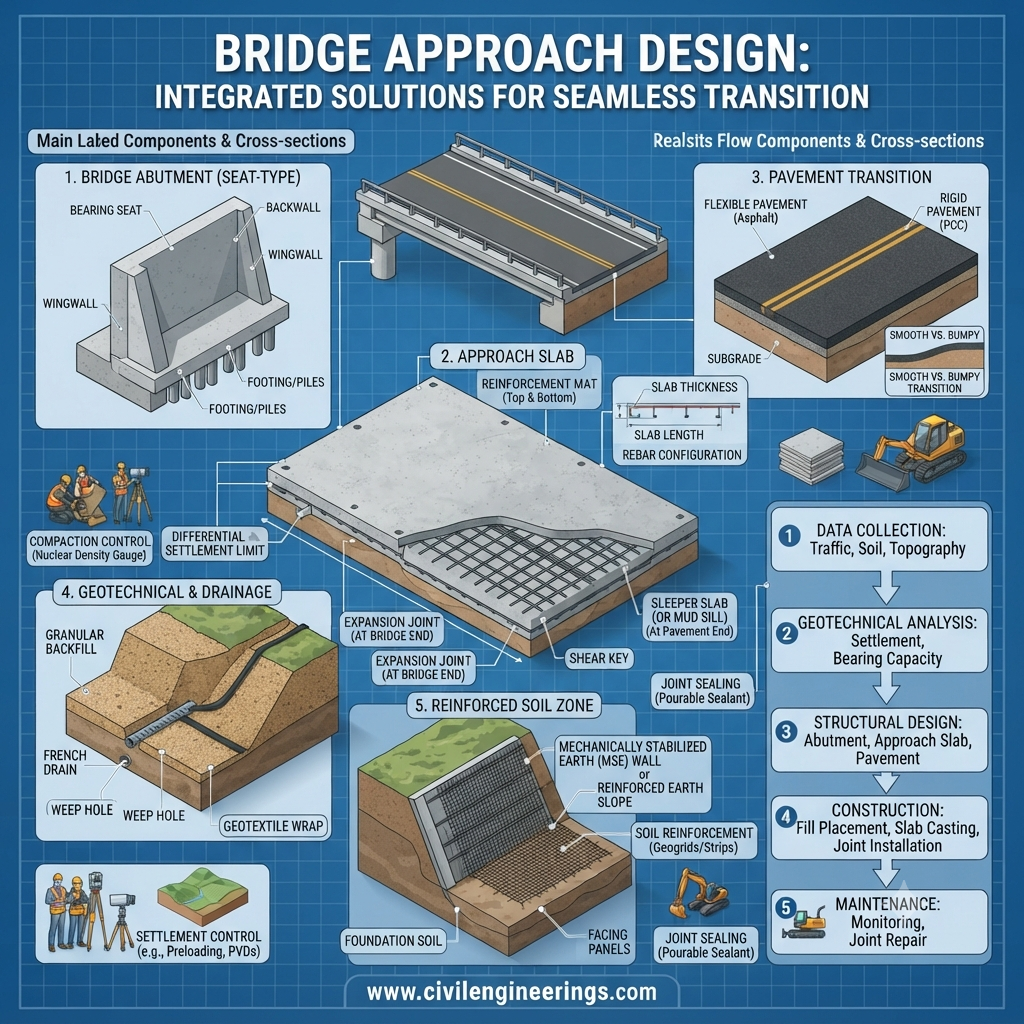
2. Transition Slab
The transition slab is one of the most important elements in modern Bridge Approach Design.
It acts as an intermediate structural element between the roadway pavement and the bridge deck.
Its functions include:
- Reducing impact loads
- Minimizing settlement effects
- Improving ride quality
- Preventing pavement cracking
- Supporting wheel loads during settlement
Transition slabs are commonly used on highways, expressways, and major bridges where traffic volumes and axle loads are high.
3. Approach Pavement
The approach pavement carries traffic before vehicles reach the bridge.
Typical pavement layers include:
- Wearing course
- Binder course
- Base course
- Subbase
- Improved subgrade
The pavement structure must accommodate anticipated traffic loading while maintaining surface smoothness.
4. Retaining Structures
Where space is limited or embankment heights are significant, retaining systems become necessary.
Common retaining structures include:
- Reinforced earth walls
- Mechanically stabilized earth (MSE) walls
- Reinforced concrete retaining walls
- Sheet pile walls
- Gabion retaining walls
The selection depends on site conditions, soil properties, available right-of-way, and construction cost.
5. Drainage System
An efficient drainage system protects the approach from water-related deterioration.
Typical drainage components include:
- Side drains
- Longitudinal drains
- Cross drainage structures
- Culverts
- Catch basins
- Filter layers
- Weep holes
Proper drainage prevents saturation of embankment soils and preserves their strength.
6. Safety Features
Approach safety features improve vehicle control and reduce accident severity.
These commonly include:
- Crash barriers
- Guardrails
- Road markings
- Reflective delineators
- Approach lighting
- Signage
- Rumble strips where appropriate
These elements help guide drivers safely toward the bridge, particularly at night or during adverse weather.
Common Causes of Bridge Approach Failure
Bridge approaches can deteriorate prematurely when engineering, construction, or maintenance practices are inadequate.
The most common causes include:
Differential Settlement
Unequal movement between the bridge structure and roadway embankment remains the leading cause of approach failure.
Poor Compaction
Insufficient compaction leaves voids within the embankment. Over time, these voids compress under repeated traffic loading, leading to settlement.
Weak Foundation Soil
Soft clays, peat, loose sands, and other compressible soils are prone to excessive consolidation unless properly improved.
Inadequate Drainage
Poor drainage allows water to infiltrate the embankment, reducing soil strength and accelerating pavement deterioration.
Erosion
Surface runoff and flowing water can wash away embankment material, undermine slopes, and expose structural elements if erosion protection is inadequate.
Heavy Traffic Loading
Modern highways carry increasing volumes of overloaded trucks. Repeated heavy axle loads accelerate pavement deformation and settlement in poorly designed approaches.
Improper Material Selection
Using low-quality fill, poorly graded aggregates, or moisture-sensitive soils can significantly reduce the long-term performance of the approach section.
Practical Engineering Considerations
Successful Bridge Approach Design requires engineers to consider both theoretical design principles and real-world construction challenges.
Conduct Comprehensive Geotechnical Investigations
A detailed subsurface investigation should determine soil stratification, groundwater conditions, bearing capacity, consolidation characteristics, and settlement potential. Reliable geotechnical data forms the foundation of every successful design.
Select Appropriate Fill Materials
Use well-graded granular materials or engineered fills with adequate strength, drainage capacity, and compaction characteristics. Avoid highly plastic or organic soils in critical approach zones.
Emphasize Quality Control During Construction
Field density tests, moisture content checks, layer thickness verification, and material testing should be performed regularly to ensure the embankment meets design specifications.
Plan for Long-Term Performance
Design decisions should account not only for initial construction costs but also for maintenance requirements, anticipated traffic growth, environmental exposure, and climate-related impacts over the bridge’s service life.
Coordinate Multidisciplinary Design
Bridge approach projects require close collaboration among highway engineers, bridge engineers, geotechnical specialists, drainage experts, structural designers, and construction teams. Early coordination helps identify potential conflicts and improves overall project outcomes.
Key Challenges During Bridge Approach Design
Despite advances in materials and analytical methods, engineers continue to face several recurring challenges:
- Managing settlement on soft or compressible ground
- Balancing construction costs with long-term durability
- Designing effective drainage in flood-prone areas
- Accommodating increasing heavy vehicle traffic
- Constructing approaches within limited right-of-way
- Maintaining traffic flow during staged construction
- Adapting designs to varying climatic and geological conditions
- Ensuring compatibility between bridge and roadway performance over the design life
Addressing these challenges requires careful planning, adherence to established standards, and continuous monitoring throughout construction and operation.
Step-by-Step Bridge Approach Design Process
Bridge Approach Design follows a systematic engineering workflow that integrates geotechnical, structural, hydraulic, and highway design principles. Although the exact methodology varies with project type and applicable standards, the following steps represent industry best practices.
1. Site Investigation and Data Collection
Every successful bridge approach begins with a thorough understanding of site conditions.
Engineers should collect information on:
- Topography and existing road alignment
- Geological and geotechnical conditions
- Groundwater level
- Soil profile and bearing capacity
- Flood history and hydrological data
- Existing utilities
- Traffic volume and axle loads
- Environmental constraints
Accurate field data minimizes design uncertainties and helps identify potential risks early in the project lifecycle.
2. Geotechnical Investigation
Since the performance of a bridge approach depends heavily on soil behavior, a detailed geotechnical investigation is essential.
Typical laboratory and field tests include:
- Standard Penetration Test (SPT)
- Cone Penetration Test (CPT)
- Plate Load Test (where required)
- Grain Size Analysis
- Atterberg Limits
- Compaction Tests
- California Bearing Ratio (CBR)
- Consolidation Test
- Triaxial Compression Test
- Direct Shear Test
The investigation determines:
- Settlement characteristics
- Soil strength
- Compressibility
- Drainage properties
- Suitability of foundation soils
3. Embankment Design
The approach embankment must safely support traffic loads while maintaining long-term stability.
Key design considerations include:
- Embankment height
- Side slope stability
- Fill material quality
- Degree of compaction
- Ground improvement requirements
- Long-term settlement predictions
- Seismic stability where applicable
Slope stability analyses are often performed using limit equilibrium methods to ensure an adequate factor of safety.
4. Settlement Analysis
Settlement analysis is one of the most critical aspects of Bridge Approach Design.
Engineers estimate:
- Immediate settlement
- Primary consolidation settlement
- Secondary compression
- Differential settlement
If predicted settlement exceeds allowable limits, mitigation measures should be incorporated into the design before construction begins.
5. Pavement Design
The pavement approaching the bridge should provide sufficient structural capacity while maintaining a smooth riding surface.
The design generally considers:
- Design traffic
- Equivalent Single Axle Loads (ESAL)
- Subgrade strength
- Environmental conditions
- Pavement materials
- Expected service life
Both flexible and rigid pavements are used depending on project requirements and agency standards.
6. Drainage Design
Proper drainage protects the approach embankment from moisture-related damage.
The drainage system should efficiently remove:
- Surface runoff
- Groundwater
- Seepage water
Typical drainage facilities include:
- Side drains
- Longitudinal drains
- French drains
- Culverts
- Catch basins
- Filter layers
- Toe drains
Effective drainage significantly reduces maintenance costs and extends pavement life.
Settlement Control Methods
Managing settlement is one of the primary objectives of Bridge Approach Design.
Several engineering solutions are available depending on soil conditions and project constraints.
Preloading and Surcharging
Temporary surcharge loads accelerate consolidation before pavement construction.
Benefits include:
- Reduced long-term settlement
- Improved soil strength
- Lower future maintenance
Vertical Drains
Prefabricated Vertical Drains (PVDs) shorten drainage paths within soft clay deposits.
Advantages include:
- Faster consolidation
- Reduced construction time
- Improved embankment performance
Ground Improvement
Where foundation soils are weak, engineers may use:
- Stone columns
- Vibro-compaction
- Dynamic compaction
- Deep soil mixing
- Lime stabilization
- Cement stabilization
- Geosynthetic reinforcement
Ground improvement increases bearing capacity and reduces post-construction settlement.
Lightweight Fill Materials
Lightweight embankment materials reduce the load applied to compressible soils.
Examples include:
- Expanded Polystyrene (EPS) blocks
- Lightweight cellular concrete
- Foamed concrete
- Lightweight aggregates
These materials are particularly useful where excessive settlement is anticipated.
Transition Slab Design
The transition slab bridges the difference in stiffness between the roadway embankment and the bridge deck.
Its primary functions are to:
- Minimize differential settlement effects
- Improve ride quality
- Reduce impact loading
- Prevent pavement cracking
- Protect bridge expansion joints
Important design considerations include:
- Slab length
- Thickness
- Reinforcement detailing
- Bearing arrangement
- Load transfer
- Drainage around the slab
Longer transition slabs generally provide smoother load transfer on high-speed highways.
Bridge Approach Drainage Design
Drainage is often overlooked during design but remains one of the most important factors influencing long-term performance.
A well-designed drainage system should:
- Prevent water accumulation
- Reduce pore water pressure
- Protect embankment slopes
- Prevent erosion
- Improve pavement durability
Best practices include:
- Providing adequate longitudinal slope
- Maintaining positive cross fall
- Installing filter media around drains
- Protecting outlets against scour
- Cleaning drainage systems regularly
Construction Sequence
Proper construction practices are just as important as proper design.
A typical sequence includes:
- Site clearing
- Earthwork and excavation
- Ground improvement (if required)
- Foundation preparation
- Embankment construction
- Layer-by-layer compaction
- Drainage installation
- Transition slab construction
- Pavement construction
- Guardrail installation
- Pavement markings
- Final inspection and quality assurance
Strict quality control during each stage reduces the likelihood of premature failures.
Design Standards and Engineering Guidelines
Bridge approaches should be designed in accordance with recognized engineering standards and project-specific specifications.
IRC (Indian Roads Congress)
IRC publications provide guidance on:
- Highway geometric design
- Embankment construction
- Bridge design
- Pavement design
- Drainage
- Road safety
They are widely adopted for highway and bridge projects in India and neighboring regions.
AASHTO (American Association of State Highway and Transportation Officials)
AASHTO guidelines emphasize:
- LRFD bridge design principles
- Pavement structural design
- Traffic loading
- Geotechnical engineering
- Bridge approach details
- Safety considerations
These standards are extensively referenced for highway projects worldwide.
ICE (Institution of Civil Engineers)
ICE publications promote:
- Sustainable infrastructure
- Risk-based engineering
- Whole-life asset management
- Construction quality
- Innovation in transportation engineering
Their guidance supports best practices for bridge and highway infrastructure throughout the project lifecycle.
Best Practices for Bridge Approach Design
Experienced engineers consistently follow several practices that improve long-term performance.
- Perform detailed geotechnical investigations before finalizing the design.
- Use high-quality, well-graded embankment materials.
- Compact fill in thin, controlled layers to achieve the specified density.
- Install efficient surface and subsurface drainage systems.
- Incorporate transition slabs for major highway bridges.
- Predict long-term settlement using appropriate analytical methods.
- Monitor embankment performance during and after construction.
- Select pavement materials suited to local traffic and climate conditions.
- Protect embankment slopes against erosion with suitable stabilization measures.
- Plan for routine inspection and preventive maintenance throughout the service life.
Practical Recommendations for
Highway Engineers
- Prioritize settlement prediction during the preliminary design stage.
- Integrate geotechnical and structural analyses rather than treating them as separate tasks.
- Consider future traffic growth and heavier axle loads when sizing pavement and embankment components.
Site Engineers
- Maintain strict control over compaction, moisture content, and layer thickness.
- Verify material quality through regular field and laboratory testing.
- Ensure drainage features are constructed exactly as shown on approved drawings.
Contractors
- Follow approved construction sequences to avoid unnecessary rework.
- Use calibrated compaction equipment and document quality control results.
- Protect completed embankments from erosion until permanent slope protection is installed.
Civil Engineering Students
- Develop a strong understanding of soil mechanics, pavement engineering, and bridge engineering, as these disciplines intersect in bridge approach projects.
- Study case histories of successful and failed bridge approaches to understand the impact of design and construction decisions.
Frequently Asked Questions (FAQs)
1. What is Bridge Approach Design?
Bridge Approach Design is the engineering process of designing the roadway section that connects a highway or road to a bridge while ensuring smooth traffic movement, structural stability, and controlled settlement.
2. Why is differential settlement a major concern?
The bridge is supported by rigid foundations, while the adjacent embankment rests on soil that may continue to settle. This difference in movement can create bumps, pavement cracking, and increased maintenance requirements.
3. What causes the “bump at the bridge”?
The bump typically results from settlement of the approach embankment, poor compaction, weak foundation soils, inadequate drainage, or insufficient transition detailing between the roadway and bridge deck.
4. What is the purpose of a transition slab?
A transition slab provides a gradual structural transition between the bridge deck and roadway pavement, improving ride quality and reducing impact loads caused by differential settlement.
5. Which soil improvement methods are commonly used?
Common techniques include stone columns, prefabricated vertical drains, lime stabilization, cement stabilization, deep soil mixing, geogrid reinforcement, and dynamic compaction, depending on site conditions.
6. Why is drainage critical in bridge approaches?
Effective drainage prevents water infiltration, reduces pore water pressure, limits erosion, preserves soil strength, and extends the service life of both the pavement and embankment.
7. Which engineering disciplines are involved in Bridge Approach Design?
The design process typically involves highway engineering, bridge engineering, geotechnical engineering, pavement engineering, hydrology, structural engineering, and construction management.
8. Which standards are commonly referenced?
Bridge approach projects generally follow the relevant provisions of IRC, AASHTO, ICE guidance, and local highway authority specifications, depending on the country and project requirements.
9. What are the most common maintenance issues?
Typical issues include pavement settlement, cracking, drainage blockages, erosion of embankment slopes, joint deterioration, and localized pavement deformation near the bridge entrance.
10. How can the service life of a bridge approach be increased?
Long-term performance can be improved through proper geotechnical investigation, high-quality materials, effective compaction, efficient drainage, settlement control measures, transition slabs, and regular inspection and maintenance.
Conclusion
Bridge Approach Design is a vital component of highway and bridge engineering that directly affects ride quality, structural performance, safety, and lifecycle costs. A successful design requires much more than connecting a roadway to a bridge—it demands a balanced integration of geotechnical investigation, embankment stability, pavement engineering, drainage management, and structural detailing.
Modern infrastructure projects increasingly rely on advanced settlement prediction methods, ground improvement techniques, durable transition slabs, and strict quality control to address challenges such as differential settlement and heavy traffic loading. Adhering to established guidance from organizations such as IRC, AASHTO, and ICE further strengthens design reliability and promotes consistent engineering practice.
For civil engineering students, mastering bridge approach fundamentals builds a strong foundation for future design work. For engineers, contractors, and consultants, applying proven design principles and construction best practices leads to safer roads, smoother transitions, lower maintenance costs, and longer-lasting infrastructure. Ultimately, investing time and expertise in Bridge Approach Design ensures that bridges perform as intended while providing comfortable and reliable travel for road users over many decades.
