
Introduction
Road networks are the backbone of economic growth, but increasing traffic volumes often push existing roads beyond their original capacity. Congestion, longer travel times, frequent accidents, and higher vehicle operating costs are common signs that a road can no longer meet current transportation demands. Instead of constructing entirely new highways, engineers often choose to widen existing roads because it is more practical, economical, and environmentally responsible.
Road Widening Design is a specialized branch of highway engineering that focuses on increasing roadway capacity while maintaining safety, structural stability, drainage efficiency, and long-term pavement performance. A successful widening project requires much more than simply adding extra lanes. Engineers must evaluate traffic demand, geometric design, pavement compatibility, drainage systems, utilities, environmental impacts, and future expansion needs before construction begins.
This comprehensive guide explains every major aspect of road widening design, including planning, surveys, geometric principles, pavement design, construction methods, quality control, challenges, engineering best practices, and international standards. Whether you are a civil engineering student, highway engineer, consultant, contractor, or infrastructure professional, this article provides practical knowledge that can be applied to real-world highway projects.
What is Road Widening Design?
Road widening design is the engineering process of increasing the width or capacity of an existing roadway to accommodate higher traffic demand while maintaining structural integrity, road safety, and operational efficiency.
The process may involve:
- Adding additional traffic lanes
- Widening shoulders
- Improving intersections
- Expanding bridges and culverts
- Strengthening pavement
- Upgrading drainage systems
- Improving pedestrian and cycling facilities
Unlike new road construction, widening projects must integrate seamlessly with existing infrastructure, making planning significantly more complex.
Why Road Widening is Important
Population growth and urbanization continuously increase transportation demand. Roads that performed well twenty years ago may now operate beyond their design capacity.
Major benefits include:
- Reduced traffic congestion
- Lower travel time
- Improved road safety
- Increased freight movement
- Better fuel efficiency
- Reduced vehicle operating costs
- Higher economic productivity
- Improved emergency response
Road widening also supports regional development by improving connectivity between industrial, commercial, and residential areas.
Objectives of Road Widening Design
A successful road widening project aims to achieve several engineering objectives.
Increase Road Capacity
Additional lanes accommodate higher traffic volumes and reduce bottlenecks.
Improve Safety
Better lane widths, shoulders, sight distance, and medians reduce accident risks.
Enhance Traffic Flow
Improved geometry minimizes delays and improves travel speed consistency.
Increase Pavement Life
Proper structural design ensures the widened pavement performs similarly to the existing pavement.
Support Future Growth
Designers often include provisions for future widening to minimize reconstruction costs.
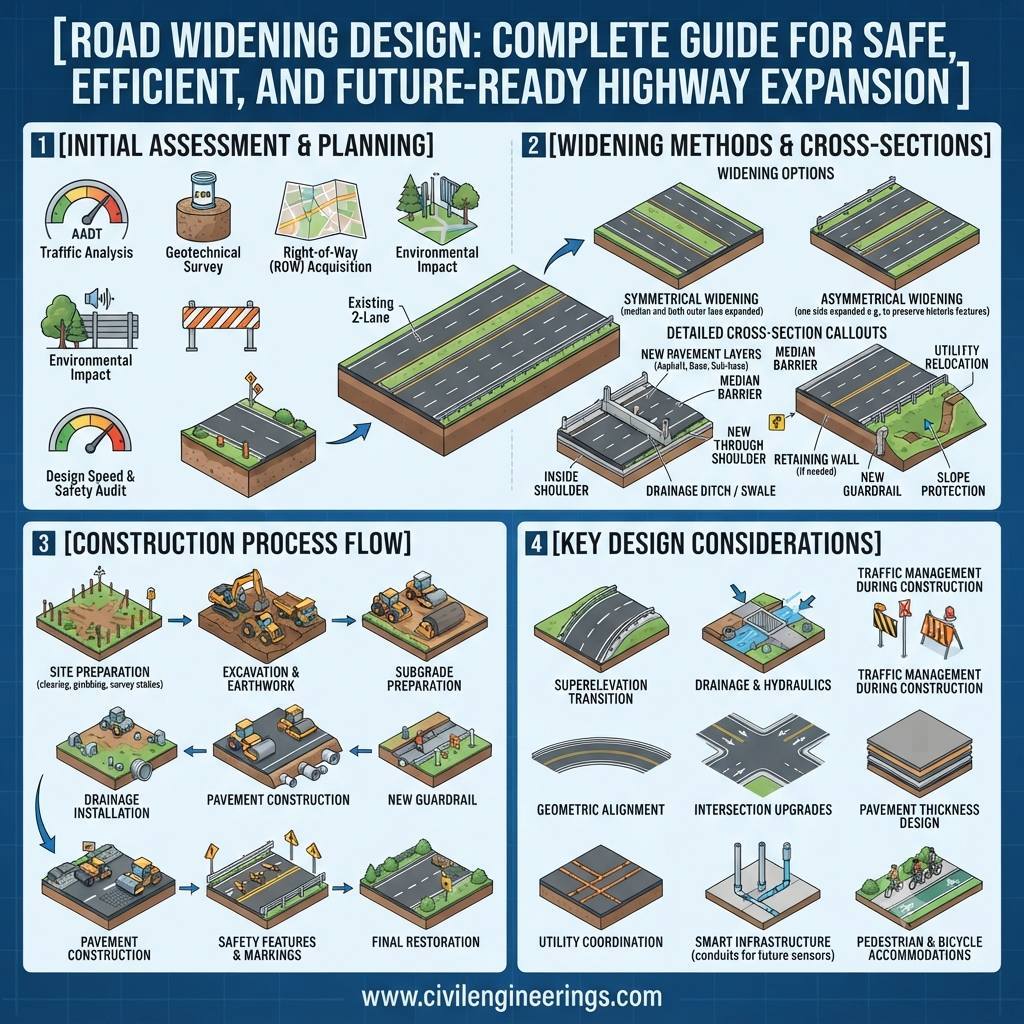
Types of Road Widening
1. Symmetrical Widening
Additional pavement is constructed equally on both sides of the centerline.
Advantages include:
- Balanced geometry
- Better traffic distribution
- Improved aesthetics
2. Asymmetrical Widening
Expansion occurs on only one side of the road.
Common when:
- Utilities exist on one side
- Land acquisition is limited
- Rivers or railways restrict expansion
3. Lane Addition
Entire traffic lanes are added.
Typical examples include:
- Two-lane to four-lane highways
- Four-lane to six-lane expressways
4. Shoulder Widening
Existing shoulders are expanded to improve safety and accommodate breakdown vehicles.
5. Intersection Widening
Extra turning lanes improve traffic movement at junctions.
Engineering Surveys Before Widening
Accurate surveys form the foundation of successful design.
Essential surveys include:
Topographic Survey
Provides existing ground levels, terrain features, utilities, and drainage paths.
Traffic Survey
Determines:
- Average Daily Traffic (ADT)
- Peak Hour Volume
- Vehicle classification
- Turning movements
- Growth rate
Geotechnical Investigation
Evaluates:
- Soil strength
- Bearing capacity
- Moisture content
- Groundwater level
- Settlement characteristics
Utility Survey
Identifies:
- Water pipelines
- Gas pipelines
- Sewer lines
- Electrical cables
- Fiber optic networks
Environmental Survey
Assesses:
- Trees
- Water bodies
- Wildlife
- Air quality
- Noise levels
Traffic Studies and Capacity Analysis
Traffic engineering determines whether widening is necessary.
Key analyses include:
Existing Traffic Volume
Current traffic conditions establish baseline capacity.
Design Traffic
Future traffic is estimated over a 20–30-year design period using growth models.
Level of Service (LOS)
LOS measures operational quality from A (free flow) to F (heavy congestion). Widening is often justified when roads consistently operate at LOS D, E, or F.
Capacity Analysis
Engineers compare roadway capacity against projected traffic demand to determine the required number of lanes.
Geometric Design Considerations
Road widening must maintain safe and comfortable vehicle movement.
Important design elements include:
Lane Width
Typical lane widths range from 3.5 to 3.75 meters depending on road classification.
Shoulder Width
Adequate shoulders improve emergency stopping and pavement edge support.
Horizontal Alignment
Curve widening may be necessary to accommodate vehicle off-tracking.
Vertical Alignment
Grades should remain within acceptable limits to maintain visibility and vehicle performance.
Cross Slope
Proper cross slope promotes rapid drainage and reduces hydroplaning.
Camber
Camber prevents water accumulation on the pavement surface.
Superelevation
On curved sections, superelevation counteracts centrifugal forces and improves vehicle stability.
Pavement Design for Road Widening
One of the greatest challenges is ensuring the new pavement performs similarly to the existing pavement.
Engineers evaluate:
- Existing pavement condition
- Remaining structural life
- Pavement thickness
- Material properties
- Traffic loading
- Subgrade strength
Flexible Pavement
Typical layers include:
- Surface Course
- Binder Course
- Base Course
- Subbase
- Subgrade
Rigid Pavement
May consist of:
- PCC slab
- Base layer
- Subbase
- Prepared subgrade
Joint Between Old and New Pavement
Proper joint treatment prevents:
- Differential settlement
- Reflection cracking
- Water infiltration
- Uneven riding quality
Drainage Design Considerations
Poor drainage remains one of the leading causes of pavement deterioration.
Road widening should include:
- Side drains
- Median drains
- Cross drainage structures
- Culvert extensions
- Longitudinal drains
- Catch basins
Effective drainage extends pavement life while reducing maintenance costs.
Utility Relocation Planning
Road widening often affects underground and overhead utilities.
Typical relocations involve:
- Water supply lines
- Sewer systems
- Power transmission
- Street lighting
- Communication cables
- Gas pipelines
Early coordination with utility agencies minimizes project delays.
Road Safety Features
Safety improvements should accompany every widening project.
Recommended features include:
- Road markings
- Traffic signs
- Crash barriers
- Guardrails
- Reflective studs
- Pedestrian crossings
- Lighting systems
- Median barriers
- Rumble strips
- Speed management measures
Safety audits should be performed during design and after construction.
Environmental and Social Considerations
Road widening can significantly affect surrounding communities.
Engineers should evaluate:
- Noise pollution
- Air emissions
- Tree removal
- Water resources
- Wildlife habitats
- Community access
- Cultural heritage
- Land acquisition impacts
Mitigation measures may include landscaping, noise barriers, erosion control, and environmental restoration.
Construction Methodology
A systematic construction sequence reduces disruption and improves quality.
Typical workflow:
- Site clearance
- Traffic management implementation
- Utility relocation
- Earthwork
- Embankment construction
- Subgrade preparation
- Granular subbase placement
- Base course construction
- Pavement laying
- Shoulder construction
- Drainage installation
- Road marking
- Sign installation
- Final inspection
Maintaining traffic during construction requires careful staging and temporary traffic control plans.
Quality Control During Construction
Quality assurance ensures long-term pavement performance.
Routine tests include:
- Soil compaction
- Density testing
- Aggregate gradation
- Asphalt temperature
- Concrete strength
- Bitumen content
- Surface evenness
- Pavement thickness
- Plate load tests
- Field moisture testing
Regular inspections help identify issues before they become costly defects.
Common Challenges in Road Widening Projects
Several technical and administrative challenges can affect project success.
Common issues include:
- Limited right-of-way
- Traffic diversion difficulties
- Utility conflicts
- Weak subgrade
- Existing pavement deterioration
- Drainage constraints
- Land acquisition delays
- Environmental approvals
- Budget limitations
- Weather-related interruptions
Proper planning and risk management significantly reduce these challenges.
Best Practices for Engineers and Contractors
Experienced highway professionals follow proven strategies to improve project outcomes.
- Conduct detailed site investigations before design.
- Use accurate traffic forecasting models.
- Design for future traffic growth.
- Match new pavement performance with existing pavement.
- Prioritize effective drainage systems.
- Perform independent road safety audits.
- Coordinate utility relocation early.
- Monitor construction quality continuously.
- Use durable construction materials.
- Document all field changes for future maintenance.
For students, understanding the relationship between traffic engineering, geotechnical engineering, pavement engineering, and construction management is essential for mastering road widening projects.
General IRC, AASHTO, and ICE Guidance
Leading engineering organizations provide valuable guidance for road widening design.
- IRC (Indian Roads Congress) publishes recommendations on highway geometric design, pavement design, traffic engineering, and road safety suitable for a wide range of highway conditions.
- AASHTO (American Association of State Highway and Transportation Officials) offers internationally respected guidance on geometric design, pavement structures, bridge integration, drainage, and transportation planning through its highway design manuals.
- ICE (Institution of Civil Engineers) promotes best practices in infrastructure planning, sustainable construction, asset management, risk management, and professional engineering standards.
Although project-specific requirements vary by country, engineers should always follow the applicable national codes, agency specifications, and contract documents alongside internationally recognized engineering principles.
Frequently Asked Questions (FAQs)
1. What is road widening design?
Road widening design is the engineering process of expanding an existing roadway to improve traffic capacity, safety, and operational efficiency.
2. Why is road widening preferred over constructing a new road?
It usually requires less land, lower investment, shorter construction time, and makes better use of existing infrastructure.
3. What surveys are essential before widening a road?
Topographic, traffic, geotechnical, utility, drainage, and environmental surveys are fundamental for accurate design.
4. How is the required number of lanes determined?
Engineers analyze current traffic, forecast future demand, perform capacity analysis, and evaluate the desired Level of Service (LOS).
5. Why is drainage critical in road widening projects?
Proper drainage prevents water infiltration, reduces pavement damage, minimizes erosion, and extends roadway service life.
6. What is the biggest engineering challenge during road widening?
Integrating the new pavement with the existing roadway while maintaining structural continuity and minimizing differential settlement is often the most demanding task.
7. How does road widening improve safety?
It reduces congestion, provides wider lanes and shoulders, improves sight distance, enhances intersections, and allows the installation of modern safety features.
8. What role do geotechnical investigations play?
They determine soil properties, bearing capacity, groundwater conditions, and foundation requirements, enabling engineers to design stable pavement structures.
9. Can road widening be completed while traffic remains open?
Yes. Most projects use phased construction, temporary diversions, lane closures, and traffic management plans to keep vehicles moving safely.
10. Which professionals are involved in road widening projects?
Civil engineers, highway engineers, transportation planners, geotechnical engineers, surveyors, environmental specialists, utility engineers, contractors, and project managers all contribute to successful delivery.
Conclusion
Road Widening Design is far more than the addition of extra pavement. It is a multidisciplinary engineering process that combines transportation planning, traffic engineering, geometric design, geotechnical investigation, pavement engineering, drainage, environmental management, and construction expertise to create safer and more efficient road networks. Every stage—from surveys and traffic analysis to utility coordination, pavement integration, quality control, and safety audits—plays a vital role in the long-term performance of the upgraded roadway.
As traffic volumes continue to rise worldwide, well-planned widening projects will remain one of the most cost-effective solutions for improving mobility without constructing entirely new corridors. Engineers who adopt data-driven design methods, follow recognized standards, and prioritize durability, sustainability, and road user safety can deliver infrastructure that serves communities for decades. Whether you are a student building technical knowledge or a professional managing complex highway projects, understanding Road Widening Design is essential for designing resilient, future-ready transportation systems.
