
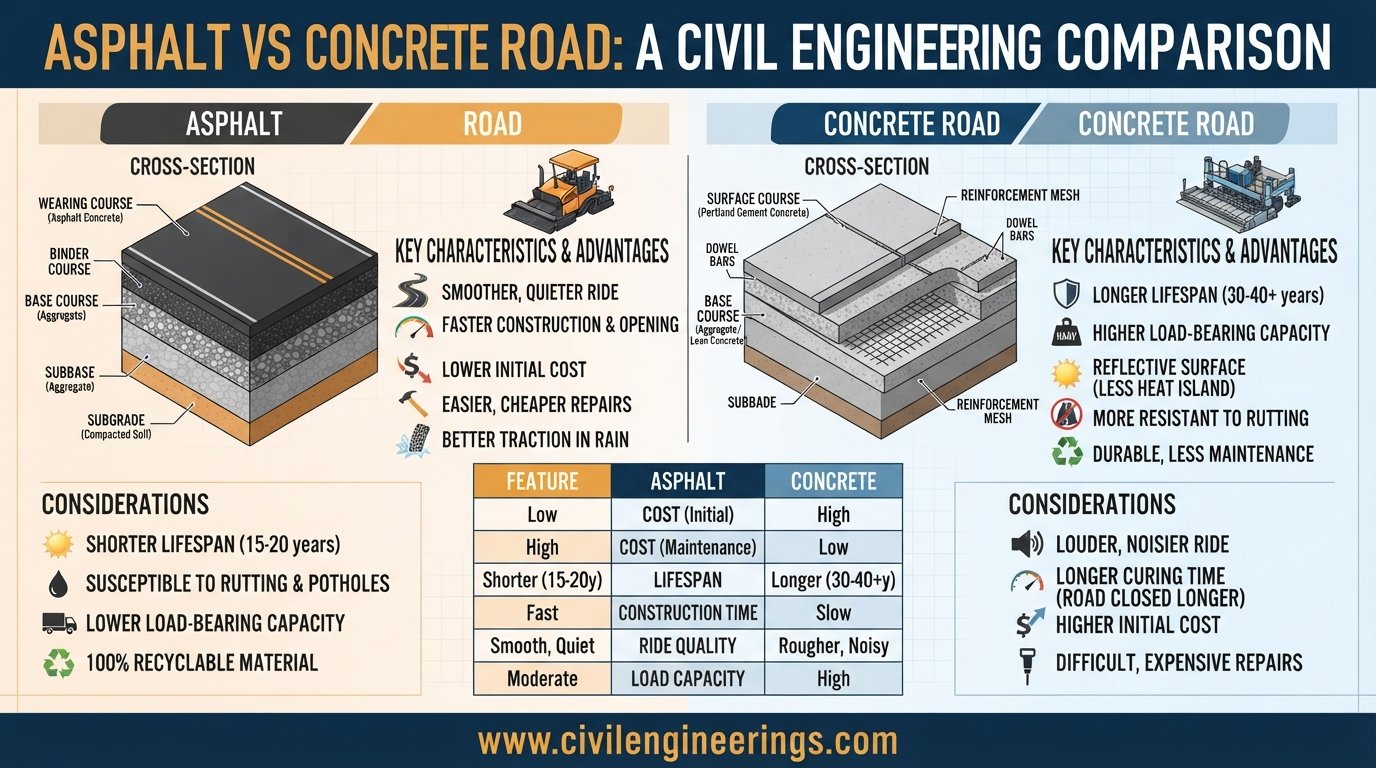
Choosing between asphalt and concrete is one of the most important decisions in highway and pavement engineering. The pavement type affects construction cost, traffic disruption, structural performance, maintenance requirements, riding quality, and the long-term life-cycle cost of a road. A pavement that works well for a low-volume local road may not be the best solution for a heavily loaded highway.
The Asphalt vs Concrete Road debate therefore cannot be reduced to simply asking which material is stronger. Engineers must consider traffic loading, climate, soil conditions, drainage, construction resources, material availability, design life, maintenance strategy, and project economics.
Asphalt pavement, often called flexible pavement, relies on a layered structure in which bituminous materials distribute traffic loads through the pavement layers. Concrete pavement, generally classified as rigid pavement, uses a cement concrete slab to carry and distribute loads.
This guide compares asphalt and concrete roads from an engineering perspective. It explains their structure, materials, advantages, disadvantages, construction processes, durability, maintenance, environmental considerations, costs, and suitable applications. It also provides practical recommendations for students, engineers, contractors, and infrastructure professionals.
What Is an Asphalt Road?
An asphalt road is a pavement system that uses bituminous-bound aggregate as its primary surfacing material. The pavement normally consists of several engineered layers designed to transfer wheel loads safely to the underlying soil.
Asphalt pavement is commonly called flexible pavement because its structure can undergo small amounts of deformation under traffic without behaving as one large rigid slab.
Typical Asphalt Pavement Structure
A conventional asphalt pavement may contain:
- Wearing or surface course
- Binder course
- Asphalt base course
- Granular base
- Subbase
- Compacted subgrade
The exact configuration depends on traffic, climate, soil strength, drainage, available materials, and pavement design methodology.
How Asphalt Pavement Carries Traffic
When a vehicle passes over an asphalt pavement, the wheel load creates stresses within the surface and underlying layers. The load gradually spreads as it moves downward.
A simplified representation is:
Traffic Load → Asphalt Surface → Base Course → Subbase → Subgrade
The structural design aims to keep stresses and strains within acceptable limits. Important failure mechanisms include fatigue cracking, rutting, thermal cracking, stripping, potholes, and surface deterioration.
Common Asphalt Materials
Typical asphalt pavement materials include:
- Bitumen or asphalt binder
- Crushed aggregates
- Fine aggregates
- Mineral filler
- Modified asphalt binders where required
- Asphalt mixtures produced according to specified gradation and performance requirements
The quality of aggregate, binder selection, mixing temperature, compaction, and moisture control strongly influence pavement performance.
What Is a Concrete Road?
A concrete road uses Portland cement concrete or another specified cementitious concrete mixture as its principal structural pavement layer. Concrete pavement is generally classified as rigid pavement because the concrete slab has considerably greater flexural stiffness than an asphalt layer.
Instead of relying mainly on a series of flexible layers, the concrete slab distributes wheel loads over a wider area.


Typical Concrete Pavement Structure
A concrete pavement may consist of:
- Portland cement concrete slab
- Base or subbase
- Subgrade
- Drainage and edge-support features
Depending on pavement type, the concrete system may also contain:
- Contraction joints
- Expansion joints where required
- Dowel bars
- Tie bars
- Reinforcement
- Joint sealants
How Concrete Pavement Carries Traffic
The concrete slab has high flexural rigidity. Instead of transferring the wheel load through many flexible layers in the same manner as asphalt, the slab spreads the load over a relatively large area.
A simplified load path is:
Traffic Load → Concrete Slab → Base/Subbase → Subgrade
Concrete pavement performance depends heavily on slab thickness, concrete strength, joint design, load transfer, support conditions, drainage, temperature effects, and construction quality.
Asphalt vs Concrete Road: Key Differences
The central difference between asphalt and concrete pavement is their structural behavior.
Asphalt pavement is flexible and generally distributes traffic loads progressively through multiple layers. Concrete pavement behaves more like a structural slab and uses its flexural strength and stiffness to distribute loads.
Structural Behavior
Asphalt pavement accommodates small movements and deformation. Its performance is strongly affected by asphalt mixture properties, aggregate structure, temperature, moisture, and underlying support.
Concrete pavement has much higher rigidity. Temperature and moisture gradients can cause slab curling and warping, making joint design and load transfer important.
Service Life
A properly designed and constructed concrete pavement can provide a long service life with relatively limited routine maintenance.
Asphalt pavements can also provide excellent service life, particularly when appropriate mixtures, drainage, structural thickness, and preventive maintenance are used. Asphalt has the additional advantage that resurfacing and rehabilitation can often be performed comparatively quickly.
Initial Construction Cost
The initial cost varies considerably by location and project conditions.
Concrete may have a higher initial construction cost because of cement, reinforcement or load-transfer components, formwork or paving equipment, curing requirements, and longer construction constraints.
Asphalt often provides faster construction and earlier traffic opening. However, the lowest initial cost does not automatically mean the lowest overall cost.
Maintenance Requirements
Asphalt commonly requires periodic:
- Crack sealing
- Patching
- Surface treatments
- Milling
- Overlaying
- Resurfacing
Concrete generally requires fewer frequent surface interventions but may need:
- Joint resealing
- Slab repair
- Partial-depth repairs
- Full-depth repairs
- Grinding
- Faulting correction
- Joint replacement
The appropriate maintenance strategy depends on pavement condition and traffic.
Asphalt vs Concrete Road: Cost Comparison
Pavement cost should be evaluated using a life-cycle cost analysis (LCCA) rather than comparing only the initial construction price.
A basic conceptual life-cycle cost relationship is:
LCC = Initial Cost + Maintenance Cost + Rehabilitation Cost + User Cost − Residual Value
Where:
- LCC = Life-cycle cost
- Initial Cost = Construction expenditure
- Maintenance Cost = Routine and preventive maintenance
- Rehabilitation Cost = Major future intervention
- User Cost = Costs associated with traffic disruption and delays
- Residual Value = Remaining pavement value at the end of the analysis period
Factors Affecting Pavement Cost
Engineers should evaluate:
- Material availability
- Hauling distance
- Aggregate quality
- Cement and bitumen prices
- Plant availability
- Equipment requirements
- Labor requirements
- Traffic management
- Construction duration
- Expected maintenance frequency
- Design life
- Future rehabilitation requirements
A concrete pavement that costs more initially may become competitive when long-term maintenance is included. Conversely, asphalt may be more economical when rapid construction and staged rehabilitation are valuable.
Asphalt Road Advantages and Disadvantages
Advantages of Asphalt Roads
Asphalt offers several practical advantages in highway construction.
Fast construction: Asphalt can usually be placed and compacted efficiently, allowing roads to reopen relatively quickly when construction planning is effective.
Smooth riding surface: Properly designed asphalt mixtures can provide excellent ride quality and skid resistance.
Easy rehabilitation: Milling and asphalt overlay operations can restore pavement condition without completely rebuilding the road.
Staged construction: Asphalt works well when traffic volumes require phased construction.
Recyclability: Reclaimed asphalt pavement can be incorporated into new asphalt mixtures when permitted by specifications and mixture design.
Disadvantages of Asphalt Roads
Asphalt also has limitations.
Temperature sensitivity: High temperatures can soften asphalt binder and increase rutting susceptibility.
Oxidation: Exposure to air, ultraviolet radiation, and environmental conditions gradually hardens the binder.
Water-related damage: Poor drainage can accelerate stripping, potholing, and weakening of pavement layers.
Recurring maintenance: Asphalt generally requires periodic preservation and rehabilitation.
Heavy-load deformation: Poor mixture selection or inadequate structural design can result in rutting under repeated heavy traffic.
Concrete Road Advantages and Disadvantages
Advantages of Concrete Roads
Concrete pavement provides several important engineering benefits.
High structural capacity: Concrete slabs can effectively handle heavy and repeated wheel loads when properly designed.
Long service potential: Well-designed concrete pavements can remain functional for decades with appropriate maintenance.
Resistance to rutting: Concrete does not rut in the same way as conventional asphalt mixtures under high temperatures.
Reduced deformation: The rigid slab maintains its structural geometry under heavy traffic better than many flexible systems.
Potentially lower maintenance frequency: Although concrete repairs can be specialized, routine surface maintenance may be less frequent.
Disadvantages of Concrete Roads
Concrete pavement has its own challenges.
Higher initial investment: Construction can require substantial upfront expenditure.
Longer curing requirements: Concrete must achieve adequate strength before opening to traffic unless specialized rapid-strength systems are used.
Joint maintenance: Poorly designed or maintained joints can lead to faulting, spalling, water infiltration, and other defects.
Repair complexity: Concrete slab replacement can require traffic control and specialized equipment.
Construction sensitivity: Finishing, curing, joint cutting, temperature control, and concrete quality must be carefully managed.
Asphalt vs Concrete Road Construction Process
Construction quality can be just as important as pavement selection. A theoretically superior pavement can fail prematurely when construction practices are poor.
Asphalt Road Construction
A typical asphalt pavement construction sequence includes:
- Site preparation
- Subgrade preparation
- Drainage installation
- Subbase placement
- Base course construction
- Asphalt plant production
- Transportation of hot-mix asphalt
- Asphalt placement
- Rolling and compaction
- Quality control
- Surface finishing
- Road marking and opening
Compaction is particularly important. Insufficient density can increase air voids, water infiltration, oxidation, rutting, and premature cracking.
Concrete Road Construction
Concrete pavement generally involves:
- Subgrade preparation
- Subbase construction
- Form or paving system preparation
- Concrete batching
- Concrete transportation
- Placement
- Vibration and consolidation
- Surface finishing
- Texturing
- Joint installation or sawing
- Curing
- Strength verification
- Opening to traffic
Joint sawing must be carefully timed. Cutting too late can encourage uncontrolled cracking, while inappropriate timing or depth can create other construction problems.
Asphalt vs Concrete Road Durability
Durability depends on more than the pavement material itself.
Factors Affecting Asphalt Durability
Asphalt performance depends on:
- Binder grade
- Aggregate quality
- Aggregate gradation
- Air void content
- Compaction
- Pavement thickness
- Drainage
- Climate
- Traffic loading
- Mixture temperature
- Moisture susceptibility
Heavy trucks and high tire pressures can significantly influence pavement distress.
Factors Affecting Concrete Durability
Concrete pavement durability depends on:
- Water-cement ratio
- Concrete strength
- Aggregate quality
- Air entrainment where appropriate
- Joint design
- Curing
- Load transfer
- Drainage
- Freeze-thaw exposure where applicable
- Chemical exposure
- Construction quality
For concrete, cracking and joint deterioration should be addressed through pavement design and construction controls rather than relying solely on repair after failure.
Asphalt vs Concrete Road for Heavy Traffic
Heavy traffic is a major consideration when selecting pavement type.
Concrete can be particularly attractive for:
- Freight corridors
- Industrial roads
- Container terminals
- Bus lanes
- Intersections
- Truck parking areas
- High-load pavement applications
However, asphalt can also perform exceptionally well under heavy traffic when engineers use appropriate structural thickness, high-performance asphalt mixtures, quality aggregates, adequate drainage, and effective compaction.
The correct question is not simply:
“Is concrete stronger than asphalt?”
A better engineering question is:
“Which pavement system provides the required structural and functional performance at the lowest acceptable life-cycle cost under the project’s specific conditions?”
Asphalt vs Concrete Road in Different Climates
Climate has a significant effect on pavement performance.
Hot Climate
In hot regions, asphalt may become softer as pavement temperature rises. Engineers therefore need suitable binder properties and rut-resistant mixture designs.
Concrete does not soften in the same manner. However, concrete slabs experience thermal expansion, contraction, curling, and warping. Joint design becomes especially important.
Cold Climate
In cold regions, asphalt can experience thermal cracking. Concrete may experience freeze-thaw damage if materials, air entrainment, drainage, and construction are inadequate.
Wet Climate
Drainage becomes critical for both pavement types.
Water can weaken the subgrade and base layers beneath asphalt. In concrete pavement, water entering joints can contribute to pumping, erosion, and loss of support.
Good pavement engineering therefore treats surface drainage, subsurface drainage, shoulders, edge drainage, and groundwater control as integral components of pavement performance.
Environmental Considerations
Environmental performance should be considered over the entire pavement life cycle.
Asphalt offers an important sustainability advantage through the reuse of reclaimed asphalt pavement. Existing pavement can often be milled and incorporated into new mixtures, reducing the demand for virgin aggregate and binder.
Concrete pavement has a long potential service life, which can reduce the frequency of complete reconstruction. However, cement manufacturing has a significant carbon footprint, making concrete mixture optimization and lower-carbon cementitious materials important areas of sustainable pavement engineering.
Environmental assessment should consider:
- Material production
- Transportation
- Construction energy
- Pavement longevity
- Maintenance frequency
- Recycling
- Rehabilitation
- End-of-life recovery
A life-cycle environmental assessment can provide a better comparison than focusing only on construction-stage emissions.
Pavement Design Considerations
Pavement selection should begin with engineering data rather than preference.
Traffic Analysis
Important traffic inputs include:
- Average daily traffic
- Commercial vehicle percentage
- Axle-load distribution
- Equivalent axle loads where applicable
- Traffic growth
- Lane distribution
- Design period
A simplified traffic growth relationship can be represented as:
Future Traffic = Present Traffic × (1 + g)ⁿ
Where:
- g = annual traffic growth rate
- n = number of years
Actual pavement design requires more detailed traffic characterization.
Subgrade Evaluation
Subgrade strength directly affects pavement thickness.
Engineers may evaluate:
- CBR
- Resilient modulus
- Soil classification
- Moisture condition
- Compaction
- Groundwater
- Swell potential
Weak subgrade conditions can require stabilization, improved drainage, thicker pavement layers, or other ground improvement measures.
Drainage Design
Poor drainage is one of the most common causes of premature pavement deterioration.
A complete pavement design should evaluate:
- Crossfall
- Side drains
- Culverts
- Subsurface drainage
- Shoulder drainage
- Edge drainage
- Water table
- Runoff paths
A strong pavement with poor drainage can still experience rapid deterioration.
Asphalt vs Concrete Road: Which One Should You Choose?
There is no universal winner.
Asphalt may be preferable when:
- Rapid construction is important.
- Future overlays are expected.
- Construction staging is complicated.
- Local asphalt materials are readily available.
- Frequent rehabilitation can be accommodated.
- Traffic disruption must be minimized.
Concrete may be preferable when:
- Very heavy traffic is expected.
- Rut resistance is critical.
- Long service life is a major objective.
- Maintenance closures are difficult.
- The project can accommodate longer construction or curing periods.
- Concrete materials and paving resources are readily available.
The final decision should be supported by pavement design, geotechnical investigation, traffic analysis, drainage assessment, constructability review, and life-cycle cost analysis.
Practical Recommendations for Civil Engineering Students
Students should learn to compare pavement systems using engineering principles rather than memorizing that one pavement is always better.
Focus on:
- Flexible pavement theory
- Rigid pavement theory
- Pavement materials
- Traffic loading
- CBR and resilient modulus
- Asphalt mix properties
- Concrete properties
- Drainage
- Pavement distress identification
- Pavement maintenance
- Life-cycle cost analysis
When studying an existing road, observe actual pavement failures. Identify whether the problem is structural, functional, drainage-related, material-related, or construction-related.
Practical Recommendations for Highway Engineers and Consultants
Engineers should avoid making pavement selection based solely on initial cost.
Before recommending asphalt or concrete:
- Conduct traffic forecasting.
- Investigate subgrade conditions.
- Assess material sources.
- Evaluate drainage.
- Determine climatic conditions.
- Develop alternative pavement sections.
- Estimate construction costs.
- Estimate maintenance requirements.
- Conduct life-cycle cost analysis.
- Review constructability.
- Consider sustainability.
- Document the final engineering decision.
A pavement selection report should clearly explain why the selected system is appropriate for the project.
Practical Recommendations for Contractors
Contractors have a major influence on pavement performance.
For asphalt work, pay particular attention to:
- Mix temperature
- Hauling time
- Paver operation
- Layer thickness
- Rolling pattern
- Compaction temperature
- Joint construction
- Surface tolerance
For concrete work, control:
- Concrete batching
- Water addition
- Slump
- Placement rate
- Consolidation
- Finishing
- Texturing
- Joint cutting
- Curing
- Strength development
Construction records and quality-control test results should be maintained throughout the project.
IRC, AASHTO and ICE Guidance
Pavement engineers should follow the standards and design guidance specified for the project jurisdiction rather than applying a generic pavement section.
In South Asian projects, IRC publications provide important guidance for road and pavement engineering. Engineers working on international or U.S.-influenced projects may encounter AASHTO pavement design procedures and specifications.
ICE, through its professional engineering resources and standards-related publications, also provides valuable engineering knowledge relevant to infrastructure planning and construction.
The exact standard, edition, material specification, traffic methodology, and design procedure should always be verified against the contract documents and the authority responsible for the project. Local highway agencies may also impose requirements that take precedence over general international guidance.
Common Pavement Distresses to Watch
Asphalt Distresses
Common asphalt failures include:
- Fatigue cracking
- Longitudinal cracking
- Transverse cracking
- Rutting
- Ravelling
- Potholes
- Bleeding
- Stripping
- Edge cracking
Concrete Distresses
Concrete pavement can experience:
- Joint spalling
- Slab cracking
- Faulting
- Pumping
- Blow-ups
- Scaling
- Corner breaks
- Surface defects
- Loss of load transfer
Correct diagnosis matters because the visible symptom may not identify the underlying cause.
For example, potholes may appear to be a surface problem, while the underlying cause could involve water infiltration, weak base material, inadequate drainage, insufficient compaction, or structural overload.
Final Engineering Verdict
The Asphalt vs Concrete Road decision should be treated as a pavement-system selection problem rather than a simple material comparison.
Asphalt provides flexibility, rapid construction, smooth riding quality, convenient rehabilitation, and strong recycling potential. Concrete offers high stiffness, excellent rut resistance, substantial load-carrying capability, and potentially long service life.
Neither material automatically wins every project.
The best pavement is the one that satisfies the project’s structural, functional, economic, environmental, and maintenance objectives. Engineers should consider traffic, climate, subgrade, drainage, construction capability, material availability, design life, and life-cycle cost before making the final decision.
For students, understanding both pavement systems builds a stronger foundation in highway engineering. Contractors, construction quality determines whether the designed pavement actually achieves its intended performance. For consultants and government agencies, objective life-cycle analysis provides a defensible basis for pavement selection.
Ultimately, good pavement engineering is not about choosing asphalt or concrete by preference. It is about selecting, designing, constructing, and maintaining the right pavement system for the conditions in which it must perform.
Frequently Asked Questions About Asphalt vs Concrete Road
Is asphalt or concrete better for highways?
Both can be suitable for highways. The selection depends on traffic loading, climate, subgrade, drainage, construction conditions, expected service life, maintenance strategy, and life-cycle cost.
Which road lasts longer, asphalt or concrete?
Concrete can provide a very long service life when properly designed, constructed, and maintained. Asphalt can also achieve long performance periods when high-quality materials, adequate thickness, drainage, and preventive maintenance are provided.
Is asphalt cheaper than concrete?
Asphalt often has a lower or more flexible initial construction cost, but the result varies by project. Engineers should compare complete life-cycle costs instead of looking only at the initial price.
Why is asphalt called flexible pavement?
Asphalt pavement is called flexible because its layered structure can accommodate relatively small deformation under traffic. Load distribution occurs progressively through the asphalt, base, subbase, and subgrade.
Why is concrete called rigid pavement?
Concrete pavement is called rigid because the cement concrete slab has significantly greater stiffness and flexural strength than flexible pavement materials. The slab distributes traffic loads over a relatively broad area.
Which pavement is better for heavy trucks?
Concrete can be advantageous for heavily loaded facilities because of its stiffness and rut resistance. However, properly designed asphalt pavement can also perform effectively under heavy truck traffic.
Which pavement requires more maintenance?
Asphalt generally receives more frequent surface maintenance and rehabilitation activities. Concrete can require less frequent routine work but may need specialized joint and slab repairs.
Is asphalt more environmentally friendly than concrete?
Neither material is automatically more sustainable. Asphalt benefits from established recycling practices, while concrete can provide long service life. A proper comparison should consider material production, transportation, construction, maintenance, recycling, and service life.
Can asphalt be placed over concrete?
Yes. Asphalt overlays can be used as a rehabilitation strategy for existing concrete pavement under appropriate conditions. Engineers must evaluate the existing slab, joints, drainage, reflective cracking risk, structural capacity, and surface condition before selecting an overlay.
What is the most important factor in pavement performance?
There is no single factor. Pavement performance results from the interaction of structural design, materials, traffic, drainage, climate, subgrade, construction quality, and maintenance. Even an excellent pavement design can perform poorly if drainage or construction quality is inadequate.


Asphalt vs Concrete Road: Quick Engineering Comparison
| Factor | Asphalt Road | Concrete Road |
|---|---|---|
| Pavement type | Flexible pavement | Rigid pavement |
| Main binder | Bitumen/asphalt | Cement |
| Structural behavior | Flexible layered system | Rigid slab |
| Initial construction | Often faster | Generally slower |
| Traffic opening | Usually quicker | Often requires curing |
| Rut resistance | Can be vulnerable at high temperatures | Excellent |
| Surface rehabilitation | Relatively convenient | More specialized |
| Joint requirement | No concrete-style joints | Important design feature |
| Heavy-load performance | Very good with proper design | Excellent |
| Recycling | Strong established potential | Reuse is also possible but differs from asphalt recycling |
| Climate sensitivity | Temperature affects binder behavior | Temperature affects slab movement |
| Maintenance approach | Frequent preservation and overlays may be used | Joint and slab maintenance |
| Life-cycle performance | Highly dependent on maintenance | Potentially long service life |
| Best application | Wide range of roads and highways | Heavy-load and long-life applications |
The table provides a general engineering comparison. Actual pavement selection should always rely on project-specific design calculations, specifications, site investigation, and life-cycle analysis.
How Engineers Can Make a Better Pavement Decision
A professional pavement selection process should begin before detailed pavement thickness calculations.
Step 1: Define the Road Function
Determine whether the facility is:
- A local road
- Collector road
- Arterial road
- Expressway
- Highway
- Industrial access road
- Airport pavement
- Port facility
- Bus corridor
Road function influences traffic, reliability requirements, construction constraints, and acceptable maintenance interruptions.
Step 2: Establish Design Traffic
Estimate current and future traffic. Commercial vehicles deserve particular attention because heavy axle loads contribute disproportionately to pavement deterioration.
Step 3: Investigate the Ground Conditions
Conduct geotechnical investigation and determine the engineering properties of the subgrade.
A pavement design should never be based only on surface observations.
Step 4: Evaluate Climate and Drainage
Temperature ranges, rainfall, groundwater, flooding potential, and drainage conditions can significantly affect pavement performance.
Step 5: Compare Alternative Pavement Sections
Develop technically viable asphalt and concrete alternatives. Compare structural capacity, constructability, material availability, cost, maintenance, and expected performance.
Step 6: Conduct Life-Cycle Evaluation
Consider what happens after construction.
A pavement requiring frequent rehabilitation may create higher costs and greater traffic disruption even if its initial construction price is attractive.
Step 7: Select the Optimum System
The final selection should be documented with engineering evidence. A good decision should be technically defensible, economically rational, and consistent with applicable specifications.
Why Drainage Matters in Asphalt and Concrete Pavements
Drainage deserves special emphasis because water is one of the most damaging factors affecting pavement systems.
In asphalt pavement, water can enter through cracks, joints, porous materials, shoulders, or inadequate drainage paths. Saturated base and subgrade materials may lose strength and become vulnerable to deformation.
Concrete pavement can experience pumping when repeated wheel loads force water and fine material through joints or cracks. Loss of support beneath the slab can subsequently contribute to faulting and cracking.
Effective drainage design should therefore be integrated with pavement design from the beginning.
Key Drainage Components
Depending on the project, drainage may include:
- Road crown
- Cross slope
- Side drains
- Catch basins
- Culverts
- Subsurface drains
- Edge drains
- Underdrains
- Shoulder drainage
- Median drainage
A pavement should never be designed independently from the water-management system around it.
Quality Control in Asphalt Pavement Construction
Asphalt pavement quality begins at the material source and continues through final compaction.
Engineers should monitor aggregate gradation, binder properties, mix production, temperatures, layer thickness, density, surface tolerance, and joints.
Asphalt Compaction
Compaction reduces air voids and improves aggregate interlock.
A simplified field density relationship is:
Relative Compaction (%) = Field Density / Laboratory Reference Density × 100
Project specifications define the required density and test methodology.
Insufficient compaction may permit water penetration and accelerate oxidation, rutting, ravelling, and cracking. Excessive compaction can also create problems depending on the mixture and specification.
Quality Control in Concrete Pavement Construction
Concrete pavement requires disciplined control of concrete production and placement.
Important parameters include:
- Cementitious material content
- Water-cement ratio
- Aggregate quality
- Slump or workability
- Air content where applicable
- Concrete temperature
- Strength
- Thickness
- Surface texture
- Joint dimensions
- Curing
Concrete Strength
Compressive strength is commonly evaluated using standardized concrete specimens. Flexural performance may also be important for pavement applications.
Engineers should avoid judging pavement quality from compressive strength alone. Slab thickness, support conditions, joint design, curing, load transfer, and durability also influence pavement performance.
Maintenance Strategy: Asphalt vs Concrete
Pavement maintenance should begin before severe deterioration appears.
Asphalt Preservation
Preventive treatments can include:
- Crack sealing
- Fog sealing
- Surface treatments
- Microsurfacing
- Thin overlays
- Patching
- Milling and resurfacing
The exact treatment should be selected according to pavement condition and distress mechanism.
Concrete Preservation
Concrete maintenance can include:
- Joint resealing
- Crack repair
- Slab replacement
- Partial-depth repairs
- Full-depth repairs
- Diamond grinding
- Load-transfer restoration
Early intervention can extend pavement service life and reduce the need for major reconstruction.
Asphalt vs Concrete Road for Urban Roads
Urban roads present different challenges from rural highways.
Frequent utility work, intersections, buses, pedestrians, drainage structures, manholes, traffic signals, and underground services can influence pavement selection.
Asphalt may offer practical advantages where frequent utility cuts and rapid reinstatement are expected.
Concrete can be attractive at bus stops, intersections, truck lanes, and locations where rutting under concentrated loading is a concern.
The correct approach is often to consider pavement type according to functional requirements rather than applying one material uniformly to every part of an urban network.
Asphalt vs Concrete Road for Intersections
Intersections receive braking, acceleration, turning, and channelized traffic. These actions create stresses that differ from those on uninterrupted highway segments.
Asphalt at heavily trafficked intersections can experience rutting or shoving if the mixture and structural design are inadequate.
Concrete can offer excellent resistance to deformation at such locations. However, joint layout and drainage require careful attention.
Engineers may therefore consider specialized pavement treatments at intersections rather than simply extending the typical road pavement section through the entire corridor.
Asphalt Recycling and Concrete Sustainability
Modern pavement engineering increasingly considers circular-economy principles.
Asphalt Recycling
Reclaimed asphalt pavement can provide valuable aggregate and binder resources. Recycling can reduce virgin material demand when the reclaimed material is properly characterized and incorporated into a suitable mixture design.
Concrete Recycling
Old concrete pavement can be processed into recycled concrete aggregate for appropriate applications. Its use depends on project specifications, aggregate properties, contamination, and structural requirements.
Sustainability should therefore be evaluated as a system-level objective rather than by declaring one pavement type inherently sustainable.
Common Mistakes During Pavement Selection
Several mistakes repeatedly create pavement problems.
Choosing Only on Initial Cost
The cheapest construction option may not be the cheapest over the complete service period.
Ignoring Drainage
Water-related deterioration can undermine otherwise adequate pavement structures.
Underestimating Heavy Vehicles
Passenger-car traffic and heavy commercial traffic should not be treated as equivalent loading.
Using Inadequate Material Specifications
Poor aggregates, inappropriate asphalt binder, unsuitable concrete materials, or inconsistent production can reduce pavement life.
Neglecting Construction Quality
Design calculations cannot compensate for poor compaction, inadequate curing, incorrect joint construction, or insufficient thickness.
Ignoring Maintenance Planning
Every pavement requires a maintenance strategy. Selecting a pavement without considering future intervention is incomplete engineering.
Final Checklist for Asphalt or Concrete Pavement Selection
Before approving a pavement type, the project team should ask:
- What is the design traffic?
- How many heavy vehicles are expected?
- What is the subgrade strength?
- What drainage conditions exist?
- What climate will the pavement experience?
- Are suitable aggregates available?
- Is asphalt production capacity available?
- Is concrete batching and paving capacity available?
- How quickly must traffic be restored?
- What maintenance resources are available?
- What is the expected design life?
- What is the life-cycle cost?
- What environmental objectives apply?
- What do the governing specifications require?
- Can local contractors construct the selected pavement to the required quality?
These questions turn pavement selection into a structured engineering decision.
Conclusion
The Asphalt vs Concrete Road comparison has no universal winner. Both pavement systems can deliver excellent performance when engineers match the pavement structure to traffic, climate, subgrade, drainage, construction resources, and maintenance requirements.
Asphalt remains highly attractive because it supports rapid construction, smooth riding surfaces, flexible rehabilitation strategies, and extensive recycling opportunities. Concrete provides high stiffness, strong rut resistance, and the potential for long service life, particularly under demanding loading conditions.
The most reliable pavement decision comes from a complete engineering assessment. Traffic analysis, geotechnical investigation, pavement design, drainage evaluation, constructability, material availability, life-cycle cost, sustainability, and maintenance planning should all contribute to the final selection.
For civil engineering students, the comparison provides an excellent way to understand flexible and rigid pavement behavior. For practicing engineers and consultants, it reinforces an important principle: pavement performance is determined by the entire system, not by the surface material alone.
A properly designed, properly constructed, and properly maintained pavement—whether asphalt or concrete—will outperform an incorrectly selected or poorly constructed alternative.

Kamran Malik is a passionate civil engineering writer and researcher who specializes in construction, transportation, structural engineering, and infrastructure topics. Through his articles on CivilEngineerings.com, he simplifies complex engineering concepts and shares practical insights, industry trends, and educational resources for students, professionals, and engineering enthusiasts.