
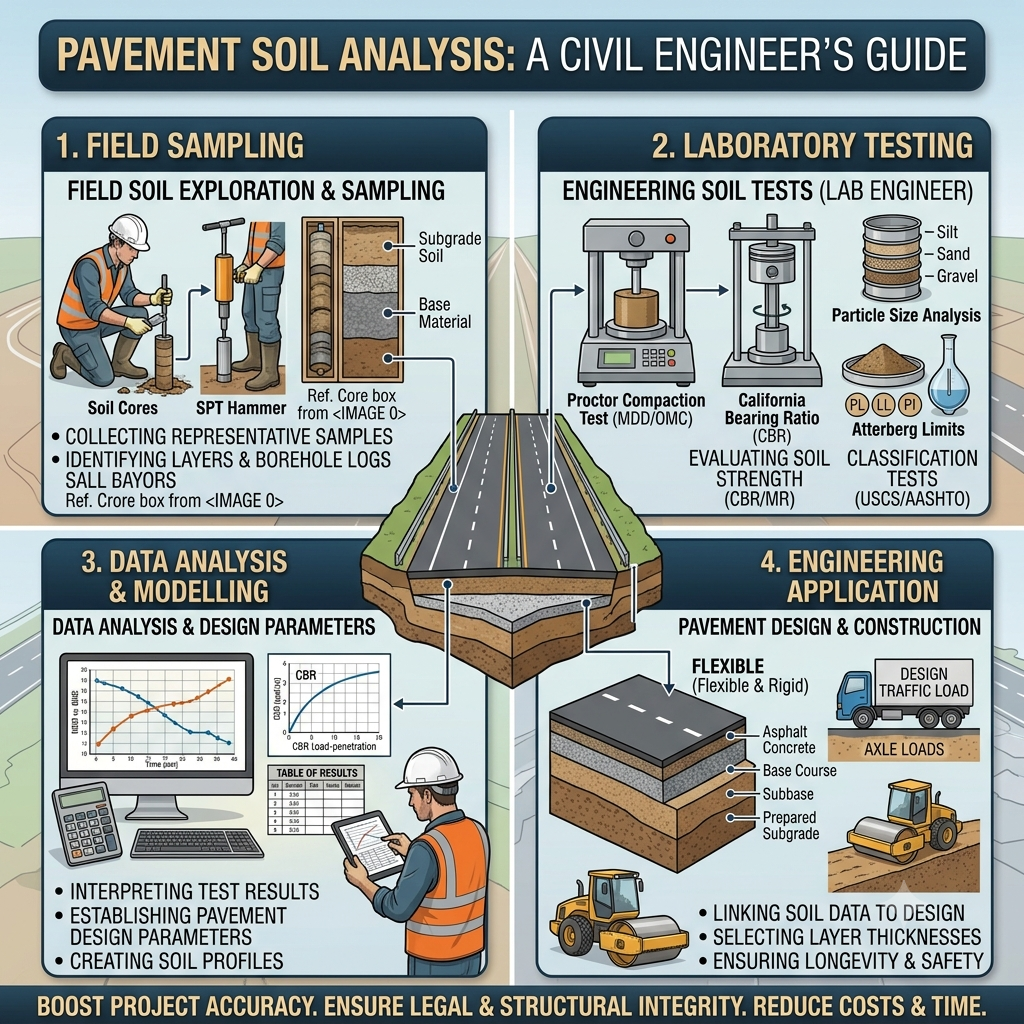
Introduction
Every durable road begins with a strong foundation, and that foundation depends on the quality of the supporting soil. Before engineers design pavement thickness or select construction materials, they must evaluate the engineering properties of the soil beneath the proposed roadway. This systematic evaluation is known as Pavement Soil Analysis.
Pavement Soil Analysis helps engineers determine whether the natural ground can safely support traffic loads throughout the pavement’s design life. The analysis identifies soil strength, moisture sensitivity, compressibility, drainage characteristics, and bearing capacity. These properties influence pavement performance, construction costs, maintenance requirements, and long-term serviceability.
Modern highway engineering relies on accurate soil investigation to minimize pavement failures such as rutting, cracking, settlement, and excessive deformation. A thorough analysis also allows engineers to select suitable stabilization methods and optimize pavement design for local site conditions.
Whether you are a civil engineer, contractor, engineering student, or highway consultant, understanding Pavement Soil Analysis is essential for designing safe, economical, and long-lasting road infrastructure.
What is Pavement Soil Analysis?
Pavement Soil Analysis is the scientific process of evaluating the physical, mechanical, and engineering properties of soil that supports a road or highway pavement.
The analysis determines whether the existing soil can safely carry anticipated traffic loads or whether engineers need to improve the soil before construction begins.
The investigation commonly evaluates:
- Soil type
- Bearing capacity
- Moisture content
- Density
- Plasticity
- Compaction characteristics
- Shear strength
- Drainage properties
- Compressibility
The collected information forms the foundation of pavement design and material selection.
Why Pavement Soil Analysis Matters
No pavement performs better than the soil supporting it. Even a high-quality asphalt or concrete pavement can fail prematurely if the subgrade lacks sufficient strength.
Proper soil analysis helps engineers:
- Improve pavement durability.
- Reduce construction risks.
- Prevent differential settlement.
- Optimize pavement thickness.
- Lower maintenance costs.
- Increase road safety.
- Enhance drainage performance.
- Extend pavement service life.
Skipping this stage often leads to expensive repairs and shortened pavement lifespan.
Engineering Principles Behind Pavement Soil Analysis
Engineers analyze soil because every pavement transfers traffic loads to the ground below.
As vehicles move along the roadway, wheel loads pass through several structural layers before reaching the natural soil.
A weak subgrade concentrates stress and accelerates pavement deterioration.
Load Distribution Principle
Each pavement layer spreads vehicle loads over a wider area.
The stronger the supporting soil, the thinner and more economical the pavement structure can become.
Moisture Control Principle
Water significantly affects soil behavior.
High moisture reduces strength, increases compressibility, and promotes pavement deformation.
Engineers therefore study groundwater conditions and seasonal moisture variations before finalizing pavement designs.
Compaction Principle
Compacted soil provides greater strength than loose soil.
Proper compaction:
- Increases density
- Improves bearing capacity
- Reduces settlement
- Minimizes air voids
- Enhances stability
Pavement Structure Diagram
               VEHICLE LOAD
                    │
                    ▼
====================================
 Asphalt / Concrete Surface Course
====================================
          Base Course
====================================
        Granular Sub-base
====================================
      Compacted Subgrade Soil
====================================
         Natural Ground
Every pavement layer depends on the strength of the subgrade.
Types of Soil Used in Pavement Construction
Different soils behave differently under traffic loading and environmental conditions.
Understanding soil characteristics helps engineers choose appropriate construction methods.
Clay Soil
Clay contains very fine particles and exhibits high plasticity.
Characteristics
- High water absorption
- Low permeability
- High shrink-swell behavior
- Low drainage capacity
Advantages
- Good cohesion
- Suitable after stabilization
Limitations
- Poor bearing capacity
- Volume changes during seasonal moisture variation
Engineers frequently stabilize clay using lime or cement before pavement construction.
Silt Soil
Silt consists of particles smaller than sand but larger than clay.
Characteristics
- Moderate strength
- Poor drainage
- Easily eroded
- Moisture sensitive
Engineering Considerations
Silty soils often require compaction improvement and drainage control.
Sand
Sand provides excellent drainage and compacts effectively under suitable moisture conditions.
Characteristics
- High permeability
- Low plasticity
- Good drainage
- Moderate bearing capacity
Sand commonly serves as a drainage layer beneath pavements.
Gravel
Gravel offers one of the strongest natural pavement foundations.
Characteristics
- Excellent drainage
- High bearing capacity
- Low compressibility
- Outstanding stability
Engineers frequently use crushed gravel in sub-base and base layers.
Organic Soil
Organic soils contain decomposed vegetation and organic matter.
Characteristics
- Very low strength
- High compressibility
- Excessive settlement
- Poor engineering performance
These soils rarely provide adequate support for pavements.
Engineers usually remove and replace them before construction.
Expansive Soil
Expansive soils contain clay minerals that swell when wet and shrink when dry.
Challenges
- Pavement cracking
- Differential settlement
- Shoulder deformation
- Uneven pavement surface
Engineers often use stabilization techniques and moisture control measures to manage expansive soils.
Pavement Soil Analysis Process
A systematic soil investigation ensures reliable pavement performance throughout its design life.
Step 1: Site Investigation
Site investigation provides the information engineers need before collecting soil samples.
Activities Include
- Visual site inspection
- Topographic survey
- Existing pavement evaluation
- Drainage assessment
- Groundwater observations
- Geological mapping
Objectives
Engineers identify:
- Soil variations
- Weak zones
- Waterlogged areas
- Rock outcrops
- Existing utilities
- Access routes
A detailed site investigation reduces uncertainty during design and construction.
Step 2: Soil Sampling
After the site investigation, engineers collect representative soil samples for laboratory testing.
Types of Samples
Disturbed Samples
Used for:
- Grain size analysis
- Moisture content
- Atterberg Limits
- Soil classification
Undisturbed Samples
Used for:
- Shear strength
- Compressibility
- Consolidation
- Density evaluation
Sampling Methods
- Hand augers
- Boreholes
- Trial pits
- Shelby tubes
- Split-spoon samplers
Proper sampling techniques ensure reliable laboratory results and accurate pavement design.
Step 3: Soil Classification
Engineers classify soils according to their physical and engineering properties.
Classification provides a common language for describing soil behavior and selecting appropriate construction methods.
Common Classification Systems
- Unified Soil Classification System (USCS)
- AASHTO Soil Classification System
Classification generally considers:
- Particle size distribution
- Plasticity
- Liquid Limit
- Plastic Limit
- Soil texture
- Engineering behavior
Why Soil Classification Matters
Accurate classification helps engineers:
- Predict soil performance
- Select pavement thickness
- Estimate bearing capacity
- Determine stabilization requirements
- Compare different project sites
Pavement Soil Investigation Workflow
Project Planning
        │
        ▼
Site Investigation
        │
        ▼
Soil Sampling
        │
        ▼
Soil Classification
        │
        ▼
Laboratory Testing
        │
        ▼
Field Testing
        │
        ▼
Soil Evaluation
        │
        ▼
Pavement Design
This workflow ensures that each stage builds on reliable engineering data, reducing uncertainty and supporting informed design decisions.
Key Takeaways
Pavement Soil Analysis forms the foundation of every successful road and highway project. Engineers use systematic site investigations, representative soil sampling, and accurate soil classification to understand subgrade behavior before pavement design begins. These early activities reduce construction risks, improve pavement performance, and support cost-effective design decisions. A strong understanding of soil properties enables engineers to select suitable materials, determine appropriate pavement thickness, and identify locations that require stabilization before construction starts. The next stage focuses on laboratory testing, field testing, soil improvement techniques, and practical engineering applications that transform investigation results into durable pavement designs.
Step 4: Laboratory Testing
After engineers collect representative soil samples, they perform laboratory tests to determine the engineering properties of the subgrade. The results help engineers select appropriate pavement thickness, evaluate soil performance, and recommend stabilization methods when necessary.
1. Moisture Content Test
The moisture content test measures the amount of water present in the soil.
Purpose
- Evaluate field moisture conditions.
- Determine compaction requirements.
- Assess seasonal moisture variations.
Engineering Significance
Excessive moisture reduces soil strength and increases pavement deformation. Maintaining optimum moisture content during construction improves compaction efficiency and long-term pavement performance.
2. Grain Size Analysis
Grain size analysis determines the percentage of gravel, sand, silt, and clay in a soil sample.
Methods
- Sieve Analysis
- Hydrometer Analysis
Applications
- Soil classification
- Drainage evaluation
- Filter design
- Material selection
Proper particle distribution improves load transfer and enhances pavement stability.
3. Atterberg Limits Test
This test evaluates the consistency and plasticity characteristics of fine-grained soils.
The primary parameters include:
- Liquid Limit (LL)
- Plastic Limit (PL)
- Plasticity Index (PI)
Importance
Engineers use these values to:
- Identify expansive soils.
- Predict shrink-swell behavior.
- Assess workability.
- Determine stabilization requirements.
4. Proctor Compaction Test
The Proctor Test establishes the relationship between moisture content and dry density.
The test determines:
- Optimum Moisture Content (OMC)
- Maximum Dry Density (MDD)
Why It Matters
Compacting soil at OMC allows engineers to achieve maximum density and improve bearing capacity while reducing settlement.
5. California Bearing Ratio (CBR) Test
The CBR Test is one of the most important tests in Pavement Soil Analysis.
It measures the strength of subgrade soil under loading conditions.
Applications
- Flexible pavement design
- Subgrade evaluation
- Pavement thickness determination
Typical Interpretation
- Low CBR: Weak soil requiring improvement.
- Moderate CBR: Suitable with appropriate pavement design.
- High CBR: Strong subgrade capable of supporting heavier traffic loads.
6. Shear Strength Tests
Engineers evaluate shear strength using tests such as:
- Direct Shear Test
- Triaxial Compression Test
- Unconfined Compression Test
These tests help determine the soil’s resistance to sliding and deformation under traffic loads.
Step 5: Field Testing
Laboratory tests provide valuable information, but field tests confirm actual site conditions.
Common Field Tests
Field Density Test
Verifies whether field compaction meets design specifications.
Plate Load Test
Measures the bearing capacity and deformation characteristics of the subgrade.
Dynamic Cone Penetrometer (DCP)
Provides a rapid estimate of subgrade strength in the field.
In-Situ Moisture Testing
Ensures that moisture remains within acceptable limits during construction.
Benefits of Field Testing
- Confirms laboratory results.
- Identifies weak zones.
- Improves construction quality.
- Supports quality assurance.
Step 6: Soil Stabilization
If soil properties do not meet project requirements, engineers improve the soil through stabilization techniques.
Soil stabilization increases strength, reduces plasticity, and improves durability.
Mechanical Stabilization
Mechanical stabilization improves soil by mixing it with stronger granular materials.
Examples include:
- Gravel
- Crushed stone
- Sand
Advantages
- Improved load distribution
- Better drainage
- Increased density
Lime Stabilization
Lime reacts with clay minerals and reduces plasticity.
This method works particularly well for expansive clay soils.
Benefits
- Increased strength
- Reduced swelling
- Improved workability
- Better long-term performance
Cement Stabilization
Cement binds soil particles together, creating a stronger foundation.
Applications include:
- Highway subgrades
- Airport pavements
- Industrial roads
Advantages
- High strength
- Reduced permeability
- Improved durability
Chemical Stabilization
Engineers sometimes use specialized additives such as polymers, enzymes, or proprietary stabilizing agents to improve weak soils where conventional methods may not be practical.
Geosynthetics
Modern highway projects increasingly use:
- Geotextiles
- Geogrids
- Geocells
These materials improve reinforcement, separation, filtration, and drainage.
Soil Stabilization Flow Diagram
Weak Subgrade
      │
      ▼
Engineering Investigation
      │
      ▼
Select Stabilization Method
      │
 ┌────┼─────────────┐
 │    │             │
 ▼    ▼             ▼
Lime Cement Mechanical
      │
      ▼
Improved Soil Strength
      │
      ▼
Pavement Construction
Practical Applications of Pavement Soil Analysis
Pavement Soil Analysis supports a wide range of infrastructure projects, including:
- National highways
- Expressways
- Rural roads
- Urban streets
- Airport runways
- Industrial pavements
- Container terminals
- Parking areas
Accurate soil analysis enables engineers to design pavements that meet traffic demands while controlling construction and maintenance costs.
Common Problems and Engineering Solutions
| Problem | Likely Cause | Recommended Solution |
|---|---|---|
| Pavement settlement | Weak subgrade | Soil replacement or stabilization |
| Rutting | Poor compaction | Improve compaction quality |
| Longitudinal cracking | Expansive clay | Lime stabilization and drainage |
| Pumping | Excess moisture | Install proper drainage |
| Surface deformation | Low bearing capacity | Increase pavement thickness |
| Edge failures | Poor shoulder support | Improve shoulder construction and drainage |
Field Recommendations
Civil Engineers
- Complete detailed geotechnical investigations before pavement design.
- Review laboratory and field test results together.
- Consider seasonal groundwater variations.
- Specify suitable stabilization methods for weak soils.
Contractors
- Verify moisture content before compaction.
- Compact each layer according to project specifications.
- Prevent contamination between pavement layers.
- Calibrate testing equipment regularly.
Engineering Students
- Learn soil classification systems thoroughly.
- Understand the purpose of each laboratory test.
- Visit active highway projects to observe field testing.
- Study the relationship between subgrade strength and pavement performance.
Best Practices for Pavement Soil Analysis
- Perform comprehensive site investigations.
- Collect representative soil samples.
- Use both laboratory and field testing.
- Maintain accurate documentation.
- Follow approved compaction procedures.
- Design effective drainage systems.
- Stabilize weak soils before construction.
- Conduct quality control throughout the project.
- Consider future traffic growth in pavement design.
- Review investigation data before approving construction.
General Discussion of IRC, AASHTO, and ICE Practices
Highway agencies around the world emphasize the importance of reliable soil investigations before pavement construction.
In general, guidance from IRC, AASHTO, and ICE encourages engineers to:
- Carry out detailed geotechnical investigations before design.
- Classify soils using recognized engineering methods.
- Determine subgrade strength through appropriate laboratory and field testing.
- Design pavement thickness according to traffic loading and soil characteristics.
- Achieve specified compaction levels during construction.
- Incorporate effective drainage to protect the pavement foundation.
- Implement continuous quality assurance and quality control throughout the project lifecycle.
Following these principles helps improve pavement durability, safety, and long-term performance.
Frequently Asked Questions (FAQs)
1. What is Pavement Soil Analysis?
Pavement Soil Analysis is the engineering process of evaluating soil properties to determine whether the subgrade can safely support pavement loads.
2. Why is CBR important in pavement design?
The California Bearing Ratio (CBR) measures subgrade strength and helps engineers determine the required pavement thickness.
3. Which laboratory test determines optimum compaction?
The Proctor Compaction Test establishes the Optimum Moisture Content (OMC) and Maximum Dry Density (MDD).
4. Why do engineers perform soil classification?
Soil classification helps predict engineering behavior, select suitable construction methods, and determine stabilization requirements.
5. Which soils create the greatest challenges for road construction?
Expansive clay and organic soils often present significant challenges because of low strength, high compressibility, and moisture sensitivity.
6. How does drainage affect pavement performance?
Proper drainage prevents water from weakening the subgrade, reducing the risk of rutting, pumping, and premature pavement failure.
7. When should soil stabilization be used?
Engineers use stabilization when natural soils cannot provide adequate strength or durability for the proposed pavement.
8. What field tests verify construction quality?
Common field tests include the Field Density Test, Plate Load Test, Dynamic Cone Penetrometer (DCP), and in-situ moisture testing.
9. Which standards commonly guide pavement soil investigations?
Many projects follow nationally adopted standards and generally align with engineering practices recommended by organizations such as IRC, AASHTO, and ICE.
Conclusion
Pavement Soil Analysis forms the backbone of every successful highway and road project because the quality of the subgrade directly influences pavement strength, durability, and service life. Comprehensive site investigations, accurate soil classification, laboratory testing, field verification, and appropriate stabilization techniques enable engineers to design safe, economical, and long-lasting pavements. Investing time in proper soil evaluation reduces construction risks, minimizes maintenance costs, and improves overall project performance. Whether designing a rural road, urban street, expressway, or airport pavement, engineers should treat Pavement Soil Analysis as a critical design activity rather than a routine procedure. By following sound engineering principles and recognized practices, project teams can deliver resilient pavement structures that withstand heavy traffic and changing environmental conditions for decades.
