
Introduction
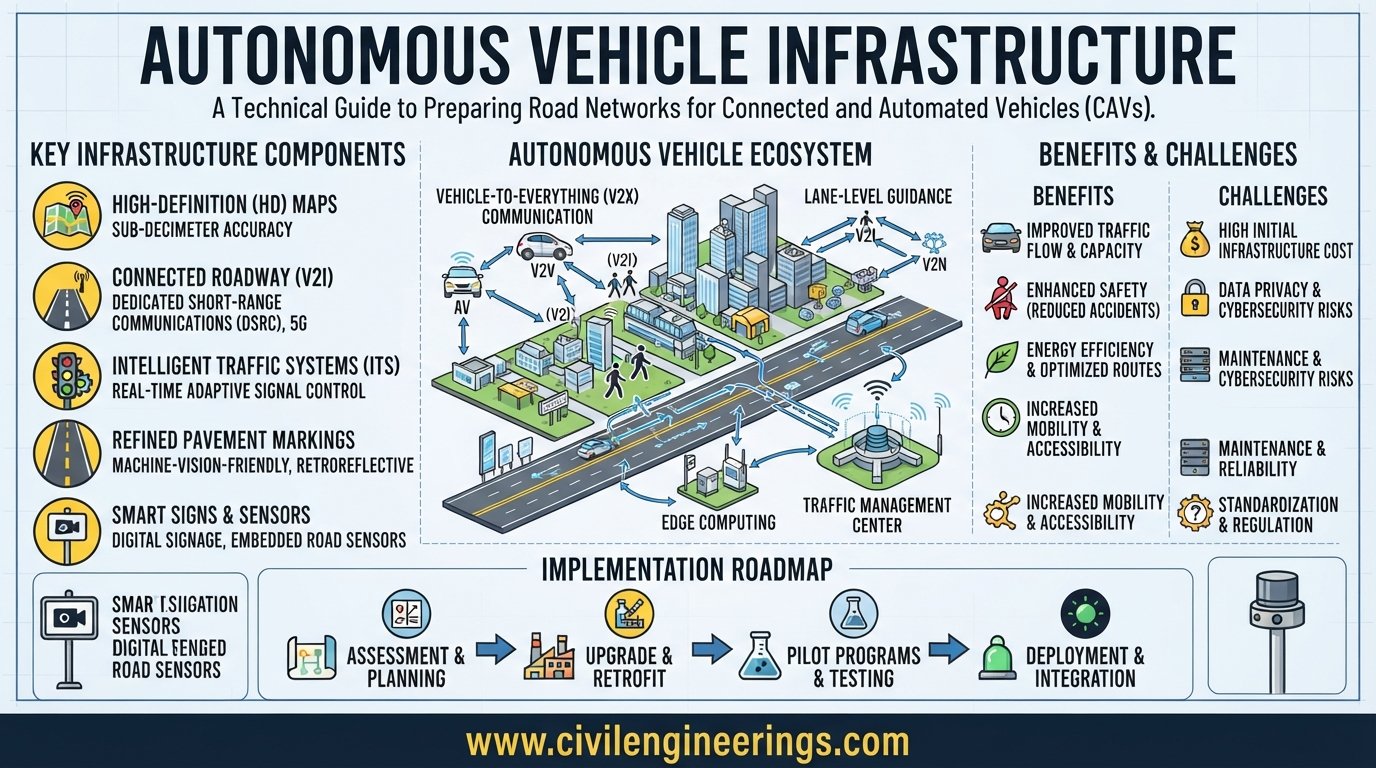
The future of transportation will not depend on autonomous vehicles alone. It will also depend on whether roads, bridges, intersections, traffic signals, pavement markings, communication networks, and roadside systems can provide a reliable environment for automated driving. This is where Autonomous Vehicle Infrastructure becomes essential.
An autonomous vehicle can use cameras, radar, lidar, positioning systems, and onboard computing to understand its surroundings. However, physical and digital road infrastructure can extend that awareness beyond what the vehicle can detect by itself. Connected traffic signals, high-quality lane markings, roadside sensors, digital maps, vehicle-to-everything communication, weather stations, and edge-computing systems can collectively create a more predictable transportation environment.
For civil and highway engineers, this represents a significant shift. Traditional road design focuses heavily on geometry, pavement performance, drainage, traffic operations, safety, and human-driver behavior. Autonomous mobility adds another dimension: machine-readable infrastructure.
This guide explains the engineering principles, major components, design considerations, applications, challenges, standards, and practical implementation strategies behind autonomous-ready roads.
What Is Autonomous Vehicle Infrastructure?
Autonomous Vehicle Infrastructure is the combination of physical roadway assets, digital systems, communication technologies, traffic-management equipment, and supporting facilities that enable or improve the safe operation of connected and automated vehicles.
It includes much more than roadside communication equipment. A properly prepared corridor may require:
- Consistent pavement markings
- Clear and standardized traffic signs
- Reliable traffic signals
- Roadside sensors
- Vehicle-to-everything (V2X) communication
- Fiber-optic and wireless communication networks
- Digital road maps
- Accurate positioning systems
- Intelligent transportation systems (ITS)
- Weather and road-condition monitoring
- Smart intersections
- Connected work zones
- Emergency-vehicle communication
- Traffic management centers
- Cybersecurity and data-management systems
- Adequate pavement and structural performance
The Federal Highway Administration has specifically identified pavement markings, traffic-control devices, pavements, bridges, barriers, communications systems, pedestrians, bicyclists, and curb space among the infrastructure areas potentially affected by automated vehicles. (Federal Highway Administration)
In simple terms, autonomous vehicles need roads that machines can understand consistently and reliably.


Why Autonomous Vehicle Infrastructure Matters
Automated driving systems do not operate in isolation. Their performance depends on the quality of information available from the vehicle, surrounding environment, communication systems, and roadway.
A conventional driver can interpret an unclear lane marking from context. An automated driving system may face a more difficult perception problem if markings are faded, contradictory, obscured by construction, or poorly visible during rain.
Similarly, a human driver approaching a blind intersection may slow down because of experience and visual cues. Connected infrastructure could potentially provide information about signal timing, approaching vehicles, incidents, or vulnerable road users before they become visible.
USDOT describes V2X as a communications framework covering vehicle-to-vehicle, vehicle-to-infrastructure, and vehicle-to-pedestrian interactions, with the potential to complement onboard sensing for automated-vehicle applications. (Department of Transportation)
The engineering objective is therefore not simply to “make roads smart.” It is to make transportation infrastructure:
- Predictable
- Consistent
- Detectable
- Connected
- Maintainable
- Resilient
- Safe for every road user
Major Components of Autonomous Vehicle Infrastructure
Intelligent Roadway and Pavement Systems
The pavement remains the foundation of every automated transportation corridor.
Engineers must continue to address:
- Structural capacity
- Rutting
- Cracking
- Skid resistance
- Surface texture
- Ride quality
- Drainage
- Settlement
- Potholes
- Differential deformation
Autonomous vehicles may also create different traffic-loading patterns. Vehicles operating in coordinated platoons could repeatedly use similar wheel paths, potentially influencing rutting, polishing, and maintenance requirements. ICE has highlighted this possibility when discussing future-proof road infrastructure. (Institution of Civil Engineers (ICE))
A simplified pavement loading concept can be expressed as:
where:
- = number of axle-load applications in a category
- = corresponding load equivalency factor
For autonomous corridors, engineers should not assume that conventional traffic distributions will remain unchanged. Future traffic models should examine lane utilization, platooning, freight automation, and changes in headway.
Machine-Readable Pavement Markings
Lane markings are particularly important because automated vehicles commonly use visual perception systems to detect lane boundaries and road alignment.
Good autonomous-ready markings should provide:
- Adequate contrast
- Consistent geometry
- Appropriate width
- Good retroreflectivity
- Proper maintenance
- Reliable visibility in wet and nighttime conditions
- Consistent lane-line placement
For Indian projects, IRC:35 provides the relevant framework for road markings, while IRC road-sign guidance provides complementary requirements for traffic control. IRC material specifically emphasizes the importance of adequate road markings for guidance and safe operation. (Indian Red Cross)
This does not mean conventional markings should be redesigned solely for autonomous vehicles. Rather, existing engineering requirements should be implemented with greater consistency and maintenance discipline.
Intelligent Traffic Signals
Traffic signals can become communication nodes rather than merely colored lamps.
A connected signalized intersection can potentially communicate:
- Signal phase and timing
- Remaining green time
- Red-light information
- Emergency-vehicle priority
- Pedestrian crossing information
- Intersection restrictions
- Work-zone conditions
These applications can improve situational awareness and support cooperative traffic management. USDOT identifies signal phasing and timing information, emergency-vehicle priority, and intelligent traffic signals among practical connected-vehicle applications. (Department of Transportation)
Roadside Units and V2X Communication
Roadside units (RSUs) provide communication between infrastructure and connected vehicles.
A simplified architecture is:
Vehicle → RSU → Traffic Management Center → Other Infrastructure/Vehicles
V2X can include:
- V2V — Vehicle-to-Vehicle
- V2I — Vehicle-to-Infrastructure
- V2P — Vehicle-to-Pedestrian
- V2N — Vehicle-to-Network
- V2X — Vehicle-to-Everything
The major engineering benefit is extending awareness beyond direct line of sight. A vehicle may receive information about an approaching hazard even when buildings, curves, heavy traffic, or terrain prevent direct detection.
FHWA’s V2X work has demonstrated how infrastructure can communicate with connected and automated vehicles, pedestrians, vulnerable road users, and center-based traffic-management systems. (Federal Highway Administration)


Road Design Requirements for Autonomous Vehicles
Geometric Consistency
Road geometry becomes even more important when automated systems rely on precise maps and perception algorithms.
Engineers should pay attention to:
- Horizontal alignment
- Vertical alignment
- Superelevation
- Lane width
- Shoulder width
- Merge and diverge areas
- Intersections
- Sight distance
- Ramp geometry
- Work-zone transitions
A sudden geometric inconsistency can create problems for both human drivers and automated systems.
For example, a lane that gradually narrows without adequate markings may be manageable for an attentive human driver but could create uncertainty for a perception system.
Pavement Condition and Ride Quality
Autonomous vehicles require reliable vehicle dynamics just as conventional vehicles do.
Poor pavement can influence:
- Vehicle trajectory
- Suspension movement
- Sensor stability
- Braking performance
- Lane positioning
- Water accumulation
- Emergency maneuvering
Therefore, autonomous-ready road programs should integrate pavement condition monitoring with digital asset-management systems.
Drainage and Weather Resilience
Heavy rain, standing water, fog, snow, dust, and glare can reduce the performance of cameras and other sensors.
Civil engineers should therefore consider:
- Adequate crossfall
- Functional side drains
- Proper inlets
- Shoulder drainage
- Ponding prevention
- Flood-resilient road elevations
- Vegetation control
- Weather monitoring
A technologically advanced roadway with poor drainage is not genuinely intelligent infrastructure.
Smart Intersections and Autonomous Mobility
Intersections are among the most complex environments for autonomous vehicles because multiple road users interact within a confined space.
A smart intersection may combine:
- Traffic signals
- Radar
- Cameras
- Pedestrian detection
- RSUs
- Edge computing
- V2X communication
- Signal controllers
- Emergency-vehicle detection
- Traffic-management software
The system can create a shared operational picture of the intersection.
For example, consider a four-leg urban intersection. A connected vehicle approaches on the east approach while a pedestrian is preparing to cross the north leg. A roadside sensor detects the pedestrian before the vehicle’s onboard camera has a clear view. The infrastructure can transmit an appropriate warning or operational message.
This illustrates an important principle:
Infrastructure should supplement vehicle perception, not become an excuse to neglect vehicle-based safety systems.
Redundancy is essential.
Digital Infrastructure and Data Networks
Physical roads increasingly need a digital layer.
Fiber-Optic Networks
Fiber can provide high-capacity communication between:
- Traffic signals
- RSUs
- Cameras
- Weather stations
- Traffic management centers
- Roadside sensors
- Data servers
Highway agencies have also explored broadband and fiber deployment along highway corridors as a foundation for smart-road technologies and future connected-vehicle applications. (AASHTO Journal)
Edge Computing
Sending every piece of sensor data to a distant cloud server may introduce unnecessary delay.
Edge computing places processing capability closer to the roadway.
For example:
Sensor → Edge Processor → Safety Message → Vehicle
This architecture can reduce communication distance and support time-sensitive applications.
Digital Twins and High-Definition Maps
Future road infrastructure management may increasingly use:
- Digital twins
- GIS databases
- LiDAR surveys
- HD maps
- 3D roadway models
- Asset inventories
- Real-time condition data
These systems can support both autonomous mobility and conventional road-asset management.
IRC has also highlighted emerging work involving Building Information Modeling, digital twins, and artificial intelligence for road infrastructure, demonstrating the growing intersection between conventional highway engineering and digital asset management. (Indian Red Cross)


Autonomous Vehicle Infrastructure in Work Zones
Temporary traffic control represents one of the greatest challenges for automated vehicles.
A work zone may contain:
- Temporary lane markings
- Cones
- Barriers
- Portable signals
- Flaggers
- Lane shifts
- Temporary speed restrictions
- Construction equipment
- Workers
- Unexpected vehicle movements
An autonomous system may encounter a roadway configuration that differs from its stored map.
Consequently, connected work zones can become increasingly important. Temporary infrastructure may need to communicate current lane configurations, closures, speed restrictions, hazards, and detours.
Contractors should maintain exceptionally clear traffic-control layouts and ensure that temporary signs and markings are consistent with approved traffic-management plans.
Safety and Cybersecurity Considerations
Autonomous infrastructure introduces a new category of engineering risk: digital failure.
A conventional sign may deteriorate physically. A connected roadside system can also experience:
- Software failure
- Communication failure
- Sensor malfunction
- Power interruption
- Cyberattack
- Data corruption
- Incorrect messages
- Network congestion
Therefore, safety-critical systems require redundancy and fail-safe strategies.
A basic reliability concept can be represented as:
for independent components arranged in a series-dependent system.
However, real infrastructure architectures are usually more complicated because redundant components can operate in parallel. Engineers should therefore use appropriate reliability-block diagrams and risk-analysis techniques rather than applying a simplified equation blindly.
Cybersecurity should cover:
- Authentication
- Encryption
- Access control
- Software updates
- Network monitoring
- Device management
- Incident response
- Backup communication
- Data privacy
USDOT’s V2X deployment planning emphasizes safety while also addressing security, privacy, and consumer protection. (Department of Transportation)
Benefits of Autonomous Vehicle Infrastructure
Well-designed autonomous-ready infrastructure can provide benefits beyond self-driving vehicles.
Improved Road Safety
Connected warnings can help identify hazards outside a vehicle’s immediate field of view.
Potential applications include:
- Collision warnings
- Wrong-way driving alerts
- Work-zone warnings
- Emergency-vehicle alerts
- Red-light violation warnings
- Pedestrian conflict warnings
Better Traffic Operations
Connected vehicles and infrastructure can support:
- Adaptive traffic signals
- Speed harmonization
- Cooperative merging
- Queue warnings
- Incident management
- Dynamic routing
FHWA research has investigated V2I speed harmonization, including field testing and simulation of connected and automated vehicle applications. (Federal Highway Administration)
Improved Asset Management
Roadside sensors can continuously collect information about:
- Pavement condition
- Bridge condition
- Weather
- Traffic
- Flooding
- Incidents
- Roadside assets
This supports predictive rather than purely reactive maintenance.
Greater Freight Efficiency
Automated trucks and connected freight corridors may eventually improve logistics by supporting:
- Coordinated truck movements
- Better routing
- Reduced idle time
- Automated freight operations
- Improved incident awareness
The exact benefits will depend heavily on deployment scale, vehicle capabilities, traffic conditions, and operating rules.
Key Challenges in Implementing Autonomous Vehicle Infrastructure
High Capital Cost
Retrofitting existing roads can be expensive.
Costs may involve:
- Fiber installation
- RSUs
- Sensors
- Traffic-signal upgrades
- Power supply
- Communications
- Software
- Control centers
- Maintenance
- Cybersecurity
Infrastructure agencies therefore need prioritization rather than attempting to make every road fully connected at once.
Lack of Uniformity
Different manufacturers, jurisdictions, communication systems, and software platforms may use different technical approaches.
AASHTO has emphasized interoperability, reliability, consistency, partnerships, and appropriate infrastructure investment as important considerations for connected and automated transportation. (AASHTO Journal)
Maintenance Requirements
Installing sensors is only the beginning.
A roadside unit can become ineffective if:
- Its power supply fails
- The antenna is damaged
- A camera becomes dirty
- Road markings fade
- Firmware becomes obsolete
- Fiber is cut
- Data becomes inaccurate
Autonomous infrastructure must therefore be treated as a long-term asset-management responsibility.
Rural and Developing Areas
Urban pilot projects often receive greater attention because they have dense communication networks and controlled environments.
Rural highways present different challenges:
- Long distances
- Limited fiber
- Weak cellular coverage
- Harsh weather
- Fewer maintenance facilities
- Higher communication infrastructure costs
A practical national strategy should not create a technology system that works only in major cities.
Engineering Standards: IRC, AASHTO and ICE
There is currently no single universal civil-engineering code that can simply be called an “autonomous vehicle road design code.” Autonomous transportation combines conventional highway engineering with rapidly evolving digital and automotive technologies.
IRC
For Indian projects, engineers should continue using applicable IRC and MoRTH requirements for:
- Road geometry
- Pavement design
- Traffic signs
- Road markings
- Safety
- Bridges
- Drainage
- Traffic management
- Intelligent transportation systems
IRC’s current publication and technical-development activity also shows increasing attention to smart parking, red-light violation detection, multimodal transport, digital twins, AI, and related transportation technologies. (Indian Red Cross)
AASHTO
AASHTO guidance and policy work is valuable for understanding connected and automated transportation, infrastructure readiness, interoperability, investment, and transportation-system operations. Its cooperative automated transportation guidelines were specifically developed to support integrated vehicle, infrastructure, and system automation. (AASHTO Journal)
ICE
ICE provides useful professional perspectives on future-proofing roads, smart infrastructure, pavement impacts, sensor deployment, and the role of civil engineers in preparing existing networks for connected and automated transportation. (Institution of Civil Engineers (ICE))
The key principle is simple: use existing highway standards as the engineering foundation, then add validated digital and connected-vehicle requirements appropriate to the application.


Practical Implementation Strategy for Highway Agencies
A highway authority can approach autonomous-ready infrastructure in stages.
Stage 1: Assess Existing Assets
Inventory:
- Pavement condition
- Markings
- Signs
- Signals
- Fiber
- Cellular coverage
- Traffic sensors
- Weather stations
- ITS equipment
- Power availability
Stage 2: Identify Priority Corridors
Prioritize locations with:
- High traffic volumes
- High crash rates
- Freight activity
- Major intersections
- Tunnels
- Bridges
- Emergency-response routes
- Planned autonomous-vehicle operations
Stage 3: Improve Fundamental Road Quality
Before installing sophisticated technology, address basic deficiencies.
Repair pavement, improve drainage, standardize markings, correct signs, improve lighting where appropriate, and remove unnecessary roadside ambiguity.
Stage 4: Deploy Connected Infrastructure
Introduce:
- RSUs
- V2X communications
- Smart signals
- Traffic sensors
- Weather stations
- Fiber networks
Stage 5: Test and Validate
Testing should include:
- Simulation
- Closed-course testing
- Hardware-in-the-loop testing
- Controlled field trials
- Real-world operational testing
FHWA has used hardware-in-the-loop approaches for connected and automated vehicle applications because large-scale testing can otherwise be expensive and difficult to reproduce. (Federal Highway Administration)
Stage 6: Monitor and Maintain
Establish performance indicators for:
- Communication uptime
- Sensor availability
- Marking condition
- Pavement condition
- Message latency
- Cybersecurity incidents
- Equipment failures
- Safety performance
Practical Recommendations for Students, Engineers and Contractors
For Civil Engineering Students
Develop a working understanding of:
- Highway geometric design
- Pavement engineering
- Traffic engineering
- ITS
- GIS
- V2X concepts
- Digital twins
- Road safety
- Data analysis
The most valuable future engineers will understand both physical infrastructure and digital infrastructure.
For Highway Engineers and Consultants
Do not treat autonomous infrastructure as a separate technology project.
Integrate it with:
- Road safety audits
- Pavement management
- Traffic operations
- Asset management
- ITS planning
- Drainage design
- Maintenance planning
Design infrastructure that remains useful even if a particular autonomous technology changes.
For Contractors
Construction quality becomes even more important.
Pay particular attention to:
- Lane-marking tolerances
- Sign placement
- Road geometry
- Signal installation
- Cable ducts
- Fiber protection
- Equipment foundations
- Sensor mounting
- Power supply
- Temporary traffic control
Document installed assets accurately so that the final digital asset database reflects actual field conditions.
Frequently Asked Questions
1. What is Autonomous Vehicle Infrastructure?
It is the physical and digital transportation infrastructure that supports connected and automated vehicles, including roads, markings, signals, sensors, communications, digital maps, and traffic-management systems.
2. Do autonomous vehicles require smart roads?
Not always. Many automated vehicles rely heavily on onboard sensors and computing. However, connected infrastructure can provide additional information, improve situational awareness, and support cooperative transportation applications.
3. What is V2X in autonomous transportation?
V2X means vehicle-to-everything communication. It can connect vehicles with other vehicles, infrastructure, pedestrians, networks, and other transportation devices.
4. Why are road markings important for autonomous vehicles?
Road markings can provide important visual information about lane boundaries, road alignment, intersections, and traffic organization. Consistent and well-maintained markings can make roadway perception more reliable.
5. Can existing highways be converted into autonomous-ready roads?
Yes. Retrofitting is possible. Agencies can progressively improve markings, signs, signals, communications, sensors, pavement condition, and digital asset information.
6. How do autonomous vehicles affect pavement design?
They may change traffic distribution and wheel-path concentration. Platooning and automated freight could create different loading patterns, so future pavement assessments should consider changing traffic behavior rather than relying exclusively on historical patterns.
7. What is the role of civil engineers in autonomous transportation?
Civil engineers design and maintain the physical environment in which automated vehicles operate. Their responsibilities increasingly overlap with ITS, digital asset management, traffic engineering, safety, communications, and technology integration.
8. What standards should engineers use for autonomous-ready roads?
Engineers should follow applicable national and local highway standards, including relevant IRC, AASHTO, MoRTH, traffic-control, pavement, bridge, ITS, and safety requirements. Emerging AV technologies should be integrated through validated project-specific requirements.
9. Are autonomous vehicle infrastructure systems expensive?
They can be. Costs vary substantially according to corridor length, communication requirements, sensor density, existing ITS infrastructure, power availability, and required reliability.
10. What is the biggest challenge for autonomous-ready infrastructure?
One of the biggest challenges is maintaining consistency and reliability across physical roads, digital systems, communication networks, vehicles, and different jurisdictions. Infrastructure must remain functional even when individual technologies change.
Conclusion
Autonomous Vehicle Infrastructure represents a major evolution in highway engineering. The future road will not simply be a layer of asphalt or concrete carrying vehicles. It will increasingly function as an integrated physical and digital transportation system in which pavement, markings, signs, signals, sensors, communications, traffic management, and data work together.
For civil and highway engineers, the most important lesson is that autonomous readiness should begin with fundamentals. Good pavement, consistent geometry, effective drainage, visible markings, reliable signs, safe roadside design, and well-maintained traffic-control devices remain essential. Digital technology should strengthen those fundamentals rather than replace them.
The transition should also be gradual and evidence-based. Highway agencies can begin by auditing existing assets, selecting strategic corridors, improving basic infrastructure, deploying V2X and intelligent transportation systems, and validating performance through controlled testing.
As AASHTO, FHWA, IRC, ICE, transportation agencies, researchers, and industry continue developing connected and automated transportation practices, engineers have an opportunity to create roads that are safer, more resilient, more data-driven, and adaptable to future mobility technologies. (Federal Highway Administration)
The road of the future will not only carry autonomous vehicles—it will communicate with them.
