
Introduction
A road can look perfectly finished on opening day and still fail within a few years. In many cases, the problem does not begin with traffic or extreme weather. It starts during planning, material selection, earthwork, drainage, pavement construction, or quality control. Small mistakes made at one stage can create expensive defects at another.
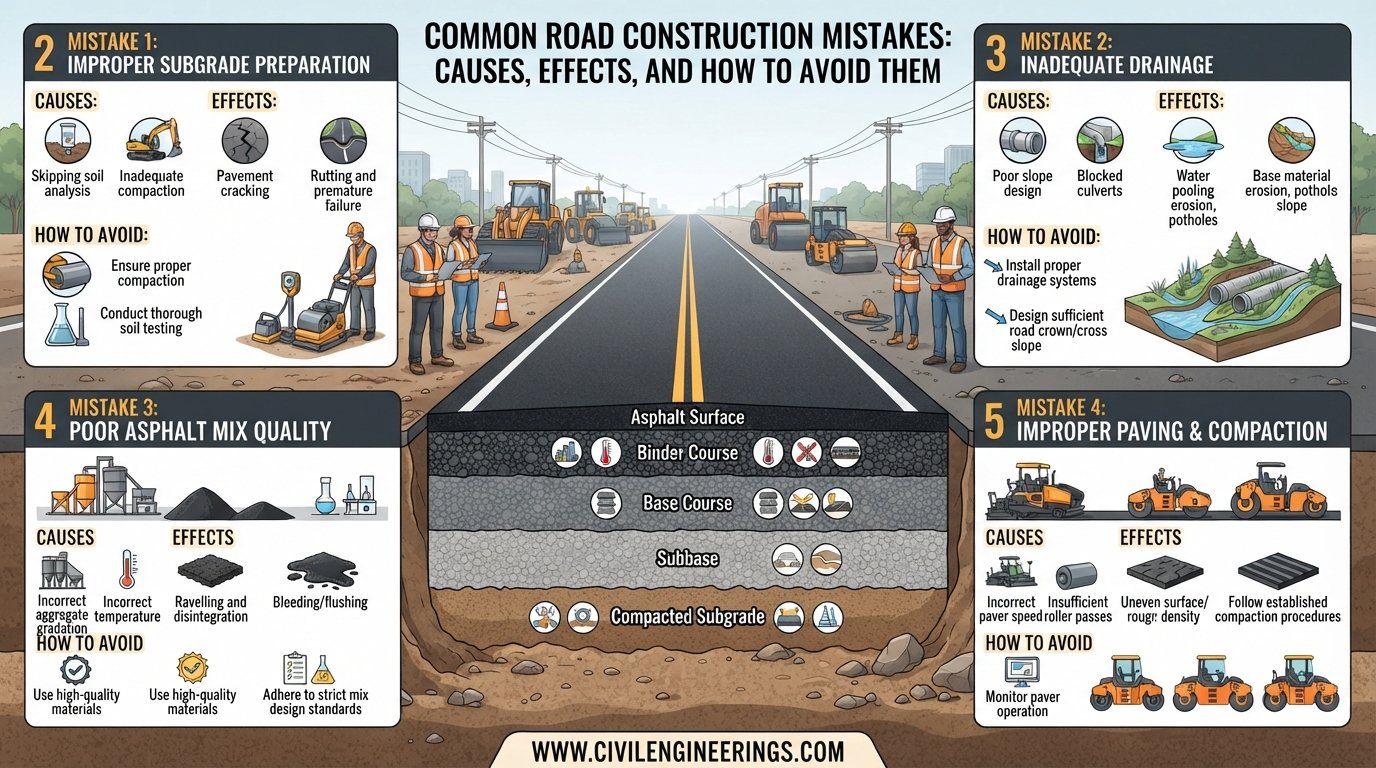
Common Road Construction Mistakes include inadequate site investigation, poor subgrade preparation, incorrect pavement thickness, improper compaction, unsuitable materials, inadequate drainage, poor surveying, weak construction joints, and insufficient quality control. These errors can lead to rutting, cracking, potholes, settlement, water damage, premature pavement failure, and costly maintenance.
For civil engineering students, understanding these failures provides valuable practical knowledge. Site engineers and contractors can use the same principles to improve construction quality, while consultants and government engineers can apply them during design review and supervision.
This guide examines the most frequent mistakes in road projects, explains why they occur, discusses their consequences, and provides practical methods for preventing them.
1. Poor Site Investigation and Inadequate Planning
Every successful highway project begins with reliable information. Unfortunately, inadequate investigation remains one of the most damaging road construction mistakes.
1.1 Insufficient Geotechnical Investigation
A pavement system depends heavily on the ground beneath it. If engineers do not properly investigate soil conditions, the design may be based on assumptions rather than actual field conditions.
Important investigations may include:
- Soil classification
- Subgrade strength
- California Bearing Ratio (CBR)
- Groundwater conditions
- Soil density
- Moisture content
- Atterberg limits
- Existing pavement condition
- Rock and weak-soil locations
- Settlement potential
A weak subgrade may require stabilization, improved drainage, undercutting, or additional pavement support.
For example, constructing a pavement over expansive clay without recognizing its volume changes can result in cracking and uneven settlement. The pavement itself may be structurally adequate, but the supporting soil remains unstable.
1.2 Incomplete Traffic Assessment
Pavement design depends on expected traffic loading. Engineers should consider current traffic, heavy vehicles, axle loads, traffic growth, and design life.
A simplified concept for cumulative traffic loading can be represented as:
ESAL = Σ (Number of axle loads × Load equivalency factor)
Actual pavement design uses the methodology specified by the applicable standard and project requirements. Underestimating heavy-vehicle traffic can result in an inadequate pavement structure.
1.3 Poor Route and Drainage Planning
Road alignment should not be selected solely because it provides the shortest distance. Terrain, soil, drainage, utilities, environmental conditions, intersections, property constraints, and construction feasibility all matter.
A route that crosses flood-prone ground may appear economical initially but create major maintenance problems later.
2. Incorrect Surveying and Setting Out
Surveying errors can affect almost every subsequent construction activity.
2.1 Wrong Benchmarks and Control Points
If horizontal or vertical control is incorrect, the road may be constructed at the wrong elevation or alignment.
Common problems include:
- Incorrect benchmark transfer
- Poorly established control points
- Instrument calibration errors
- Wrong coordinates
- Incorrect chainage
- Failure to verify existing ground levels
Survey teams should independently check important control points before major earthwork begins.
2.2 Incorrect Road Levels and Crossfall
Road levels determine pavement thickness, drainage performance, and connection with existing roads.
The cross slope or camber must provide adequate surface drainage without creating uncomfortable or unsafe vehicle movement.
If the crossfall is too small, water can remain on the pavement. Excessive crossfall can affect vehicle stability and road usability.
2.3 Failure to Check As-Built Conditions
Survey verification should continue during construction. Checking formation levels, pavement thickness, drainage structures, and final elevations helps identify deviations before they become expensive to correct.
3. Poor Subgrade Preparation
The subgrade forms the foundation of the pavement system. Treating it as ordinary earthwork is a serious mistake.
3.1 Constructing Over Weak Soil
Weak areas should not simply be covered with aggregate and pavement layers. Engineers must identify the cause of weakness.
Possible solutions include:
- Removal and replacement
- Lime stabilization
- Cement stabilization
- Mechanical stabilization
- Geosynthetics
- Improved drainage
- Increased structural thickness
The appropriate solution depends on soil characteristics, groundwater, project specifications, and economic considerations.
3.2 Incorrect Moisture During Compaction
Soil cannot always achieve maximum density at any moisture level. Laboratory testing establishes an approximate relationship between moisture content and dry density.
The basic dry-density relationship is:
γd = γ / (1 + w)
Where:
- γd = dry unit weight
- γ = wet unit weight
- w = water content expressed as a decimal
Field compaction should target the specified percentage of maximum dry density at an acceptable moisture range.
3.3 Insufficient Compaction
Loose subgrade can consolidate under traffic. The result may include differential settlement, depressions, cracking, and pavement deformation.
Compaction equipment, roller passes, lift thickness, moisture condition, and soil type should all be controlled.
4. Incorrect Pavement Thickness
Pavement thickness should come from engineering design rather than visual judgment or construction convenience.
4.1 Under-Designing the Pavement
An excessively thin pavement may initially appear satisfactory. Once repeated wheel loads accumulate, structural distress can develop.
Flexible pavement typically distributes traffic loads through several layers, including:
- Wearing course
- Binder course
- Base course
- Subbase
- Compacted subgrade
Rigid pavement behaves differently because the concrete slab provides substantial structural capacity.
4.2 Ignoring Construction Tolerances
Even when the design thickness is correct, poor construction control can reduce the actual thickness.
For example, if an asphalt layer requires 50 mm but field measurements repeatedly show significantly less material, the pavement may not provide the intended structural capacity.
Thickness should be verified using appropriate field measurement and testing procedures.
5. Using Poor-Quality or Unsuitable Materials
Material quality has a direct relationship with pavement performance.
5.1 Poor Aggregate Selection
Aggregates should satisfy project requirements for properties such as:
- Gradation
- Strength
- Toughness
- Durability
- Cleanliness
- Shape
- Abrasion resistance
- Water absorption
Weak or excessively flaky aggregates may contribute to pavement deformation and premature deterioration.
5.2 Poor Asphalt Binder Selection
Bituminous mixtures require an appropriate binder and mix design for the expected traffic, climate, and pavement application.
Incorrect binder selection can contribute to rutting, cracking, stripping, or temperature-related distress.
5.3 Unsuitable Fill Material
Earthwork material should be evaluated before placement. Highly plastic, organic, contaminated, or otherwise unsuitable material may cause long-term settlement or instability.
Material approval should therefore occur before large-scale placement.
6. Inadequate Drainage
Water is one of the major enemies of pavement performance. A road that cannot remove water efficiently is vulnerable to deterioration.
6.1 Ignoring Surface Drainage
Rainwater should leave the pavement quickly through proper crossfall, shoulders, gutters, inlets, and drainage channels.
Standing water can increase the risk of:
- Skidding
- Potholes
- Surface deterioration
- Moisture infiltration
- Edge failure
6.2 Undersized Culverts
A culvert that cannot safely convey design runoff may cause water to overtop the road.
Hydraulic design should consider catchment area, rainfall intensity, runoff characteristics, hydraulic capacity, debris, inlet and outlet conditions, and allowable headwater.
A commonly used runoff relationship is:
Q = CIA
Where:
- Q = peak runoff
- C = runoff coefficient
- I = rainfall intensity
- A = drainage area
Units must remain consistent with the selected formulation.
6.3 Blocked or Poorly Constructed Drains
Even a correctly designed drainage system will fail if outlets are blocked or channels are improperly graded.
Construction teams should check invert levels, slopes, joints, outlets, erosion protection, and accessibility for maintenance.
7. Poor Compaction of Base and Subbase Layers
Compaction is not limited to the soil subgrade. Granular base and subbase layers also require proper density and uniformity.
7.1 Excessive Layer Thickness
Placing material in excessively thick lifts can prevent the roller from achieving the required density throughout the layer.
The specified maximum loose-lift thickness should be followed according to the material and project specification.
7.2 Inadequate Roller Operation
Compaction quality depends on more than simply sending a roller over the road.
Engineers should control:
- Roller type
- Number of passes
- Rolling pattern
- Operating speed
- Moisture condition
- Lift thickness
- Compaction temperature for asphalt
7.3 Failure to Perform Field Density Testing
Visual inspection cannot reliably determine density.
Field testing should verify whether the constructed layer meets the specified compaction requirement. The test method may vary according to project specifications and material type.
8. Poor Asphalt Mixing, Placement, and Compaction
Asphalt construction requires careful temperature and process control.
8.1 Incorrect Mixing Temperature
Heating affects asphalt viscosity and coating of aggregates. Excessive heating can damage binder properties, while insufficient temperature may prevent proper coating and compaction.
The approved mix design and plant requirements should determine production and placement temperatures.
8.2 Delayed Asphalt Placement
Asphalt can lose temperature during transportation and placement. If the mixture becomes too cool, achieving proper density becomes increasingly difficult.
Transport distance, truck covers, weather, layer thickness, paver operation, and roller timing all influence temperature control.
8.3 Poor Roller Coordination
The compaction sequence should be planned before paving begins.
A typical operation may include:
- Initial breakdown rolling
- Intermediate rolling
- Final rolling
The exact sequence depends on mixture properties, weather, equipment, and specification requirements.
9. Poor Concrete Road Construction Practices
Rigid pavement introduces another group of potential construction errors.
9.1 Incorrect Concrete Mix
Concrete pavement requires suitable cementitious materials, aggregates, water, admixtures, and proportions.
Excess water may increase workability but can reduce strength and durability when it pushes the water-cement ratio beyond the design requirement.
A simplified relationship is:
w/c = Mass of water / Mass of cementitious material
The actual mix must comply with the approved concrete mix design.
9.2 Poor Joint Construction
Joints control movement and help manage cracking in concrete pavement.
Problems can occur when:
- Joint spacing is inappropriate
- Saw cutting is delayed
- Joint depth is insufficient
- Joint alignment is poor
- Dowels are incorrectly positioned
- Joint sealing is defective
9.3 Inadequate Curing
Fresh concrete needs appropriate curing to support hydration and strength development.
Poor curing can contribute to:
- Surface cracking
- Reduced durability
- Lower strength
- Increased permeability
- Surface scaling
The selected curing method and duration should follow the project specification and concrete requirements.
10. Neglecting Construction Joints and Interfaces
Transitions are often vulnerable areas.
A new pavement joining an existing pavement requires careful attention to levels, materials, drainage, and structural behavior.
Poor interfaces can develop:
- Cracks
- Differential settlement
- Edge breaks
- Water infiltration
- Uneven riding surfaces
Special attention is also required around bridges, culverts, utility trenches, intersections, and pavement widening.
11. Ignoring Weather Conditions
Road construction does not take place in a laboratory. Temperature, rain, wind, humidity, and groundwater can influence construction quality.
11.1 Paving During Unsuitable Conditions
Rain can introduce moisture into pavement layers and interfere with asphalt or concrete operations.
Similarly, low temperatures can reduce the available time for asphalt compaction.
11.2 Failing to Protect Fresh Concrete
Concrete exposed to excessive evaporation, rain, or extreme temperatures without suitable protection can develop defects.
Weather monitoring should therefore form part of daily site planning.
12. Weak Quality Control and Testing
Quality control should not be treated as paperwork. It is a construction management tool.
12.1 Testing Only at the End
End-of-project testing cannot correct every hidden defect.
Quality checks should occur throughout construction, including:
- Material approval
- Earthwork
- Subgrade
- Subbase
- Base
- Asphalt
- Concrete
- Drainage
- Pavement thickness
- Finished levels
12.2 Poor Documentation
Inspection records should identify what was tested, when it was tested, where it was tested, and whether the result complied with the requirement.
Useful documentation includes:
- Test reports
- Inspection requests
- Survey records
- Material approvals
- Concrete records
- Asphalt temperature records
- Density results
- Nonconformance reports
- Corrective action records
Good documentation creates traceability and supports defensible engineering decisions.
13. Failing to Control Construction Traffic
Construction traffic can damage completed layers before the pavement reaches the required condition.
Heavy trucks operating repeatedly over unfinished or weak layers may create rutting, contamination, or surface deformation.
Site managers should establish controlled haul routes and prevent unnecessary traffic over completed work.
Temporary access roads can be worthwhile when they protect expensive pavement layers.
14. Poor Shoulder Construction
Shoulders are often treated as secondary components, but they perform important structural, drainage, and safety functions.
Weak shoulders can contribute to edge cracking and pavement edge failure.
Engineers should control:
- Shoulder material
- Compaction
- Crossfall
- Width
- Drainage connection
- Edge support
- Interface with the pavement
A well-built pavement can deteriorate rapidly if water enters through an unprotected pavement edge.
15. Ignoring Utilities and Existing Infrastructure
Utility conflicts can cause major delays and unsafe working conditions.
Before excavation, project teams should identify known and unknown utility risks through records, surveys, trial pits, and coordination with utility agencies where appropriate.
Important services may include:
- Water pipelines
- Sewer lines
- Gas pipelines
- Electrical cables
- Telecommunication ducts
- Drainage systems
Road construction should also account for existing bridges, buildings, retaining structures, railway crossings, and adjacent roads.
16. Cutting Costs in the Wrong Areas
Cost control is necessary, but reducing expenditure without considering lifecycle performance can create larger costs later.
For example, using cheaper aggregate that does not satisfy performance requirements may save money during construction but increase maintenance expenses.
A better approach considers:
Life-Cycle Cost = Initial Construction Cost + Maintenance Cost + Rehabilitation Cost + User/Agency Impacts
The exact evaluation methodology varies by project.
The objective should be value optimization rather than simply achieving the lowest initial construction price.
17. Poor Work Zone Safety
Road construction exposes workers and road users to significant hazards.
Common safety failures include:
- Poor traffic control
- Missing warning signs
- Inadequate barriers
- Poor night visibility
- Unprotected excavations
- Unsafe equipment movement
- Insufficient personal protective equipment
Work zone traffic management should separate construction activity from live traffic as far as reasonably practicable.
Safety should be integrated into planning rather than added after construction begins.
18. How Engineers Can Prevent Common Road Construction Mistakes
Prevention begins with a systematic approach.
18.1 Before Construction
Engineers should verify:
- Design drawings
- Geotechnical information
- Traffic assumptions
- Survey control
- Material sources
- Drainage design
- Utility information
- Construction methodology
- Quality control plans
- Safety plans
Any design uncertainty should be resolved before large-scale construction.
18.2 During Construction
Site engineers should continuously compare actual work with approved drawings and specifications.
Daily inspections should cover:
- Alignment
- Levels
- Layer thickness
- Moisture
- Compaction
- Material quality
- Weather
- Drainage
- Workmanship
- Safety
Early correction is almost always cheaper than late reconstruction.
18.3 Before Opening the Road
A final inspection should verify pavement condition, drainage, road markings, signs, shoulders, safety features, structures, and as-built information.
Defects identified before opening can usually be addressed with less disruption to road users.
19. Practical Recommendations for Students, Engineers, and Contractors
19.1 Recommendations for Civil Engineering Students
Students should connect theoretical concepts with actual construction processes.
Focus on understanding:
- Pavement layer functions
- Soil compaction
- CBR testing
- Aggregate properties
- Asphalt technology
- Concrete pavement
- Drainage design
- Surveying
- Quality control
- Construction safety
When visiting a construction site, observe how drawings become physical layers. That experience is difficult to gain from textbooks alone.
19.2 Recommendations for Site and Highway Engineers
Do not rely solely on contractor statements or visual appearance.
Verify critical work through measurements and testing. Pay particular attention to weak locations, drainage interfaces, pavement edges, transitions, and areas where construction conditions differ from the design assumptions.
Maintain clear inspection records. If a defect is found, document its location, likely cause, corrective action, and verification.
19.3 Recommendations for Contractors
Contractors should establish quality control before mobilization.
Train operators, survey teams, laboratory staff, and supervisors on the project requirements. Equipment should be suitable, calibrated where required, and maintained.
A productive construction operation is not necessarily the fastest operation. It is the one that produces compliant work consistently while controlling safety, waste, time, and cost.
20. IRC, AASHTO, and ICE: Using Standards Correctly
Road construction should follow the contract documents and applicable national or project-specific standards rather than generic online advice.
In projects influenced by Indian practice, IRC publications provide guidance covering areas such as geometric design, pavement materials, traffic engineering, and road construction.
AASHTO publications are widely used internationally for highway materials, pavement design, testing, and transportation engineering. Different editions and project requirements can change the applicable procedures, so engineers should always verify the edition specified in the contract.
The Institution of Civil Engineers (ICE) provides broader professional guidance relevant to infrastructure delivery, project management, engineering practice, and professional responsibility.
These references should support engineering judgment rather than replace it. The applicable contract specifications, drawings, local regulations, design criteria, and approved construction methodology remain fundamental.
21. Key Warning Signs of Poor Road Construction
Certain defects can reveal problems before major pavement failure occurs.
Watch for:
- Ponding water
- Uneven pavement levels
- Soft subgrade areas
- Visible segregation
- Loose aggregate
- Poorly compacted shoulders
- Early rutting
- Construction cracks
- Improper drainage outlets
- Inconsistent pavement thickness
- Differential settlement
- Weak joints
Early warning signs should trigger investigation rather than simply cosmetic repair.
For example, sealing a recurring crack without investigating underlying settlement may hide the symptom while allowing the structural problem to continue.
22. Common Road Construction Mistakes: A Practical Checklist
Before approving major construction activities, project teams can use a simple checklist.
Planning
- Has the site been properly investigated?
- Are traffic projections reasonable?
- Are utilities identified?
- Is drainage adequately designed?
Surveying
- Are benchmarks verified?
- Are alignment and levels checked?
- Are as-built measurements recorded?
Earthwork
- Is unsuitable material removed or treated?
- Is moisture controlled?
- Does field density meet requirements?
Pavement
- Are approved materials being used?
- Is layer thickness controlled?
- Is compaction adequate?
- Are asphalt temperatures monitored?
Concrete
- Is the approved mix being followed?
- Are joints correctly positioned?
- Is curing properly implemented?
Drainage
- Are drains correctly graded?
- Are culverts installed at the required levels?
- Are outlets protected and unobstructed?
Safety
- Is traffic control adequate?
- Are workers and road users protected?
- Are excavations and equipment operations controlled?
A checklist cannot replace engineering judgment, but it reduces the chance of overlooking routine yet important controls.
FAQs About Common Road Construction Mistakes
1. What are the most common road construction mistakes?
The most common mistakes include poor site investigation, inadequate subgrade preparation, insufficient compaction, unsuitable materials, incorrect pavement thickness, poor drainage, surveying errors, inadequate quality control, and improper construction practices.
2. Why is subgrade preparation important in road construction?
The subgrade supports the pavement structure. Weak, poorly compacted, or moisture-sensitive subgrade can cause settlement, cracking, rutting, and premature pavement failure even when the upper pavement layers are properly constructed.
3. How does poor drainage damage roads?
Water can weaken soil and unbound pavement layers, enter pavement cracks, accelerate deterioration, and contribute to erosion and settlement. Proper surface and subsurface drainage help protect the pavement structure.
4. What happens if a road is not compacted properly?
Insufficient compaction leaves excessive air voids and reduces layer stability. Traffic can then cause settlement, rutting, deformation, cracking, and other forms of pavement distress.
5. Can poor materials cause road failure?
Yes. Aggregates, asphalt binders, soil, concrete ingredients, and other materials must meet the required specifications. Unsuitable materials can reduce strength, durability, skid resistance, and resistance to environmental damage.
6. Why do newly constructed roads develop cracks?
Cracking may result from several causes, including inadequate structural capacity, thermal movement, shrinkage, poor joints, reflective cracking, settlement, poor compaction, or construction defects. The underlying cause should be established before selecting a repair method.
7. How can contractors reduce road construction defects?
Contractors can reduce defects through proper planning, approved materials, trained personnel, calibrated equipment, controlled construction procedures, field testing, inspection, documentation, and timely corrective action.
8. What role does surveying play in road construction?
Surveying controls horizontal alignment, vertical profile, crossfall, drainage levels, pavement thickness, and connections with existing infrastructure. Survey errors can therefore affect both construction quality and road safety.
9. Are road construction standards mandatory?
The applicable requirements depend on the project’s contract, jurisdiction, specifications, and governing regulations. Engineers should identify the standards named in the project documents and ensure construction follows those requirements.
10. What is the best way to prevent premature road failure?
The strongest approach is to control the complete project lifecycle: investigate the site properly, design for actual conditions and traffic, select suitable materials, construct each layer correctly, provide effective drainage, perform quality testing, and maintain accurate records.
Conclusion
Common Road Construction Mistakes rarely come from one isolated error. More often, pavement failure develops through a chain of small problems: incomplete site investigation, weak subgrade preparation, inadequate compaction, poor materials, insufficient drainage, inaccurate surveying, weak quality control, or unsuitable construction practices.
The most effective solution is to manage road construction as an integrated engineering process. Design assumptions must match field conditions. Materials need verification before use. Each pavement layer should meet the specified thickness, density, moisture, and workmanship requirements. Drainage deserves the same attention as pavement structure because uncontrolled water can undermine otherwise good construction.
For students, these principles provide a foundation for understanding real highway projects. For engineers and consultants, they reinforce the importance of inspection, testing, and professional judgment. Contractors can reduce rework by planning quality into every operation rather than correcting defects after completion.
A durable road is not created by one excellent construction activity. It results from hundreds of correct decisions made consistently from investigation and design through construction, inspection, opening, and maintenance.
