
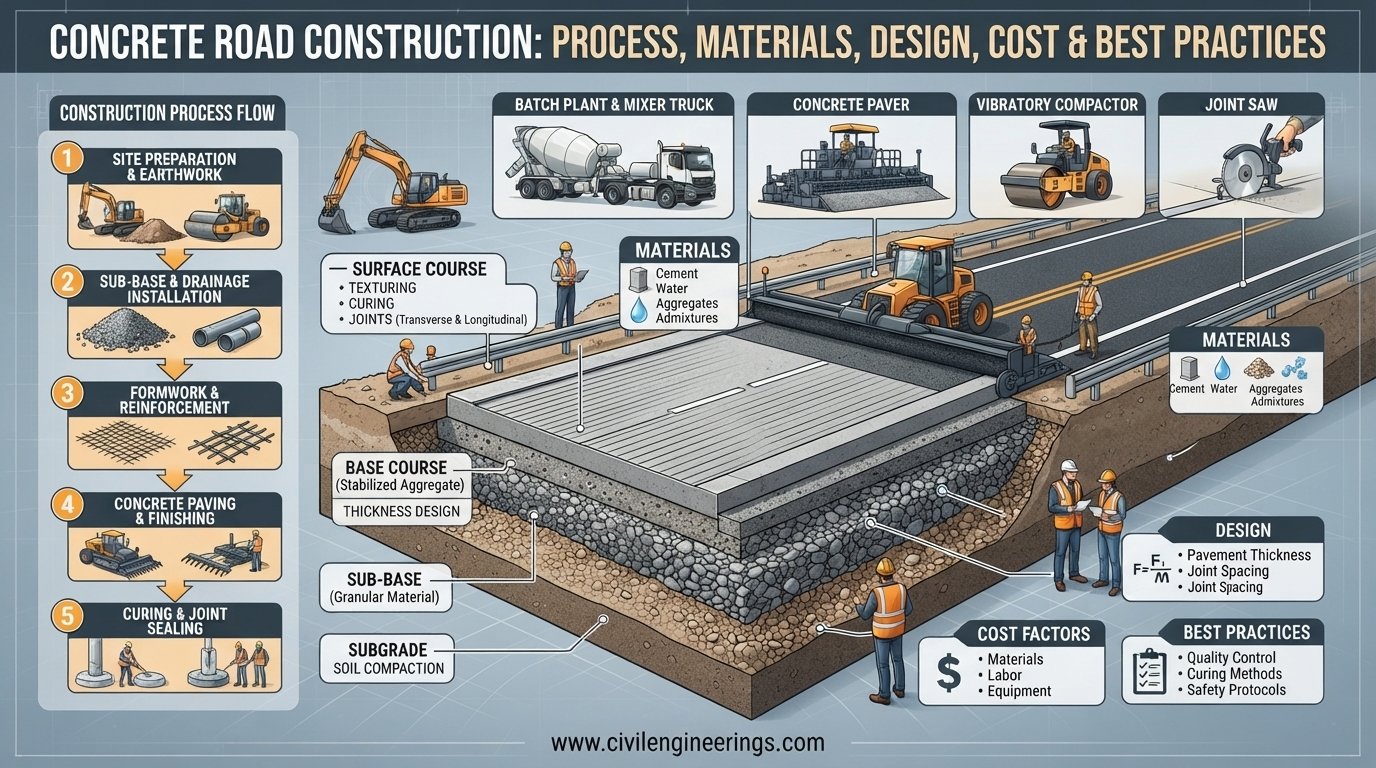
Introduction
Concrete pavements are widely used for highways, urban roads, industrial yards, airport pavements, intersections, and heavily trafficked routes where long service life and structural strength matter. Unlike flexible pavement, which relies heavily on bituminous layers, a concrete pavement carries traffic through a rigid slab that distributes wheel loads over a comparatively large area.
Concrete Road Construction requires much more than placing and finishing concrete. The final performance depends on pavement design, subgrade preparation, drainage, concrete mix quality, reinforcement, joints, batching, placement, curing, and quality control. A small mistake at any stage can lead to cracking, joint deterioration, faulting, surface defects, or premature rehabilitation.
For civil engineering students, understanding the complete construction sequence provides a strong foundation in pavement engineering. Site engineers and contractors need the practical knowledge to control workmanship, while consultants and government engineers must verify compliance with specifications and design requirements.
This guide explains the complete concrete road construction process, materials, pavement components, design principles, joints, equipment, quality tests, common failures, safety practices, and recommendations based on established highway engineering principles.


What Is Concrete Road Construction?
Concrete road construction is the process of designing and building a road pavement using hydraulic cement concrete as the primary structural paving material. The hardened concrete slab forms a rigid pavement system that transfers traffic loads to the supporting layers and ultimately to the subgrade.
The pavement may contain cement concrete, coarse and fine aggregates, water, chemical admixtures, mineral additions, and steel reinforcement where required.
A typical rigid pavement consists of:
- Prepared subgrade
- Granular or stabilized subbase
- Concrete pavement slab
- Reinforcement, where specified
- Transverse and longitudinal joints
- Joint sealants and load-transfer devices where applicable
- Surface texture for skid resistance
The exact arrangement depends on traffic, climate, drainage, soil conditions, pavement design method, and project specifications.
Why Concrete Pavement Is Used for Roads
Concrete pavement offers several characteristics that make it attractive for demanding transportation facilities.
High Structural Capacity
A properly designed concrete slab can withstand substantial wheel loads and distribute them across a relatively broad area. This makes rigid pavement suitable for heavy trucks, bus routes, industrial roads, ports, and other high-load applications.
Long Service Life
Good-quality concrete pavement can provide a long service period when engineers control drainage, joints, materials, construction quality, and maintenance.
However, a long design life does not mean concrete roads are maintenance-free. Joint sealing, localized repairs, drainage maintenance, and surface treatments may still become necessary.
Resistance to Rutting
Flexible pavements can develop permanent deformation under repeated heavy traffic and high temperatures. Concrete pavement generally resists conventional wheel-path rutting because the cementitious slab behaves as a rigid structural layer.
Lower Sensitivity to Fuel and Oil Spills
Concrete surfaces generally offer better resistance to localized petroleum contamination than many asphalt surfaces, making them useful in industrial and logistics areas.
High Initial Construction Cost
The major disadvantage is often the higher initial cost. Concrete pavement also demands careful construction control because errors in slab thickness, curing, joint timing, or concrete quality can be difficult and expensive to correct.
Components of a Concrete Road
Understanding each pavement layer helps engineers identify how the complete system behaves under traffic.
Subgrade
The subgrade is the prepared soil foundation beneath the pavement structure. Its strength, uniformity, moisture condition, and drainage characteristics significantly affect pavement performance.
Weak areas should not simply be covered with concrete. Engineers should investigate the cause and provide appropriate treatment, such as stabilization, replacement, drainage improvement, or improved subbase support.
Subbase
The subbase is positioned above the subgrade and below the concrete slab when included in the pavement design.
It can:
- Improve uniform support
- Reduce pumping
- Assist drainage
- Provide a stable construction platform
- Reduce the effects of subgrade variability
- Improve load distribution
Common materials include crushed aggregate, granular material, cement-treated material, and other approved stabilized layers.
Concrete Slab
The slab provides the primary structural capacity. Its required thickness depends on design traffic, axle loading, concrete properties, support conditions, joint configuration, environmental effects, and the selected pavement design method.
Reinforcement
Not every concrete road requires conventional reinforcement throughout the slab.
Depending on the pavement type and design, steel may be used to control crack widths, maintain continuity, transfer loads, or support specific structural arrangements.
Joints
Joints allow engineers to control where movement and cracking occur.
Important joint categories include:
- Transverse contraction joints
- Longitudinal joints
- Construction joints
- Expansion joints where required
Poorly designed or poorly constructed joints are among the most common sources of rigid pavement distress.
Materials Used in Concrete Road Construction
Concrete pavement requires materials that meet specified engineering and durability requirements.
Cement
Portland cement and other approved cementitious systems may be used depending on the project specification.
Engineers should consider:
- Strength development
- Setting characteristics
- Heat generation
- Durability
- Compatibility with admixtures
- Environmental exposure
The cement type should always comply with the governing project specification rather than being selected solely because it produces high early strength.
Aggregates
Aggregates normally make up a major portion of concrete volume.
Coarse and fine aggregates should have suitable:
- Gradation
- Cleanliness
- Strength
- Durability
- Shape and texture
- Resistance to abrasion
- Chemical stability
Aggregate quality strongly affects workability, strength, shrinkage, durability, and pavement texture.
Water
Concrete mixing water should be suitable for concrete production. Excessive water increases the water-cement ratio and can reduce strength and durability.
Admixtures
Chemical admixtures can modify concrete properties. Depending on project requirements, engineers may use water reducers, high-range water reducers, air-entraining agents, retarders, accelerators, or other approved products.
Admixtures should undergo compatibility checks with the cementitious materials and be dosed according to the approved mix design.
Supplementary Cementitious Materials
Materials such as fly ash, slag, silica fume, or other approved supplementary cementitious materials can modify durability, workability, heat development, and long-term strength.
Their use depends on availability, specification requirements, climate, construction schedule, and desired concrete performance.
Concrete Road Construction Process Step by Step
A successful project follows a controlled sequence rather than treating concrete placement as an isolated activity.
1. Site Investigation and Survey
Before construction starts, engineers establish the road alignment, levels, drainage requirements, pavement width, crossfall, and existing ground conditions.
The investigation may include:
- Topographic survey
- Soil investigation
- Subgrade testing
- Groundwater assessment
- Existing utility identification
- Traffic studies
- Material-source investigation
Accurate survey control prevents problems with pavement thickness, drainage, levels, and geometric alignment.
2. Earthwork and Subgrade Preparation
The contractor excavates or fills the road formation to the required level.
The subgrade should then be:
- Shaped to the specified profile.
- Moisture-conditioned when necessary.
- Compacted to the required density.
- Checked for soft spots.
- Tested for uniformity and strength.
A proof-rolling operation can help identify weak locations, although the exact procedure should follow project specifications.
3. Subbase Construction
The approved subbase material is spread in controlled layers and compacted.
Engineers should verify:
- Layer thickness
- Moisture content
- Compaction
- Surface tolerance
- Crossfall
- Finished elevation
A smooth and uniform subbase provides a much better platform for concrete paving.
4. Formwork or Paving Machine Setup
Traditional projects may use fixed side forms, while major highway projects commonly use slipform paving equipment.
The setup must maintain:
- Pavement width
- Line and level
- Slab thickness
- Cross slope
- Joint position
- Edge geometry
Survey checks should occur before concrete placement rather than relying entirely on machine controls.
5. Concrete Batching and Mixing
Concrete ingredients are proportioned according to the approved mix design.
Batching systems should control material quantities accurately. Mixing must provide uniform distribution of cementitious material, aggregate, water, and admixtures.
One critical field principle is water control. Workers should never add uncontrolled water simply to make concrete easier to place.
6. Concrete Transportation
Concrete should reach the paving operation within the specified time and condition.
The transportation method must minimize:
- Segregation
- Excessive temperature rise
- Loss of workability
- Contamination
- Delays
The allowable time between mixing and placement depends on the concrete system, weather, admixtures, and specification.
7. Concrete Placement
Concrete is discharged and spread across the prepared paving area.
For highway projects, a slipform paver can continuously place, consolidate, and shape the concrete.
Proper placement should avoid segregation and maintain consistent slab thickness.
8. Concrete Consolidation
Vibration removes entrapped air and helps concrete achieve proper density.
Mechanical vibrators should be correctly adjusted. Excessive vibration can contribute to segregation, while inadequate consolidation can create honeycombing and weak zones.
9. Surface Finishing
The pavement surface is struck off and finished to the specified profile.
Finishing should not introduce excessive water to the surface or disturb the concrete unnecessarily.
The objective is a uniform surface that meets requirements for:
- Smoothness
- Elevation
- Crossfall
- Texture
- Thickness
- Edge profile


10. Surface Texturing
Fresh concrete pavement generally requires a suitable surface texture to improve skid resistance and manage tire-water interaction.
Texturing methods vary according to project specifications and pavement type.
The selected texture should provide adequate friction without creating unnecessary surface irregularity.
11. Joint Construction
Joints should be constructed at the correct locations and at the appropriate stage.
For saw-cut contraction joints, timing is critical. Cutting too early can cause raveling or damage, while cutting too late may allow uncontrolled cracking.
The actual timing depends on concrete strength development, weather, mixture characteristics, equipment, and site conditions.
12. Curing
Curing is one of the most important steps in concrete pavement construction.
The objective is to maintain suitable moisture and temperature conditions so hydration can continue and the concrete can develop the required properties.
Common approaches include:
- Membrane curing compounds
- Wet curing
- Moisture-retaining coverings
- Other approved curing systems
Poor curing can increase shrinkage cracking and reduce surface durability.
13. Joint Sealing
Where joint sealing is specified, joints are prepared and sealed using an approved material.
The joint must be clean, properly shaped, and dry enough for the selected sealant system.
A defective seal can allow water and incompressible materials to enter the joint, increasing the risk of deterioration.
14. Opening to Traffic
Concrete pavement should not be opened simply because the surface appears hard.
The project specification should establish opening criteria based on strength, maturity, temperature, curing, and other relevant requirements.
Concrete Pavement Design Principles
Concrete pavement design determines the slab thickness and structural arrangement needed to withstand expected loading and environmental conditions.
Design Traffic
Traffic loading is usually converted into a design parameter representing the damaging effect of repeated axle loads.
A simplified conceptual relationship for cumulative traffic loading can be expressed as:
where:
- = cumulative design load repetitions
- = repetitions of a particular axle-load category
Actual pavement design requires detailed axle-load distributions and an approved design methodology.
Flexural Strength
Concrete pavement design often places strong emphasis on flexural strength because slabs experience bending under wheel loading.
A common laboratory measure is the modulus of rupture.
For a third-point loading beam test, a commonly used relationship is:
where:
- = modulus of rupture
- = maximum applied load
- = span
- = specimen width
- = specimen depth
The exact test method and equation should follow the applicable standard.
Slab Thickness
Increasing slab thickness generally increases structural capacity, but thickness should come from an engineering design rather than an arbitrary rule.
Design inputs may include:
- Traffic volume
- Axle-load spectrum
- Concrete strength
- Subgrade support
- Subbase properties
- Reliability
- Climate
- Drainage
- Joint spacing
- Shoulder conditions
Types of Concrete Pavements
Concrete pavement can be categorized according to its reinforcement and structural arrangement.
Jointed Plain Concrete Pavement
JPCP uses regularly spaced joints to control cracking and accommodate slab movement.
Jointed Reinforced Concrete Pavement
JRCP includes distributed reinforcement and uses joints at designed intervals.
Continuously Reinforced Concrete Pavement
CRCP contains continuous longitudinal reinforcement and is designed to develop closely spaced, controlled transverse cracks rather than relying on frequent transverse contraction joints.
Roller-Compacted Concrete Pavement
Roller-compacted concrete uses a relatively stiff concrete mixture that can be placed and compacted with paving and compaction equipment.
It can be useful for industrial roads, heavy-duty yards, and selected transportation applications.
Concrete Pavement Joints Explained
Joint design deserves special attention because joints form intentional discontinuities within the pavement.


Transverse Contraction Joints
These joints control cracking caused by drying shrinkage and temperature-related movement.
Longitudinal Joints
Longitudinal joints divide wide pavement sections into manageable lanes and help control longitudinal cracking.
Dowel Bars
Dowel bars provide load transfer across selected transverse joints while allowing horizontal movement.
Proper alignment and placement are essential. Misaligned dowels can restrict slab movement and create joint distress.
Tie Bars
Tie bars are generally used across longitudinal joints to hold adjacent lanes together. They are not intended to function in the same manner as dowel bars.
Quality Control in Concrete Road Construction
Quality control should continue throughout construction rather than relying only on final testing.
Important checks include:
Fresh Concrete Tests
Depending on the specification, field testing can include:
- Slump
- Air content
- Concrete temperature
- Unit weight
- Workability observations
Hardened Concrete Tests
Testing may include:
- Compressive strength
- Flexural strength
- Core testing where required
- Thickness verification
- Surface regularity
Pavement Geometry Checks
Survey and inspection teams should verify:
- Alignment
- Elevation
- Cross slope
- Thickness
- Width
- Joint spacing
- Surface smoothness
A strong QA/QC system also records batch tickets, test results, weather conditions, curing operations, joint-cutting times, and construction locations.
Common Problems in Concrete Roads
Several defects repeatedly appear when design or construction control is inadequate.
Cracking
Cracks may result from:
- Improper joint timing
- Excessive drying
- Poor curing
- Thermal stresses
- Weak support
- Structural overloading
- Inadequate joint design
Joint Faulting
Faulting occurs when adjacent slab sections develop a difference in elevation.
Water, pumping, repeated loading, poor support, and inadequate load transfer can contribute to the problem.
Surface Scaling
Scaling can occur when the concrete surface deteriorates and loses particles.
Potential contributors include poor concrete quality, inadequate curing, improper finishing, severe exposure, and unsuitable deicing practices where applicable.
Blow-Ups
In certain conditions, thermal expansion combined with restricted movement and inadequate joint functioning can cause localized upward movement or buckling.
Pumping
Pumping involves movement of water and fine material from beneath the slab under repeated wheel loading.
Improved drainage, suitable subbase design, and adequate support can reduce the risk.
Equipment Used for Concrete Road Construction
Modern projects may use specialized paving equipment to achieve consistent quality.
Typical equipment includes:
- Batching plant
- Concrete mixer or central mixing plant
- Dumpers or concrete transport vehicles
- Slipform paver
- Fixed-form paving equipment
- Concrete vibrator
- Texturing equipment
- Joint saw
- Curing compound sprayer
- Survey equipment
- Testing equipment
- Concrete cutting equipment
Large highway projects benefit from mechanized paving because consistent production and placement rates can improve slab uniformity.
IRC, AASHTO and ICE Guidance
Concrete pavement design and construction should follow the standards specified for the particular project and jurisdiction.
In India, engineers commonly consult relevant IRC publications for pavement design, concrete roads, materials, geometric considerations, and construction practices.
In the United States and many international projects, AASHTO guidance is widely used for pavement design and transportation engineering practice.
The Institution of Civil Engineers (ICE) provides broader professional and engineering guidance, although it should not be treated as a single concrete pavement construction specification.
Engineers should always use the latest contract documents, national standards, project specifications, and approved design methodology. A generic online recommendation should never override a project’s governing specification.
Best Practices for Concrete Road Construction
The following practices can significantly improve pavement performance:
- Investigate the subgrade before finalizing pavement design.
- Provide adequate drainage.
- Use approved and well-graded aggregates.
- Control the water-cementitious materials ratio.
- Calibrate batching equipment regularly.
- Avoid uncontrolled addition of water at the paving site.
- Maintain consistent concrete delivery.
- Control concrete temperature during hot-weather construction.
- Place and consolidate concrete uniformly.
- Avoid excessive surface finishing.
- Texture the surface according to specification.
- Cut joints at the correct time.
- Maintain correct dowel alignment.
- Apply curing immediately using the approved method.
- Record construction and testing data systematically.
- Do not open the road until specified acceptance criteria are achieved.
Practical Recommendations for Civil Engineering Students
Students should learn concrete pavement as a complete system rather than memorizing isolated definitions.
Focus on:
- Pavement components
- Rigid pavement behavior
- Flexural strength
- Load transfer
- Joint functions
- Subgrade support
- Concrete mix design
- Curing
- Pavement failures
- Quality control
During site visits, observe the relationship between drawings, survey levels, concrete production, paving equipment, joint layout, and testing.
A useful exercise is to take a typical road cross-section and identify the function of every layer and component.
Practical Recommendations for Highway and Site Engineers
Engineers should focus heavily on field control.
Before paving, verify:
- Survey control
- Subbase condition
- Weather forecast
- Concrete supply
- Equipment calibration
- Joint materials
- Dowel and tie-bar arrangements
- Curing resources
- Testing personnel
During paving, continuously monitor concrete consistency, slab thickness, machine operation, surface profile, joints, curing, and weather conditions.
Do not wait until the next day to discover that the paving operation produced an incorrect thickness or poorly aligned joint.
Practical Recommendations for Contractors
Contractors should treat concrete paving as a production system.
The batching plant, transport fleet, paver, finishing crew, testing laboratory, survey team, and curing operation must work at compatible rates.
Before large-scale paving, a trial section can help confirm:
- Concrete workability
- Paving speed
- Vibration settings
- Surface texture
- Joint-cutting timing
- Curing procedure
- Finishing practices
A well-planned trial section can expose problems before they affect hundreds or thousands of square meters of pavement.
Advantages and Disadvantages of Concrete Roads
Advantages
- High structural strength
- Good resistance to rutting
- Long potential service life
- Suitable for heavy traffic
- Good load distribution
- Reduced sensitivity to fuel spills
- Potentially lower routine maintenance frequency
Disadvantages
- Higher initial construction cost in many cases
- Longer curing requirements
- Joint maintenance is necessary
- Repairs can be more complex
- Construction quality strongly affects performance
- Poorly controlled cracking can become a major defect
- Specialized equipment may be required for large projects
Frequently Asked Questions About Concrete Road Construction
How long does a concrete road last?
A properly designed and constructed concrete pavement can provide a long service life, but actual performance depends on traffic, climate, drainage, materials, design, construction quality, and maintenance.
What is the most important factor in concrete road construction?
There is no single factor. A durable pavement requires adequate structural design, uniform support, quality concrete, effective joints, proper curing, drainage, and consistent workmanship.
Why are joints provided in concrete roads?
Joints control movement and help manage cracking caused by shrinkage, temperature changes, construction operations, and slab geometry.
Are dowel bars and tie bars the same?
No. Dowel bars primarily provide load transfer across selected transverse joints while allowing movement. Tie bars generally hold adjacent concrete lanes together across longitudinal joints.
Why is curing important for concrete pavement?
Curing helps maintain conditions required for cement hydration and strength development. Poor curing can contribute to surface deterioration, shrinkage cracking, and reduced durability.
Can concrete roads be constructed during hot weather?
Yes, but hot-weather paving requires additional controls. Engineers may need to manage concrete temperature, delivery time, evaporation, curing, and setting behavior according to project requirements.
What tests are performed on concrete roads?
Depending on specifications, testing can include slump, temperature, air content, compressive strength, flexural strength, thickness, surface regularity, and other acceptance tests.
Is concrete pavement better than asphalt pavement?
Neither is universally better. Concrete may be advantageous for heavy traffic and long service-life applications, while asphalt can offer faster construction, easier staged rehabilitation, and different cost advantages. Selection should follow a life-cycle and engineering assessment.
What causes cracks in concrete pavement?
Cracking can result from shrinkage, temperature movement, inadequate joint timing, poor curing, weak support, excessive loading, design deficiencies, or construction problems.
When can a new concrete road open to traffic?
Opening should follow the project’s specified strength, curing, maturity, or other acceptance criteria. Visual hardness alone is not an adequate basis for opening a pavement.
Conclusion
Concrete Road Construction is a multidisciplinary process that combines pavement engineering, concrete technology, surveying, geotechnical engineering, drainage, construction management, and quality control. The concrete slab receives most of the attention, but its performance depends heavily on everything beneath and around it.
A durable rigid pavement starts with a properly investigated subgrade and a suitable pavement design. From there, contractors must maintain accurate batching, controlled water content, uniform placement, effective consolidation, appropriate finishing, timely joint cutting, and reliable curing. Dowel and tie-bar installation also requires careful attention because small alignment errors can create long-term problems.
For students, concrete pavement offers an excellent practical example of how civil engineering principles interact on a real project. For engineers and contractors, disciplined field control is the key to converting a good design into a durable road.
Ultimately, successful Concrete Road Construction is not achieved by concrete strength alone. It comes from combining sound design, quality materials, proper drainage, precise workmanship, effective quality assurance, and timely maintenance throughout the pavement’s life cycle.
