
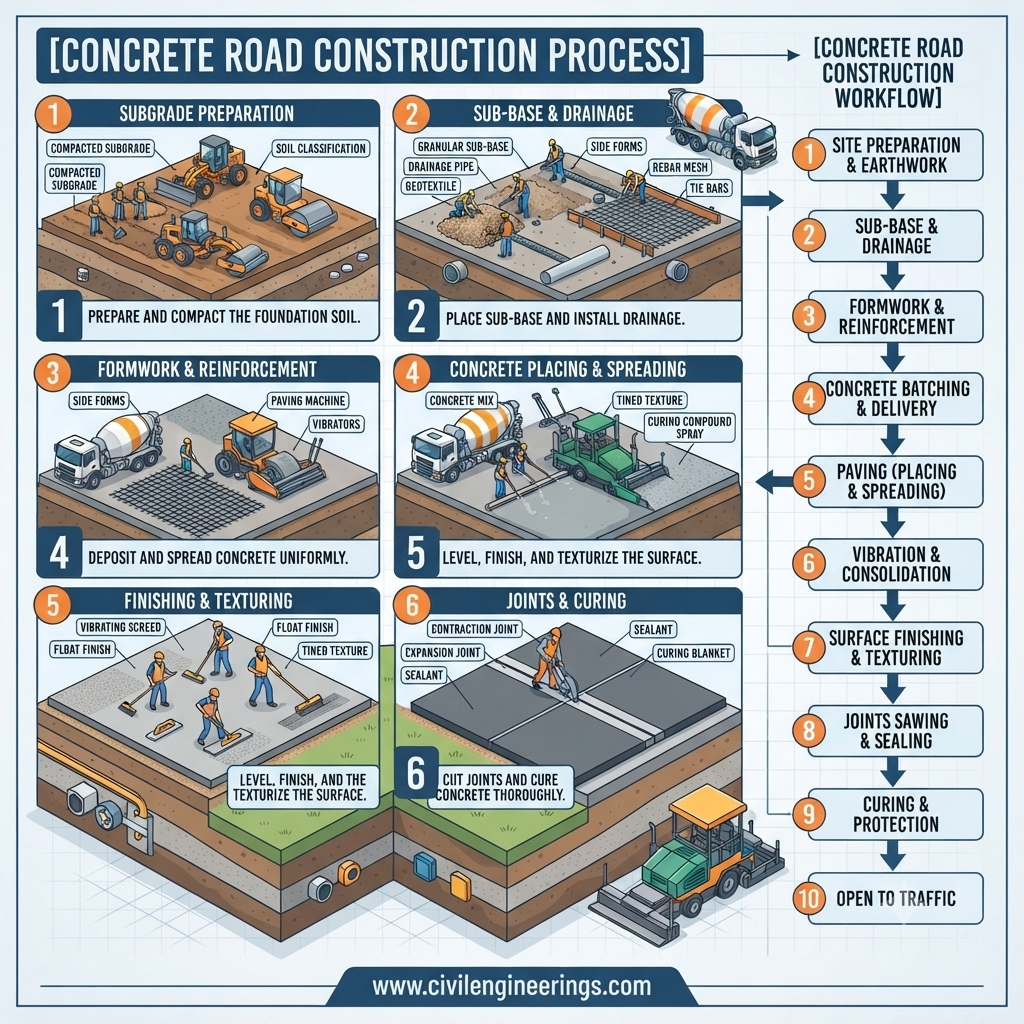
Concrete roads are built to carry repeated wheel loads while maintaining strength, ride quality, and serviceability for many years. Unlike flexible pavements, concrete pavement relies primarily on a rigid cement-concrete slab to distribute traffic loads over the underlying layers. That makes workmanship, material control, joint detailing, curing, and surface finishing especially important.
The Concrete Road Construction Process involves much more than placing fresh concrete on a prepared surface. It starts with route and pavement planning, subgrade preparation, drainage, subbase construction, reinforcement and joint installation, concrete batching, transportation, placement, compaction, finishing, texturing, curing, joint cutting, and quality control. Every stage influences the performance of the finished pavement.
For civil engineering students, highway engineers, site engineers, contractors, consultants, and infrastructure professionals, understanding this sequence helps prevent costly construction defects. A well-designed concrete pavement can provide excellent durability, structural capacity, and resistance to deformation when the construction process is properly controlled.
This guide explains each major stage, practical engineering considerations, common problems, quality tests, relevant standards, and field recommendations for successful concrete road construction.
What Is Concrete Road Construction?
Concrete road construction is the process of constructing a pavement system using hydraulic cement concrete as the principal structural pavement layer. The concrete slab generally consists of cement, fine aggregate, coarse aggregate, water, and, where required, chemical or mineral admixtures.
The slab transfers wheel loads to the supporting layers through its flexural strength and stiffness. Depending on the pavement design, the road may include a compacted subgrade, granular or stabilized subbase, drainage provisions, concrete slab, joints, dowel bars, tie bars, and other pavement features.
Rigid pavement behaves differently from flexible pavement. A flexible pavement distributes traffic loads through several aggregate and bound layers, while a concrete slab spreads loads over a comparatively wider area because of its high stiffness.
The performance of the finished road depends on both pavement design and construction quality. Even an adequately designed slab can develop premature cracking, faulting, scaling, or joint deterioration if construction controls are poor.
Main Components of a Concrete Road
A concrete pavement is a complete structural system rather than a single layer.
Subgrade
The subgrade is the prepared soil surface supporting the pavement structure. Its strength, uniformity, moisture condition, and drainage characteristics significantly affect pavement performance.
Weak areas should be identified before concrete placement. Depending on project requirements, unsuitable material may be removed and replaced, stabilized, or otherwise improved.
Subbase
A subbase may consist of granular material, cement-treated material, lean concrete, or another approved layer.
Its functions can include:
- Providing uniform support
- Reducing pumping of fine soil
- Improving drainage
- Providing a stable construction platform
- Controlling moisture movement
- Reducing erosion beneath the slab
The appropriate subbase type depends on traffic, soil conditions, climate, drainage, and pavement design.
Concrete Slab
The concrete slab forms the principal structural element of the rigid pavement. Its thickness and concrete properties come from the pavement design.
Important characteristics include compressive strength, flexural strength, modulus of elasticity, durability, workability, shrinkage behavior, and resistance to environmental exposure.
Joints
Joints control or accommodate movement within the concrete pavement. Common arrangements include transverse contraction joints, longitudinal joints, construction joints, and expansion joints where required by the design.
Poorly constructed joints can become major sources of water infiltration, faulting, spalling, and roughness.
Dowels and Tie Bars
Dowel bars transfer wheel loads across transverse joints while allowing controlled horizontal movement.
Tie bars generally connect adjacent concrete lanes and help maintain alignment between slabs. They are not normally intended to function as primary load-transfer devices in the same manner as dowels.
Concrete Road Construction Process Step by Step
A successful project follows a controlled sequence. The exact method varies according to pavement type, project specifications, equipment, climate, and traffic requirements.
1. Site Investigation and Construction Planning
Before physical construction begins, engineers review the route, existing ground conditions, traffic requirements, drainage, utilities, material sources, and environmental conditions.
The investigation normally considers:
- Soil classification
- Subgrade strength
- Groundwater conditions
- Existing pavement conditions
- Drainage patterns
- Traffic loading
- Material availability
- Construction access
- Weather conditions
- Utility conflicts
A detailed method statement should define construction sequences, equipment, testing frequencies, tolerances, concrete handling procedures, joint construction, curing, and contingency measures.
2. Surveying and Setting Out
Survey teams establish the road centerline, pavement edges, elevations, crossfall, longitudinal profile, and construction limits.
Modern projects may use total stations, GNSS equipment, machine-control systems, or other digital surveying technologies.
Before earthwork begins, the team should verify benchmarks and control points. Errors at this stage can later appear as incorrect pavement thickness, poor drainage, incorrect cross slope, or alignment problems.
3. Earthwork and Subgrade Preparation
The existing ground is excavated or filled according to the approved road profile.
Cut and fill operations should achieve the required formation level. Soft pockets, organic soils, loose zones, and unsuitable material require treatment.
After shaping, the subgrade is brought to the appropriate moisture condition and compacted using suitable equipment.
The objective is not simply to achieve a high density value. The finished formation should also provide uniform support.
A useful field relationship for checking compaction is:
The required percentage depends on the project specification and applicable standard.
4. Subgrade Inspection and Proof Rolling
Before placing the next pavement layer, engineers inspect the prepared formation.
Proof rolling can help identify yielding or unstable areas that conventional spot density tests may not reveal.
If a loaded roller produces noticeable rutting, pumping, or excessive deflection in an isolated location, the area should be investigated rather than simply covered with the next layer.
This is one of the practical lessons that often separates durable pavement construction from short-term work: uniform support matters as much as nominal strength.
5. Subbase Construction
Approved subbase material is spread to the specified thickness and compacted.
The construction crew must control:
- Layer thickness
- Moisture content
- Gradation
- Compaction
- Surface level
- Crossfall
- Smoothness
- Cleanliness
The finished surface should provide continuous support for the concrete pavement.
Any contamination, loose material, standing water, or significant surface irregularity should be corrected before concrete placement.
6. Installation of Drainage and Edge Features
Effective drainage is essential for pavement durability.
Depending on the road design, drainage may include side drains, longitudinal drains, transverse drainage systems, subdrains, outlets, shoulders, and other water-management features.
Water trapped beneath a concrete pavement can contribute to erosion, pumping, loss of support, and joint-related deterioration.
Drainage structures must therefore be coordinated with pavement elevations and construction levels before concrete placement.
7. Formwork or Slipform Setup
Concrete roads may be constructed using fixed-form or slipform paving methods.
In fixed-form construction, rigid forms establish the pavement edges and elevation. Forms must be securely supported and accurately aligned.
The crew checks:
- Line
- Level
- Cross slope
- Form stability
- Joint locations
- Pavement thickness
- Surface cleanliness
Slipform paving uses a specialized paving machine to continuously place and shape concrete without conventional side forms.
For large highway projects, mechanized slipform paving can provide high production rates and consistent geometry when the concrete supply and paving operation are properly coordinated.
8. Reinforcement, Dowels, and Tie Bars
Where specified by design, reinforcement is installed before concrete placement.
Dowels at transverse joints must have correct diameter, length, spacing, alignment, and embedment. They generally require appropriate support systems to prevent displacement during paving.
Tie bars must also remain correctly positioned.
A small positional error can affect joint performance. For that reason, reinforcement and joint hardware should be inspected before the concrete operation begins.
9. Concrete Mix Design and Batching
Concrete mix design aims to achieve the required strength, workability, durability, and construction performance.
Typical components include:
- Cementitious materials
- Coarse aggregate
- Fine aggregate
- Water
- Chemical admixtures
- Supplementary cementitious materials where specified
The water-cementitious material ratio is a major factor influencing concrete performance.
A simplified relationship can be expressed as:
The actual mix design must comply with the project specification and laboratory-approved proportions.
Concrete for pavement construction should not be designed solely around compressive strength. Flexural performance, durability, shrinkage, workability, finishing characteristics, and environmental exposure also matter.
10. Transportation of Fresh Concrete
Fresh concrete must reach the paving operation within the permitted time and in suitable condition.
Long transportation times, excessive delays, high temperatures, or uncontrolled addition of water can change concrete properties.
The site team should maintain communication between the batching plant, haul vehicles, testing personnel, and paving crew.
Concrete supply should match the paving rate. Stopping and restarting the operation unnecessarily can create construction joints and reduce productivity.
11. Concrete Placement
Concrete is discharged in front of the paving equipment or into the prepared forms according to the selected construction method.
The concrete should be distributed without excessive segregation.
The crew monitors:
- Concrete thickness
- Alignment
- Reinforcement position
- Dowel alignment
- Workability
- Temperature
- Surface level
Mechanical paving equipment can help achieve consistent slab geometry on major projects.
12. Concrete Compaction
Concrete must be adequately consolidated to eliminate harmful voids and achieve proper contact around reinforcement and joint hardware.
Vibration may be performed through internal vibrators, paving-machine vibration systems, or other approved equipment.
Over-vibration should also be avoided because it can encourage segregation and adversely affect the uniformity of the concrete.
The goal is adequate consolidation without disturbing the mix.
13. Screeding and Surface Finishing
After placement and initial consolidation, the surface is struck off and finished to the specified profile.
The operation establishes the pavement’s final geometry.
Excessive finishing should be avoided, particularly when it brings excessive water or mortar to the surface.
Experienced crews focus on achieving the specified elevation and texture without repeatedly manipulating the surface.
14. Surface Texturing
Concrete pavement requires suitable surface texture to provide skid resistance and manage tire-water interaction.
Texturing may involve methods such as brooming, tining, or other project-approved techniques.
The texture should be consistent across the pavement and appropriate for the intended operating conditions.
Surface texture is not merely an appearance issue. It contributes directly to pavement safety and wet-weather performance.
15. Concrete Curing
Curing is one of the most important stages in the Concrete Road Construction Process.
Fresh concrete needs suitable moisture and temperature conditions so that cement hydration can continue and the required properties can develop.
Approved curing compounds, wet curing methods, sheets, or other specified systems may be used.
Poor curing can contribute to:
- Plastic shrinkage cracking
- Reduced surface strength
- Excessive drying
- Surface dusting
- Reduced durability
Curing should begin at the appropriate stage after finishing and texturing, following the project specification and environmental conditions.
16. Joint Saw Cutting
For many jointed concrete pavement systems, contraction joints are formed or saw-cut at controlled locations.
Timing is critical.
If cutting occurs too early, the concrete can ravel or break along the joint. If it occurs too late, uncontrolled shrinkage cracking may develop.
The required depth and timing depend on pavement design, concrete characteristics, weather, equipment, and specifications.
Joint layout should be established before paving so the cutting crew can work efficiently once the concrete reaches the appropriate condition.
17. Joint Sealing
Where specified, joint reservoirs are prepared and sealed using an approved sealant system.
Before sealing, joints should be clean and dry as required by the selected sealant and project specification.
Effective sealing limits the entry of water and incompressible materials into the joint system.
18. Pavement Edge and Shoulder Construction
After the concrete slab reaches the required condition, shoulders and edge features are completed according to the road design.
The pavement edge should have proper support and drainage.
Poor edge conditions can increase water infiltration and create localized structural problems.
19. Concrete Strength and Quality Testing
Quality control continues throughout the construction process.
Typical tests may include:
- Slump or workability testing
- Concrete temperature
- Air content where applicable
- Compressive strength
- Flexural strength
- Density
- Aggregate grading
- Cementitious material testing
- Surface level and thickness checks
- Smoothness measurements
Concrete pavement design often gives significant importance to flexural strength because slabs primarily respond to bending stresses.
For a simple stress relationship:
where:
- = bending stress
- = bending moment
- = section modulus
Actual pavement analysis is considerably more complex and should follow the selected pavement design method.
20. Final Inspection and Opening to Traffic
The finished pavement is inspected for geometry, joints, surface texture, cracks, defects, drainage, smoothness, and other acceptance criteria.
Traffic should not be allowed simply because the surface appears hard.
The pavement must achieve the required strength or maturity criteria and satisfy the project’s opening-to-traffic requirements.
Important Engineering Factors in Concrete Pavement Construction
Several variables have a major influence on pavement performance.
Subgrade Uniformity
A strong location beside a weak location creates differential support. The resulting variation can increase slab stresses.
Uniformity should therefore be treated as a fundamental construction objective.
Concrete Temperature
Hot-weather concreting can accelerate setting and increase moisture loss. Cold conditions can slow strength development and create other risks.
Temperature control should be incorporated into the construction plan rather than treated as an emergency response.
Joint Spacing
Joint dimensions and spacing influence slab behavior and crack control.
The selected arrangement should correspond to pavement design, slab thickness, concrete properties, reinforcement strategy, and environmental conditions.
Drainage
Even a high-quality concrete slab can suffer premature deterioration when water repeatedly reaches and remains beneath the pavement.
Drainage should be considered part of pavement engineering rather than an independent roadside feature.
Common Defects in Concrete Roads
Understanding defects helps engineers identify problems before they become expensive failures.
Cracking
Cracks can result from shrinkage, thermal effects, inadequate joint timing, excessive slab restraint, poor curing, construction errors, or structural deficiencies.
Not every crack has the same cause. Engineers should investigate the pattern, location, width, depth, timing, and surrounding pavement condition before selecting a repair.
Joint Spalling
Spalling occurs when concrete breaks away around a joint.
Possible contributing factors include poor joint construction, incompressible materials entering joints, inadequate concrete quality, environmental exposure, or improper joint movement.
Faulting
Faulting describes a difference in elevation between adjacent slabs.
Repeated traffic, inadequate load transfer, water-related erosion, and loss of support can contribute to faulting.
Scaling
Scaling involves deterioration or peeling of the concrete surface.
Poor finishing, inadequate curing, unsuitable materials, freezing exposure where relevant, or improper construction practices can contribute to surface deterioration.
Pumping
Pumping occurs when repeated wheel loads force water and fine material from beneath slab joints or cracks.
It indicates a support and moisture-management problem that deserves investigation.
Quality Control Checklist for Concrete Road Construction
Before concrete placement, the site engineer should confirm:
- Approved drawings are available.
- Subgrade and subbase have passed inspection.
- Pavement levels are correct.
- Drainage works are complete.
- Forms or paving equipment are correctly aligned.
- Dowels and tie bars are correctly positioned.
- Concrete mix has been approved.
- Testing equipment is available.
- Curing materials are ready.
- Joint layout has been established.
- Weather conditions have been assessed.
- Concrete supply is coordinated with paving production.
During paving, the team should continuously monitor concrete consistency, placement rate, slab thickness, alignment, surface level, joint hardware, finishing, texture, and curing.
Best Practices for Contractors
Contractors should treat concrete paving as an integrated production system.
First, maintain a stable concrete supply. A high-capacity paver cannot compensate for irregular concrete delivery.
Second, calibrate batching equipment and monitor aggregate moisture. Changes in aggregate moisture can significantly alter the effective water content of the mix.
Third, keep testing personnel close to the paving operation. Quality problems are easier and cheaper to correct while the concrete is still fresh.
Fourth, prepare curing and joint-cutting crews before paving starts. Delayed curing or saw cutting can create problems that are difficult to reverse.
Finally, record production data. Concrete batch records, temperatures, test results, paving rates, joint locations, weather observations, and inspection results provide valuable evidence for quality assurance and future maintenance decisions.
Practical Recommendations for Civil Engineering Students
Students should learn the process as a connected system rather than memorizing isolated construction steps.
Understand why each layer exists and how loads move through the pavement.
Practice reading:
- Pavement drawings
- Typical cross sections
- Joint layouts
- Concrete mix designs
- Testing reports
- Material specifications
- Method statements
Students should also become familiar with field equipment such as total stations, concrete testing equipment, plate compactors, rollers, paving machines, vibrators, and concrete saws.
A useful exercise is to visit an active pavement project and compare the approved drawings with actual site operations.
Practical Recommendations for Highway Engineers and Site Engineers
Engineers should focus heavily on verification before irreversible operations.
Check subgrade uniformity before approving the subbase. Verify dowel and tie-bar alignment before concrete placement. Confirm concrete temperature and workability before allowing large-scale paving.
Do not rely on a single test result to judge an entire pavement section.
Trend data can be more informative than isolated values. Increasing concrete temperature, changing workability, or declining strength results may indicate a developing process-control problem.
Engineers should also document deviations immediately. Good construction records can help identify the root cause of later pavement distress.
Practical Recommendations for Consultants and Government Engineers
Consultants and supervising agencies should establish clear inspection and hold points.
Important hold points may include:
- Subgrade approval
- Subbase approval
- Joint hardware inspection
- Concrete mix approval
- Trial paving
- Concrete placement
- Curing inspection
- Joint cutting
- Final pavement inspection
Acceptance criteria should be measurable and linked to the contract specifications.
Independent quality assurance testing can complement the contractor’s quality-control system, particularly on major highway and infrastructure projects.
IRC, AASHTO, and ICE Considerations
Concrete pavement construction should follow the standards and specifications adopted for the particular project and jurisdiction.
In South Asian road projects, IRC publications provide important guidance on pavement design, materials, construction, joints, and related highway engineering practices.
In projects using American design and specification frameworks, AASHTO documents are widely referenced for pavement design, materials, testing, and transportation infrastructure practices.
The Institution of Civil Engineers (ICE) provides broader professional guidance, engineering principles, contract-related knowledge, and infrastructure practice relevant to civil engineering.
These references should not be treated as interchangeable rulebooks. A project should identify the governing specification, design method, testing standards, and contractual requirements before construction begins. Engineers should always use the latest project-approved editions and local requirements rather than relying on generic online summaries.
Advantages of Concrete Road Construction
Concrete pavement offers several important advantages.
High Structural Capacity
Concrete slabs can efficiently distribute heavy wheel loads, making rigid pavement suitable for many high-traffic applications.
Long Service Potential
When properly designed, constructed, drained, and maintained, concrete pavement can provide a long service life.
Resistance to Rutting
Unlike asphalt surfaces, concrete slabs do not develop conventional wheel-path rutting through permanent deformation in the same manner.
Reduced Routine Maintenance
Concrete pavement may require less frequent surface rehabilitation than some flexible pavement systems, although joints and localized defects still require maintenance.
Good Performance Under Heavy Loads
Concrete roads can be particularly attractive for industrial areas, ports, intersections, bus routes, freight corridors, and other locations experiencing substantial loading.
Disadvantages of Concrete Road Construction
Concrete pavement also has limitations.
Higher Initial Construction Cost
The initial investment can be greater than some flexible pavement alternatives.
Longer Construction Constraints
Concrete requires controlled setting and strength development before traffic can use the pavement.
Joint Maintenance
Joints require careful construction and may need periodic maintenance.
Construction Sensitivity
Concrete pavement is highly dependent on workmanship, curing, joint timing, temperature management, and material consistency.
Repairs Can Be More Complex
Localized concrete pavement repairs can require specialized equipment and careful traffic management.
Frequently Asked Questions
How long does concrete road construction take?
The construction period depends on road length, pavement width, concrete supply, equipment, weather, curing requirements, and project specifications. Large projects can progress rapidly with mechanized paving, but traffic opening must wait until the pavement meets the specified strength or maturity requirements.
What is the most important step in concrete road construction?
There is no single step that determines the entire outcome. However, uniform subgrade support, accurate joint construction, appropriate concrete quality, effective curing, and proper surface finishing are particularly important.
Why are joints provided in concrete roads?
Joints help control cracking and accommodate movements associated with drying shrinkage, temperature changes, construction sequences, and slab behavior.
What is the role of dowel bars?
Dowel bars provide load transfer across transverse joints while allowing the adjacent concrete slabs to move horizontally as designed.
What is the difference between dowel bars and tie bars?
Dowel bars primarily facilitate load transfer across joints while allowing movement. Tie bars generally hold adjacent lanes together and maintain lane-to-lane contact.
Why is curing important for concrete pavement?
Curing supports cement hydration and helps concrete develop its intended strength and durability. Poor curing can increase surface deterioration and early cracking.
Can concrete roads be constructed during hot weather?
Yes, but hot-weather paving requires additional controls. Engineers may need to manage concrete temperature, evaporation, delivery time, curing, and construction timing according to project requirements.
How is concrete pavement quality checked?
Quality is evaluated through material tests, concrete workability and temperature checks, strength testing, pavement thickness and level surveys, joint inspections, surface texture, smoothness, and other specified acceptance tests.
What causes cracks in concrete roads?
Cracks can result from shrinkage, thermal movement, inadequate curing, incorrect joint timing, excessive restraint, poor support, construction defects, or structural loading. The visible crack alone does not identify its cause.
Is concrete pavement better than asphalt pavement?
Neither material is universally better. The appropriate pavement depends on traffic, climate, soil, drainage, construction cost, maintenance strategy, availability of materials, design life, and project requirements.
Conclusion
A successful Concrete Road Construction Process depends on disciplined execution from the prepared formation to the final pavement inspection. Concrete pavement is a structural system, so every stage has a purpose. Subgrade uniformity provides consistent support, the subbase improves the construction platform and pavement environment, joint hardware controls slab behavior, and properly proportioned concrete supplies the required structural and durability characteristics.
The construction team must then maintain control during transportation, placement, consolidation, finishing, texturing, curing, and joint cutting. Small mistakes can become significant pavement defects when they are repeated across thousands of square meters.
For engineers and contractors, the most effective approach is proactive quality control. Verify each stage before moving to the next, maintain accurate records, monitor concrete and environmental conditions, and investigate abnormal test results rather than accepting them blindly.
For students and young engineers, learning the reasoning behind each operation is more valuable than memorizing a construction sequence. When design, materials, drainage, workmanship, testing, and maintenance work together, concrete pavement can deliver reliable performance for demanding transportation infrastructure.
The result should not simply be a hard concrete surface. It should be a properly engineered pavement system designed to provide safe, durable, and economical service throughout its intended life.
