
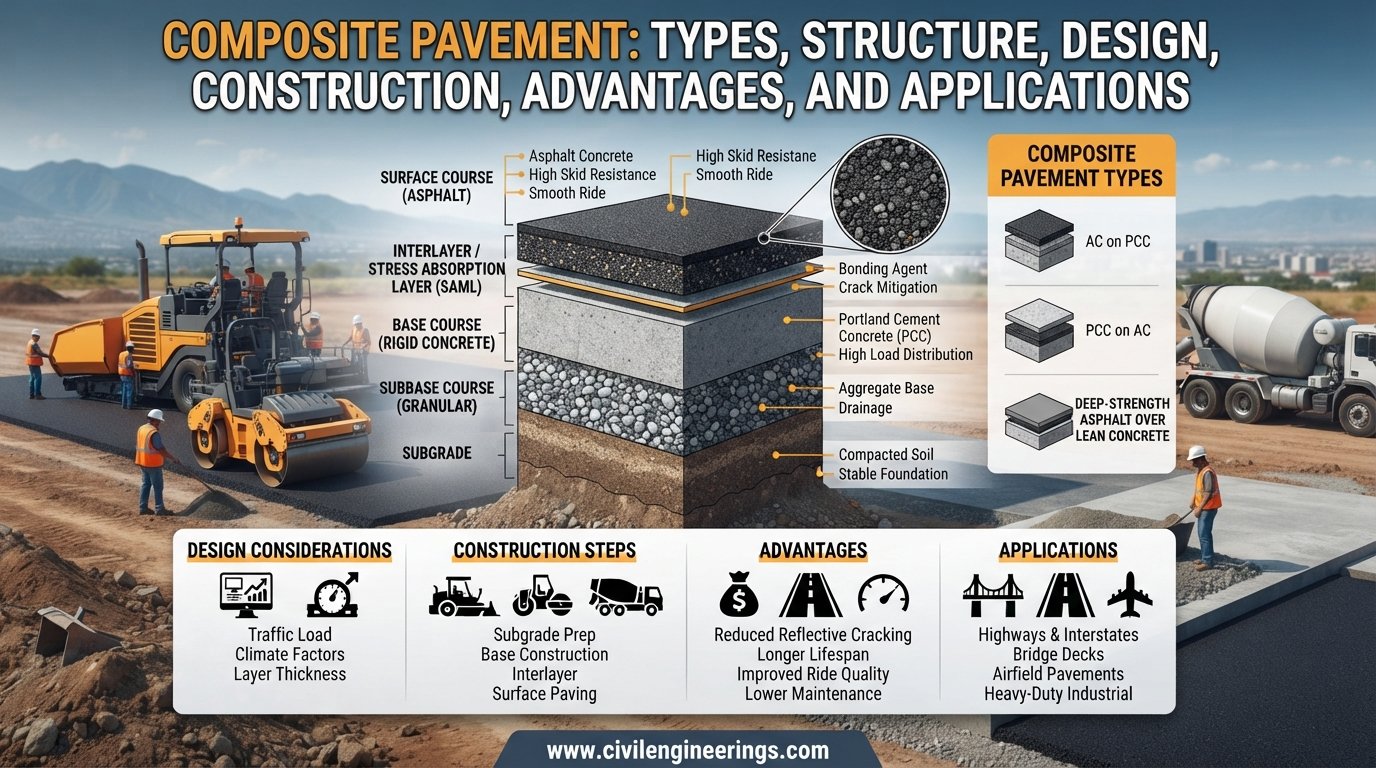
Composite pavement brings together the structural characteristics of rigid and flexible pavement systems. Instead of relying entirely on asphalt or concrete, it uses a combination of materials to achieve a practical balance between strength, ride quality, durability, constructability, and maintenance needs.
For highway engineers and pavement designers, the concept is particularly important because an asphalt layer over a concrete slab can provide a smooth, skid-resistant surface while the underlying concrete supplies substantial structural capacity. Composite pavement is also widely associated with pavement rehabilitation, especially where an existing Portland cement concrete (PCC) pavement receives an asphalt concrete overlay. FHWA describes this as one of the most prevalent composite pavement configurations.
This guide explains composite pavement from an engineering and construction perspective, including its definition, components, types, structural behavior, design considerations, construction procedure, common failures, advantages, limitations, and practical recommendations for students, engineers, contractors, and infrastructure professionals.
What Is Composite Pavement?
Composite pavement is a pavement structure that combines two or more pavement materials having substantially different structural characteristics. The most familiar arrangement consists of an asphalt concrete or hot-mix asphalt (HMA) surface over a Portland cement concrete (PCC) slab.
FHWA broadly classifies pavements into flexible, rigid, composite, and unpaved systems. Composite pavement combines characteristics of flexible and rigid pavement because the asphaltic layer works with a stiff concrete or bound layer beneath it.
A typical section may look like this:
Traffic → Asphalt Concrete Surface → PCC Slab → Base/Subbase → Compacted Subgrade
The asphalt surface contributes smoothness, skid resistance, waterproofing, and relatively easy maintenance. The PCC slab provides high stiffness and distributes wheel loads over a larger area.
However, composite pavement should not be treated simply as “asphalt plus concrete.” The interaction between layers, temperature, moisture, traffic loading, joints, interface condition, and existing pavement condition determines its actual performance.
Why Is Composite Pavement Important?
Modern highways must handle heavy axle loads while maintaining acceptable ride quality for many years. A single pavement material may not provide the most economical solution for every project.
Composite pavement can be useful when engineers want to:
- Increase structural capacity.
- Improve ride quality.
- Reduce surface noise in some applications.
- Restore an aging concrete pavement.
- Provide a durable wearing surface.
- Extend pavement service life.
- Reuse an existing concrete pavement.
- Reduce the frequency of major reconstruction.
- Combine locally available pavement materials.
- Improve maintainability through asphalt resurfacing.
FHWA’s SHRP2 research has specifically examined composite systems such as HMA over PCC and PCC-over-PCC systems, including their design, construction, performance, and life-cycle considerations.
Composite Pavement Structure and Components
A composite pavement consists of several layers, and each layer performs a specific engineering function.


Asphalt Concrete Layer
The upper asphalt layer acts as the pavement’s primary wearing surface. It directly receives traffic, tire forces, environmental exposure, and surface water.
Important properties include:
- Stability
- Fatigue resistance
- Rutting resistance
- Skid resistance
- Durability
- Moisture resistance
- Thermal cracking resistance
The asphalt layer may be dense-graded HMA, modified asphalt mixture, or another specified asphalt surface depending on project requirements.
Its thickness is not selected independently from the concrete layer. The complete pavement system must be analyzed according to traffic, climate, materials, drainage, and structural requirements.
Portland Cement Concrete Layer
The PCC slab provides much of the structural stiffness in a conventional AC/PCC composite pavement.
Concrete pavement may be:
- Jointed plain concrete pavement (JPCP)
- Jointed reinforced concrete pavement (JRCP)
- Continuously reinforced concrete pavement (CRCP)
The concrete layer transfers wheel loads over a wider area than a typical flexible pavement layer. Its flexural strength, elastic modulus, slab thickness, joint condition, support, and temperature behavior influence pavement performance.
Base and Subbase
The base or subbase provides support beneath the PCC slab and helps control moisture, drainage, frost effects, and pumping.
Depending on project conditions, engineers may specify:
- Granular aggregate base
- Cement-treated base
- Asphalt-treated base
- Lean concrete
- Stabilized subbase
- Drainage layer
The quality of the supporting layers is critical. A strong concrete slab cannot compensate indefinitely for poor subgrade preparation or inadequate drainage.
Subgrade
The subgrade is the prepared soil foundation beneath the pavement structure.
Important subgrade characteristics include:
- Strength
- Resilient modulus
- Density
- Moisture condition
- Uniformity
- Drainage behavior
- Swell and shrink characteristics
A pavement designer should evaluate weak zones rather than relying solely on an average soil value. Localized soft areas can become major sources of settlement and cracking.
Types of Composite Pavement
Composite pavement can be classified according to its layer arrangement and how the system was created.
Asphalt Over PCC
This is the most recognizable composite pavement configuration.
Typical section:
HMA → PCC → Base/Subbase → Subgrade
It is frequently produced as a rehabilitation treatment when an existing concrete pavement receives an asphalt overlay. FHWA identifies AC overlay on existing PCC as a very common composite pavement rehabilitation scenario.
The existing concrete may require joint repair, slab replacement, grinding, crack treatment, or other corrective work before asphalt placement.
PCC Over PCC
PCC-over-PCC systems use two concrete lifts, with the upper and lower concrete layers designed to work together.
FHWA’s SHRP2 composite pavement research identifies PCC-over-PCC constructed wet-on-wet as another composite pavement system.
This arrangement can allow engineers to optimize concrete materials and structural performance between layers.
Asphalt Over Cement-Treated Base
Another configuration uses asphalt concrete over a cement-treated or otherwise bound base.
Typical section:
HMA → CTB/CSB → Granular Base/Subbase → Subgrade
The cement-treated layer has considerably greater stiffness than an ordinary unbound aggregate base. Therefore, cracking behavior and reflection cracking must be considered during design.
Asphalt Over Lean Concrete
A lean concrete or similar bound layer may support an asphalt surface. The resulting system combines the wearing characteristics of asphalt with the stiffness of a cementitious foundation.
The exact terminology varies among agencies, so project specifications should always control.
How Composite Pavement Behaves Under Traffic
Understanding structural behavior is essential for proper design.
When a wheel load reaches the asphalt surface, the load produces stresses and strains within the asphalt layer. A substantial portion of the load is then transferred through the stiff concrete layer and supporting layers.
The PCC slab distributes the load over a relatively broad area. This can reduce the magnitude of stress reaching the subgrade.
At the same time, the asphalt layer experiences:
- Compressive stresses
- Tensile strains
- Shear stresses
- Temperature-related movement
- Repeated wheel loading
The interaction becomes more complicated at PCC joints and cracks.
Load Transfer at PCC Joints
Concrete slabs expand and contract with temperature and moisture changes. Joints are therefore introduced to control movement and cracking.
If an asphalt overlay covers the concrete, movement or deterioration at the underlying joint can eventually influence the asphalt surface.
This phenomenon is commonly called reflection cracking.
Interface Behavior
The asphalt-PCC interface is one of the most important parts of the pavement system.
Engineers must consider whether the layers should:
- Bond strongly,
- Remain partially separated, or
- Include a designed interlayer.
The appropriate treatment depends on the pavement type, rehabilitation strategy, crack-control objectives, and design methodology.
Composite Pavement Design Considerations
Composite pavement design requires more than selecting asphalt and concrete thicknesses. Engineers must evaluate the pavement as an interacting structural system.
Traffic Loading
Traffic data normally includes:
- AADT
- Heavy commercial vehicles
- Axle configurations
- Truck growth rate
- Lane distribution
- Directional distribution
- Design period
- Equivalent axle loading or mechanistic traffic inputs
A simplified cumulative traffic relationship can be expressed as:
where:
- = approximate cumulative design traffic
- = annual average daily traffic
- = directional distribution factor
- = design-lane factor
- = traffic growth accumulation factor
Actual pavement design should use the applicable agency’s approved traffic methodology rather than relying on this simplified relationship alone.
Climate and Temperature
Temperature significantly affects both asphalt and concrete.
Asphalt can become softer at high temperatures, increasing rutting susceptibility. At low temperatures, it can become more susceptible to thermal cracking.
Concrete experiences thermal expansion and contraction. Temperature gradients can create curling and warping stresses within slabs.
Therefore, composite pavement design should consider:
- Maximum and minimum temperatures
- Temperature cycles
- Freeze-thaw conditions where applicable
- Rainfall
- Moisture
- Solar exposure
- Drainage
Material Properties
Important asphalt properties include:
- Dynamic modulus
- Binder grade
- Air voids
- Asphalt content
- Rutting resistance
- Fatigue characteristics
For PCC, engineers may evaluate:
- Compressive strength
- Flexural strength
- Elastic modulus
- Coefficient of thermal expansion
- Shrinkage
- Fracture characteristics
FHWA composite pavement evaluation methods also consider PCC elastic modulus, flexural strength, and resilient modulus values for base, subbase, and subgrade materials.
Pavement Thickness
There is no universal composite pavement thickness.
A highway pavement may require a different structure from an urban arterial, industrial access road, airport pavement, or low-volume road.
Thickness design should account for:
Mechanistic-empirical procedures can evaluate stresses, strains, cracking, rutting, and other performance indicators rather than relying only on empirical thickness relationships.
Composite Pavement Construction Process
Successful construction begins long before the asphalt paver reaches the project.
Step 1: Investigate the Existing Pavement
For rehabilitation projects, engineers should determine:
- Existing PCC thickness
- Concrete strength
- Joint condition
- Slab cracking
- Faulting
- Drainage condition
- Base condition
- Subgrade support
- Existing asphalt thickness, if present
Falling Weight Deflectometer (FWD) testing can help evaluate structural response. FHWA notes that HMA-over-PCC pavements require special consideration during FWD interpretation because the asphalt layer compresses under the loading plate.
Step 2: Repair Defects
The existing pavement should not simply be covered with asphalt while serious structural problems remain untreated.
Depending on the survey, corrective work may include:
- Slab replacement
- Partial-depth repairs
- Full-depth repairs
- Joint repair
- Crack treatment
- Diamond grinding
- Drainage improvements
- Removal of unstable material
Step 3: Prepare the Surface
Surface preparation may involve cleaning, milling, grinding, patching, or other specified treatments.
The objective is to create a surface that provides the required geometry and interface condition.
Step 4: Install the Asphalt Layer
The HMA is delivered, placed with a paver, and compacted according to the project specification.
Quality control should monitor:
- Mix temperature
- Layer thickness
- Aggregate gradation
- Binder content
- Density
- Air voids
- Surface smoothness
- Joint construction
Compaction deserves particular attention. Insufficient density can accelerate oxidation, moisture damage, rutting, and premature deterioration.
Step 5: Inspect the Finished Pavement
Final inspection should verify:
- Surface elevation
- Smoothness
- Crossfall
- Thickness
- Density
- Drainage
- Joints
- Cracks
- Ride quality
- Safety features
A composite pavement should be accepted based on measurable quality requirements rather than appearance alone.
Common Composite Pavement Failures
Composite pavement can provide excellent performance, but poor design or inadequate rehabilitation can create distinctive failure mechanisms.
Reflection Cracking
Reflection cracking occurs when cracks, joints, or movement in an underlying layer propagate upward through the asphalt.
Common sources include:
- PCC transverse joints
- PCC longitudinal joints
- Slab cracks
- Structural movement
- Temperature changes
This is one of the major concerns when designing AC overlays over existing concrete.
Rutting
Rutting creates longitudinal depressions in wheel paths.
Possible causes include:
- Weak asphalt mixture
- Excessive asphalt temperature
- Poor compaction
- Heavy traffic
- Inadequate structural support
Thermal Cracking
Low temperatures can cause asphalt contraction. When tensile stresses exceed the material’s resistance, cracks can develop.
Faulting and Joint-Related Distress
If an underlying concrete joint has differential movement, the asphalt surface may eventually show a corresponding depression or crack.
Moisture Damage
Water entering through cracks, joints, shoulders, or drainage deficiencies can weaken pavement layers.
Good drainage is therefore not an optional feature. It is a major part of pavement durability.
Advantages of Composite Pavement
Composite pavement offers several engineering and operational advantages.
High Structural Capacity
The stiff PCC layer can provide substantial load-carrying capacity, making the system suitable for heavy traffic when properly designed.
Smooth Asphalt Surface
Asphalt can provide a smooth riding surface and allows relatively rapid surface rehabilitation compared with reconstructing the entire concrete structure.
Rehabilitation Potential
Existing concrete pavements can often be rehabilitated rather than completely reconstructed. FHWA identifies HMA overlays as a major component of composite pavement mileage in the United States.
Flexible Maintenance Options
Future maintenance may include:
- Asphalt milling
- Asphalt overlays
- Local patching
- Crack sealing
- Surface treatments
This can provide agencies with more rehabilitation choices.
Potential Life-Cycle Benefits
A well-designed composite system can combine durable structural support with a renewable surface. FHWA’s SHRP2 work highlights potential long service life, surface performance, structural capacity, and rapid renewal as important benefits.
Disadvantages and Limitations
Composite pavement is not automatically superior to flexible or rigid pavement.
Higher Design Complexity
The engineer must understand the interaction between asphalt, concrete, joints, base, and subgrade.
Reflection Cracking Risk
Existing concrete cracks and joints can propagate through the asphalt layer.
Rehabilitation Quality Is Critical
If the underlying pavement has severe structural deficiencies, an asphalt overlay alone may provide disappointing results.
Interface Problems
Poor bonding, contamination, inadequate preparation, or unsuitable interlayers can affect pavement performance.
More Detailed Investigation
Composite pavement rehabilitation often requires structural testing, pavement condition surveys, material testing, and drainage evaluation.
Composite Pavement vs Flexible and Rigid Pavement
| Feature | Flexible Pavement | Rigid Pavement | Composite Pavement |
|---|---|---|---|
| Main surface | Asphalt | PCC | Usually asphalt |
| Main structural behavior | Layered/flexible | Slab action | Combined behavior |
| Concrete slab | Normally absent | Present | Usually present |
| Initial construction | Often faster | More curing considerations | Depends on system |
| Surface rehabilitation | Relatively convenient | More specialized | Often convenient |
| Reflection cracking | Not applicable from PCC | Not applicable in same sense | Important concern |
| Structural stiffness | Moderate | High | High potential |
| Design complexity | Moderate | Moderate to high | High |
The correct choice depends on traffic, soil, climate, materials, construction capability, maintenance strategy, and life-cycle cost—not on the pavement category alone.
Standards and Engineering References
Composite pavement design should follow the governing road agency’s specifications rather than a generic internet guideline.
IRC
In projects using Indian Roads Congress practices, relevant IRC publications may be consulted for pavement design, concrete pavement design, materials, construction, quality control, and rehabilitation.
The applicable IRC edition and project specification should always be verified because design procedures and recommendations can change.
AASHTO
AASHTO pavement design guidance provides important principles for traffic loading, pavement materials, reliability, structural response, and performance-based design.
Modern mechanistic-empirical pavement design approaches can consider layer properties and predicted pavement responses rather than treating each layer in isolation.
FHWA
FHWA provides particularly useful technical resources on composite pavement evaluation, rehabilitation, design, construction, and performance. Its SHRP2 research includes guidance for HMA-over-PCC and PCC-over-PCC composite systems.
ICE and Professional Practice
ICE publications and professional civil engineering practice provide useful guidance on project management, materials, construction quality, sustainability, risk, and infrastructure delivery.
For an actual project, engineers should combine these professional references with the applicable national highway authority specifications, laboratory standards, contract documents, and approved drawings.
Practical Recommendations for Students, Engineers and Contractors
For Civil Engineering Students
Do not study composite pavement only as a definition.
Focus on understanding:
- Flexible pavement behavior.
- Rigid pavement behavior.
- Layer interaction.
- PCC joints.
- Reflection cracking.
- Traffic loading.
- Pavement drainage.
- Material properties.
- Structural evaluation.
- Pavement rehabilitation.
A useful exercise is to draw an AC/PCC pavement cross-section and identify the function of every layer.
For Highway Engineers and Consultants
Start with pavement investigation before selecting an overlay.
Use:
- Visual condition surveys
- Core sampling
- FWD testing
- Material testing
- Drainage investigation
- Traffic analysis
- Climate data
- Existing pavement records
Then compare alternatives using structural performance and life-cycle cost.
For Site Engineers
Pay particular attention to:
- Surface preparation
- Asphalt temperature
- Paver operation
- Layer thickness
- Compaction
- Density testing
- Longitudinal joints
- Transverse joints
- Drainage
- Construction tolerances
A theoretically excellent pavement design can fail because of poor field execution.
For Contractors
Construction planning should integrate plant production, haul distance, paving speed, roller patterns, weather, traffic management, and quality control.
Do not increase paving speed at the expense of compaction or temperature control.
Maintain detailed inspection records because pavement quality is easier to manage when production data can be connected with test results.
FAQs About Composite Pavement
What is composite pavement?
Composite pavement is a pavement system that combines different pavement materials, commonly asphalt concrete over a Portland cement concrete slab or another stiff bound layer.
What is the most common type of composite pavement?
One of the most common forms is an asphalt concrete or HMA overlay over an existing PCC pavement. FHWA identifies this configuration as a prevalent composite pavement type.
Is composite pavement stronger than flexible pavement?
It can provide greater structural capacity than a conventional flexible pavement when appropriately designed, but performance depends on thickness, material properties, traffic, subgrade, drainage, and construction quality.
What is reflection cracking in composite pavement?
Reflection cracking occurs when cracks, joints, or movement from an underlying pavement layer appear through the overlying asphalt surface.
Can composite pavement be used for highways?
Yes. Composite pavement can be considered for heavily trafficked highways, rehabilitation projects, industrial routes, urban arterials, and other facilities where its structural and maintenance characteristics suit the project.
What tests are useful before an asphalt overlay on concrete?
Engineers may use pavement condition surveys, coring, laboratory testing, FWD testing, joint evaluation, drainage assessment, and subgrade investigations.
Does composite pavement require more maintenance?
Not necessarily. The maintenance requirement depends heavily on design quality, construction, traffic, climate, drainage, and the condition of the underlying pavement.
What causes composite pavement failure?
Common causes include reflection cracking, weak asphalt mixtures, poor compaction, inadequate drainage, defective PCC joints, insufficient structural capacity, moisture damage, and untreated underlying defects.
How is composite pavement different from whitetopping?
Conventional composite pavement often refers to asphalt over PCC or other combinations of flexible and rigid layers. Whitetopping generally refers to a PCC overlay placed over an existing asphalt pavement, so the layer arrangement is reversed.
Is composite pavement sustainable?
It can offer sustainability advantages when engineers successfully extend pavement life, reuse existing pavement structures, incorporate recycled materials where technically appropriate, and reduce major reconstruction requirements. FHWA’s SHRP2 research specifically identifies opportunities involving recycled content and optimized material use.
Conclusion
Composite pavement is more than a combination of asphalt and concrete. It is an engineered pavement system in which different materials work together to carry traffic, resist environmental effects, provide ride quality, and support long-term infrastructure performance.
The most familiar configuration—HMA over PCC—can be particularly valuable for rehabilitation because the asphalt provides a practical wearing surface while the concrete foundation retains substantial structural capacity. Yet the success of the treatment depends on what lies beneath the asphalt. Cracked slabs, deteriorated joints, weak bases, poor drainage, and unstable subgrades must be investigated and addressed before construction.
For highway professionals, the key lesson is to design the entire pavement system, not individual layers in isolation. Traffic loading, climate, material properties, interface behavior, drainage, construction quality, and future maintenance should all influence the final decision. With proper investigation, mechanistic or approved pavement design procedures, quality materials, and disciplined construction control, Composite Pavement can provide a durable and maintainable solution for demanding road infrastructure projects.

Kamran Malik is a passionate civil engineering writer and researcher who specializes in construction, transportation, structural engineering, and infrastructure topics. Through his articles on CivilEngineerings.com, he simplifies complex engineering concepts and shares practical insights, industry trends, and educational resources for students, professionals, and engineering enthusiasts.