
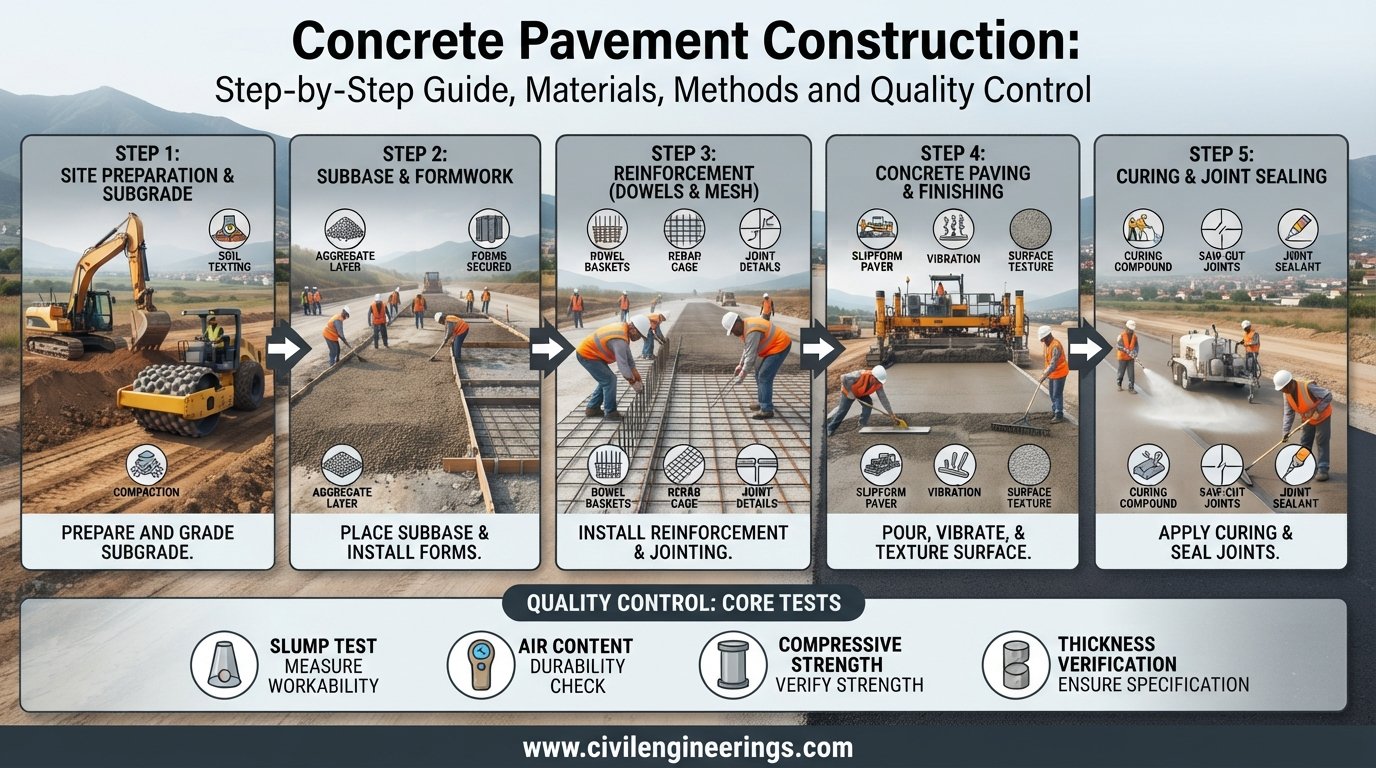
Concrete pavement is one of the most durable solutions for roads, highways, intersections, industrial yards, airport pavements, and other heavily trafficked facilities. Unlike flexible pavement, which relies mainly on asphalt layers to distribute traffic loads, concrete pavement uses a rigid Portland cement concrete slab to carry and spread wheel loads over a relatively large area.
However, Concrete Pavement Construction is not simply a matter of placing concrete on a prepared surface. Long-term performance depends on a coordinated process involving pavement design, subgrade preparation, base or subbase construction, concrete mix control, reinforcement and joint installation, paving, consolidation, finishing, texturing, curing, saw cutting, testing, and protection.
A small mistake during any of these stages can lead to cracking, faulting, scaling, loss of smoothness, or premature deterioration. This guide explains the complete construction process from an engineering and site-management perspective, including materials, equipment, joints, quality control, common problems, practical calculations, and recommendations for students, engineers, and contractors.
What Is Concrete Pavement Construction?
Concrete Pavement Construction is the process of building a rigid pavement using cement concrete as the primary structural layer. The concrete slab receives traffic loads and distributes them to the underlying base, subbase, and subgrade.
A typical rigid pavement structure may consist of:
- Prepared subgrade
- Subbase or base course
- Separation or bond-breaking layer where specified
- Concrete pavement slab
- Dowel bars and tie bars where required
- Joint sealant where specified
- Surface texture and curing treatment
The concrete slab is generally designed according to traffic loading, climatic conditions, foundation support, material properties, drainage, joint layout, and expected service life.
The basic structural concept can be simplified as:
Wheel load → Concrete slab → Base/Subbase → Subgrade
The slab’s flexural strength, thickness, modulus of elasticity, joint performance, load transfer, and foundation support all influence pavement behavior.
Modern highway projects commonly use mechanized paving equipment. FHWA guidance emphasizes the importance of consistent concrete supply and proper slipform-paver operation because interruptions, poor concrete consistency, and incorrect equipment settings can adversely affect pavement smoothness.


Types of Concrete Pavement
Different rigid pavement systems are selected according to traffic, design life, climate, maintenance strategy, and project requirements.
Jointed Plain Concrete Pavement
Jointed Plain Concrete Pavement, commonly called JPCP, uses regularly spaced contraction joints to control cracking. Conventional reinforcement is generally not intended to carry traffic-related slab stresses across the entire pavement.
Dowel bars may be installed at transverse joints to transfer wheel loads between adjacent slabs.
JPCP is widely used for highways, urban roads, and other applications where a systematic joint layout can control slab movement.
Jointed Reinforced Concrete Pavement
Jointed Reinforced Concrete Pavement contains distributed reinforcement and uses relatively widely spaced joints.
The reinforcement helps control crack width and provides additional structural behavior. It does not eliminate the need for proper joint design.
Continuously Reinforced Concrete Pavement
Continuously Reinforced Concrete Pavement, or CRCP, uses substantial longitudinal reinforcement and does not rely on regularly spaced transverse contraction joints in the same manner as JPCP.
Controlled transverse cracking develops at relatively frequent intervals, while reinforcement limits crack opening.
CRCP can be particularly suitable for heavily trafficked facilities where long-term performance and reduced joint-related maintenance are important.
Roller-Compacted Concrete Pavement
Roller-compacted concrete uses a relatively dry concrete mixture placed and compacted with equipment similar to that used for conventional pavement construction.
It can be useful for industrial roads, heavy-duty yards, low-speed facilities, and selected highway applications.
Materials Used in Concrete Pavement
Material quality directly affects strength, durability, workability, shrinkage, and pavement service life.
Cementitious Materials
Portland cement forms the primary binder in conventional pavement concrete. Depending on project specifications, supplementary cementitious materials may also be incorporated.
Examples include:
- Fly ash
- Slag cement
- Silica fume
- Other approved supplementary cementitious materials
The selected cementitious system should satisfy strength development, durability, setting-time, and environmental requirements.
Aggregates
Coarse and fine aggregates form most of the concrete volume.
Important aggregate properties include:
- Gradation
- Particle shape
- Cleanliness
- Toughness
- Soundness
- Absorption
- Abrasion resistance
- Resistance to deleterious reactions
Well-graded aggregates can improve packing and reduce paste demand when properly proportioned.
Water
Water must meet the project specification and be suitable for concrete production.
The water-cementitious materials ratio is a major factor affecting concrete strength and durability.
A simplified relationship is:
w/cm = Mass of mixing water ÷ Mass of cementitious materials
For example, if a concrete mixture contains 150 kg of water and 375 kg of cementitious material:
w/cm = 150 / 375 = 0.40
The actual allowable ratio should come from the approved pavement mix design and applicable specification rather than from a generic target.
Chemical Admixtures
Admixtures can modify concrete properties such as setting time, workability, air entrainment, and water demand.
Their use should be based on laboratory trials and compatibility with the cementitious system.
Dowel Bars and Tie Bars
Dowel bars primarily provide load transfer across transverse joints while allowing the slabs to move longitudinally.
Tie bars are generally used across longitudinal joints to help hold adjacent lanes together.
Correct bar alignment matters. Poorly aligned dowels can restrict slab movement and contribute to joint distress.
Preparation of Subgrade and Subbase
A strong concrete slab cannot compensate indefinitely for a poorly prepared foundation.
Subgrade Preparation
The subgrade should provide uniform and stable support beneath the pavement.
Construction activities generally include:
- Clearing and excavation
- Embankment construction where necessary
- Moisture conditioning
- Grading
- Compaction
- Proof rolling
- Correction of weak areas
- Final trimming and level verification
The objective is not simply to achieve a specified density. Engineers should also look for non-uniform zones, pumping potential, excessive moisture, soft spots, and drainage problems.
Unstable subgrade conditions are a recognized contributor to pavement problems, while adequate drainage and uniform foundation support are fundamental to rigid pavement performance. (NJIT)
Base and Subbase Construction
Depending on the design, the concrete slab may rest on a granular subbase, stabilized base, lean concrete layer, or another engineered foundation.
The base layer should be:
- Properly compacted
- Uniform in thickness
- Correctly graded
- Free from contamination
- Properly drained
- Within specified elevation tolerances
Before concrete placement, the engineer should verify the finished level, crossfall, surface condition, line, and pavement thickness.
Concrete Pavement Construction Process
The construction sequence should be planned before concrete production begins. A typical operation includes survey control, foundation inspection, reinforcement and joint preparation, concrete batching, transportation, paving, consolidation, finishing, texturing, curing, joint sawing, sealing where required, and quality testing.
Survey and Grade Control
Survey control establishes:
- Pavement centerline
- Edge lines
- Longitudinal grade
- Cross slope
- Pavement elevation
- Joint locations
- Structure interfaces
Slipform pavers commonly use stringlines or electronic machine-control systems to maintain alignment and elevation. FHWA and TxDOT guidance both highlight the importance of accurate grade control and consistent paver operation for surface smoothness.
Inspection of the Foundation
Before paving starts, the site team should inspect the completed base or subbase.
Check:
- Thickness
- Level
- Cross slope
- Surface uniformity
- Compaction
- Cleanliness
- Drainage
- Construction joints
- Edge restraints
- Embedded items
Do not allow concrete placement to proceed over an unapproved foundation.
Installation of Dowel Bars and Tie Bars
Dowel baskets, embedded dowels, or automatic dowel insertion systems should maintain the required position.
Tie bars should also be placed at the specified spacing, depth, and orientation.
Inspectors should pay particular attention to vertical and horizontal alignment because improperly positioned bars can interfere with joint movement and load transfer.
Concrete Batching and Mixing
Concrete should be produced using an approved mix design.
Quality control should monitor:
- Aggregate moisture
- Aggregate gradation
- Cementitious material quantities
- Water quantity
- Admixture dosage
- Concrete temperature
- Slump or consistency
- Air content where applicable
- Batch uniformity
Aggregate moisture corrections are especially important because unaccounted moisture changes the effective water-cementitious materials ratio.
Transportation
Concrete should reach the paving operation within the allowable time and temperature limits established by the project specification.
Delivery must be coordinated with production and paving speed.
The objective is a continuous and predictable supply. Excessive delays can cause variations in workability and setting time.
Concrete Placement
Large highway projects frequently use slipform paving.
A modern slipform paver can spread, consolidate, screed, and initially finish concrete in one continuous operation.
The basic sequence is:
Concrete delivery → Spreading → Screeding → Consolidation → Initial finishing → Texturing → Curing
Maintaining a consistent paver speed is important. Frequent stopping and starting can create surface irregularities and inconsistent pavement quality.


Consolidation
Fresh concrete must be adequately consolidated to eliminate harmful voids and produce a dense slab.
Slipform pavers generally use internal vibrators.
However, excessive vibration can also create problems such as segregation or mortar-rich zones. Proper vibrator spacing, frequency, insertion depth, and paver speed should therefore follow the approved equipment setup and project requirements.
Finishing
Finishing should produce the specified pavement profile without excessive manipulation.
Common equipment may include:
- Screeds
- Pan floats
- Tube floats
- Auto floats
- Hand tools for localized correction
Adding water to the pavement surface during finishing is a common poor practice because it can weaken the surface layer and contribute to scaling, crazing, or other defects.
The goal is to correct genuine surface irregularities without overworking the concrete.
Surface Texturing
A pavement needs adequate skid resistance and surface texture.
Common techniques include:
- Burlap drag
- Artificial turf drag
- Transverse tining
- Longitudinal tining
- Other specified texturing systems
Texture depth and orientation should follow project requirements and local standards.
Curing
Curing is one of the most critical stages of concrete pavement construction.
Fresh concrete can lose moisture rapidly, particularly under hot, dry, windy conditions. Rapid moisture loss can produce plastic shrinkage cracking and reduce surface durability.
Curing methods may include:
- Membrane curing compounds
- Wet curing
- Burlap or other moisture-retaining systems
- Approved curing blankets
On large slip form projects, texturing and curing machines commonly follow the paving operation and apply curing compound soon after finishing.
The curing compound should provide uniform coverage without missed strips or excessive application.
Concrete Pavement Joints
Joints are an essential part of rigid pavement design. They provide controlled locations for slab movement and cracking.
Transverse Contraction Joints
Contraction joints control cracking caused by drying shrinkage and temperature-related movement.
The joint is usually formed by saw cutting after placement.
The timing is critical: the concrete needs enough strength to resist raveling during sawing, but cutting must occur before uncontrolled cracking develops. This period is commonly called the sawing window.
Longitudinal Joints
Longitudinal joints divide pavement lanes and accommodate movement between adjacent slabs.
Tie bars are often used where required by the pavement design.
The joint must remain correctly aligned throughout construction.
Construction Joints
Construction joints occur when concrete placement stops, such as at the end of a working day or because of an unexpected interruption.
Where practical, construction joints can be coordinated with planned transverse joints. Proper consolidation at the joint is important because normal paver vibration may not fully consolidate concrete against the stopping point.
Expansion and Isolation Joints
Expansion or isolation joints may be provided at selected structures and fixed objects where required.
Typical locations can include:
- Bridges
- Manholes
- Drainage structures
- Buildings
- Culverts
- Other fixed structures
Joint details should always follow the approved drawings rather than an arbitrary spacing rule.
Saw Cutting and Joint Sealing
Saw cutting requires careful control of timing, alignment, depth, and equipment.
The cutting operation should produce clean joint edges without excessive raveling.
A simplified concept for saw-cut depth is:
Saw-cut depth = specified percentage or dimension based on slab thickness and project specification
For example, a project may specify a particular fraction of slab depth, but engineers should never substitute a generic percentage for the actual contract requirement.
Joint sealing, where specified, helps prevent water and incompressible materials from entering the joint.
Before sealing, the joint should be properly cleaned and prepared.
Quality Control and Testing
Quality control should operate throughout the project rather than only after paving is complete.
Fresh Concrete Tests
Depending on the specification, common tests include:
- Slump or consistency
- Concrete temperature
- Air content
- Unit weight
- Strength specimens
- Batch uniformity checks
Hardened Concrete Tests
Typical evaluation may include:
- Compressive strength
- Flexural strength
- Thickness
- Surface smoothness
- Joint dimensions
- Pavement profile
- Texture
- Core testing when required
For pavement applications, flexural strength is particularly important because concrete slabs experience bending under wheel loads.
A simplified flexural stress concept is:
Stress = Load effect / Section resistance
Actual pavement design uses established analytical or empirical procedures rather than this simplified relationship.
Smoothness and Ride Quality
Surface smoothness is an important performance indicator.
A pavement may meet strength requirements yet provide poor ride quality because of construction irregularities.
Common causes include:
- Inconsistent paver speed
- Poor grade control
- Incorrect concrete supply
- Improper finishing
- Paver track problems
- Excessive hand correction
FHWA research specifically identifies paver setup, consistent concrete delivery, paver speed, and vibration control as important factors in achieving smooth concrete pavements.
Common Concrete Pavement Construction Problems
Understanding failure mechanisms helps engineers prevent them rather than simply repair them.
Random Cracking
Possible causes include:
- Late saw cutting
- Poor joint spacing
- Rapid moisture loss
- Excessive shrinkage
- Temperature gradients
- Weak foundation support
The solution begins with controlling the cause, not simply sealing the visible crack.
Joint Faulting
Faulting occurs when adjacent slabs develop a difference in elevation at a joint.
Potential contributors include:
- Poor load transfer
- Water infiltration
- Pumping
- Foundation erosion
- Heavy repetitive traffic
Proper dowel installation, drainage, joint design, and foundation preparation help reduce the risk.
Surface Scaling
Scaling can result from inadequate concrete quality, improper finishing, poor curing, freezing exposure, or unsuitable deicing conditions.
The surface should not be overworked or weakened by adding water during finishing.
Slab Edge Slumping
Slipform paving requires a mixture with suitable consistency so that the concrete can maintain the required shape after leaving the paver.
Improper mixture consistency or equipment settings can cause edge deformation.
Poor Smoothness
A smooth pavement requires a smooth construction process.
Frequent paver stops, inconsistent concrete supply, stringline problems, and excessive finishing can all affect the final profile. (Federal Highway Administration)
Equipment Used in Concrete Pavement Construction
A typical highway paving operation may use:
- Batching plant
- Concrete transit mixers
- Dump trucks or agitator trucks
- Concrete placer/spreader
- Slipform paver
- Internal vibrators
- Finishing equipment
- Texture/curing machine
- Joint saws
- Diamond blades
- Joint cleaning equipment
- Survey instruments
- Concrete testing equipment
Modern paving trains can integrate spreading, consolidation, finishing, texturing, and curing to maintain a continuous workflow. (Pavement Interactive)
Equipment selection should consider pavement width, production rate, concrete supply, project geometry, access restrictions, and required quality.
Practical Recommendations for Students, Engineers and Contractors
For Civil Engineering Students
Students should learn the complete relationship between:
Traffic → Pavement Design → Materials → Construction → Quality Control → Maintenance
Do not study concrete pavement as an isolated concrete-technology topic. Understand joints, load transfer, subgrade support, drainage, flexural strength, construction tolerances, and pavement performance together.
For Highway Engineers
Before paving, establish a detailed inspection checklist covering foundation condition, survey control, reinforcement, dowels, tie bars, mix approval, equipment calibration, weather conditions, concrete delivery, and curing arrangements.
A trial paving section can also help verify equipment settings and construction procedures before full production.
For Site Engineers
Monitor the paving operation continuously.
Record:
- Concrete delivery time
- Batch information
- Temperature
- Workability
- Paver speed
- Weather
- Joint cutting time
- Curing application
- Testing results
- Defects and corrective actions
Good site records make troubleshooting much easier.
For Contractors
Coordinate the entire production chain.
A fast paver is of little value if the concrete plant cannot maintain supply. Likewise, high concrete production is wasteful if the paving equipment cannot place the material continuously.
The strongest projects maintain balance between:
Batching capacity + Transportation + Paving capacity + Finishing + Curing
IRC, AASHTO and ICE References for Concrete Pavement
Concrete pavement design and construction should follow the standards specified for the particular project and jurisdiction.
In South Asian highway practice, IRC publications provide important guidance on pavement design, materials, construction, quality control, and related highway engineering practices.
AASHTO publications are widely used internationally for pavement design, materials testing, construction specifications, and transportation infrastructure practices.
The Institution of Civil Engineers (ICE) provides broader professional guidance and engineering principles relevant to infrastructure planning, construction management, sustainability, risk, and professional practice.
Engineers should always use the latest project-approved editions and specifications. A general article should not replace contract documents, national standards, approved drawings, or pavement-specific design calculations.
Best Practices for Long-Lasting Concrete Pavement
A durable pavement is usually the result of many small controls working together.
The most important practices include:
- Provide uniform subgrade support.
- Maintain effective drainage.
- Use an approved concrete mix design.
- Control aggregate moisture.
- Maintain consistent concrete production.
- Avoid unnecessary water addition.
- Maintain accurate grade and alignment.
- Keep the paver moving consistently.
- Control vibrator settings.
- Install dowels and tie bars accurately.
- Saw joints within the appropriate window.
- Apply curing promptly and uniformly.
- Protect fresh pavement from traffic and weather.
- Test materials and finished pavement systematically.
- Document construction activities and corrective actions.
The most successful pavement projects treat quality control as a continuous process rather than a final inspection activity.
FAQs About Concrete Pavement Construction
What is Concrete Pavement Construction?
Concrete Pavement Construction is the process of constructing a rigid road pavement using cement concrete over a prepared subgrade and base or subbase system. The process includes foundation preparation, concrete production, placement, consolidation, finishing, texturing, curing, joint construction, and quality control.
What is the difference between concrete pavement and asphalt pavement?
Concrete pavement is a rigid pavement system that uses a concrete slab to distribute traffic loads. Asphalt pavement is flexible and generally distributes loads through several compacted layers. Concrete typically has higher initial construction requirements but can provide long service life when properly designed and constructed.
Why are joints required in concrete pavement?
Joints provide controlled locations for movement and cracking. Concrete expands, contracts, and shrinks as temperature and moisture conditions change. Properly designed joints help control these movements and reduce random cracking.
What is the purpose of dowel bars?
Dowel bars transfer traffic loads across transverse joints while allowing adjacent concrete slabs to move. Their alignment is important because poorly positioned dowels can interfere with joint movement and pavement performance.
Why is curing important in concrete pavement?
Curing controls moisture loss and supports proper hydration and strength development. Inadequate curing can increase the risk of shrinkage cracking and surface deterioration, particularly under hot, dry, or windy conditions.
What equipment is commonly used for highway concrete paving?
Large projects commonly use batching plants, concrete transport vehicles, placer/spreaders, slipform pavers, internal vibrators, finishing equipment, texture-and-curing machines, joint saws, and testing equipment.
When should concrete pavement joints be saw cut?
Joint sawing should occur during the specified sawing window. Cutting too early can cause raveling, while cutting too late can allow uncontrolled cracking. Weather, mixture properties, cement system, slab temperature, and setting behavior all influence the timing.
What causes cracks in concrete pavement?
Cracking can result from drying shrinkage, thermal movement, late saw cutting, poor joint design, inadequate curing, excessive moisture loss, foundation problems, construction defects, or traffic-related stresses.
How can concrete pavement smoothness be improved?
Accurate grade control, consistent concrete delivery, proper paver setup, steady paving speed, suitable vibration, controlled finishing, and proper surface texturing all contribute to better smoothness. FHWA guidance particularly emphasizes avoiding unnecessary paver stops and maintaining consistent paving conditions.
Is reinforcement always required in concrete pavement?
No. Reinforcement depends on the selected pavement type and design. Jointed plain concrete pavement may not use distributed reinforcement, while jointed reinforced and continuously reinforced pavement systems use reinforcement as part of their structural and crack-control strategy.
Conclusion
Concrete Pavement Construction requires much more than producing and placing high-strength concrete. Long-term pavement performance comes from the interaction of a stable foundation, suitable pavement thickness, durable materials, accurate joint design, correct dowel and tie-bar placement, controlled paving operations, effective curing, and rigorous quality control.
For engineers and contractors, the most important lesson is that construction quality must be managed from the subgrade upward. A well-designed slab can still perform poorly when the foundation is unstable, joints are incorrectly positioned, curing is delayed, or concrete placement becomes inconsistent.
Modern slipform paving technology has made large-scale rigid pavement construction faster and more precise, but machinery cannot replace engineering control. Survey accuracy, concrete consistency, experienced operators, proper testing, and disciplined site supervision remain essential.
By following approved project specifications and applying the principles discussed in this guide, infrastructure professionals can produce concrete pavements with better ride quality, structural performance, durability, and service life.
