
Introduction
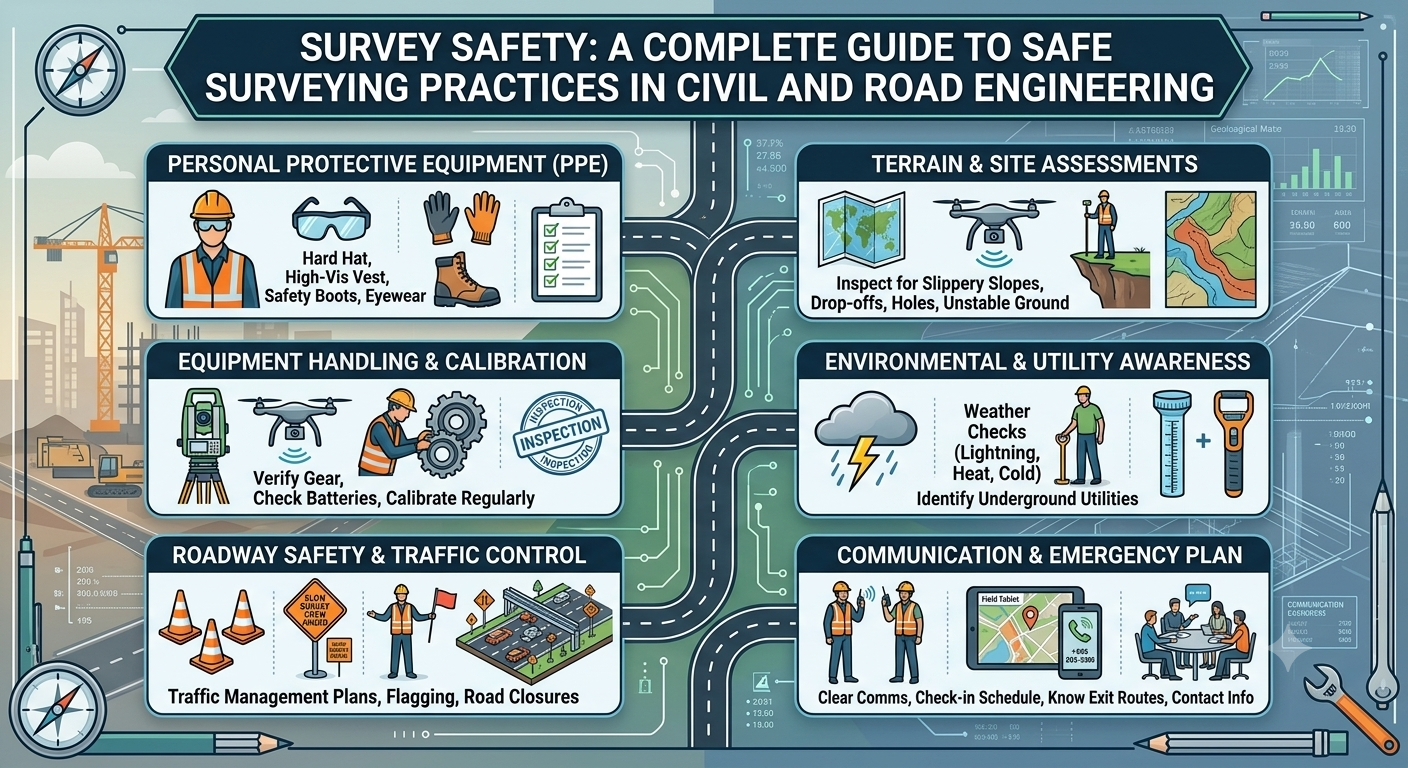
Surveying forms the foundation of every successful civil engineering and road construction project. Engineers rely on accurate survey data to select routes, design highways, establish property boundaries, and prepare construction layouts. However, surveyors often work in environments that expose them to moving traffic, uneven terrain, heavy machinery, adverse weather, wildlife, and electrical hazards. These conditions make Survey Safety an essential part of every engineering project rather than an optional precaution.
A well-planned safety program protects survey teams, improves productivity, reduces project delays, and ensures compliance with engineering standards and workplace regulations. Every survey begins with hazard identification, risk assessment, proper planning, and the correct use of personal protective equipment. When safety becomes part of the surveying process, teams can collect accurate field data while minimizing risks to people, equipment, and the surrounding environment.
This comprehensive guide explains the principles of Survey Safety, common field hazards, risk assessment methods, personal protective equipment, and practical safety measures for engineers, contractors, and students.
What Is Survey Safety?
Survey Safety refers to the planning, procedures, equipment, and practices that protect survey personnel while they perform field measurements, inspections, and data collection. A safe survey operation focuses on preventing accidents before they occur rather than responding after an incident.
Survey safety applies to every type of engineering survey, including:
- Topographic surveys
- Route surveys
- Highway alignment surveys
- Construction layout surveys
- Boundary surveys
- GPS surveys
- Utility surveys
- Hydrographic surveys
A comprehensive safety program combines technical knowledge, hazard awareness, effective communication, and disciplined field practices.
Why Survey Safety Is Important
Surveyors often work in locations where conditions change rapidly. A busy highway, a steep embankment, or an active construction site can become hazardous within seconds.
Strong safety practices provide several benefits:
- Protect survey personnel from injuries.
- Reduce project interruptions.
- Improve data collection efficiency.
- Prevent equipment damage.
- Support legal and regulatory compliance.
- Increase public confidence.
- Lower project costs caused by accidents.
A single safety incident can delay construction, damage expensive surveying equipment, and expose organizations to legal liability. Preventive measures always cost less than accident recovery.
Common Hazards in Surveying
Understanding workplace hazards allows engineers to develop effective control measures before field activities begin.
Physical Hazards
Physical hazards exist on nearly every survey site.
Examples include:
- Uneven ground
- Loose rocks
- Excavations
- Slippery surfaces
- Steep slopes
- Falling objects
- Heavy construction equipment
Practical Example
A surveyor setting up a total station on a loose embankment may lose balance if the tripod shifts. Selecting firm ground and checking tripod stability before taking measurements greatly reduces this risk.
Traffic Hazards
Road and highway surveys expose personnel to moving vehicles, especially on high-speed roads.
Typical traffic hazards include:
- Fast-moving vehicles
- Blind curves
- Limited shoulder width
- Distracted drivers
- Construction traffic
- Poor nighttime visibility
Engineering Principle
Traffic control should always separate workers from live traffic whenever practical. Warning signs, cones, barricades, flaggers, and high-visibility clothing create additional layers of protection.
Environmental Hazards
Natural conditions can change quickly and affect survey operations.
Environmental hazards include:
- Heavy rainfall
- Strong winds
- Flooding
- Extreme heat
- Low temperatures
- Dense fog
- Lightning storms
Best Practice
Suspend surveying during thunderstorms or severe weather. Metal tripods, ranging rods, and GPS poles can increase the risk of lightning-related injuries.
Electrical Hazards
Survey equipment frequently operates near overhead or underground utility lines.
Potential risks include:
- High-voltage transmission lines
- Buried electrical cables
- Electrified railway systems
- Temporary construction power
Safety Measure
Always verify utility locations before beginning work. Maintain safe clearance distances from energized power lines and avoid raising metallic survey poles beneath overhead conductors.
Biological Hazards
Surveyors working in remote or undeveloped areas may encounter biological risks.
Examples include:
- Snakes
- Insects
- Bees
- Wild animals
- Poisonous plants
- Tick bites
Field teams should carry basic first-aid supplies and remain alert to local wildlife conditions.
Survey Safety Planning
Successful fieldwork begins long before the survey team arrives on site. A detailed safety plan identifies hazards, assigns responsibilities, and establishes emergency procedures.
Elements of a Survey Safety Plan
Project Information
Include:
- Survey location
- Scope of work
- Schedule
- Team members
- Contact information
Hazard Identification
Evaluate:
- Traffic conditions
- Terrain
- Utilities
- Weather forecasts
- Construction activities
- Environmental risks
Emergency Planning
Prepare procedures for:
- Medical emergencies
- Vehicle accidents
- Equipment failure
- Severe weather
- Fire incidents
Communication Plan
Every survey team should establish reliable communication through:
- Mobile phones
- Two-way radios
- GPS tracking devices
- Emergency contact lists
A pre-survey safety briefing ensures that all team members understand their responsibilities before fieldwork begins.
Personal Protective Equipment (PPE)
Personal Protective Equipment provides the last line of defense against workplace hazards. Every surveyor should wear appropriate PPE based on site conditions.
Essential PPE for Surveyors
Safety Helmet
Protects against falling objects and accidental impacts.
High-Visibility Safety Vest
Improves visibility around moving vehicles and heavy equipment.
Safety Boots
Provide ankle support, slip resistance, and protection from sharp objects.
Safety Glasses
Protect the eyes from dust, debris, and flying particles.
Protective Gloves
Improve grip and protect hands while handling equipment.
Hearing Protection
Required near heavy machinery or high-noise environments.
Weather Protection
Depending on the conditions, surveyors may require:
- Rain gear
- Sun hats
- Sunscreen
- Cold-weather clothing
PPE Inspection
Before each survey, inspect PPE for:
- Damage
- Cracks
- Worn straps
- Reduced visibility
- Expired safety equipment
Replacing damaged PPE immediately helps maintain a safe working environment.
Site Risk Assessment
A site risk assessment identifies hazards, evaluates their likelihood, and determines suitable control measures before work begins.
Five-Step Risk Assessment Process
Step 1: Identify Hazards
Observe the work area carefully and document potential risks.
Step 2: Determine Who May Be Affected
Consider:
- Surveyors
- Contractors
- Visitors
- Road users
- Nearby residents
Step 3: Evaluate Risks
Assess:
- Probability of occurrence
- Severity of consequences
- Existing safety controls
Step 4: Implement Control Measures
Examples include:
- Traffic control
- PPE
- Safe work procedures
- Equipment inspections
- Warning signs
Step 5: Review the Assessment
Update the assessment whenever site conditions change or new hazards appear.
Regular risk assessments improve decision-making and help prevent accidents throughout the project.
Field Safety Workflow Diagram
The following simplified workflow illustrates how safety should be integrated into every survey operation.
             SURVEY SAFETY WORKFLOW

        Project Planning
               │
               ▼
      Hazard Identification
               │
               ▼
       Site Risk Assessment
               │
               ▼
      Select Required PPE
               │
               ▼
      Safety Team Briefing
               │
               ▼
      Conduct Field Survey
               │
               ▼
 Continuous Hazard Monitoring
               │
               ▼
    Complete Work Safely
               │
               ▼
      Review & Report Lessons
Basic Highway Survey Safety Zone Diagram
             Direction of Traffic
======================================================>

      Warning Sign

          ▲
          │
   -------------------
   Traffic Cones
   Traffic Cones
   Traffic Cones
   -------------------

        Safe Work Zone
   [ Survey Team ]
   [ Total Station ]
   [ Tripod ]

-------------------------------
 Buffer Zone
-------------------------------

Moving Traffic Lane
======================================================
This arrangement improves visibility, separates workers from traffic, and creates a safer working environment for survey operations.
Key Takeaways
Survey Safety begins with careful planning, thorough hazard identification, and disciplined field practices. Survey teams face a wide range of risks, including traffic, unstable terrain, electrical utilities, severe weather, and biological hazards. A structured safety plan, appropriate personal protective equipment, and regular site risk assessments significantly reduce these risks while improving productivity and data quality. By making safety a core part of every surveying activity, engineers and contractors protect both personnel and project outcomes, laying the groundwork for successful infrastructure development.
Traffic Safety During Road Surveys
Road and highway surveys expose engineers and surveyors to one of the highest workplace risks—moving traffic. Unlike controlled construction zones, many survey activities take place on active roads where drivers may not expect workers ahead. Proper traffic management protects both the survey crew and road users.
Traffic Safety Measures
- Prepare a traffic management plan before fieldwork.
- Install advance warning signs at appropriate distances.
- Place reflective traffic cones to define the work area.
- Use barricades where additional protection is necessary.
- Assign trained flaggers to control traffic when required.
- Wear high-visibility reflective clothing at all times.
- Keep survey vehicles parked in safe locations with warning lights activated.
- Avoid standing in live traffic lanes whenever possible.
Best Practice
Always face oncoming traffic when working near active roadways. This position allows surveyors to react quickly to unexpected vehicle movements.
Survey Equipment Safety
Modern surveying equipment provides highly accurate measurements, but improper handling can create safety risks and reduce data accuracy.
Safe Handling of Survey Equipment
Total Station
- Set up the tripod on firm, level ground.
- Secure all tripod legs before mounting the instrument.
- Protect the instrument from excessive vibration.
- Store equipment in protective cases during transport.
GPS Equipment
- Inspect batteries before leaving the office.
- Maintain adequate distance from overhead power lines.
- Secure poles during windy conditions.
- Verify satellite signal quality before collecting data.
Drones for Surveying
When using unmanned aerial vehicles (UAVs):
- Conduct pre-flight inspections.
- Check weather conditions.
- Follow local aviation regulations.
- Keep visual contact with the drone.
- Avoid flying near airports or power transmission lines.
Laser Scanners
- Follow manufacturer safety instructions.
- Prevent unauthorized personnel from entering scanning zones.
- Protect equipment from dust and moisture.
- Verify calibration before use.
Proper equipment maintenance reduces downtime and extends instrument life.
Environmental and Weather Safety
Weather conditions can change rapidly during field operations. Survey teams should monitor forecasts continuously and adjust work schedules when conditions become unsafe.
Working in Hot Weather
High temperatures increase the risk of heat stress and dehydration.
Safety Recommendations
- Drink water frequently.
- Schedule demanding tasks during cooler hours.
- Take regular breaks in shaded areas.
- Wear lightweight, breathable clothing.
- Apply sunscreen to exposed skin.
Signs of Heat Stress
- Dizziness
- Excessive sweating
- Muscle cramps
- Fatigue
- Confusion
Any team member showing these symptoms should stop work immediately and seek medical attention if necessary.
Working in Cold Weather
Cold environments present different challenges.
Surveyors should:
- Wear layered clothing.
- Use insulated gloves.
- Protect electronic equipment from moisture.
- Watch for icy surfaces.
- Warm up regularly during extended fieldwork.
Working During Rain
Rain reduces visibility and increases slip hazards.
Survey teams should:
- Use waterproof PPE.
- Protect instruments with weather covers.
- Avoid flooded areas.
- Stop work if visibility becomes poor.
Lightning Safety
Metallic survey equipment attracts lightning.
During thunderstorms:
- Stop surveying immediately.
- Leave open fields.
- Avoid isolated trees.
- Stay away from metal poles and tripods.
- Resume work only after conditions become safe.
Communication and Emergency Response
Clear communication plays a critical role in preventing accidents and managing emergencies.
Communication Procedures
Before starting work:
- Confirm emergency contact numbers.
- Review communication methods.
- Identify meeting points.
- Verify radio channels.
During field operations:
- Maintain regular communication between team members.
- Report hazards immediately.
- Inform supervisors of changing site conditions.
- Confirm safe completion of daily activities.
Emergency Response Plan
Every survey project should include a documented emergency response procedure.
Essential Elements
- Emergency phone numbers
- First-aid kit locations
- Hospital information
- Evacuation routes
- Vehicle access points
- Incident reporting procedures
Quick and organized responses reduce the severity of workplace incidents.
Best Practices for Survey Safety
Successful surveying teams follow disciplined safety procedures throughout every project.
Recommended Best Practices
- Conduct daily safety briefings before fieldwork.
- Complete site-specific risk assessments.
- Inspect equipment before use.
- Maintain clear communication within the survey team.
- Wear appropriate PPE throughout the project.
- Monitor weather forecasts regularly.
- Use traffic control measures on road projects.
- Keep survey equipment calibrated and well maintained.
- Record near misses and safety observations.
- Encourage continuous safety training.
Developing a strong safety culture improves both project quality and worker confidence.
Practical Recommendations
Civil Engineers
- Include safety planning during project scheduling.
- Review hazard assessments before approving field activities.
- Coordinate with traffic management authorities for highway surveys.
- Promote continuous safety training within project teams.
Contractors
- Supply approved PPE to all field personnel.
- Provide clear safety instructions before work begins.
- Maintain surveying instruments in excellent condition.
- Monitor compliance with safety procedures throughout the project.
Engineering Students
- Learn workplace safety before using surveying equipment.
- Practice correct instrument setup techniques.
- Understand common field hazards.
- Participate in supervised field exercises.
- Develop the habit of performing risk assessments before starting work.
Safety awareness developed during education becomes an essential professional skill throughout an engineering career.
General Discussion of IRC, AASHTO, and ICE Practices
Leading highway engineering organizations emphasize that safety must remain an integral part of every surveying operation.
General recommendations commonly reflected in IRC, AASHTO, and ICE guidance include:
- Plan fieldwork before arriving on site.
- Conduct detailed hazard and risk assessments.
- Provide appropriate personal protective equipment.
- Implement traffic management on active roadways.
- Maintain reliable communication systems.
- Train survey personnel regularly.
- Protect workers from environmental hazards.
- Inspect equipment before each survey.
- Document incidents and continuously improve safety procedures.
Although project requirements differ by country, these principles support safer and more efficient surveying operations worldwide.
Common Survey Safety Mistakes to Avoid
Even experienced survey teams can create unnecessary risks if they overlook basic safety practices.
Avoid these common mistakes:
- Working without a site-specific risk assessment.
- Ignoring changing weather conditions.
- Wearing incomplete or damaged PPE.
- Setting up instruments too close to live traffic.
- Failing to inspect surveying equipment before use.
- Working alone in remote locations without communication.
- Skipping daily safety briefings.
- Leaving tripods or equipment unattended in public areas.
- Underestimating fatigue during long field surveys.
- Continuing work despite unsafe site conditions.
Recognizing and correcting these mistakes helps prevent accidents and improves overall project performance.
Frequently Asked Questions (FAQs)
1. What is Survey Safety?
Survey Safety is the process of identifying hazards, assessing risks, and applying protective measures to keep survey personnel, equipment, and the public safe during field operations.
2. Why is Survey Safety important in road engineering?
Road surveys often take place near moving traffic, heavy equipment, and uneven terrain. Proper safety measures reduce accidents, improve productivity, and ensure reliable survey results.
3. What PPE should every surveyor wear?
Essential PPE includes a safety helmet, high-visibility vest, safety boots, gloves, eye protection, and hearing protection where required.
4. What are the most common hazards during surveying?
Surveyors commonly face traffic hazards, slips and falls, electrical risks, extreme weather, wildlife encounters, heavy machinery, and manual handling injuries.
5. Why is a risk assessment necessary before a survey?
A risk assessment identifies potential hazards, evaluates their severity, and determines suitable control measures before fieldwork begins.
6. How can surveyors stay safe near highways?
Survey teams should use warning signs, traffic cones, reflective clothing, trained flaggers, and approved traffic management plans while maintaining a safe distance from moving vehicles.
7. What should surveyors do during a thunderstorm?
Stop work immediately, move to a safe shelter, avoid open fields and metal equipment, and resume work only after the storm has completely passed.
8. How often should surveying equipment be inspected?
Inspect all surveying equipment before each field operation and perform regular maintenance according to the manufacturer’s recommendations.
9. What role does communication play in Survey Safety?
Effective communication ensures that team members receive hazard updates, coordinate tasks, respond quickly to emergencies, and maintain situational awareness throughout the project.
10. Which engineering organizations promote surveying safety standards?
Organizations such as IRC, AASHTO, and ICE promote engineering practices that emphasize planning, risk management, traffic control, PPE, training, and continuous safety improvement.
Conclusion
Survey Safety forms the foundation of every successful surveying operation in civil engineering and road construction. Accurate measurements alone cannot guarantee project success unless survey teams also protect themselves from workplace hazards. Effective planning, detailed risk assessments, appropriate personal protective equipment, traffic management, reliable communication, and continuous training work together to create a safe working environment. Engineers, contractors, and students should view safety as a professional responsibility rather than a regulatory requirement. Every field visit presents unique challenges, from busy highways and difficult terrain to changing weather and electrical hazards. A proactive approach helps prevent injuries, protects valuable equipment, improves data quality, and keeps projects on schedule. By following recognized engineering principles and adopting proven safety practices, organizations can build a strong safety culture that supports long-term project success. Investing in Survey Safety protects people, enhances operational efficiency, and contributes to the delivery of reliable, high-quality infrastructure projects.
