
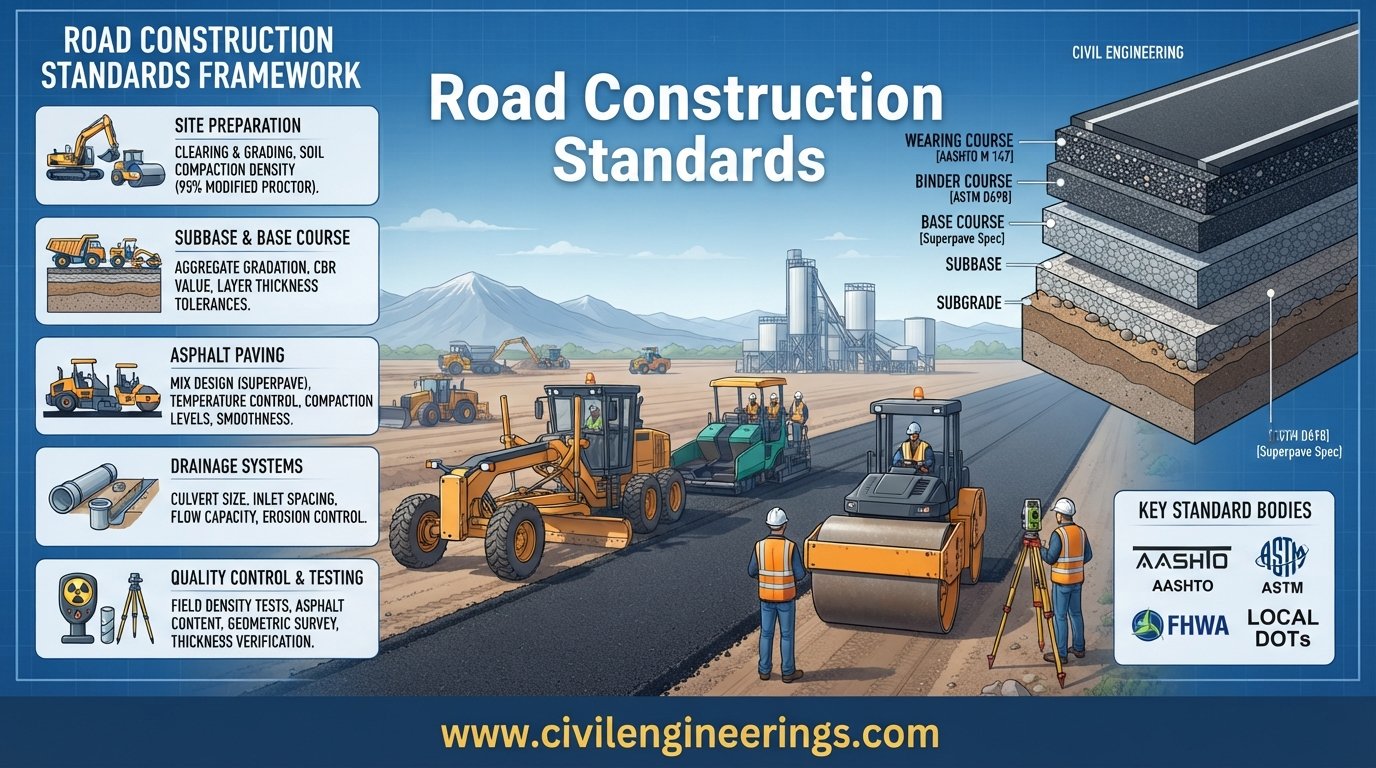
A road may look simple after completion, but a durable highway is the result of hundreds of engineering decisions made before the first layer of soil is compacted. Alignment, pavement thickness, drainage, material quality, construction tolerances, traffic loading, safety features, and inspection procedures all have to work together. This is where Road Construction Standards become essential.
Road construction standards provide the technical framework used to plan, design, construct, inspect, and maintain roads consistently. They help engineers establish acceptable requirements for materials, pavement layers, earthwork, geometric features, drainage, workmanship, testing, and safety.
For students, site engineers, contractors, consultants, and government agencies, understanding these requirements is more useful than simply memorizing standard numbers. The real objective is knowing which standard applies, why it applies, how to verify compliance, and what can happen when requirements are ignored.
This guide explains the major components of road construction standards, including pavement materials, earthwork, geometric requirements, drainage, quality control, testing, construction procedures, safety, documentation, and the roles of IRC, AASHTO, and ICE-based highway practice.
What Are Road Construction Standards?
Road construction standards are documented technical requirements that establish how a road or highway should be designed and constructed to achieve specified levels of safety, serviceability, durability, and performance.
They may cover:
- Earthwork and embankment construction
- Subgrade preparation
- Granular sub-base and base courses
- Asphalt and concrete pavement
- Aggregate quality
- Bituminous materials
- Pavement thickness
- Drainage structures
- Road geometry
- Shoulders and medians
- Traffic signs and markings
- Roadside safety
- Construction tolerances
- Testing and inspection
- Environmental and work-zone requirements
A standard is not simply a drawing or specification. It provides measurable criteria against which construction can be checked.
For example, an engineer should not approve a granular layer merely because it “looks compact.” The project specification may require a particular material grading, moisture condition, layer thickness, field density, surface tolerance, and testing frequency.
That distinction separates professional quality control from visual inspection.
Why Road Construction Standards Matter
Roads carry repeated traffic loads under changing weather and environmental conditions. A pavement that performs well during its first few months may still fail prematurely if the subgrade, drainage, compaction, or material quality was inadequate.
Standards help reduce these risks by creating consistent engineering requirements.
They also provide a common technical language between:
- Client and contractor
- Designer and site engineer
- Consultant and testing laboratory
- Government agency and construction company
- Surveyor and construction team
The exact requirements vary by country, road classification, contract, climate, traffic level, and governing authority. Therefore, engineers should always identify the contract-specific specification and applicable national standard rather than applying a generic requirement to every project.
Major Components of Road Construction Standards


A good road construction standard covers much more than pavement thickness. It establishes requirements throughout the project life cycle, from site preparation to final acceptance.
Geometric Design Requirements
Geometric standards control the physical arrangement of a road so that vehicles can travel safely and comfortably.
Important parameters include:
- Design speed
- Lane width
- Shoulder width
- Horizontal alignment
- Vertical alignment
- Superelevation
- Sight distance
- Gradient
- Curve radius
- Intersection geometry
- Median arrangement
- Roadside clear zones
For a horizontal curve, the relationship between speed, radius, and superelevation is commonly represented in simplified form as:
Where:
- = superelevation rate
- = side-friction factor
- = design speed in km/h
- = curve radius in metres
The actual design equation, permissible values, units, and assumptions depend on the governing standard.
A road with inadequate sight distance or inappropriate curvature can create safety problems even when its pavement is structurally excellent.
Earthwork and Embankment Standards
Earthwork creates the foundation on which the pavement system rests.
Standards generally address:
- Clearing and grubbing
- Excavation
- Borrow material
- Embankment construction
- Fill placement
- Moisture conditioning
- Layer thickness
- Compaction
- Unsuitable soil removal
- Slope protection
- Formation preparation
The objective is to produce a stable and uniform platform.
Engineers commonly use laboratory compaction testing to establish a relationship between moisture content and dry density. Field compaction is then compared with the specified requirement.
A simplified relationship is:
The required percentage should always come from the applicable project specification rather than from a universal assumption.
Subgrade Standards
The subgrade is the prepared soil foundation beneath the pavement structure.
Its engineering performance depends on:
- Soil classification
- Strength
- Moisture condition
- Drainage
- Density
- Uniformity
- Swell and shrink characteristics
- Bearing capacity
Weak areas should not simply be covered with additional pavement. Depending on the project design, engineers may consider undercutting, replacement, stabilization, improved drainage, reinforcement, or other ground-improvement measures.
For flexible pavement design, subgrade strength may be characterized through parameters such as CBR, resilient modulus, or other locally specified methods.
Granular Sub-Base Requirements
The granular sub-base provides structural support and helps distribute traffic stresses.
Typical requirements concern:
- Aggregate grading
- Plasticity
- Cleanliness
- Strength
- Moisture
- Layer thickness
- Compaction
- Surface regularity
Poorly graded or contaminated material can prevent proper compaction and create weak zones.
A practical site rule is simple: do not allow the next pavement layer to hide a defective layer beneath it.
Base Course Standards
The base course carries a significant portion of pavement stresses and therefore requires strict material and construction control.
Depending on the pavement system, the base may consist of:
- Crushed aggregate
- Wet Mix Macadam
- Cement-treated material
- Asphalt-treated base
- Other stabilized materials
Quality control can involve aggregate tests, grading checks, moisture control, density testing, thickness measurement, and surface-level verification.
Asphalt Pavement Requirements
For flexible pavements, road construction standards may cover:
- Aggregate properties
- Binder grade
- Mix design
- Asphalt content
- Mixing temperature
- Transportation
- Laying temperature
- Compaction
- Joint construction
- Surface tolerance
- Thickness
- Density
Asphalt quality is strongly influenced by temperature and timing. Material that loses excessive temperature before compaction may become difficult to densify adequately.
A common construction sequence is:
Mixing → Transportation → Paving → Initial Compaction → Intermediate Compaction → Final Compaction → Inspection
The precise roller pattern should normally be established through a controlled trial section.
Rigid Pavement Requirements
Concrete roads require a different set of construction controls.
Important considerations include:
- Concrete mix design
- Cementitious materials
- Aggregate quality
- Water-cement ratio
- Slump or workability
- Reinforcement where applicable
- Joint layout
- Dowels and tie bars
- Concrete placement
- Finishing
- Curing
- Surface texture
- Strength testing
For rigid pavement, joint construction is particularly important because concrete naturally undergoes volume changes caused by temperature, moisture, and drying.
Material Standards Used in Road Construction
Road performance is closely related to material quality. A strong pavement design cannot compensate indefinitely for unsuitable materials.
Aggregates
Aggregates are used in sub-base, base, asphalt, concrete, and surface treatments.
Depending on their intended application, engineers may evaluate:
- Particle size distribution
- Aggregate crushing resistance
- Abrasion resistance
- Impact resistance
- Soundness
- Flakiness and elongation
- Water absorption
- Specific gravity
- Cleanliness
- Polishing characteristics
The appropriate test and acceptance criterion depend on the layer and governing specification.
Bituminous Materials
Bitumen and modified binders require control of properties appropriate to the climate, traffic, pavement type, and selected mix technology.
Commonly controlled characteristics can include:
- Viscosity
- Penetration or binder consistency
- Softening characteristics
- Elastic or rheological behavior
- Aging resistance
- Temperature susceptibility
The binder specification should be selected as part of the pavement design rather than simply choosing the most readily available product.
Cement and Concrete
Concrete pavement construction requires control over constituent materials and the finished concrete.
Quality assurance may include:
- Cement verification
- Aggregate testing
- Water quality
- Mix proportioning
- Workability
- Temperature
- Compressive or flexural strength
- Thickness
- Curing
- Joint quality
Drainage Standards in Road Construction
Water is one of the most important causes of pavement deterioration.
Road construction standards therefore address drainage through features such as:
- Side drains
- Catch drains
- Median drainage
- Cross-drainage structures
- Culverts
- Kerb and channel systems
- Subsurface drainage
- Scuppers
- Outfalls
A simple rational-method relationship frequently used for preliminary runoff estimation is:
Where:
- = peak runoff in m³/s
- = runoff coefficient
- = rainfall intensity in mm/h
- = drainage area in km²
The method, coefficient selection, design storm, and hydraulic assumptions must match the applicable drainage standard.
A technically strong pavement can deteriorate rapidly if water remains trapped within its layers.
Quality Control and Testing Requirements
Quality control converts written standards into measurable construction performance.
A typical road project may require testing of:
| Construction Activity | Typical Quality Checks |
|---|---|
| Earthwork | Moisture, density, material classification |
| Subgrade | Strength, level, density, drainage |
| Sub-base | Gradation, density, thickness |
| Base course | Gradation, strength, density, thickness |
| Asphalt | Temperature, mix properties, density, thickness |
| Concrete | Slump, temperature, strength, thickness |
| Drainage | Dimensions, levels, concrete quality |
| Finished pavement | Roughness, levels, crossfall, defects |
Field Density Testing
Compaction is one of the most important construction controls.
A field density test verifies whether the placed material has achieved the required density. The testing method may include nuclear density equipment, sand-cone testing, or another approved procedure.
Testing frequency should follow the project specification.
More testing is often appropriate when:
- Material changes
- Weather conditions change
- Compaction equipment changes
- Test results become inconsistent
- A weak area is suspected
Pavement Thickness Verification
Thickness can be checked through construction measurements, cores, survey data, or other approved techniques.
Suppose a pavement layer is specified at 100 mm and field measurements repeatedly show significant under-thickness. The engineer should not treat this as a minor visual issue.
The structural capacity of a pavement depends substantially on the thickness and quality of its layers.
Construction Tolerances and Acceptance Criteria
No construction process is perfectly exact. Standards therefore establish allowable tolerances.
Typical acceptance parameters can include:
- Horizontal position
- Vertical elevation
- Layer thickness
- Crossfall
- Surface smoothness
- Density
- Material grading
- Strength
- Alignment
- Drainage dimensions
An important professional principle is that tolerance is not a target.
For example, if a layer is allowed a certain construction tolerance, the contractor should still aim for the design value rather than deliberately constructing at the edge of the acceptable range.
Road Safety Standards During Construction
Road construction itself creates hazards for workers and road users.
Construction standards and project safety plans may address:
- Traffic management
- Temporary signs
- Cones and barriers
- Work-zone speed control
- Flaggers
- Night visibility
- Worker PPE
- Equipment movement
- Excavation protection
- Temporary pedestrian routes
A well-built road is not considered successful if the construction process exposes workers or motorists to unnecessary risk.
Engineers should inspect traffic-control arrangements regularly because work zones change as construction progresses.
Environmental Requirements in Road Construction
Modern highway projects must consider environmental performance as well as structural performance.
Construction controls may cover:
- Dust suppression
- Noise
- Construction waste
- Water pollution
- Material storage
- Fuel handling
- Vegetation protection
- Erosion control
- Borrow areas
- Recycling of pavement materials
Sustainable road construction increasingly includes reclaimed asphalt pavement, recycled aggregates where permitted, energy-efficient production, material optimization, and improved construction practices.
However, recycled or alternative materials should only be used when they satisfy the applicable engineering and environmental requirements.
Road Construction Standards and Major International References
Different countries use different standards. An engineer should identify the legally and contractually applicable documents before construction begins.
IRC Standards
In India, the Indian Roads Congress (IRC) publishes standards, codes, guidelines, and special publications covering highway planning, geometric design, pavement design, materials, bridges, safety, construction, and maintenance.
The IRC catalogue contains documents covering subjects such as pavement construction, recycling, traffic safety barriers, roughness measurement, road project preparation, and construction technology. (Internet Resource Centre)
IRC also maintains current publications and updates through its official platform, so engineers should verify the latest applicable edition rather than relying on an old PDF or secondary website. (Internet Resource Centre)
AASHTO Standards
The American Association of State Highway and Transportation Officials (AASHTO) provides widely used transportation specifications, test methods, guide specifications, and pavement-related documents.
Its materials standards include specifications and test methods commonly used in highway construction. (Transportation Downloads)
AASHTO’s Guide Specifications for Highway Construction also provides a framework for developing transportation contract specifications and construction requirements. (Transportation Downloads)
AASHTO documents are particularly relevant to engineers working with U.S.-based specifications or international projects that adopt AASHTO methods.
ICE and UK Highway Practice
The Institution of Civil Engineers (ICE) provides professional guidance on highway engineering and points practitioners toward established UK highway design and construction procedures.
ICE highlights the importance of understanding material properties, design loading, ground conditions, environmental interaction, and validated engineering methods. It also identifies the Design Manual for Roads and Bridges and the Specification for Highway Works as key references within UK highway practice. (Institution of Civil Engineers (ICE))
The important lesson is that IRC, AASHTO, ICE-related guidance, DMRB, and national specifications should not be mixed casually. Each project needs a defined hierarchy of applicable requirements.
How Engineers Should Apply Road Construction Standards on Site
Having standards in the project office is not enough. They must be translated into practical inspection procedures.
A useful workflow is:
Review Contract → Identify Applicable Standards → Prepare Method Statement → Approve Materials → Establish Trial Sections → Construct → Test → Inspect → Record → Correct → Approve
Before Construction
The engineer should confirm:
- Approved drawings
- Technical specifications
- Applicable standards
- Material sources
- Laboratory test requirements
- Survey control points
- Construction methodology
- Inspection and test plans
- Environmental requirements
- Traffic-management arrangements
During Construction
Site personnel should continuously monitor:
- Line and level
- Layer thickness
- Moisture
- Compaction
- Material quality
- Temperature
- Equipment performance
- Workmanship
- Drainage
- Safety
Do not wait until final inspection to discover problems that could have been corrected during construction.
After Construction
Final acceptance may involve:
- As-built surveys
- Material test records
- Density results
- Concrete strength results
- Asphalt test results
- Pavement thickness
- Surface regularity
- Drainage inspection
- Road marking inspection
- Safety-feature inspection
- Defect correction
Good documentation is part of engineering quality.
Practical Recommendations for Students, Engineers and Contractors
For Civil Engineering Students
Students should avoid learning standards entirely through memorization.
Instead:
- Understand why each requirement exists.
- Learn pavement layer functions.
- Practice reading specifications.
- Study laboratory and field tests.
- Learn how drawings relate to specifications.
- Visit active road construction sites.
- Compare design assumptions with actual construction conditions.
A student who understands the engineering principle behind a requirement will remember it much longer.
For Highway and Site Engineers
Keep a project-specific standards register.
It should identify:
- Applicable code
- Edition
- Relevant section
- Drawing reference
- Specification clause
- Test method
- Acceptance criterion
When a discrepancy occurs, refer to the controlling project document instead of relying on memory.
For Contractors
Contractors should treat quality control as a production process rather than an inspection burden.
Before placing a major pavement layer, verify:
- Material approval
- Equipment readiness
- Weather conditions
- Survey levels
- Trial-section results
- Mix temperature
- Moisture condition
- Compaction strategy
- Testing arrangements
Preventing defects is usually less expensive than removing and reconstructing defective work.
For Consultants and Government Engineers
Inspection should focus on risk, not only paperwork.
Give particular attention to:
- Weak subgrade
- Drainage
- Material source changes
- Poor compaction
- Asphalt temperature
- Concrete curing
- Pavement thickness
- Interfaces between different construction activities
Independent verification becomes especially valuable where the consequences of failure are high.
Common Mistakes in Following Road Construction Standards
Several mistakes repeatedly appear on road projects.
Using an Outdated Standard
A contractor or engineer may use an old edition because it is easily available online.
Always verify the current contractual requirement.
Applying a Standard Without Checking Its Scope
A test method suitable for one material may not be appropriate for another.
Every standard has a defined scope and application.
Treating Specifications as Optional Guidance
Contract specifications often contain mandatory acceptance requirements. A general guideline cannot automatically override a project specification.
Ignoring Drainage
Many pavement failures originate from water-related problems rather than inadequate asphalt alone.
Testing Only the Final Product
Quality must be controlled at every construction stage. Final testing cannot always identify or repair defects hidden beneath subsequent layers.
Frequently Asked Questions About Road Construction Standards
1. What are road construction standards?
Road construction standards are technical requirements that establish acceptable procedures, materials, dimensions, testing methods, tolerances, and quality criteria for road and highway projects.
2. Why are road construction standards important?
They promote consistent engineering quality, structural performance, road safety, durability, and reliable construction practices. They also provide measurable criteria for inspection and acceptance.
3. Which standards are commonly used for highway construction?
Common references include IRC standards in India, AASHTO specifications and test methods in the United States and international projects, and UK highway documents associated with DMRB, Specification for Highway Works, and professional guidance.
4. Do all roads use the same construction standards?
No. Requirements vary according to country, road authority, traffic, climate, pavement type, materials, terrain, and project specifications.
5. What is the most important quality control activity in road construction?
There is no single universal test. However, controlling earthwork, subgrade preparation, material quality, compaction, pavement thickness, drainage, and asphalt or concrete placement is fundamental to long-term performance.
6. How is road pavement quality checked?
Engineers may use material tests, field density tests, thickness measurements, level surveys, temperature checks, asphalt or concrete testing, surface regularity measurements, and other project-specific acceptance tests.
7. Why is compaction important in road construction?
Proper compaction reduces excessive voids, improves strength and stiffness, limits settlement, and helps pavement layers perform under repeated traffic loading.
8. Can AASHTO standards be used on an IRC-based project?
They may be referenced where the contract or authority permits them, but engineers should not automatically substitute one standard for another. The governing contract documents and national requirements must be followed.
9. What should a site engineer check before approving a pavement layer?
The engineer should verify material approval, layer thickness, line and level, moisture, compaction, surface condition, test results, drainage, and compliance with the relevant specification.
10. Where can engineers find current road construction standards?
Engineers should obtain standards from the responsible road authority or official standards organization. For example, IRC maintains its publications and updates through its official website, while AASHTO provides its transportation standards through its publication platform. (Internet Resource Centre)
Conclusion
Road Construction Standards provide the foundation for consistent, safe, durable, and economically responsible highway construction. They establish the technical expectations for everything from earthwork and subgrade preparation to pavement materials, drainage, geometric design, testing, safety, and final acceptance.
The most important lesson for professionals is not to memorize hundreds of clauses. It is to understand how standards translate engineering principles into measurable construction requirements. A properly compacted subgrade, correctly graded aggregate, controlled asphalt temperature, adequate drainage system, accurate survey control, and reliable testing regime can collectively determine whether a road performs for decades or develops premature failures.
IRC, AASHTO, ICE-related guidance, national specifications, and project-specific contract documents all have valuable roles, but their applicability must always be established for the individual project. Engineers should verify current editions and follow the controlling specification.
For students, contractors, consultants, and highway engineers, mastering standards means learning to connect design → specification → construction → testing → inspection → performance. That approach produces better roads and better engineering decisions.
