
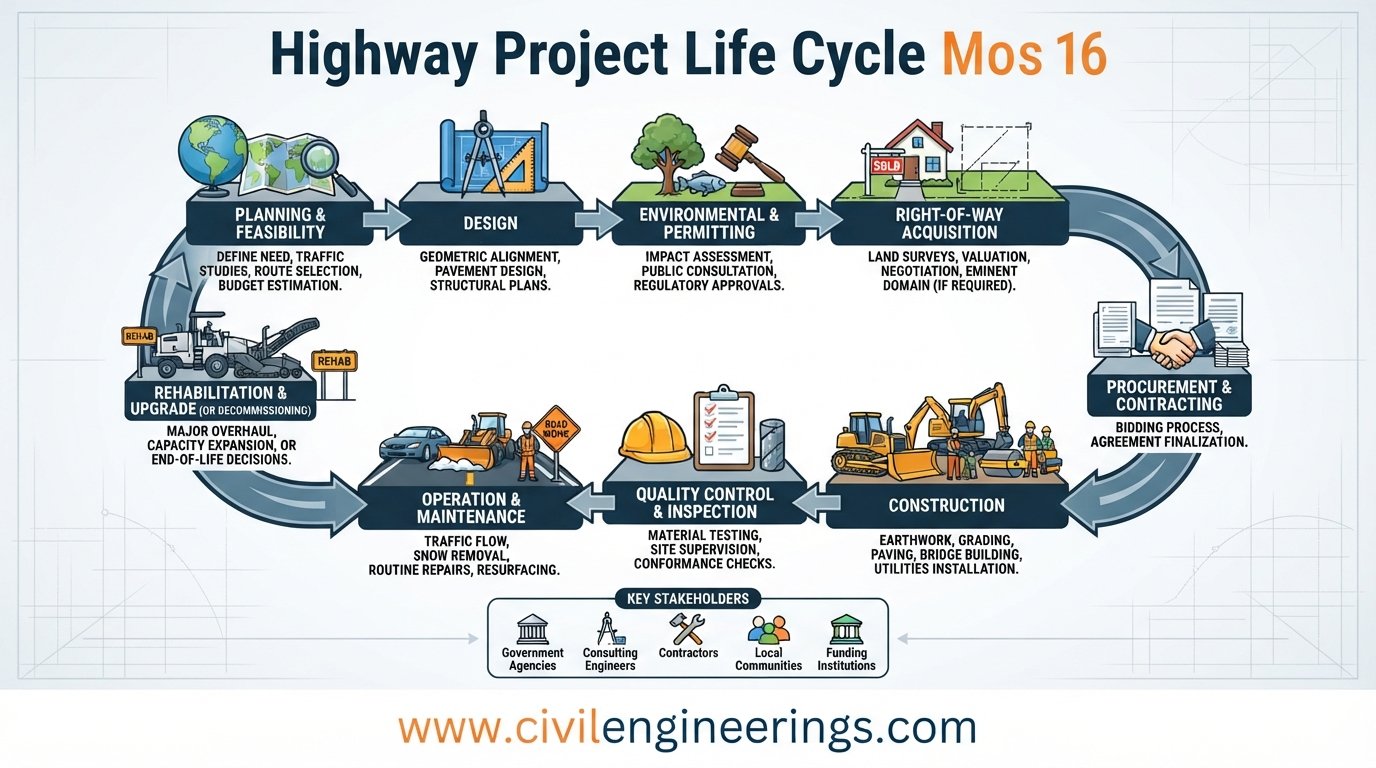
A highway may look like a finished strip of pavement, but the engineering work behind it begins long before the first excavator reaches the site. A successful road project requires coordinated decisions involving transportation planning, traffic studies, route selection, environmental assessment, land acquisition, geometric design, pavement engineering, procurement, construction, quality control, commissioning, and long-term maintenance.
The Highway Project Life Cycle provides a structured framework for managing these activities from the initial identification of a transportation need through planning, design, construction, operation, maintenance, and eventual rehabilitation or replacement. Understanding this cycle helps engineers and project managers make better decisions at every stage rather than treating highway construction as an isolated site activity.
For civil engineering students, the life cycle explains how theoretical concepts become real infrastructure. For highway engineers, consultants, contractors, and government agencies, it provides a practical framework for controlling scope, cost, schedule, quality, safety, risk, and performance.
This guide explains each major phase, important engineering activities, typical deliverables, practical examples, formulas, standards, common problems, and professional recommendations.
What Is the Highway Project Life Cycle?
The Highway Project Life Cycle is the sequence of activities through which a highway project progresses from identifying a transportation problem to planning, design, approval, construction, commissioning, operation, maintenance, rehabilitation, and eventual renewal.
The exact terminology differs between countries and transportation agencies. For example, FHWA describes project development through stages such as project need identification, project initiation, project clearance, plans/specifications/estimates (PS&E), construction, and operation. (Federal Highway Administration)
A broader asset-management approach extends the cycle beyond construction because the road remains an operational asset for decades.
A practical highway project life cycle can therefore be represented as:
Need Identification → Planning → Feasibility → Route Selection → Environmental & Social Assessment → Preliminary Design → Detailed Design → Land Acquisition & Approvals → Procurement → Construction → Testing & Commissioning → Opening → Operation & Maintenance → Rehabilitation → Renewal/Replacement
The important point is that these stages are connected. A poor decision during planning can create expensive problems during construction or maintenance.


Why the Life Cycle Approach Matters
Highway projects involve numerous stakeholders, including government agencies, design consultants, contractors, utility owners, environmental authorities, communities, road users, financiers, and maintenance organizations.
Each group has different responsibilities. Without a defined project life cycle, important decisions can become fragmented.
The life-cycle approach helps teams:
- Define the transportation problem correctly.
- Compare alternative solutions.
- Estimate project costs realistically.
- Identify environmental and social constraints.
- Manage right-of-way requirements.
- Coordinate utilities and structures.
- Develop safe geometric designs.
- Control construction quality.
- Manage project risks.
- Plan maintenance before construction is complete.
- Measure operational performance after opening.
FHWA guidance also emphasizes managing cost, schedule, risk, funding, responsibilities, and project-management processes throughout major project delivery. (Federal Highway Administration)
Phase 1: Transportation Need Identification
Every highway project begins with a problem, opportunity, or transportation need.
The need could arise because an existing road has reached capacity, traffic crashes are increasing, pavement condition is deteriorating, economic development requires better connectivity, or a new corridor is needed between important population and commercial centers.
Defining the Problem
The first question should not be:
“Where should we build the highway?”
A better question is:
“What transportation problem are we trying to solve?”
For example, suppose a two-lane road carries 18,000 vehicles per day and experiences severe congestion during peak periods. The potential solution may involve widening, intersection improvements, public transport measures, traffic management, or construction of a new bypass.
The engineering team should establish:
- Existing traffic volume.
- Traffic composition.
- Peak-hour demand.
- Level of service.
- Crash history.
- Existing pavement condition.
- Freight movement requirements.
- Future land-use development.
- Network connectivity.
- Environmental constraints.
- Expected travel demand.
FHWA identifies planning and scoping as early activities for defining project needs, alternatives, impacts, safety considerations, right-of-way requirements, and construction costs. (Federal Highway Administration)
Initial Traffic Assessment
Traffic forecasting is particularly important because highway capacity should reflect both current and future demand.
A simplified traffic-growth relationship can be expressed as:
Where:
- = projected traffic after years
- = current traffic
- = annual growth rate
- = design period in years
Actual traffic forecasting is more sophisticated and may include land-use development, trip generation, trip distribution, mode choice, assignment, freight demand, and network effects.
Phase 2: Feasibility Study and Project Planning
Once the transportation need has been established, the project enters a more detailed planning and feasibility stage.
The objective is to determine whether the proposed project is technically, economically, environmentally, socially, and financially feasible.
Feasibility Components
A highway feasibility study commonly considers:
- Technical feasibility
- Economic feasibility
- Financial feasibility
- Environmental feasibility
- Social feasibility
- Constructability
- Operational feasibility
- Risk feasibility
At this point, engineers may investigate several corridor options rather than committing immediately to one alignment.
Preliminary Cost Estimation
A conceptual cost estimate may include:
- Earthwork
- Pavement
- Bridges
- Culverts
- Drainage
- Interchanges
- Land acquisition
- Utility relocation
- Traffic management
- Road furniture
- Lighting
- Environmental mitigation
- Design and supervision
- Contingency
A simple feasibility-level estimate can be expressed as:
The estimate becomes progressively more accurate as surveys, designs, quantities, and construction information become available.
FHWA notes that major projects require careful cost estimation, risk assessment, funding strategies, and management planning before construction funding is released. (Federal Highway Administration)
Phase 3: Corridor and Route Selection
Route selection is one of the most consequential decisions in highway engineering.
An alignment that appears inexpensive initially may create expensive earthwork, drainage, land acquisition, environmental mitigation, or maintenance problems later.
Factors Affecting Highway Route Selection
Engineers normally evaluate:
- Terrain and topography
- Geology and soil conditions
- Hydrology
- Floodplains
- Existing settlements
- Agricultural land
- Environmental resources
- Utilities
- Railways
- Existing roads
- Bridges and river crossings
- Property acquisition
- Construction access
- Future development
- Safety
- Travel time
- Construction cost
GIS, satellite imagery, digital terrain models, drone surveys, LiDAR, cadastral data, and field reconnaissance can significantly improve corridor analysis.
Multi-Criteria Route Evaluation
A useful approach is to assign scores to competing alternatives.
For example:
Where:
- = total alternative score
- = weight assigned to criterion
- = score of the alternative for criterion
The weights should reflect project objectives rather than simply favoring the cheapest route.
Phase 4: Environmental, Social, and Regulatory Assessment
A highway affects more than traffic movement. It can influence communities, ecosystems, drainage patterns, noise levels, air quality, businesses, agricultural land, and cultural resources.
Environmental assessment should therefore begin early rather than being treated as paperwork at the end of design.
FHWA explains that transportation project development considers impacts on both human and natural environments, with environmental review forming an important part of project approval. (Federal Highway Administration)
Typical Environmental Considerations
Depending on the jurisdiction and project, studies may address:
- Water resources
- Wetlands
- Wildlife
- Forests
- Air quality
- Noise
- Cultural heritage
- Soil erosion
- Construction pollution
- Community impacts
- Resettlement
- Waste management
- Climate resilience
The environmental process can influence the selected route, bridge locations, drainage structures, construction methods, and mitigation measures.
Stakeholder Consultation
Effective consultation can identify problems that technical studies overlook.
Local communities may know about:
- Seasonal flooding
- Informal access routes
- Agricultural movement
- School traffic
- Livestock crossings
- Market activity
- Local drainage paths
Ignoring these factors can produce technically acceptable drawings but a poorly functioning highway.
Phase 5: Surveys and Preliminary Engineering Design
After a preferred corridor is established, detailed engineering investigations begin.
This stage converts a broad corridor into an engineering concept.
Topographic and Cadastral Survey
Survey teams collect:
- Existing ground levels
- Road centerlines
- Property boundaries
- Buildings
- Utilities
- Drainage channels
- Rivers
- Trees
- Existing structures
- Benchmarks
- Control points
Modern projects increasingly use GNSS, total stations, drones, mobile mapping, LiDAR, and digital terrain models.
Geotechnical Investigation
Subsurface conditions influence pavement thickness, embankment stability, cut slopes, bridge foundations, and drainage design.
Investigations may include:
- Boreholes
- Trial pits
- Soil classification
- Grain-size analysis
- Atterberg limits
- California Bearing Ratio (CBR)
- Compaction testing
- Groundwater investigation
- Rock investigation
- Laboratory strength tests
A highway alignment should not be finalized without understanding major geotechnical risks.
Preliminary Geometric Design
Engineers establish:
- Design speed
- Horizontal alignment
- Vertical alignment
- Lane width
- Shoulder width
- Median
- Superelevation
- Sight distance
- Intersections
- Interchanges
- Crossfall
- Clear zones
The design must balance safety, operating speed, terrain, cost, constructability, and environmental impacts.
Phase 6: Detailed Highway Design
Detailed design converts the approved concept into construction-ready engineering information.
This is where many disciplines must work together.
Pavement Design
The pavement engineer determines the required pavement structure based on:
- Design traffic
- Axle loading
- Subgrade strength
- Climate
- Drainage
- Material properties
- Reliability
- Design life
Typical pavement systems include:
Flexible pavement: asphalt layers over granular and/or stabilized layers.
Rigid pavement: concrete slab supported by a base or subbase.
Pavement design methods vary by country and agency. AASHTO-based procedures are widely used internationally, while local highway authorities may apply their own national standards and catalogues.
Drainage Design
Highway drainage protects pavement and earthworks from water-related deterioration.
Design may include:
- Side drains
- Catch drains
- Cross-drainage culverts
- Pipe drains
- Inlets
- Outfalls
- Median drainage
- Bridge drainage
For a simplified rational-method estimate:
Where:
- = peak runoff
- = runoff coefficient
- = rainfall intensity
- = drainage area
Units must remain consistent with the selected formula and local hydrological practice.
Structural Design
Major highway projects can include:
- Box culverts
- Pipe culverts
- Retaining walls
- Underpasses
- Overpasses
- Flyovers
- Viaducts
- River bridges
Structural design should consider dead load, live load, environmental actions, seismic effects where applicable, hydraulic conditions, foundation behavior, durability, constructability, and inspection requirements.
Road Safety Design
Safety should not be added after geometric design is finished.
The design team should examine:
- Intersection visibility
- Horizontal and vertical sight distance
- Median treatment
- Roadside hazards
- Pedestrian facilities
- Signage
- Markings
- Guardrails
- Delineation
- Lighting
- Work-zone requirements
FHWA design guidance highlights safety assessment, design decisions, design exceptions, value engineering, and work-zone transportation management during preliminary and final design. (Federal Highway Administration)
Phase 7: Approvals, Right-of-Way, and Procurement
A technically complete design cannot proceed if land, permits, funding, or contractual arrangements remain unresolved.
Right-of-Way Acquisition
The project team must identify the required corridor and obtain legal rights for construction.
ROW activities can involve:
- Property identification
- Cadastral verification
- Valuation
- Negotiation
- Compensation
- Resettlement
- Legal documentation
- Possession and handover
Utility conflicts should be investigated at the same time.
Procurement Strategy
Common delivery approaches include:
- Design-bid-build
- Design-build
- EPC-style arrangements
- Public-private partnerships
- Framework or package contracts
The selection depends on project complexity, risk allocation, funding arrangements, design maturity, schedule requirements, and applicable procurement law.
ICE’s infrastructure lifecycle guidance describes a broader delivery sequence involving briefing, procurement, detailed design, construction and commissioning, and handover/close-out. (Institution of Civil Engineers (ICE))
Phase 8: Highway Construction
Construction transforms engineering documents into physical infrastructure.
The construction team normally begins with mobilization, site establishment, surveys, temporary facilities, traffic management, and environmental controls.


Typical Construction Sequence
A highway construction sequence may include:
- Site clearance
- Utility relocation
- Setting out
- Earthwork
- Embankment construction
- Subgrade preparation
- Subbase construction
- Base-course construction
- Drainage installation
- Culverts and structures
- Asphalt or concrete pavement
- Road shoulders
- Signs and markings
- Safety barriers
- Landscaping and environmental works
- Testing and commissioning
The actual sequence may overlap significantly.
Earthwork and Subgrade
Earthwork requires strict control of:
- Moisture content
- Layer thickness
- Compaction
- Material suitability
- Embankment geometry
- Slope stability
- Drainage
A basic field compaction relationship is:
Where is relative compaction, is field dry density, and is maximum laboratory dry density.
The specified compaction percentage depends on the material, layer, project specification, and governing standard.
Pavement Quality Control
Asphalt construction requires control of:
- Aggregate gradation
- Binder content
- Mixing temperature
- Delivery temperature
- Layer thickness
- Rolling pattern
- Density
- Surface regularity
For concrete pavements, quality control includes:
- Cementitious material properties
- Aggregate quality
- Water-cement ratio
- Slump
- Air content where applicable
- Strength
- Joint construction
- Curing
- Thickness
A highway can have an excellent design and still fail prematurely because construction quality was poor.
Phase 9: Testing, Commissioning, and Handover
Before opening the highway to traffic, the project team must confirm that the completed facility satisfies contractual, safety, engineering, and operational requirements.
Pre-Opening Inspection
Typical checks include:
- Pavement condition
- Surface levels
- Crossfall
- Drainage
- Road markings
- Signs
- Guardrails
- Lighting
- Roadside safety
- Bridge elements
- Expansion joints
- Culverts
- Intersections
- Traffic signals
- ITS equipment
Deficiencies should be documented and corrected.
As-Built Documentation
The final record should capture what was actually constructed rather than simply reproducing the original drawings.
Useful records include:
- As-built drawings
- Survey data
- Material test results
- Inspection records
- Change orders
- Equipment manuals
- Warranties
- Maintenance requirements
- Asset registers
- Photographic records
FHWA project-management guidance specifically identifies documentation, reporting, lessons learned, and coordinated transition from construction to operations and maintenance as important closeout activities. (Federal Highway Administration)
Phase 10: Highway Operation and Maintenance
Opening day is not the end of the Highway Project Life Cycle. It marks the beginning of the asset’s operational life.
The highway authority must monitor whether the facility performs as expected.
Operational Monitoring
Performance indicators can include:
- Traffic volume
- Travel time
- Average speed
- Crash frequency
- Pavement condition
- Congestion
- Drainage performance
- Bridge condition
- Maintenance costs
- User complaints
FHWA notes that monitoring after opening can determine whether the facility operates as predicted and can provide lessons for future project development. (Federal Highway Administration)
Routine and Periodic Maintenance
Routine maintenance may include:
- Drain cleaning
- Vegetation control
- Sign replacement
- Shoulder repair
- Crack sealing
- Pothole repair
- Road marking renewal
Periodic maintenance may include:
- Asphalt overlays
- Surface treatments
- Pavement rehabilitation
- Bridge repairs
- Drainage rehabilitation
- Safety upgrades
Maintenance decisions should consider life-cycle cost rather than only immediate expenditure.
Life-Cycle Cost and Risk Management
A low construction price does not automatically mean a low-cost highway.
Engineers should evaluate total ownership cost over the analysis period.
A simplified present-value expression is:
Where:
- = present value
- = initial cost
- = cost occurring in year
- = discount rate
- = analysis period
The analysis can include construction, routine maintenance, rehabilitation, user costs, and residual value depending on the methodology.
Managing Highway Project Risks
Typical risks include:
- Land acquisition delays
- Utility conflicts
- Unforeseen geology
- Flooding
- Material shortages
- Price escalation
- Contractor performance
- Design errors
- Environmental approvals
- Traffic management problems
- Extreme weather
- Safety incidents
A useful risk register should record:
Risk → Probability → Impact → Owner → Mitigation → Trigger → Response
Risk management should continue throughout the project rather than being performed only during feasibility.
Role of IRC, AASHTO, and ICE Guidance
Highway engineers should always identify the standards governing their particular jurisdiction and contract.
IRC
In India and projects influenced by Indian practice, relevant Indian Roads Congress (IRC) codes and guidelines may cover geometric design, pavement design, traffic studies, road safety, materials, bridges, and other highway engineering subjects.
AASHTO
AASHTO publications provide widely used guidance covering areas such as geometric design, pavement design, structural considerations, traffic, and transportation asset management.
ICE
The Institution of Civil Engineers (ICE) provides broader infrastructure and project-delivery guidance. Its lifecycle guidance emphasizes coordinated activities from briefing and procurement through detailed design, construction, commissioning, handover, and closeout. (Institution of Civil Engineers (ICE))
These references should not be treated as interchangeable. The governing contract documents, national regulations, agency standards, and approved project criteria always take precedence.
Common Highway Project Life Cycle Problems
Even technically strong projects can encounter serious difficulties when lifecycle management is weak.
Incomplete Early Investigations
Insufficient geotechnical, survey, traffic, utility, or environmental information often creates redesign and variation orders during construction.
Poor Scope Definition
If the project scope is vague, stakeholders may develop different expectations about what the highway should deliver.
Delayed Right-of-Way
Construction cannot proceed smoothly if required land remains unavailable.
Weak Design Coordination
Conflicts between drainage, utilities, pavement, structures, traffic systems, and geometric design can create costly site changes.
Lowest-Price Thinking
Selecting solutions solely by initial construction price may increase maintenance and rehabilitation costs later.
Poor Construction-to-Operations Handover
Missing as-built information can make future maintenance unnecessarily difficult.
A strong lifecycle process therefore treats planning, design, construction, and operation as one connected system.
Practical Recommendations for Students, Engineers, and Contractors
For Civil Engineering Students
Students should learn the sequence rather than memorizing isolated highway topics.
Understand how:
Traffic → Route → Survey → Geometric Design → Pavement → Drainage → Structures → Construction → Maintenance
are connected.
Practice reading plan drawings, quantity calculations, cross-sections, longitudinal profiles, specifications, and laboratory reports.
For Highway Engineers and Consultants
Maintain traceability between project requirements and design decisions.
Before approving a design, ask:
- What problem does this element solve?
- Which design standard governs it?
- What assumptions were made?
- Has constructability been reviewed?
- Has maintenance considered the design?
- What happens if site conditions differ?
- Has road safety been independently reviewed?
Early multidisciplinary coordination can prevent many downstream problems. FHWA also promotes integrating operations and maintenance perspectives into project development rather than waiting until construction is finished. (FHWA Operations)
For Contractors
Contractors should study the contract drawings, specifications, geotechnical information, BOQ, traffic management requirements, environmental conditions, and approved construction methodology before starting major work.
Do not rely solely on drawings.
Field verification matters.
Establish strong systems for:
- Survey control
- Material approval
- Inspection and testing
- Method statements
- Daily records
- Nonconformance management
- Safety
- Environmental compliance
- Quantity measurement
- As-built documentation
Good records can become extremely valuable when investigating defects, claims, variations, or maintenance problems later.
FAQs About Highway Project Life Cycle
What is the Highway Project Life Cycle?
The Highway Project Life Cycle is the complete sequence of activities used to develop and manage a highway, beginning with identification of transportation needs and continuing through planning, design, approvals, construction, commissioning, operation, maintenance, rehabilitation, and renewal.
What are the main stages of a highway project?
The main stages generally include need identification, feasibility, route selection, environmental assessment, preliminary design, detailed design, approvals and ROW acquisition, procurement, construction, testing, commissioning, operation, maintenance, and rehabilitation.
Why is planning important in highway projects?
Planning establishes the transportation problem, future demand, project objectives, alternatives, constraints, preliminary costs, risks, and implementation strategy before major resources are committed.
What is the role of traffic analysis in the project life cycle?
Traffic analysis supports demand forecasting, capacity assessment, intersection design, road classification, lane requirements, operational evaluation, safety analysis, and long-term performance assessment.
When does highway construction begin?
Construction normally begins after sufficient design development, approvals, land availability, procurement, permits, funding arrangements, and contract requirements have been completed. Exact requirements vary by jurisdiction and project delivery method.
What is the difference between highway design and highway construction?
Highway design determines what should be built, including alignment, pavement, drainage, structures, safety systems, and specifications. Construction converts those approved designs into physical infrastructure while maintaining quality, safety, cost, and schedule controls.
Why is maintenance part of the highway project life cycle?
Maintenance affects the long-term performance, safety, serviceability, and cost of the highway. Considering maintenance during design can reduce future intervention costs and improve asset performance.
Which standards are used for highway projects?
The applicable standards depend on the country, road authority, contract, and project type. Common references include IRC guidance, AASHTO publications, agency specifications, national standards, and relevant ICE/project-management guidance.
What is the most important phase of a highway project?
There is no single universally most important phase. However, early planning and definition have particularly strong influence because decisions about need, route, scope, design criteria, and risk can affect every later phase.
How can highway projects be completed more successfully?
Success improves when the project has a clearly defined scope, reliable investigations, coordinated design, realistic cost and schedule estimates, effective risk management, strong construction quality control, stakeholder coordination, proper documentation, and planned maintenance.
Conclusion
The Highway Project Life Cycle is much more than a sequence of construction activities. It is an integrated engineering and management framework that connects transportation needs with long-term infrastructure performance.
A successful highway begins with a clearly defined problem. It then progresses through feasibility studies, corridor selection, environmental assessment, surveys, geometric and pavement design, approvals, procurement, construction, testing, commissioning, operation, and maintenance. Each stage influences the next.
For highway engineers and consultants, the greatest value of lifecycle thinking is better decision-making. Contractors, it provides a clear understanding of how construction fits within the wider project objectives. For students, it connects individual civil engineering subjects into one practical workflow.
Modern highway development also demands stronger attention to safety, sustainability, climate resilience, digital surveying, asset management, constructability, and whole-life cost. A road should not simply be built and opened; it should be planned, designed, constructed, operated, maintained, and ultimately renewed as a complete infrastructure asset.
The best highway projects are those in which every stage—from the first feasibility study to long-term maintenance—works toward the same objectives: safety, reliability, value, durability, and public benefit.

Kamran Malik is a passionate civil engineering writer and researcher who specializes in construction, transportation, structural engineering, and infrastructure topics. Through his articles on CivilEngineerings.com, he simplifies complex engineering concepts and shares practical insights, industry trends, and educational resources for students, professionals, and engineering enthusiasts.