
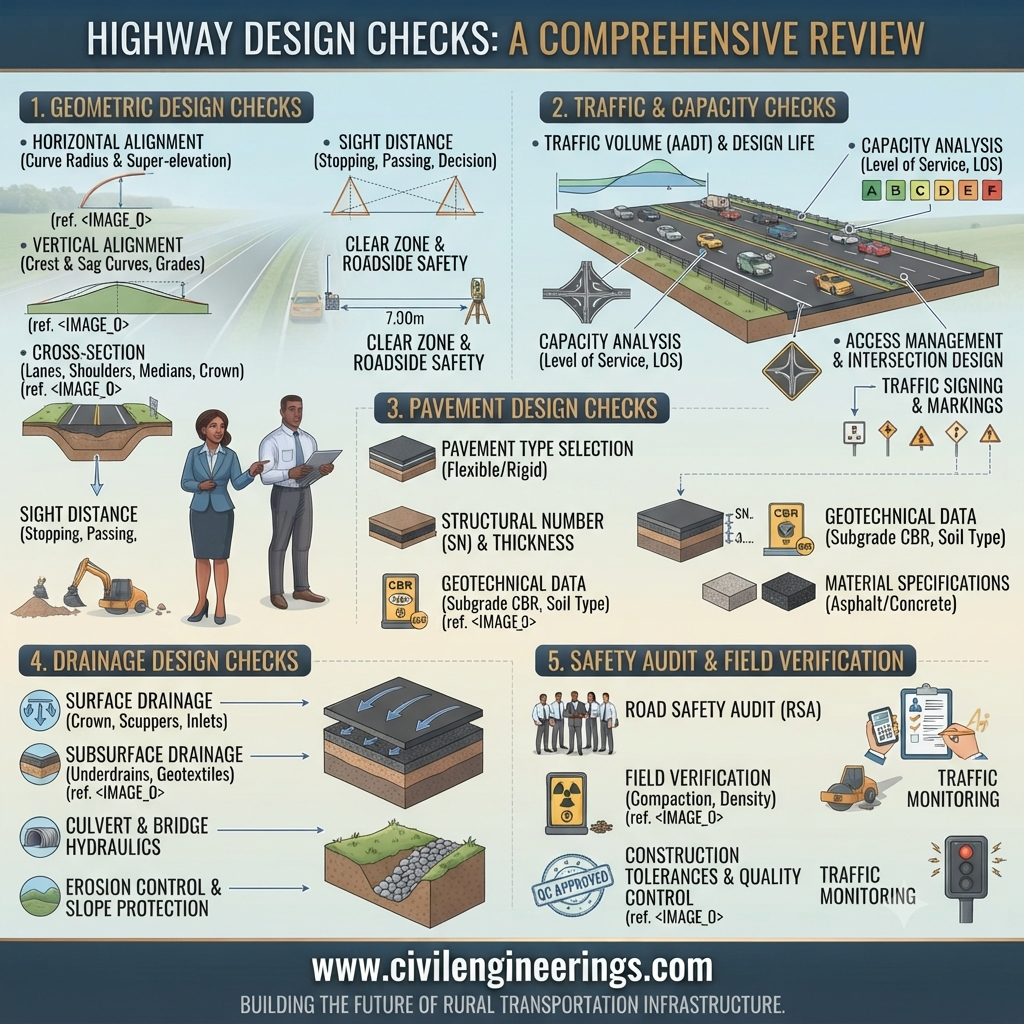
Introduction
Highway design is far more than drawing alignments on paper. Every successful road project depends on a series of engineering verifications that ensure the highway is safe, durable, economical, and capable of handling expected traffic throughout its design life. These verifications are collectively known as Highway Design Checks, and they form one of the most important stages of highway engineering.
Whether you are a civil engineering student, highway engineer, consultant, contractor, or researcher, understanding Highway Design Checks is essential for delivering infrastructure that meets technical requirements while minimizing future maintenance costs. From geometric design and sight distance to pavement, drainage, and traffic safety, each design element must be evaluated before construction begins.
This comprehensive guide explains the purpose of highway design checks, their major types, engineering principles, practical applications, and best practices used by experienced transportation professionals.
What Are Highway Design Checks?
Highway Design Checks are systematic engineering reviews carried out during the planning and design phases of a road or highway project. Their purpose is to verify that every component of the proposed highway complies with accepted engineering principles, safety requirements, traffic demands, environmental considerations, and construction feasibility.
Instead of assuming that a design is correct, engineers perform a series of calculations, comparisons, and technical assessments to identify potential weaknesses before construction starts.
Typical highway design checks include:
- Geometric design verification
- Traffic capacity analysis
- Pavement design verification
- Drainage assessment
- Earthwork evaluation
- Road safety assessment
- Structural adequacy checks
- Material suitability verification
- Environmental compliance review
- Construction feasibility analysis
A properly executed design check reduces costly redesigns, improves road safety, and increases the service life of highway infrastructure.
Why Highway Design Checks Are Important
Every highway project involves significant public investment and directly affects the safety of thousands of road users. Even a minor design error can lead to operational problems, premature pavement failure, drainage issues, or increased accident risks.
Highway design checks help engineers:
- Improve road safety
- Reduce construction errors
- Optimize project costs
- Enhance traffic efficiency
- Increase pavement lifespan
- Ensure proper drainage
- Reduce maintenance expenses
- Improve construction quality
- Verify engineering assumptions
- Support sustainable infrastructure development
In practice, design checks also improve communication among planners, geotechnical engineers, pavement specialists, structural engineers, and contractors, leading to better project coordination.
Objectives of Highway Design Checks
The primary objectives of highway design checks include:
Ensure User Safety
Road users should experience consistent and predictable driving conditions. Design checks verify that alignments, curves, intersections, and visibility provide adequate safety margins.
Improve Traffic Operations
Engineers evaluate whether the highway can accommodate current and projected traffic volumes without excessive congestion or delays.
Verify Structural Performance
Design checks confirm that pavement layers, embankments, bridges, and retaining structures can safely withstand anticipated loads over their intended service life.
Minimize Construction Risks
Early identification of design inconsistencies reduces changes during construction, saving both time and cost.
Promote Long-Term Durability
Proper verification ensures that the highway performs effectively under varying environmental conditions, including rainfall, temperature changes, and heavy traffic loading.
Major Types of Highway Design Checks
Highway projects require several categories of engineering checks. Each focuses on a specific aspect of the overall design.
| Design Check | Primary Purpose |
|---|---|
| Geometric Design Checks | Safe roadway geometry |
| Pavement Design Checks | Adequate pavement strength |
| Drainage Design Checks | Efficient stormwater management |
| Traffic Design Checks | Capacity and operational efficiency |
| Safety Design Checks | Accident prevention |
| Structural Design Checks | Bridge and retaining wall stability |
| Earthwork Design Checks | Stable embankments and cuttings |
| Environmental Checks | Minimize environmental impacts |
| Material Design Checks | Verify material suitability |
| Construction Feasibility Checks | Practical and economical construction |
Among these, geometric design checks are the foundation of highway design because they directly influence driver behavior, vehicle performance, and overall road safety.
Geometric Highway Design Checks
Geometric design checks ensure that the physical layout of the highway provides a safe, comfortable, and efficient driving experience. They involve evaluating roadway dimensions, alignments, curves, gradients, and visibility.
Major geometric design checks include:
- Alignment verification
- Sight distance analysis
- Horizontal curve evaluation
- Vertical curve evaluation
- Cross slope verification
- Superelevation assessment
- Lane width assessment
- Shoulder width verification
- Median design review
- Intersection geometry assessment
Alignment Checks
Road alignment determines the overall path followed by the highway. Engineers review both horizontal and vertical alignments to ensure smooth vehicle movement and minimize abrupt directional changes.
During alignment checks, engineers evaluate:
- Terrain suitability
- Driver comfort
- Vehicle operating speeds
- Earthwork balance
- Environmental constraints
- Construction feasibility
A well-planned alignment reduces fuel consumption, enhances safety, and lowers maintenance costs over the highway’s lifespan.
ASCII Diagram: Highway Alignment
Start
  |
  |
  |______________
                 \
                  \
                   \
                    \___________ End
A smooth alignment minimizes sudden steering corrections and provides a more predictable driving path.
Sight Distance Checks
Sight distance is the length of roadway visible to a driver. Adequate visibility allows sufficient time to perceive hazards, react, and stop or maneuver safely.
Highway engineers typically evaluate:
- Stopping Sight Distance (SSD)
- Overtaking Sight Distance (OSD)
- Decision Sight Distance
- Intersection Sight Distance
Insufficient sight distance is a major contributor to highway accidents, especially on curves, crests, and intersections.
Basic Stopping Sight Distance Formula
[
SSD = \text{Reaction Distance} + \text{Braking Distance}
]
Where:
- SSD = Stopping Sight Distance (m)
- Reaction Distance = Distance traveled during driver reaction time
- Braking Distance = Distance required to stop after braking begins
Example
Assume:
- Design speed = 80 km/h
- Reaction time = 2.5 s
Convert speed:
[
80 \times \frac{1000}{3600}=22.22 \text{ m/s}
]
Reaction distance:
[
22.22 \times 2.5=55.5\text{ m}
]
The total stopping sight distance also includes braking distance, which depends on pavement friction and roadway gradient. Engineers verify that the available sight distance exceeds the calculated requirement to maintain safe operations.
Horizontal Curve Checks
Horizontal curves allow vehicles to change direction gradually without compromising stability or comfort.
Engineers verify:
- Curve radius
- Design speed compatibility
- Superelevation
- Side friction
- Transition curve length
- Vehicle stability
- Driver comfort
A curve with an inadequate radius can increase lateral forces, causing discomfort and elevating the risk of skidding or rollover, particularly for heavy vehicles.
ASCII Diagram: Horizontal Curve
-----------------------
                     )
                   )
                )
             )
----------)
Properly designed curves enable smooth directional changes while maintaining safe vehicle control.
Vertical Curve Checks
Vertical curves connect roadway grades smoothly, improving ride quality and visibility.
Two main types are used:
- Crest curves
- Sag curves
Engineers check:
- Driver visibility
- Ride comfort
- Drainage performance
- Vehicle acceleration
- Night-time headlight visibility
- Compliance with design speed
ASCII Diagram
Crest Curve

        /\
      /    \
_____/      \_____
Sag Curve

_____\      /_____
      \    /
       \__/
Well-designed vertical curves reduce abrupt grade changes and provide a safer driving experience.
Cross Slope and Superelevation Checks
Cross slope helps drain water from the pavement surface, while superelevation counteracts centrifugal force on horizontal curves.
Engineers verify:
- Adequate surface drainage
- Smooth transition into curves
- Compatibility with design speed
- Vehicle stability
- Prevention of water ponding
Failure to provide proper cross slope can lead to hydroplaning, reduced skid resistance, and accelerated pavement deterioration.
ASCII Diagram: Cross Slope
Shoulder      Road Center      Shoulder

      \          /\          /
       \        /  \        /
        \______/    \______/
Water should flow efficiently toward the pavement edges without causing erosion or ponding.
Lane Width and Shoulder Checks
Lane and shoulder dimensions directly influence highway capacity, driver comfort, and operational safety.
During design reviews, engineers assess:
- Lane width consistency
- Shoulder width adequacy
- Emergency stopping space
- Space for cyclists or pedestrians (where applicable)
- Recovery area for errant vehicles
- Future traffic expansion needs
Proper lane and shoulder design reduces side-swipe collisions, accommodates oversized vehicles, and provides safer conditions during maintenance or emergencies.
Key Engineering Parameters Checked During Geometric Design
The following parameters are routinely reviewed to ensure the highway geometry meets performance and safety objectives:
| Parameter | Engineering Purpose |
|---|---|
| Design Speed | Basis for geometric design |
| Horizontal Curve Radius | Vehicle stability |
| Vertical Gradient | Safe climbing and descending |
| Sight Distance | Driver visibility |
| Lane Width | Traffic flow and safety |
| Shoulder Width | Emergency stopping and recovery |
| Cross Slope | Surface drainage |
| Superelevation | Counteract centrifugal force |
| Transition Curve Length | Smooth steering transition |
| Right-of-Way Width | Future expansion and safety |
These geometric checks form the backbone of highway design. Once they are verified, engineers proceed to evaluate pavement strength, drainage performance, traffic operations, and structural adequacy to ensure the roadway performs safely and efficiently throughout its intended service life.
Pavement Design Checks
After completing geometric design verification, engineers evaluate the pavement structure to ensure it can safely withstand traffic loads and environmental conditions throughout its intended service life. Pavement design checks help prevent common failures such as rutting, fatigue cracking, potholes, and excessive settlement.
The pavement structure generally consists of:
- Surface Course
- Binder Course (where applicable)
- Base Course
- Sub-base Course
- Compacted Subgrade
ASCII Diagram: Typical Flexible Pavement
          VEHICLE LOAD
               ↓
 ┌────────────────────────┐
 │ Asphalt Wearing Course │
 ├────────────────────────┤
 │    Binder Course       │
 ├────────────────────────┤
 │      Base Course       │
 ├────────────────────────┤
 │     Sub-base Layer     │
 ├────────────────────────┤
 │ Compacted Subgrade Soil│
 └────────────────────────┘
Important Pavement Design Checks
1. Traffic Loading Assessment
Engineers estimate future traffic volume and convert axle loads into Equivalent Single Axle Loads (ESALs) or similar design traffic parameters depending on the adopted design methodology.
The assessment considers:
- Current traffic volume
- Annual traffic growth
- Vehicle classification
- Heavy commercial vehicles
- Design life
- Lane distribution
Accurate traffic prediction is essential because underestimating heavy vehicle traffic often results in premature pavement failure.
2. Subgrade Strength Verification
The subgrade forms the foundation of the pavement system. Weak subgrade soils require stabilization or thicker pavement layers.
Common parameters include:
- California Bearing Ratio (CBR)
- Resilient Modulus
- Soil Classification
- Moisture Content
- Density
Higher subgrade strength generally allows for a more economical pavement design.
3. Pavement Thickness Check
The thickness of each pavement layer must safely distribute wheel loads to the subgrade.
Engineers verify:
- Asphalt thickness
- Base thickness
- Sub-base thickness
- Overall structural capacity
- Expected service life
Improper thickness design can lead to excessive deformation, cracking, and increased maintenance costs.
4. Material Quality Check
Construction materials should satisfy engineering specifications before use.
Typical materials include:
- Crushed aggregate
- Bitumen
- Cement-treated base
- Granular sub-base
- Stabilized soil
- Geotextiles
Material consistency directly influences pavement performance and durability.
Pavement Design Calculation Example
Given
- Design Traffic = 25 million ESAL
- CBR = 8%
- Design Life = 20 years
Assume the selected pavement design method recommends:
- Asphalt Surface = 100 mm
- Base Course = 250 mm
- Granular Sub-base = 300 mm
Total Pavement Thickness
Formula
Total Thickness = Surface + Base + Sub-base
Substituting the values:
= 100 + 250 + 300
Total Thickness = 650 mm
This total thickness should then be verified against expected traffic loading, environmental conditions, drainage performance, and construction feasibility.
Drainage Design Checks
Water is one of the most damaging factors affecting highway performance. Effective drainage design protects pavement layers, embankments, slopes, and adjacent infrastructure from deterioration.
Drainage checks evaluate whether surface runoff and subsurface water can be safely collected, conveyed, and discharged.
Components Checked
- Side drains
- Longitudinal drains
- Cross drainage structures
- Culverts
- Catch pits
- Median drains
- Subsurface drainage
- Outfall locations
ASCII Diagram: Highway Drainage
 Shoulder      Carriageway      Shoulder
      \______________________/
       \                    /
        \                  /
         \________________/
          Side Drain
Proper drainage minimizes water infiltration, preserving pavement strength and extending service life.
Surface Drainage Check
Surface drainage verification includes:
- Cross slope adequacy
- Shoulder drainage
- Median drainage
- Side ditch capacity
- Road camber
- Flow direction
Standing water significantly increases the risk of hydroplaning and accelerates pavement deterioration.
Culvert Design Check
Engineers verify that culverts can safely pass design storm runoff without overtopping the roadway.
Checks include:
- Hydraulic capacity
- Inlet condition
- Outlet protection
- Sediment control
- Scour prevention
- Structural integrity
Traffic Design Checks
Traffic engineering ensures that the highway functions efficiently while maintaining safety under projected traffic demand.
Major traffic checks include:
- Traffic volume analysis
- Level of Service (LOS)
- Capacity analysis
- Vehicle composition
- Peak-hour traffic
- Turning movements
- Speed studies
- Future traffic growth
Design Speed Verification
The selected design speed influences nearly every geometric element of the highway.
Engineers ensure consistency between:
- Horizontal curves
- Vertical curves
- Sight distance
- Superelevation
- Intersection layout
Sudden changes in design speed create unsafe driving conditions and should be avoided.
Capacity Check
Road capacity determines the maximum number of vehicles that can safely travel on the highway within a given time.
Factors affecting capacity include:
- Lane width
- Number of lanes
- Heavy vehicle percentage
- Driver behavior
- Terrain
- Access points
- Speed limits
Capacity analysis helps determine whether future lane widening may be required.
Highway Safety Design Checks
Safety considerations are integrated into every stage of highway design. These checks aim to reduce crash risk and improve overall road user protection.
Key safety evaluations include:
- Stopping sight distance
- Overtaking sight distance
- Roadside hazards
- Barrier placement
- Median protection
- Sign visibility
- Road markings
- Lighting
- Pedestrian facilities
- Bicycle accommodation (where applicable)
Road Safety Audit
Many highway projects undergo an independent Road Safety Audit (RSA) before construction and, in some cases, after opening to traffic.
Typical audit items include:
- Dangerous curves
- Inadequate visibility
- Improper intersections
- Poor drainage
- Unsafe roadside obstacles
- Missing signs
- Deficient guardrails
- Pedestrian conflicts
An independent review often identifies issues that may not have been apparent during the design process.
Earthwork Design Checks
Earthwork represents a significant portion of highway construction costs. Proper verification ensures stability, economy, and long-term performance.
Checks include:
- Cut and fill balance
- Embankment stability
- Slope protection
- Settlement analysis
- Soil suitability
- Compaction requirements
- Borrow material quality
ASCII Diagram: Highway Embankment
        Pavement
──────────────────────────
      Base Layer
──────────────────────────
     Compacted Fill
    /              \
   /                \
__/__________________\__
   Natural Ground
Stable embankments reduce the likelihood of differential settlement and slope failures.
Structural Design Checks
Highways often include bridges, retaining walls, culverts, and other structures that require separate engineering verification.
Structural design checks assess:
- Dead loads
- Live loads
- Impact loads
- Wind loads
- Seismic effects
- Foundation stability
- Bearing capacity
- Structural durability
These checks ensure that highway structures perform safely throughout their design life.
Quality Control Tests Used During Highway Design and Construction
Design assumptions must be validated through laboratory and field testing. The following tests are commonly used to verify soil, pavement, concrete, and asphalt quality.
| Test | Purpose |
|---|---|
| CBR Test | Measures subgrade strength for pavement design. |
| Standard/Modified Proctor Test | Determines the optimum moisture content and maximum dry density for soil compaction. |
| Marshall Stability Test | Evaluates the strength and deformation characteristics of asphalt mixtures. |
| Slump Test | Assesses the workability and consistency of fresh concrete. |
| Core Test | Confirms in-place pavement thickness and material quality after construction. |
| Field Density Test | Verifies that soil and granular layers achieve the specified compaction level. |
| Plate Load Test | Determines the load-bearing capacity and deformation characteristics of the soil or foundation. |
| Bitumen Penetration Test | Measures the consistency and grade of paving bitumen. |
| Aggregate Impact Value Test | Evaluates aggregate toughness under impact loading. |
| Los Angeles Abrasion Test | Measures aggregate resistance to wear and abrasion. |
Regular testing during construction ensures that materials and workmanship align with the approved design, reducing the risk of premature failures.
Basic Engineering Formula: Cross Slope (Camber)
Cross slope facilitates rapid drainage of rainwater from the pavement surface.
Formula
[
\text{Cross Slope (%)} = \frac{\text{Vertical Difference}}{\text{Horizontal Width}} \times 100
]
Example
Given:
- Vertical Difference = 0.12 m
- Pavement Width = 6.0 m
[
\text{Cross Slope} = \frac{0.12}{6.0} \times 100 = 2%
]
A 2% cross slope is commonly suitable for many paved roads, helping prevent water accumulation while maintaining driver comfort. The exact value should always be selected according to the governing design standards and project requirements.
Highway Design Review Checklist
Before approving a highway design, experienced engineers typically verify that:
- ✔ Geometric alignment is consistent with the design speed.
- ✔ Horizontal and vertical curves provide adequate sight distance.
- ✔ Pavement thickness satisfies projected traffic loading.
- ✔ Subgrade strength is sufficient or appropriately improved.
- ✔ Drainage systems effectively remove surface and subsurface water.
- ✔ Earthworks are stable and economically balanced.
- ✔ Bridges, culverts, and retaining structures meet structural requirements.
- ✔ Road safety features such as barriers, markings, and signage are incorporated.
- ✔ Material specifications and quality control measures are defined.
- ✔ Future maintenance and possible roadway expansion have been considered.
A systematic review of these elements significantly improves the reliability, safety, and long-term performance of highway infrastructure.
Best Practices for Effective Highway Design Checks
Highway design checks are most effective when they are integrated into every stage of a project’s lifecycle—from planning and preliminary design to construction and maintenance. Based on practical engineering experience, the following recommendations can significantly improve project quality and long-term highway performance.
Highway Engineers
Experienced highway engineers should:
- Perform independent design reviews before final approval.
- Verify all engineering calculations using reliable software and manual checks.
- Select an appropriate design speed based on terrain and expected traffic conditions.
- Use current traffic forecasts instead of relying solely on historical data.
- Consider climate, rainfall, and future development when designing drainage systems.
- Coordinate closely with geotechnical, structural, traffic, and environmental specialists.
- Conduct road safety audits during both design and pre-opening stages.
- Maintain complete documentation of design assumptions and calculation sheets.
- Review constructability to identify potential site challenges before construction begins.
- Update designs whenever significant changes occur in traffic demand or site conditions.
Contractors
Contractors play a vital role in ensuring that the approved design is accurately implemented.
Recommended practices include:
- Verify drawings before starting construction.
- Confirm survey control points and roadway alignment.
- Follow approved construction sequences.
- Use materials that meet project specifications.
- Perform field quality control tests regularly.
- Ensure proper compaction of embankments and pavement layers.
- Maintain effective drainage throughout construction.
- Record all site modifications for future reference.
- Protect completed pavement layers from premature traffic loading.
- Report unexpected ground conditions immediately to the design team.
Civil Engineering Students
Students preparing for careers in highway engineering should focus on building both theoretical knowledge and practical skills.
Key recommendations include:
- Study the principles of geometric, pavement, and traffic engineering.
- Practice solving engineering design problems manually before using software.
- Understand the purpose behind each highway design check rather than memorizing procedures.
- Learn to interpret engineering drawings and cross-sections.
- Visit construction sites to observe real-world highway projects.
- Become familiar with industry standards and technical terminology.
- Develop proficiency in CAD, BIM, GIS, and highway design software.
- Strengthen communication and technical report-writing skills.
A strong foundation in design checks will help students transition more effectively into professional engineering roles.
Common Mistakes in Highway Design Checks
Even experienced professionals can overlook critical aspects if design reviews are not conducted systematically. The following mistakes frequently lead to construction issues, safety concerns, or increased maintenance costs.
1. Ignoring Future Traffic Growth
Designing only for current traffic volumes often results in insufficient pavement capacity and premature congestion.
2. Inadequate Site Investigation
Poor geotechnical investigation can lead to unexpected settlement, slope instability, or foundation problems during construction.
3. Incorrect Design Speed Selection
Using a design speed that does not match terrain or operating conditions can create inconsistent roadway geometry and increase accident risks.
4. Poor Drainage Planning
Insufficient drainage allows water to infiltrate pavement layers, reducing structural strength and accelerating deterioration.
5. Underestimating Heavy Vehicle Loads
Failure to account for commercial traffic can result in pavement rutting, cracking, and structural failures.
6. Insufficient Quality Control
Neglecting laboratory and field testing increases the likelihood of construction defects and reduces pavement durability.
7. Lack of Independent Design Review
A second engineering review often identifies errors that may be missed by the original design team.
8. Inadequate Safety Considerations
Missing guardrails, poor signage, insufficient sight distance, or improperly designed intersections can significantly increase crash risks.
Avoiding these common mistakes enhances project reliability and reduces life-cycle costs.
General Overview of Highway Design Standards
Highway design checks should align with recognized national and international engineering guidance. While the specific requirements vary by country and project, the following organizations provide widely accepted frameworks and best practices.
Indian Roads Congress (IRC)
IRC publishes guidelines for highway planning, geometric design, pavement engineering, traffic safety, bridge engineering, and maintenance. These documents are extensively used for road projects in India and emphasize safety, durability, and efficient transportation.
American Association of State Highway and Transportation Officials (AASHTO)
AASHTO develops comprehensive guidance on highway geometric design, pavement structures, bridge design, and transportation planning. Its recommendations are widely referenced for modern highway engineering practices.
ASTM International
ASTM establishes standardized testing methods for soils, aggregates, asphalt, concrete, bitumen, and construction materials. These standards promote consistency and quality assurance during laboratory and field testing.
Federal Highway Administration (FHWA)
FHWA provides technical resources on highway safety, pavement preservation, traffic operations, asset management, and sustainable infrastructure. Its publications support agencies in implementing safe and efficient roadway systems.
Institution of Civil Engineers (ICE)
ICE promotes professional excellence through engineering guidance, technical publications, and knowledge sharing across transportation, infrastructure, and construction disciplines.
International Organization for Standardization (ISO)
ISO develops internationally recognized standards related to quality management, environmental management, occupational safety, and risk management, supporting efficient and sustainable infrastructure delivery.
Note: Engineers should always consult the latest editions of applicable national standards, project specifications, and client requirements. This article provides only a general discussion and does not reproduce or replace official engineering documents.
Frequently Asked Questions (FAQs)
1. What are Highway Design Checks?
Highway Design Checks are systematic engineering reviews carried out during the planning and design stages of a highway project. They verify that geometric layouts, pavement structures, drainage systems, traffic operations, safety features, and structural components meet accepted engineering principles and project objectives. These checks help identify potential problems before construction begins, reducing costly redesigns, improving road safety, and extending the service life of highway infrastructure.
2. Why are Highway Design Checks important before construction?
Conducting Highway Design Checks before construction minimizes technical errors and ensures the proposed design is practical, safe, and economical. Early verification helps engineers confirm that pavement thickness, sight distances, drainage systems, and structural elements are adequate for expected traffic and environmental conditions. Addressing issues during design is significantly less expensive than correcting them after construction has started or the highway is operational.
3. Which design check is the most important in highway engineering?
There is no single most important design check because all elements are interconnected. Geometric design ensures safe vehicle movement, pavement design provides structural durability, drainage protects the roadway from water damage, and traffic and safety analyses improve operational performance. A balanced approach that verifies every component produces the safest and most cost-effective highway.
4. How do geotechnical investigations influence highway design?
Geotechnical investigations provide essential information about soil type, bearing capacity, groundwater conditions, settlement potential, and slope stability. These data influence pavement thickness, embankment design, foundation selection, and drainage requirements. Accurate site investigations reduce uncertainty, improve design reliability, and help avoid unexpected construction problems caused by unsuitable ground conditions.
5. What quality control tests are commonly performed during highway construction?
Common quality control tests include the California Bearing Ratio (CBR) Test, Standard or Modified Proctor Test, Marshall Stability Test, Slump Test, Core Test, Field Density Test, Plate Load Test, Los Angeles Abrasion Test, and Aggregate Impact Value Test. Together, these tests verify soil strength, compaction, asphalt performance, concrete workability, pavement thickness, and aggregate quality, ensuring that construction matches the approved design specifications.
6. How often should Highway Design Checks be reviewed?
Design checks should be performed throughout the project lifecycle. Initial reviews occur during preliminary design, followed by detailed verification before issuing construction drawings. Additional reviews may be required when project conditions, traffic forecasts, environmental constraints, or client requirements change. Independent design reviews and road safety audits provide an extra level of assurance before construction begins.
7. What software is commonly used for Highway Design Checks?
Modern highway engineering relies on software such as AutoCAD Civil 3D, Bentley OpenRoads Designer, Autodesk InfraWorks, MX Road, OpenBridge Designer, ArcGIS, and traffic analysis tools. While software increases efficiency and accuracy, experienced engineers should always validate important outputs with engineering judgment and manual calculations to ensure reliable results.
8. How can engineers improve the accuracy of Highway Design Checks?
Accuracy improves through detailed site investigations, reliable survey data, realistic traffic forecasting, high-quality laboratory testing, careful engineering calculations, multidisciplinary collaboration, and independent design reviews. Continuous professional development and adherence to recognized engineering standards also help engineers produce designs that are safe, durable, economical, and suitable for long-term highway performance.
Conclusion
Highway Design Checks are the foundation of safe, efficient, and durable transportation infrastructure. They ensure that every aspect of a highway—from geometric alignment and pavement structure to drainage, traffic operations, and structural stability—is thoroughly evaluated before construction begins. A comprehensive design review reduces technical risks, minimizes maintenance costs, and enhances the overall performance of the roadway throughout its service life.
For civil engineering students, mastering these concepts builds a strong technical foundation. For engineers, consultants, and contractors, systematic design checks improve decision-making, construction quality, and public safety. By combining sound engineering principles, quality control testing, and guidance from recognized standards, professionals can deliver highways that meet present demands while accommodating future growth. Incorporating Highway Design Checks into every project is an investment in safer roads, longer-lasting infrastructure, and more sustainable transportation systems.

Kamran Malik is a passionate civil engineering writer and researcher who specializes in construction, transportation, structural engineering, and infrastructure topics. Through his articles on CivilEngineerings.com, he simplifies complex engineering concepts and shares practical insights, industry trends, and educational resources for students, professionals, and engineering enthusiasts.