
Introduction
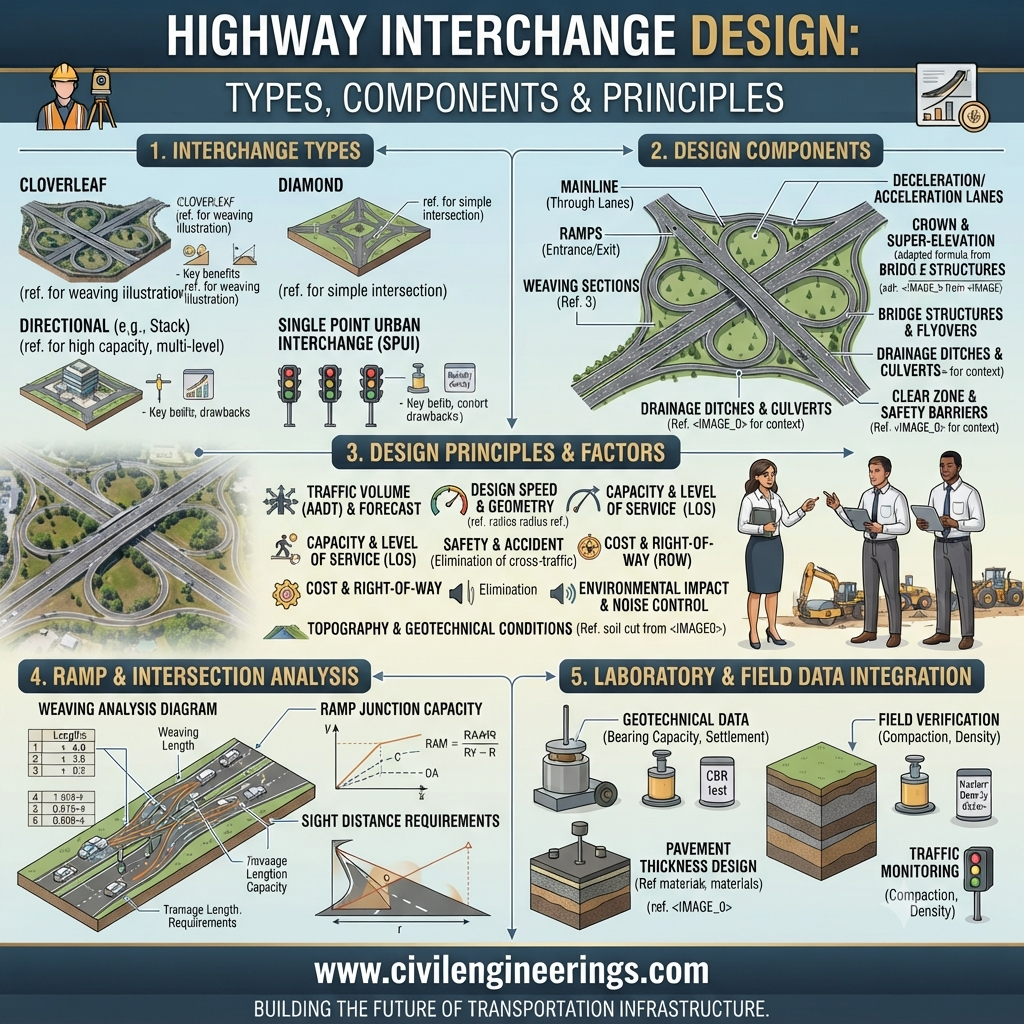
Modern highways carry thousands of vehicles every day, making efficient traffic movement a critical aspect of transportation engineering. At locations where two or more major roads intersect, engineers design highway interchanges to eliminate traffic conflicts, improve safety, and maintain uninterrupted vehicle flow. Unlike traditional at-grade intersections controlled by traffic signals, interchanges use bridges, ramps, and grade separation to allow vehicles to change direction without stopping.
Highway Interchange Design is one of the most challenging areas of highway engineering because it requires the integration of geometric design, traffic engineering, structural engineering, drainage planning, and road safety principles. A well-designed interchange reduces congestion, minimizes travel time, improves road capacity, and decreases the likelihood of severe accidents.
Whether designing an interchange for an urban expressway, a national highway, or a motorway, engineers must carefully evaluate traffic demand, available land, construction costs, environmental impacts, and future expansion requirements. This guide explains the engineering principles, components, and common interchange types that form the foundation of successful highway infrastructure.
What Is Highway Interchange Design?
Highway Interchange Design is the process of planning and designing grade-separated road junctions that allow vehicles to move between highways or major roads without crossing opposing traffic streams at the same level.
An interchange replaces traditional signalized intersections with structures such as bridges, flyovers, underpasses, and connecting ramps. This arrangement improves traffic efficiency by allowing continuous vehicle movement and reducing delays.
Objectives of Highway Interchange Design
- Maintain uninterrupted traffic flow.
- Eliminate conflict points.
- Increase roadway capacity.
- Improve travel safety.
- Reduce traffic congestion.
- Support future traffic growth.
- Minimize travel time.
- Improve freight movement.
A successful interchange balances safety, operational efficiency, construction cost, and long-term maintenance requirements.
Why Highway Interchange Design Is Important
As urban populations and traffic volumes continue to increase, highways require junctions capable of handling large numbers of vehicles efficiently. Poorly designed interchanges often create bottlenecks, increase accident rates, and raise vehicle operating costs.
Benefits of Well-Designed Interchanges
- Continuous traffic movement
- Reduced travel delays
- Lower fuel consumption
- Improved road safety
- Increased highway capacity
- Better freight transportation
- Reduced emissions from idling vehicles
- Enhanced driver comfort
From an economic perspective, efficient interchanges strengthen regional connectivity, improve logistics, and support commercial development.
Main Components of a Highway Interchange
Every interchange consists of several engineered elements that work together to provide safe and efficient traffic movement.
1. Main Carriageway
The main carriageway carries through traffic that continues along the primary highway without interruption.
2. Entrance Ramps
Entrance ramps allow vehicles to accelerate before merging with highway traffic.
Design Considerations
- Adequate acceleration length
- Proper merging angle
- Good sight distance
- Smooth horizontal curvature
3. Exit Ramps
Exit ramps allow vehicles to decelerate safely before leaving the highway.
Engineers provide sufficient deceleration lanes to reduce the risk of rear-end collisions.
4. Bridges and Flyovers
Bridges separate crossing traffic streams vertically, eliminating the need for traffic signals and reducing conflict points.
5. Underpasses
Where appropriate, one roadway passes beneath another using reinforced concrete or steel structures.
6. Loop Ramps
Loop ramps accommodate turning movements, particularly in cloverleaf and partial cloverleaf interchanges.
Their design requires careful attention to curvature and operating speed.
7. Collector-Distributor Roads
These roads separate entering and exiting traffic from the main highway, reducing weaving conflicts and improving operational efficiency.
Simple Highway Interchange Layout
                 Highway A
===============================
          \          /
           \ Ramp   /
            \      /
             \____/
             Bridge
             /    \
            / Ramp \
===========/========\===========
          Highway B
This simplified diagram illustrates how two highways connect through ramps and a grade-separated bridge without crossing traffic at the same level.
Engineering Principles of Highway Interchange Design
Designing an interchange involves more than connecting two roads. Engineers apply several fundamental principles to ensure safety, efficiency, and long-term performance.
Traffic Flow Efficiency
The primary objective is to maintain continuous vehicle movement with minimal delays.
Traffic engineers analyze:
- Peak-hour traffic
- Future traffic growth
- Turning movements
- Heavy vehicle percentages
- Lane utilization
Safety
Interchanges should minimize conflict points and provide drivers with sufficient time to make decisions.
Key safety considerations include:
- Adequate sight distance
- Consistent design speed
- Proper signage
- Lane markings
- Lighting
- Guardrails
- Clear roadside zones
Geometric Design
Geometric design governs the physical layout of the interchange.
Important factors include:
- Horizontal curves
- Vertical curves
- Ramp gradients
- Lane widths
- Shoulder widths
- Superelevation
- Cross slopes
Proper geometry ensures comfortable and predictable vehicle movements.
Drainage
Efficient drainage prevents water accumulation on pavements and structures.
Engineers typically incorporate:
- Side drains
- Inlets
- Culverts
- Stormwater channels
- Bridge drainage systems
Good drainage extends pavement life and improves skid resistance during rainfall.
Future Expansion
Traffic volumes rarely remain constant throughout the service life of a highway.
Designers often reserve space for:
- Additional lanes
- Future flyovers
- Widening projects
- New ramps
- Intelligent Transportation Systems (ITS)
Planning for future expansion reduces reconstruction costs.
Types of Highway Interchanges
Different interchange configurations suit different traffic demands, land availability, and budget constraints.
1. Diamond Interchange
The diamond interchange is one of the most common designs used where a major highway crosses a minor road.
Characteristics
- Four ramps
- Simple layout
- Lower construction cost
- Compact land requirement
- Suitable for moderate traffic
Advantages
- Economical construction
- Easy maintenance
- Simple traffic control
- Efficient land use
Limitations
- Traffic signals may be required on the crossroad.
- Capacity becomes limited under heavy turning movements.
Diamond Interchange Diagram
         Highway
========================

     \          /
      \        /
       \______/

       /      \
      /        \
========================
      Local Road
2. Cloverleaf Interchange
A cloverleaf interchange eliminates left-turn conflicts through four loop ramps.
It provides free-flow movement for all turning vehicles without traffic signals.
Characteristics
- Four loop ramps
- Four outer ramps
- Grade separation
- Continuous traffic flow
Advantages
- Eliminates left-turn conflicts
- High operational efficiency
- Suitable for high-speed highways
Limitations
- Large land requirement
- Weaving sections may reduce safety
- Higher construction cost
Cloverleaf Diagram
        ( )      ( )
=========  ======  =========

        ( )      ( )

============================
3. Partial Cloverleaf (Parclo) Interchange
The Partial Cloverleaf, commonly called Parclo, combines loop ramps with direct ramps.
Engineers often select this design where land availability or traffic demand does not justify a full cloverleaf.
Advantages
- Requires less land
- Reduces weaving
- Lower construction cost
- Better traffic operation than a standard diamond
Applications
- Urban highways
- Suburban expressways
- National highways with moderate traffic
4. Trumpet Interchange
The trumpet interchange connects one highway that terminates at another highway.
It commonly serves toll roads, airport access roads, and expressway terminals.
Features
- One loop ramp
- Three direct ramps
- Efficient turning movements
- Minimal conflict points
Advantages
- Compact design
- Suitable for T-junction highways
- Lower cost than stack interchanges
- Good operational efficiency
Trumpet Diagram
========================

        \

         \____
              )
             /
============/
Key Takeaways
Highway Interchange Design plays a vital role in ensuring safe and efficient movement across modern road networks. By combining geometric design, traffic engineering, structural design, and drainage planning, engineers create interchanges that minimize congestion, reduce conflict points, and support future traffic growth. Selecting the appropriate interchange type—whether a diamond, cloverleaf, partial cloverleaf, or trumpet—depends on traffic demand, land availability, budget, and operational requirements. A well-planned interchange not only improves travel efficiency but also enhances road safety and contributes to the long-term sustainability of highway infrastructure.
5.5 Directional Interchange
A Directional Interchange accommodates heavy turning movements by using direct or semi-direct ramps instead of loop ramps. Engineers select this configuration when a large percentage of vehicles make high-speed directional turns between major highways.
Unlike a cloverleaf interchange, directional interchanges eliminate weaving sections and allow vehicles to maintain higher operating speeds.
Key Features
- Direct flyover ramps
- High-speed turning movements
- Minimal weaving conflicts
- Large structural components
- Suitable for high-volume traffic
Advantages
- Excellent traffic capacity
- Higher design speeds
- Improved operational efficiency
- Reduced accident potential
- Better performance for heavy vehicles
Limitations
- High construction cost
- Complex structural design
- Larger bridge requirements
- Longer construction period
Typical Applications
- Urban expressways
- National highway intersections
- Motorway-to-motorway connections
- Freight transportation corridors
Directional Interchange Diagram
          Highway A
============================

        \__________

                    \______

=============================
          Highway B
5.6 Stack Interchange
The Stack Interchange represents one of the most advanced forms of highway interchange design. It uses multiple bridge levels to provide free-flow traffic movements in every direction.
Engineers often construct stack interchanges where two high-capacity expressways intersect in densely developed urban areas.
Characteristics
- Multiple bridge levels
- No weaving sections
- Fully grade-separated
- Direct turning ramps
- High-speed traffic operations
Advantages
- Maximum traffic capacity
- Outstanding safety performance
- Smooth vehicle movement
- Minimal congestion
- Excellent long-term performance
Disadvantages
- Very high construction cost
- Complex structural engineering
- Significant maintenance requirements
- Extensive design coordination
Stack Interchange Diagram
        ============
          Bridge 3

    ================

          Bridge 2

========================

          Bridge 1
Traffic Analysis and Capacity Considerations
Traffic analysis forms the foundation of every successful Highway Interchange Design. Engineers must accurately estimate present and future traffic demands before selecting the interchange configuration.
Data Required
- Average Annual Daily Traffic (AADT)
- Peak Hour Volume (PHV)
- Design Hour Volume (DHV)
- Turning movement counts
- Vehicle classification
- Heavy truck percentage
- Design speed
- Future traffic growth rate
Capacity Analysis
Traffic engineers evaluate:
- Ramp capacity
- Merge and diverge operations
- Queue lengths
- Weaving sections
- Level of Service (LOS)
- Delay times
Modern traffic simulation software helps predict interchange performance under different traffic conditions, allowing engineers to optimize layouts before construction begins.
Design Standards and Engineering Guidelines
Although project requirements vary across countries, highway authorities generally adopt internationally recognized engineering principles when designing interchanges.
General IRC Recommendations
The Indian Roads Congress (IRC) emphasizes:
- Safe geometric design
- Appropriate design speeds
- Adequate sight distance
- Efficient drainage
- Proper pavement design
- Safe merging and diverging lanes
- Roadside safety measures
General AASHTO Recommendations
The American Association of State Highway and Transportation Officials (AASHTO) recommends:
- Consistent geometric standards
- Traffic-based design criteria
- Adequate acceleration and deceleration lanes
- Driver comfort and safety
- Future capacity planning
- Durable pavement structures
General ICE Perspective
The Institution of Civil Engineers (ICE) encourages:
- Sustainable infrastructure
- Whole-life asset management
- Environmental responsibility
- Resilient transportation systems
- Innovation in construction methods
While local regulations differ, these organizations promote common engineering principles that improve safety, efficiency, and durability.
Safety Features in Highway Interchange Design
Safety remains the highest priority during interchange design. Every geometric element should help drivers make safe decisions while maintaining smooth traffic flow.
Essential Safety Features
- Guardrails
- Concrete barriers
- Crash cushions
- Road markings
- Reflective pavement markers
- Directional signs
- High-mast lighting
- Anti-skid pavement surfaces
- Rumble strips
- Clear recovery zones
Safety Design Objectives
- Reduce conflict points
- Improve driver visibility
- Minimize collision severity
- Guide drivers through complex layouts
- Enhance nighttime safety
- Protect roadside hazards
Intelligent Transportation Systems (ITS)
Modern highway interchanges increasingly incorporate Intelligent Transportation Systems (ITS) to improve traffic operations and safety.
Common ITS Applications
- Variable Message Signs (VMS)
- CCTV traffic monitoring
- Traffic detectors
- Ramp metering systems
- Automatic incident detection
- Weather monitoring stations
- Dynamic speed displays
- Smart traffic management centers
Benefits of ITS
- Reduced congestion
- Faster incident response
- Improved traveler information
- Better traffic management
- Enhanced operational efficiency
ITS technologies allow transportation agencies to manage traffic in real time and improve the overall performance of complex interchanges.
Construction Challenges
Constructing a highway interchange presents significant engineering and logistical challenges.
Common Challenges
- Maintaining traffic during construction
- Utility relocation
- Limited urban construction space
- Deep foundations
- Bridge erection
- Environmental restrictions
- Drainage management
- Budget control
- Material supply
- Worker safety
Risk Mitigation Strategies
- Phased construction
- Detailed scheduling
- Early utility coordination
- Continuous quality inspections
- Effective traffic management plans
- Regular stakeholder communication
Proper planning minimizes delays and helps ensure successful project delivery.
Best Practices for Highway Interchange Design
Experienced highway engineers follow several proven practices to achieve safe and efficient interchanges.
- Conduct comprehensive traffic studies before selecting the interchange type.
- Choose a layout that matches current and future traffic demand.
- Maintain consistent design speeds throughout ramps and connectors.
- Provide sufficient acceleration and deceleration lanes.
- Design effective drainage systems to protect pavement and structures.
- Install clear and highly visible traffic signs.
- Incorporate roadside safety barriers where required.
- Consider maintenance access during the design stage.
- Reserve space for future expansion.
- Apply strict quality control throughout design and construction.
Practical Recommendations
Civil Engineers
- Validate traffic forecasts using reliable data.
- Coordinate geometric, structural, and drainage designs.
- Review constructability before finalizing drawings.
- Perform regular safety audits throughout the project.
Contractors
- Follow approved construction sequences.
- Protect existing traffic during construction.
- Maintain strict quality assurance procedures.
- Use calibrated surveying and paving equipment.
Engineering Students
- Learn the operational differences between interchange types.
- Study highway geometric design standards.
- Understand traffic capacity analysis.
- Visit completed interchanges to observe real-world engineering solutions.
Frequently Asked Questions (FAQs)
1. What is Highway Interchange Design?
Highway Interchange Design is the engineering process of creating grade-separated junctions that allow vehicles to move between highways safely and efficiently without at-grade crossings.
2. Why are interchanges better than signalized intersections?
Interchanges eliminate crossing conflicts, improve traffic flow, reduce delays, and significantly enhance road safety, especially on high-speed highways.
3. Which interchange type requires the least land?
The diamond interchange generally requires less land than cloverleaf, directional, or stack interchanges, making it suitable for moderate traffic conditions.
4. What is the main disadvantage of a cloverleaf interchange?
Its weaving sections can reduce operational efficiency and increase collision risks when traffic volumes become high.
5. When should engineers choose a stack interchange?
A stack interchange is most appropriate where two major expressways intersect and traffic volumes are extremely high, requiring uninterrupted movement in every direction.
6. Why is drainage important in interchange design?
Proper drainage prevents water accumulation, protects pavement layers, reduces hydroplaning risks, and extends the service life of the interchange.
7. How do traffic studies influence interchange design?
Traffic studies determine lane requirements, ramp configurations, interchange type, design speed, and future expansion needs.
8. What role do Intelligent Transportation Systems play?
ITS technologies improve traffic monitoring, incident management, traveler information, and overall interchange efficiency through real-time data collection and control.
9. Which engineering disciplines contribute to interchange design?
Transportation, highway, structural, geotechnical, drainage, environmental, and traffic engineering all play important roles in developing a successful interchange.
10. Which standards commonly guide highway interchange design?
Highway authorities generally follow nationally adopted specifications while incorporating engineering principles recommended by organizations such as IRC, AASHTO, and ICE.
Conclusion
Highway Interchange Design forms a vital part of modern transportation infrastructure by enabling safe, efficient, and uninterrupted traffic movement between major roadways. Every successful interchange begins with detailed traffic analysis, careful geometric planning, and sound engineering judgment. The selection of an appropriate interchange type—whether diamond, cloverleaf, directional, trumpet, or stack—depends on traffic demand, available land, construction budget, environmental conditions, and future expansion plans. Engineers must integrate structural design, pavement engineering, drainage systems, road safety features, and Intelligent Transportation Systems to create reliable infrastructure that serves communities for decades. By following recognized engineering practices and maintaining strict quality standards throughout planning, design, and construction, transportation professionals can deliver interchanges that reduce congestion, improve road safety, and support sustainable economic growth. A well-executed Highway Interchange Design not only enhances mobility but also strengthens the efficiency and resilience of an entire highway network.

Kamran Malik is a passionate civil engineering writer and researcher who specializes in construction, transportation, structural engineering, and infrastructure topics. Through his articles on CivilEngineerings.com, he simplifies complex engineering concepts and shares practical insights, industry trends, and educational resources for students, professionals, and engineering enthusiasts.