
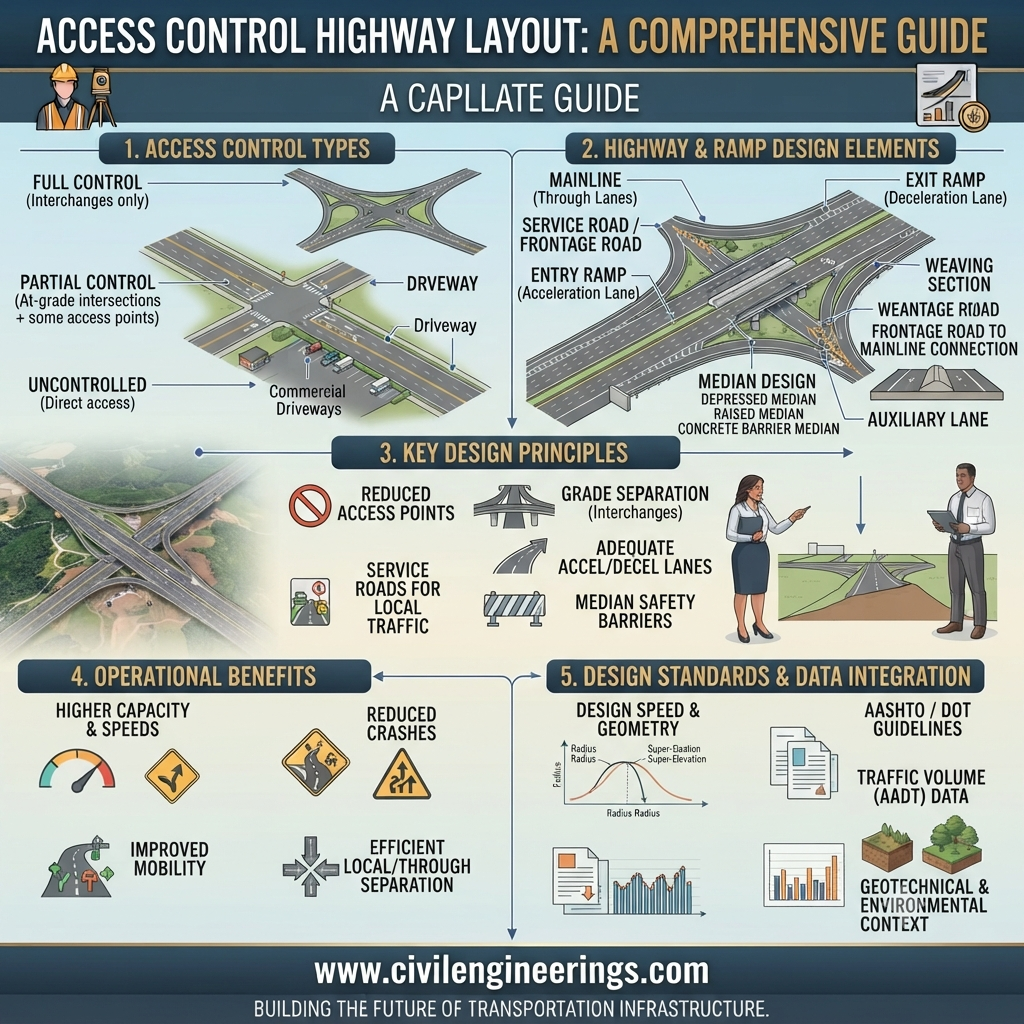
Introduction
Modern highways are designed to move people and goods quickly, safely, and efficiently. However, a highway can only achieve these goals when engineers carefully regulate how vehicles enter, exit, and cross the roadway. This concept is known as Access Control, one of the most important principles in highway engineering and transportation planning.
Access control determines where vehicles, pedestrians, and adjacent properties can connect to a roadway. Properly designed access points reduce conflict areas, improve traffic flow, lower accident rates, and increase the operational efficiency of highways. Whether the project involves an expressway, motorway, urban arterial, or rural highway, engineers must balance accessibility with mobility to create a safe and reliable transportation network.
For civil engineers, transportation planners, contractors, and students, understanding Access Control is essential because it influences geometric design, road safety, pavement performance, traffic operations, and long-term maintenance costs. Decisions made during the planning and design stages affect the highway throughout its service life.
This guide explains the principles of access control, its types, engineering design considerations, practical applications, and industry best practices. It also highlights how modern technologies and internationally recognized engineering principles contribute to safer and more sustainable highway infrastructure.
What Is Access Control?
Access Control is the systematic regulation of vehicle, pedestrian, and property access to a roadway. It defines where traffic may legally and safely enter or leave a highway while minimizing conflicts that reduce safety and traffic efficiency.
Highways with strict access control permit entry and exit only through designated interchanges or ramps. Local roads, residential driveways, and commercial entrances do not connect directly to these facilities.
By limiting access points, engineers improve travel speeds, reduce interruptions, and create safer conditions for all road users.
Primary Objectives
- Improve road safety.
- Reduce conflict points.
- Maintain uninterrupted traffic flow.
- Increase roadway capacity.
- Minimize travel delays.
- Support high-speed traffic operations.
- Extend pavement service life.
- Reduce long-term maintenance costs.
Why Access Control Is Important
Every driveway, side road, or uncontrolled intersection introduces potential conflict between vehicles. As the number of access points increases, the likelihood of collisions and congestion also rises.
Well-planned access control improves both mobility and safety.
Benefits
- Fewer traffic conflicts
- Higher average travel speeds
- Reduced accident frequency
- Lower fuel consumption
- Better freight movement
- Improved emergency response
- Greater highway capacity
- Longer pavement life
Practical Example
Consider a six-lane expressway serving an industrial corridor. If trucks entered directly from every warehouse, traffic would slow significantly and crash risks would increase. Instead, engineers provide service roads and designated interchanges so heavy vehicles merge safely without disrupting through traffic.
Objectives of Access Control
Transportation engineers implement access control to achieve several operational and safety goals.
Improve Traffic Mobility
Limited access allows vehicles to travel at consistent speeds with fewer interruptions.
Enhance Road Safety
Reducing intersections and uncontrolled entrances decreases the number of vehicle conflict points.
Support Economic Development
Efficient highways improve logistics, reduce travel time, and encourage commercial investment.
Protect Highway Investments
Controlled access reduces pavement wear caused by frequent turning and braking movements, helping preserve the roadway for a longer service life.
Types of Access Control
The level of access control depends on the function of the roadway, traffic volume, design speed, and surrounding land use.
1. Full Access Control
Full access control provides the highest level of traffic separation. Vehicles enter and leave only through grade-separated interchanges.
Characteristics
- No direct property access
- No at-grade intersections
- Grade-separated crossings
- Entrance and exit ramps
- High design speeds
- Continuous traffic flow
Common Applications
- Expressways
- Motorways
- Freeways
- National express corridors
Advantages
- Maximum safety
- High traffic capacity
- Reduced congestion
- Lower travel times
- Efficient freight movement
Limitations
- Higher construction costs
- Greater land requirements
- Complex interchange design
2. Partial Access Control
Partial access control restricts access but still permits selected intersections and controlled property connections.
Characteristics
- Limited direct access
- Signalized intersections
- Selected driveway access
- Median openings at approved locations
Applications
- Urban arterial roads
- Major suburban highways
- Commercial corridors
Advantages
- Lower construction costs
- Better accessibility
- Flexible development opportunities
Limitations
- Lower operating speeds
- More conflict points
- Increased delay during peak hours
3. Non-Access-Controlled Roads
Local streets and many rural roads generally operate without formal access restrictions.
Vehicles may enter or exit from numerous driveways, side roads, and property entrances.
Characteristics
- Frequent intersections
- Direct property access
- Lower design speeds
- Mixed traffic operations
Applications
- Residential roads
- Village streets
- Local collector roads
Highway Access Classification Diagram
                    ACCESS CONTROL

                         │
        ┌────────────────┼────────────────┐
        │                │                │
        ▼                ▼                ▼

 Full Control     Partial Control   No Control

 Expressways      Urban Arterials   Local Roads

 Entry by Ramps   Limited Junctions Direct Access
 Only
Engineering Principles of Access Control
Effective Access Control depends on several engineering principles that work together to improve safety and traffic performance.
Functional Road Classification
Engineers first determine the roadway’s function. High-speed facilities prioritize mobility, while local streets emphasize property access.
Design Speed
Higher design speeds require greater access restrictions because drivers have less time to react to unexpected maneuvers.
Traffic Volume
Roads carrying heavy traffic benefit from fewer access points to maintain smooth traffic flow.
Sight Distance
Drivers must have sufficient visibility to merge, diverge, or stop safely. Horizontal and vertical alignment should support these requirements.
Spacing Between Access Points
Adequate spacing between driveways, intersections, and interchanges reduces weaving and sudden lane changes.
Median Design
Raised medians, channelized openings, and directional median treatments help regulate turning movements and reduce collision risks.
Design Considerations for Access Control
Engineers evaluate several factors before determining the appropriate level of access control.
Traffic Characteristics
- Average Annual Daily Traffic (AADT)
- Peak Hour Volume
- Heavy vehicle percentage
- Future traffic projections
Land Use
Commercial, residential, industrial, and agricultural developments influence the number and type of access points.
Road Geometry
Design decisions consider:
- Horizontal curves
- Vertical grades
- Cross sections
- Shoulder width
- Median width
Road Safety
Engineers review historical crash data, conflict points, pedestrian activity, and expected operating speeds.
Environmental Factors
Flood-prone areas, drainage patterns, and environmentally sensitive locations also influence access planning.
Highway Access Layout Diagram
 Service Road
====================================

      |         |         |

      |         |         |
      ▼         ▼         ▼

====================================
      EXPRESSWAY

--------------------Median--------------------

====================================

Entry Ramp --->>>>>>>>>>>>>>>>>>>>>>

<<<<<<<<<<<<<<<<<<<<<<<--- Exit Ramp

====================================
 Service Road
This arrangement allows local traffic to use service roads while preserving uninterrupted movement on the main expressway.
Key Takeaways
Access Control is a fundamental element of highway engineering that directly affects safety, traffic efficiency, and long-term infrastructure performance. By regulating where vehicles enter and exit a roadway, engineers reduce conflict points, maintain consistent operating speeds, and protect the functional purpose of high-capacity highways. Selecting the appropriate level of access control depends on roadway classification, traffic demand, surrounding land use, and future development plans. When combined with sound geometric design, proper interchange spacing, and effective traffic management, access control creates safer and more reliable transportation networks that support economic growth and sustainable mobility.
Practical Applications of Access Control
Access control principles apply to a wide range of transportation facilities. The level of control depends on the road’s function, traffic demand, surrounding development, and long-term transportation objectives.
1. Expressways and Motorways
Expressways require full access control because they carry high-speed traffic over long distances. Vehicles enter and leave only through interchanges, while service roads provide access to adjacent properties.
Benefits
- Higher travel speeds
- Improved safety
- Reduced congestion
- Lower vehicle operating costs
2. Urban Arterial Roads
Urban arterial roads often use partial access control. Engineers limit driveways, consolidate entrances, and install raised medians to improve traffic flow without completely restricting property access.
Typical measures include:
- Signalized intersections
- Left-turn lanes
- Median openings at approved locations
- Access spacing standards
3. Rural Highways
Rural highways generally require a balance between mobility and accessibility. Farmers, industries, and villages often need direct access, but engineers still control entrance locations to reduce crash risks.
4. Airport Access Roads
Airport expressways rely on controlled access to accommodate heavy passenger and freight traffic while minimizing delays.
5. Industrial Corridors
Industrial highways carry large numbers of heavy trucks. Engineers often construct dedicated service roads and truck access points to separate local traffic from through traffic.
Access Management Techniques
Access management complements access control by organizing how vehicles enter and leave roadways.
Common Techniques
- Consolidating multiple driveways
- Providing service roads
- Installing raised medians
- Restricting left-turn movements
- Designing acceleration and deceleration lanes
- Improving intersection spacing
- Coordinating traffic signals
- Constructing grade-separated interchanges
These techniques improve traffic operations while maintaining reasonable property access.
Typical Access Management Layout
Local Properties
   │     │     │
   ▼     ▼     ▼
========================
    Service Road
========================
         │
         ▼
     Entry Ramp
========================
 Main Expressway
========================
     Exit Ramp
         ▲
========================
    Service Road
========================
This arrangement keeps local traffic away from high-speed lanes while maintaining access to surrounding developments.
Construction Considerations
Although access control is primarily a planning and design concept, construction activities play a significant role in ensuring the final roadway functions as intended.
Planning
Construction teams should:
- Review approved access plans.
- Coordinate with utility agencies.
- Minimize disruption to existing traffic.
- Maintain emergency vehicle access.
Surveying
Accurate surveys establish:
- Property boundaries
- Right-of-way limits
- Interchange locations
- Ramp alignments
- Service road elevations
Modern GNSS equipment, total stations, and drone surveys improve precision and reduce construction errors.
Earthwork
Earthwork operations prepare embankments for:
- Service roads
- Entrance ramps
- Exit ramps
- Grade-separated structures
Proper compaction ensures long-term pavement stability.
Drainage
Access-controlled highways require efficient drainage systems to protect pavements and maintain safe driving conditions.
Typical components include:
- Side drains
- Catch basins
- Culverts
- Cross-drainage structures
- Stormwater channels
Pavement Construction
The pavement structure depends on projected traffic loads and environmental conditions.
Typical pavement layers include:
 Asphalt Surface Course
=========================
 Binder Course
=========================
 Base Course
=========================
 Granular Sub-base
=========================
 Compacted Subgrade
=========================
 Natural Ground
Both flexible and rigid pavements may be used depending on traffic demand and lifecycle cost analysis.
Materials Used
Although access control itself is a traffic management concept, associated highway facilities rely on high-quality construction materials.
Common materials include:
- Asphalt mixtures
- Portland cement concrete
- Crushed aggregates
- Sand
- Reinforcement steel
- Geotextiles
- Geogrids
- Concrete barriers
- Reflective thermoplastic road markings
- Guardrail systems
Material selection should consider durability, climate, expected traffic loading, and maintenance requirements.
Construction Equipment
Typical equipment includes:
- Excavators
- Bulldozers
- Motor graders
- Asphalt pavers
- Vibratory rollers
- Wheel loaders
- Concrete batching plants
- Concrete pavers
- Total stations
- GNSS survey equipment
- Drone surveying systems
Using well-maintained equipment improves productivity, quality, and construction safety.
Quality Control
Quality assurance begins during planning and continues throughout construction.
Common Quality Tests
Soil
- Standard Proctor Test
- Modified Proctor Test
- California Bearing Ratio (CBR)
- Field Density Test
Aggregates
- Los Angeles Abrasion Test
- Aggregate Impact Value
- Water Absorption Test
Asphalt
- Marshall Stability Test
- Bitumen Content Test
- Core Density Test
Concrete
- Slump Test
- Compressive Strength Test
- Flexural Strength Test
Regular testing ensures that pavement layers and structures meet project specifications.
Sustainability in Access-Controlled Highways
Modern highway projects increasingly emphasize sustainability throughout planning, design, construction, and operation.
Sustainable Practices
- Recycled asphalt pavement (RAP)
- Recycled concrete aggregates
- Warm mix asphalt
- Energy-efficient LED lighting
- Rainwater management systems
- Erosion and sediment control
- Native vegetation for landscaping
- Carbon footprint reduction strategies
These practices improve environmental performance while reducing lifecycle costs.
Modern Technologies
Digital technologies continue to transform highway planning and access management.
Building Information Modeling (BIM)
BIM enables engineers to coordinate roadway geometry, structures, drainage, and utilities within a shared digital model.
Geographic Information Systems (GIS)
GIS supports route analysis, land-use planning, environmental assessment, and asset management.
LiDAR
LiDAR produces highly accurate terrain models for roadway design and corridor planning.
Drones
Unmanned aerial vehicles accelerate surveying, progress monitoring, and construction inspections.
Artificial Intelligence (AI)
AI assists with traffic prediction, safety analysis, maintenance planning, and incident detection.
IoT Sensors
Smart sensors monitor traffic flow, pavement condition, weather, and infrastructure performance in real time.
Digital Twins
Digital twins provide virtual representations of highway assets, enabling predictive maintenance and operational optimization.
General Engineering Guidance (IRC, AASHTO, ASTM, ICE, ISO, FHWA)
Although design standards vary by country, leading engineering organizations promote several common principles.
IRC
Emphasizes safe access spacing, geometric consistency, drainage, and road-user safety.
AASHTO
Supports traffic-based design, appropriate design speeds, adequate sight distance, and efficient interchange planning.
ASTM
Provides standardized methods for testing construction materials used in highway projects.
ICE
Encourages sustainable infrastructure, resilience, innovation, and lifecycle asset management.
ISO
Promotes quality management, environmental management, and continual improvement.
FHWA
Provides guidance on access management, roadway safety, and operational efficiency.
These organizations share the objective of improving safety, durability, and long-term highway performance.
Best Practices for:
Engineers
- Evaluate traffic forecasts before selecting access spacing.
- Coordinate roadway geometry with land-use planning.
- Protect future expansion corridors.
- Conduct regular road safety audits.
Contractors
- Follow approved access management plans.
- Maintain traffic safely during construction.
- Verify survey control before construction.
- Implement strict quality assurance procedures.
Students
- Learn functional road classification.
- Understand geometric design principles.
- Study traffic conflict analysis.
- Visit completed expressways and interchanges.
Consultants
- Integrate environmental and traffic considerations early.
- Communicate effectively with stakeholders.
- Prepare constructible and maintainable designs.
Project Managers
- Monitor schedule, cost, quality, and safety continuously.
- Coordinate utility relocation and land acquisition.
- Plan for future maintenance requirements.
Common Mistakes
Too Many Access Points
Excessive driveways increase conflict points, slow traffic, and raise crash rates.
Poor Access Spacing
Closely spaced entrances create weaving movements and driver confusion.
Ignoring Future Development
Failing to reserve right-of-way can limit future highway expansion.
Inadequate Drainage
Poor drainage weakens pavement layers and increases maintenance costs.
Weak Traffic Forecasts
Underestimating future demand often results in early congestion and expensive upgrades.
Proper planning and engineering analysis help prevent these issues.
Frequently Asked Questions
1. What is access control in highway engineering?
Access control is the regulation of where vehicles, pedestrians, and properties can connect to a roadway. It improves safety, reduces conflict points, and allows traffic to move efficiently, particularly on high-speed highways and expressways.
2. What is the difference between full and partial access control?
Full access control limits entry and exit to designated interchanges, while partial access control permits selected intersections and controlled property access. The choice depends on traffic volume, roadway function, and surrounding land use.
3. Why is access control important for road safety?
Fewer access points reduce turning conflicts, rear-end collisions, and weaving movements. Drivers experience more predictable traffic conditions, leading to smoother and safer travel.
4. Which roads require full access control?
Motorways, freeways, expressways, and major national highways carrying high-speed, high-volume traffic generally require full access control.
5. How do service roads improve access management?
Service roads provide local access to adjacent properties while keeping slow-moving local traffic separate from fast through traffic on the main highway.
6. What factors influence access spacing?
Traffic volume, design speed, land use, sight distance, intersection density, and future development all influence appropriate spacing between access points.
7. Which technologies support modern access control planning?
BIM, GIS, LiDAR, drones, AI, IoT sensors, and digital twins improve surveying, design coordination, traffic analysis, and asset management.
8. How does access control benefit pavement performance?
Reducing frequent turning, braking, and acceleration decreases pavement stress, helping extend the service life of asphalt and concrete pavements.
Conclusion
Access Control is a fundamental principle of highway engineering that balances mobility with accessibility to create safer, more efficient transportation networks. Careful planning of access points, service roads, interchanges, and median openings reduces conflict points, improves traffic flow, and supports long-term pavement performance. Successful access control requires coordinated efforts in transportation planning, geometric design, traffic engineering, construction, and maintenance. Modern technologies such as BIM, GIS, LiDAR, AI, and IoT sensors further enhance decision-making and operational efficiency. By following recognized engineering practices and considering future traffic growth, engineers can develop highway systems that improve safety, reduce congestion, and support sustainable infrastructure development. Whether you are a student, consultant, contractor, or practicing engineer, mastering Access Control principles will help you design and manage road networks that perform reliably for decades.
Internal Linking Suggestions
- Highway Functional Classification
- Highway Alignment Design
- Highway Geometric Design
- Highway Interchange Design
- Road Safety Engineering
- Traffic Engineering Fundamentals
- Pavement Design Basics
- Highway Drainage Systems
- Road Construction Process Step by Step
- Highway Maintenance Strategies
