Road construction and maintenance projects are essential for improving transportation networks, but they can create some of the most hazardous conditions on an active highway. Workers may operate within meters of moving traffic while motorists encounter lane closures, temporary alignments, heavy equipment, uneven surfaces, and unfamiliar traffic patterns. A small mistake in work-zone planning can therefore lead to serious injuries, crashes, project delays, or significant property damage.
Road Work Zone Safety is the systematic process of protecting road users, workers, pedestrians, cyclists, and construction personnel while highway construction or maintenance activities take place. It combines traffic management, temporary traffic control, worker protection, construction planning, signage, channelization, lighting, personal protective equipment, and continuous site monitoring.
This guide explains the engineering principles behind safe road work zones, including work-zone planning, traffic control devices, temporary traffic management, pedestrian protection, safety inspections, common hazards, practical examples, and emergency procedures. It also discusses the importance of IRC, AASHTO, and ICE guidance and provides practical recommendations for students, engineers, contractors, and project managers.
What Is Road Work Zone Safety?
Road Work Zone Safety refers to the planning and implementation of measures that reduce risks associated with construction, rehabilitation, maintenance, utility installation, and other activities performed on or near an operational roadway.
A work zone changes the normal relationship between traffic, workers, equipment, and the roadway. Lanes may become narrower, traffic may move in opposing directions, shoulders may disappear, and construction vehicles may frequently enter or leave the traffic stream.
A safe work zone should provide:
- A predictable path for motorists.
- A clearly defined work area.
- Adequate protection for workers.
- Safe pedestrian and cyclist movement.
- Appropriate traffic-control devices.
- Sufficient visibility during day and night.
- Safe access for construction equipment.
- Emergency access and incident-response arrangements.
The objective is not simply to place warning signs around construction activity. Effective safety requires an integrated temporary traffic management system.
Why Road Work Zone Safety Is Important
Road work zones combine two inherently different environments: a controlled construction site and a continuously changing public road.
Workers concentrate on activities such as excavation, paving, surveying, compaction, concrete placement, drainage installation, or equipment operation. Drivers, meanwhile, may have only a few seconds to understand a temporary traffic arrangement.
Poorly designed work zones can create several hazards.
Protecting Road Workers
Construction workers may be exposed to moving vehicles, reversing equipment, falling objects, excavation hazards, dust, noise, and construction machinery.
Physical separation between workers and live traffic is one of the most effective ways to reduce exposure.
Protecting Motorists
Drivers can encounter sudden lane reductions, temporary barriers, construction vehicles, pavement level changes, and slow-moving equipment.
Advance warning gives motorists sufficient time to recognize the change and adjust their speed and lane position.
Reducing Traffic Crashes
Improperly positioned signs, confusing lane markings, inadequate lighting, and abrupt transitions can increase crash risk.
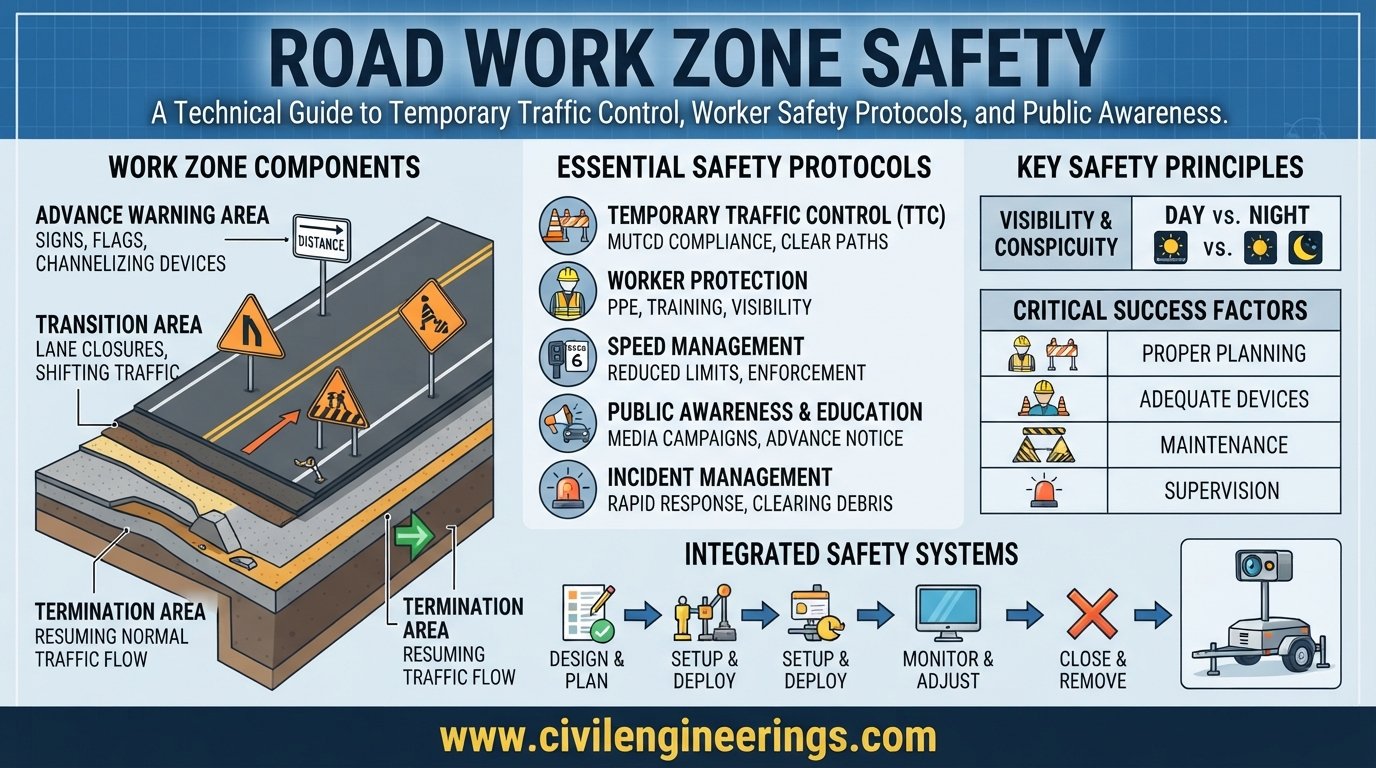
Good temporary traffic control creates a logical sequence:
Advance Warning → Transition → Activity Area → Termination
Drivers should understand what is changing before they reach the actual work area.
Maintaining Traffic Flow
Safety and mobility should not be treated as competing objectives. A properly designed work zone can protect people while maintaining reasonable traffic movement.
Engineers should consider traffic demand, available road width, project duration, work hours, vehicle composition, nearby intersections, pedestrian movement, and alternative routes.
Major Components of a Safe Road Work Zone
A work zone normally consists of several functional areas. Understanding these areas helps engineers develop a logical temporary traffic control plan.
Advance Warning Area
The advance warning area informs road users that they are approaching a changed roadway condition.
Signs should provide adequate time for drivers to:
- Detect the warning.
- Understand the message.
- Reduce speed if necessary.
- Change lanes.
- Follow the temporary route.
The required warning distance depends on operating speed, roadway geometry, traffic conditions, visibility, and the complexity of the work zone.
Transition Area
The transition area moves traffic from its normal path into the temporary traffic arrangement.
Engineers may use:
- Cones.
- Drums.
- Delineators.
- Barricades.
- Temporary pavement markings.
- Arrow boards.
- Temporary barriers.
The transition should be gradual enough for drivers to follow without abrupt steering or braking.
Activity Area
The activity area is where construction, maintenance, inspection, or other road work occurs.
It commonly includes:
- Work space.
- Traffic space.
- Buffer space.
The work space should remain physically separated from moving traffic wherever practical.
Buffer Space
A buffer provides additional separation between traffic and the work area.
It is not normally intended for workers, equipment storage, or material placement. Its purpose is to provide a margin of safety if a vehicle leaves its intended path.
Termination Area
The termination area allows traffic to return to normal roadway conditions.
Appropriate signs and channelizing devices help drivers understand that the temporary restriction has ended.
Suggested Image 1 – Work-Zone Layout Diagram: Illustrate the Advance Warning Area, Transition Area, Buffer Space, Activity Area, and Termination Area in a typical highway work zone.
Temporary Traffic Control Devices
Traffic-control devices communicate instructions and guide road users through changing roadway conditions. They should be visible, understandable, consistent, and appropriately positioned.
Warning Signs
Warning signs alert motorists to conditions such as:
- Road construction.
- Lane closure.
- Workers ahead.
- Detours.
- Uneven pavement.
- Narrow lanes.
- Temporary traffic signals.
- Two-way traffic.
- Reduced speed conditions.
Signs should be placed so that drivers receive information before reaching the hazard.
Regulatory Signs
Regulatory signs communicate mandatory restrictions or requirements.
Examples include:
- Speed restrictions.
- Stop requirements.
- Yield requirements.
- Lane-use controls.
- No-entry restrictions.
Temporary regulatory controls should match the actual work-zone arrangement.
Channelizing Devices
Channelizing devices define the intended vehicle path and separate traffic from hazardous areas.
Common devices include:
- Traffic cones.
- Drums.
- Vertical panels.
- Barricades.
- Tubular markers.
- Delineators.
- Temporary barriers.
The choice depends on traffic speed, exposure, work duration, available space, and the level of physical protection required.
Pavement Markings
Temporary pavement markings become particularly important when normal lane lines are removed or conflict with the temporary route.
Engineers should eliminate or cover misleading markings where they could cause driver confusion.
Arrow Boards and Portable Message Signs
Arrow boards can guide traffic during lane closures and merges. Portable variable-message signs can provide more detailed information where conditions justify their use.
However, excessive messaging can distract drivers. The message should remain concise and directly relevant to the approaching condition.
Work Zone Traffic Management Planning
Good Road Work Zone Safety begins before construction equipment reaches the site.
A Traffic Management Plan (TMP) or equivalent temporary traffic-control plan should identify how traffic will operate during each construction stage.
Site Investigation
Engineers should inspect the existing site before developing the plan.
Important observations include:
- Existing lane widths.
- Traffic volume.
- Vehicle speeds.
- Intersections.
- Sight distance.
- Pedestrian routes.
- Public transport stops.
- Drainage structures.
- Road geometry.
- Existing signs and markings.
- Nearby schools, hospitals, markets, or businesses.
- Nighttime visibility.
A plan based only on drawings may overlook hazards that become obvious during a field inspection.
Traffic Volume and Capacity
Traffic demand strongly influences work-zone strategy.
For example, a high-volume urban road may require night construction, staged construction, temporary diversions, or additional traffic-control personnel.
Engineers can use traffic-flow principles to assess whether the remaining roadway can accommodate expected demand.
A basic traffic relationship is:
q = k × v
Where:
- q = traffic flow rate
- k = traffic density
- v = average traffic speed
More advanced analysis may consider lane capacity, saturation flow, queue length, peak-hour demand, and delay.
Construction Staging
Large projects should divide work into manageable stages.
For example:
1: Construct drainage and shoulder works.
2: Shift traffic and construct the first pavement section.
3: Move traffic onto the completed section.
4: Construct the remaining pavement.
5: Complete markings, signs, barriers, and final restoration.
Each stage should have its own traffic-control arrangement.
Speed Management in Road Work Zones
Vehicle speed is one of the most important factors influencing work-zone severity.
Reducing speed can increase the time available for drivers to react and can reduce crash severity. However, simply placing a lower speed-limit sign does not guarantee compliance.
Effective speed management may include:
- Appropriate advance warning.
- Lane narrowing.
- Channelizing devices.
- Police or traffic-control enforcement where appropriate.
- Speed feedback signs.
- Temporary rumble strips where suitable.
- Physical separation.
- Proper work-zone geometry.
- Consistent speed-control messages.
Engineers should avoid unnecessarily low temporary speed limits that motorists are unlikely to respect. Speed restrictions should reflect actual site conditions and applicable regulations.
Worker Protection Measures
Workers require protection from both traffic and construction hazards.
High-Visibility Clothing
Workers exposed to traffic should wear appropriate high-visibility garments that comply with the applicable safety requirements.
The clothing should remain visible under the expected lighting and weather conditions.
Personal Protective Equipment
Depending on the work activity, PPE may include:
- Safety helmets.
- High-visibility garments.
- Safety footwear.
- Gloves.
- Eye protection.
- Hearing protection.
- Respiratory protection.
- Fall-protection equipment.
PPE should complement engineering controls rather than replace them.
Safe Equipment Operation
Construction equipment should operate within clearly defined areas.
Operators should maintain awareness of:
- Workers on foot.
- Blind spots.
- Reversing movements.
- Temporary barriers.
- Traffic lanes.
- Overhead utilities.
- Excavations.
- Pedestrian routes.
Where reversing creates significant risk, the project should use appropriate spotters, detection systems, exclusion zones, or alternative operating procedures.
Pedestrian and Cyclist Safety
Pedestrians and cyclists are often overlooked during highway construction.
A work zone that protects motorists but forces pedestrians into a live traffic lane is not adequately controlled.
Maintaining Accessible Routes
Temporary pedestrian routes should be:
- Clearly identified.
- Continuous.
- Stable.
- Adequately illuminated.
- Free from unnecessary obstructions.
- Separated from construction activity.
Ramps and temporary surfaces should accommodate the expected users, including people with mobility limitations where accessibility requirements apply.
Cyclist Considerations
Cyclists may require additional lateral space and smoother temporary surfaces than ordinary pedestrian routes.
Where a cycle route is disrupted, the temporary route should be clearly communicated and designed to minimize conflicts with motor vehicles and pedestrians.
Suggested Image 2 – Worker and Pedestrian Protection: Show a highway work zone with temporary barriers, high-visibility workers, a protected pedestrian path, cones, warning signs, and a controlled traffic lane.
Night Work Zone Safety
Night construction presents additional challenges because visibility decreases while glare from headlights and construction lighting can increase driver discomfort.
Important controls include:
- Retroreflective signs.
- High-visibility channelizing devices.
- Proper work-zone lighting.
- Temporary pavement markings.
- Adequate separation from traffic.
- Removal of unnecessary light sources.
- Regular nighttime inspections.
Lighting should illuminate the work area without creating excessive glare for approaching motorists.
A common mistake is to illuminate the construction area brightly while leaving the transition zone poorly visible. Drivers need to see the traffic path, not merely the construction operation.
Road Work Zone Safety for Heavy Equipment
Heavy machinery can become particularly dangerous when it interacts with public traffic.
Equipment movement should follow a planned route whenever practical.
Equipment Separation
Construction equipment should remain inside the designated activity area.
If machinery must cross or enter a live traffic lane, the operation should receive additional control through trained personnel, appropriate warning devices, and carefully selected work timing.
Blind Spots
Large rollers, pavers, excavators, dump trucks, and loaders have substantial blind areas.
Projects should establish exclusion zones around equipment and train workers not to enter them without authorization.
Delivery Vehicles
Material delivery creates additional conflict points.
Contractors should establish:
- Designated entry points.
- Exit routes.
- Waiting areas.
- Driver communication procedures.
- Safe unloading zones.
- Traffic-control arrangements.
Common Road Work Zone Safety Hazards
Several problems repeatedly appear on poorly managed projects.
Inadequate Advance Warning
Drivers discover the work zone too late and must brake or change lanes suddenly.
Solution: Provide appropriate advance warning based on speed, roadway conditions, and applicable standards.
Missing or Displaced Devices
Wind, vehicle impact, construction activity, and poor installation can move cones and signs.
Solution: Inspect temporary traffic-control devices regularly and after significant incidents or weather events.
Conflicting Pavement Markings
Old lane markings can contradict the temporary traffic route.
Solution: Remove, cover, or otherwise appropriately address conflicting markings.
Poor Nighttime Visibility
A work zone that looks acceptable during daylight may become difficult to understand after sunset.
Solution: Conduct dedicated nighttime inspections.
Unprotected Workers
Workers sometimes operate too close to moving traffic without adequate separation.
Solution: Use positive protection or appropriate channelization wherever justified by risk and site conditions.
Poor Housekeeping
Loose materials, debris, tools, and equipment can become hazards.
Solution: Maintain a clean work area and remove unnecessary objects from traffic and pedestrian paths.
Work Zone Inspection and Monitoring
Safety does not end when the traffic-control devices are installed.
Conditions change throughout the project because of weather, traffic, construction progress, equipment movement, and staging modifications.
A work-zone inspection should verify:
- Signs are present and correctly positioned.
- Cones and drums remain aligned.
- Barriers remain stable.
- Temporary markings are visible.
- Traffic lanes remain clear.
- Workers use required PPE.
- Lighting operates correctly.
- Pedestrian routes remain accessible.
- Construction vehicles follow designated routes.
- Emergency access remains available.
Contractors should document significant inspections and corrective actions according to project requirements.
Emergency Response in Road Work Zones
Every major work zone should have a practical emergency-response procedure.
Potential incidents include:
- Vehicle collisions.
- Worker injuries.
- Equipment fires.
- Hazardous-material spills.
- Structural failures.
- Flooding.
- Severe weather.
- Utility strikes.
The emergency plan should identify communication channels, emergency access routes, responsible personnel, evacuation arrangements, and coordination with relevant emergency services.
The work zone should never be designed in a way that unintentionally blocks emergency vehicles.
Road Work Zone Safety: Practical Example
Consider a two-lane road undergoing pavement rehabilitation.
Traffic normally travels in both directions, but workers need to occupy one lane.
A possible temporary arrangement is:
Advance Warning → Speed Management → Traffic Channelization → Controlled One-Way Movement → Work Area → Controlled Release → Normal Traffic
The contractor may use trained traffic controllers or an appropriate temporary signal arrangement where permitted and justified.
Before implementation, the engineer should assess traffic demand, available sight distance, work duration, queue potential, pedestrian requirements, and emergency access.
During construction, the team should monitor queues and driver behavior. If queues extend beyond the expected limits or drivers begin using unsafe maneuvers, the traffic-control strategy should be reviewed rather than simply accepting the condition.
This illustrates an important engineering principle: a temporary traffic-control plan should be treated as a dynamic system, not a fixed collection of signs and cones.
IRC, AASHTO and ICE Guidance
Road work-zone safety should always follow the standards, specifications, and legal requirements applicable to the project location.
IRC Guidance
In India and projects influenced by Indian practice, relevant Indian Roads Congress (IRC) publications provide guidance on road signs, traffic control, highway construction, maintenance, and temporary traffic arrangements.
Engineers should consult the latest applicable IRC publications rather than relying on outdated editions.
AASHTO Guidance
The American Association of State Highway and Transportation Officials (AASHTO) publishes extensive guidance related to geometric design, highway safety, traffic operations, roadside design, and transportation infrastructure.
For work-zone traffic control in the United States, engineers should also consider the applicable Manual on Uniform Traffic Control Devices (MUTCD) and relevant federal and state requirements.
ICE Guidance
The Institution of Civil Engineers (ICE) provides professional engineering knowledge and guidance relevant to construction management, infrastructure, health and safety, risk management, and professional practice.
The specific standard adopted on a project should always be identified in the contract documents and local regulatory framework.
These organizations should not be treated as interchangeable standards. A project team should identify the governing jurisdiction, contract specifications, legal requirements, and applicable technical standards before preparing its traffic-management plan.
Best Practices for Road Work Zone Safety
The following practices can significantly improve work-zone performance:
- Conduct a site-specific risk assessment before construction.
- Prepare a detailed temporary traffic-control plan.
- Inspect the work zone before opening it to traffic.
- Provide sufficient advance warning.
- Use clear and consistent channelization.
- Physically separate workers from traffic wherever practical.
- Keep temporary routes clean and unobstructed.
- Eliminate conflicting signs and pavement markings.
- Provide safe pedestrian and cyclist routes.
- Inspect work zones during both daylight and nighttime conditions.
- Train workers in traffic-control procedures.
- Maintain emergency access.
- Monitor traffic queues and driver behavior.
- Update the traffic-control plan as construction stages change.
- Record and correct deficiencies promptly.
Practical Recommendations for Students, Engineers and Contractors
For Civil Engineering Students
Students should learn to think beyond individual signs or cones.
Study:
- Traffic-flow fundamentals.
- Highway geometric design.
- Temporary traffic control.
- Road safety engineering.
- Work-zone risk assessment.
- Traffic signs and markings.
- Construction safety.
When studying a work-zone drawing, ask: Where will each road user go, what can go wrong, and what engineering control prevents that failure?
For Highway Engineers and Consultants
Engineers should focus on risk-based design.
Review traffic-control arrangements from the driver’s perspective. Check the site at different times of day, especially during peak traffic and darkness.
Do not assume that a drawing automatically represents field conditions. Construction staging should be reviewed whenever the physical roadway changes.
For Contractors and Site Engineers
Contractors are responsible for maintaining the implemented work zone throughout construction.
Assign clear responsibility for daily traffic-control inspections. Replace damaged devices quickly and keep workers informed whenever the traffic-management arrangement changes.
A strong safety culture also encourages workers to report hazards before an incident occurs.
For Government and Project Management Teams
Owner organizations should ensure that safety requirements appear clearly in contract documents and that traffic-management proposals receive appropriate technical review.
Regular audits can identify recurring problems before they become serious incidents.
Frequently Asked Questions About Road Work Zone Safety
1. What is Road Work Zone Safety?
Road Work Zone Safety is the systematic management of workers, traffic, pedestrians, equipment, and temporary roadway conditions to reduce crashes, injuries, and operational risks during road construction and maintenance.
2. What are the main areas of a road work zone?
A typical work zone contains an advance warning area, transition area, activity area, buffer space, and termination area. Exact arrangements depend on project conditions and applicable standards.
3. Why is temporary traffic control important?
Temporary traffic control provides drivers with advance information and a predictable path through changing roadway conditions while helping separate traffic from workers and equipment.
4. What PPE should road construction workers use?
PPE depends on the task and applicable regulations, but commonly includes high-visibility clothing, safety helmets, protective footwear, gloves, eye protection, hearing protection, and task-specific equipment.
5. How can engineers improve nighttime work-zone safety?
Engineers can improve nighttime safety through retroreflective devices, suitable temporary markings, controlled lighting, reduced glare, physical separation, and dedicated nighttime inspections.
6. How should pedestrians be protected during road construction?
Pedestrians should receive a continuous, clearly marked, stable, accessible, and adequately protected route that remains separated from construction hazards and moving traffic.
7. What is a Traffic Management Plan?
A Traffic Management Plan describes how traffic, pedestrians, cyclists, construction vehicles, and other road users will be managed throughout the project and during different construction stages.
8. Who is responsible for work-zone safety?
Responsibility is shared among the project owner, engineers, contractors, supervisors, workers, traffic-management personnel, and other stakeholders according to their contractual and legal duties. Each party must fulfill its assigned responsibilities.
9. Why are work-zone inspections necessary?
Work zones change continuously. Devices can move, markings can deteriorate, traffic patterns can change, and construction equipment can create new hazards. Regular inspections identify and correct these conditions.
10. Which standards should be used for road work-zone safety?
The applicable national, state, provincial, contractual, and project-specific requirements should govern the work. IRC, AASHTO, MUTCD, ICE guidance, and other recognized standards can provide valuable technical references, but engineers must use the standards applicable to their jurisdiction and project.
Conclusion
Effective Road Work Zone Safety is an engineering responsibility that extends far beyond installing warning signs around construction activity. A successful work zone creates a predictable relationship between moving traffic, construction workers, equipment, pedestrians, and the changing roadway.
The strongest approach combines advance warning, appropriate traffic-control devices, safe construction staging, physical separation, speed management, worker protection, pedestrian accessibility, nighttime visibility, equipment control, regular inspections, and emergency preparedness. Engineers should also recognize that work zones are dynamic. As construction progresses, the traffic-management strategy must evolve with it.
Students can build valuable engineering judgment by studying real work-zone layouts and identifying potential failure points. Highway engineers and consultants should use risk-based design and field verification. Contractors must maintain the implemented controls and correct deficiencies quickly. Government agencies and project owners should provide clear requirements and effective oversight.
When these responsibilities work together, road construction can progress efficiently while reducing unnecessary exposure to workers and the traveling public.
A safe work zone is not simply a construction area with signs—it is a carefully engineered temporary transportation system.
