
Introduction
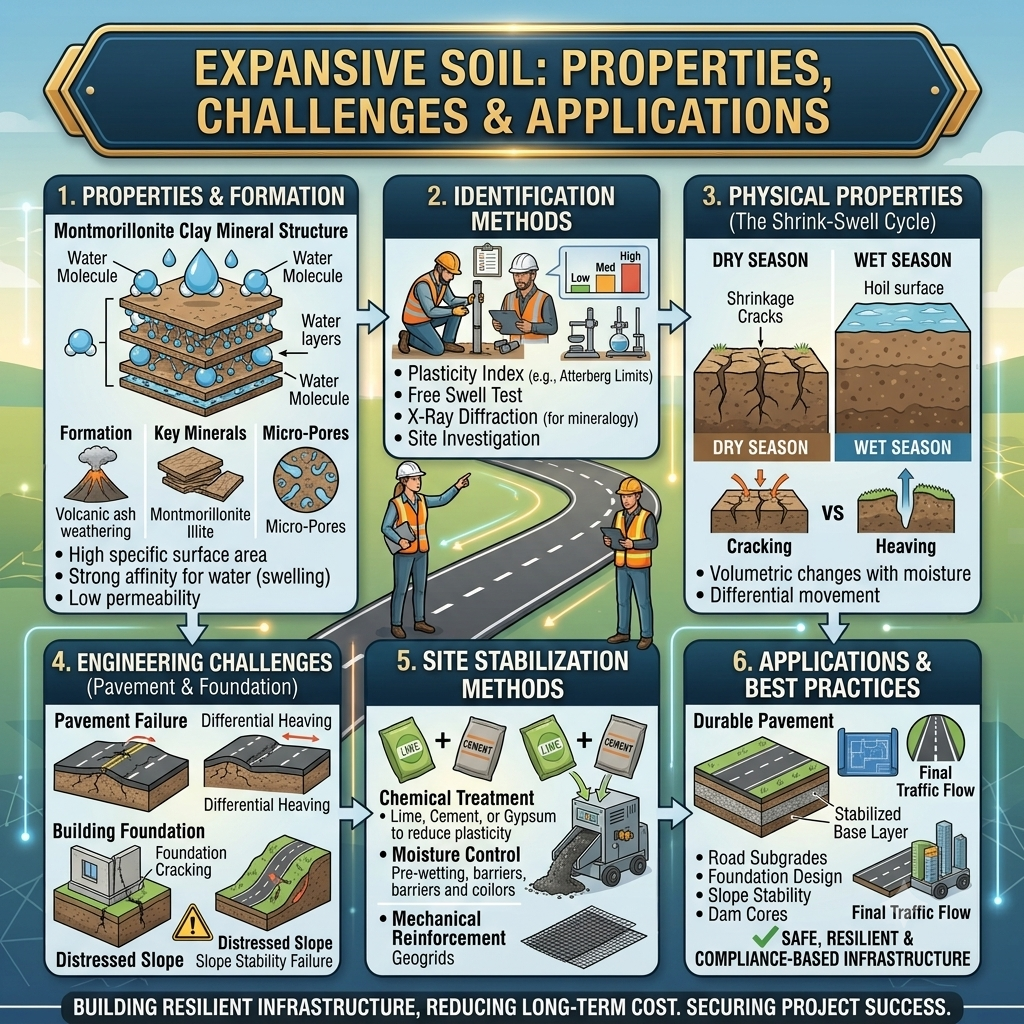
Expansive Soil presents one of the greatest challenges in geotechnical and highway engineering. Unlike ordinary soils, expansive soil changes its volume significantly with variations in moisture content. During the rainy season, it absorbs water and swells. During dry weather, it loses moisture and shrinks. These continuous volume changes create movement beneath pavements, foundations, retaining walls, pipelines, and other civil engineering structures.
Civil engineers frequently encounter expansive soil during road construction, residential developments, airport projects, railway embankments, canals, and industrial facilities. If engineers fail to identify and treat this soil properly, the resulting damage may include pavement cracking, foundation settlement, heaving, structural distortion, and costly maintenance.
Understanding the behavior of Expansive Soil allows engineers to design durable infrastructure while reducing future repair costs. This guide explains its formation, engineering properties, identification methods, practical applications, and best practices using real-world engineering principles.
What is Expansive Soil?
This is a fine-grained clay soil that undergoes significant volume changes when its moisture content changes. It expands upon absorbing water and contracts as it dries. This repeated swelling and shrinking cycle generates pressure beneath structures, leading to deformation and structural damage.
The swelling behavior mainly results from clay minerals such as:
- Montmorillonite
- Smectite
- Bentonite
- Certain mixed-layer clays
Among these minerals, montmorillonite exhibits the highest swelling potential due to its ability to absorb large amounts of water between its crystal layers.
Engineering Definition
Expansive soil is a clay-rich soil with a high shrink-swell potential that experiences substantial volume changes because of moisture fluctuations.
Characteristics:
Several physical and engineering characteristics distinguish
Expansive soil exhibits a high plasticity index, allowing it to deform without immediate cracking when wet.
Large Volume Change
The soil expands during wet conditions and shrinks during dry periods, causing continuous ground movement.
High Water Absorption
Clay particles attract and retain water, leading to significant swelling.
Low Permeability
Water infiltrates slowly because the fine particles create very small pore spaces.
High Shrinkage
Loss of moisture causes noticeable surface cracks and ground settlement.
Low Bearing Capacity During Wet Conditions
As moisture increases, soil strength decreases, reducing its ability to support engineering structures.
Formation:
Expansive soil develops over thousands of years through weathering processes that transform parent rocks into clay minerals.
Formation Process
- Weathering of igneous and sedimentary rocks.
- Breakdown of minerals into clay particles.
- Formation of swelling clay minerals.
- Deposition in low-lying areas and floodplains.
- Continuous cycles of wetting and drying.
Environmental Factors
- Climate
- Rainfall patterns
- Drainage conditions
- Parent rock composition
- Groundwater levels
- Temperature variations
Regions with alternating wet and dry seasons often experience significant expansive soil problems.
Causes of Expansion and Shrinkage
Moisture variation remains the primary cause of expansive soil movement.
Causes of Expansion
- Heavy rainfall
- Water leakage from pipelines
- Poor drainage
- Rising groundwater
- Flooding
- Irrigation
As water enters the clay structure, the particles move apart, increasing soil volume.
Causes of Shrinkage
- High temperatures
- Prolonged drought
- Evaporation
- Tree root water absorption
- Reduced groundwater
Loss of moisture causes the clay particles to move closer together, decreasing soil volume and creating cracks.
Simple Moisture Cycle Diagram
             Rainfall
                 │
                 ▼
        Water Enters Soil
                 │
                 ▼
         Soil Swells (Heave)
                 │
      Wet Season / High Moisture
                 │
                 ▼
         Dry Season / Heat
                 │
                 ▼
        Moisture Evaporation
                 │
                 ▼
        Soil Shrinks (Cracks)
This cycle may repeat many times throughout the service life of a road or structure.
Types of Expansive Soil
Highly Expansive Soil
Characteristics include:
- Very high plasticity
- Large volume changes
- Severe cracking
- High swelling pressure
- Significant engineering challenges
Common in areas rich in montmorillonite clay.
Moderately Expansive Soil
This soil experiences moderate volume changes and generally requires stabilization before supporting heavy structures.
Typical characteristics include:
- Medium plasticity
- Moderate shrink-swell behavior
- Average bearing capacity
Slightly Expansive Soil
This category exhibits relatively small volume changes and may require only minor improvement measures depending on project requirements.
Characteristics include:
- Lower plasticity
- Limited swelling
- Better engineering performance
Identification of Expansive Soil
Early identification reduces construction risks and prevents costly failures.
Field Identification
Engineers often recognize expansive soil through visual inspection.
Common Indicators
- Deep polygonal surface cracks
- Sticky texture when wet
- Hard, dense surface when dry
- Seasonal ground movement
- Uneven pavement surfaces
- Foundation heaving
Laboratory Identification
Laboratory testing provides reliable information about soil behavior.
Common laboratory tests include:
- Atterberg Limits
- Free Swell Index Test
- Swell Pressure Test
- California Bearing Ratio (CBR)
- Grain Size Analysis
- Moisture Content Test
- Specific Gravity Test
These tests help engineers evaluate swelling potential and select appropriate stabilization methods.
Engineering Properties of Expansive Soil
Understanding engineering properties allows designers to develop safe and economical solutions.
Plasticity Index
A high plasticity index indicates greater swelling potential.
Swell Pressure
Expansive soil generates upward pressure when it absorbs moisture. This pressure can lift pavements and foundations.
Compressibility
The soil compresses under structural loads, especially when moisture changes occur.
Shear Strength
Shear strength varies with moisture content. Wet expansive soil often exhibits lower strength than dry soil.
Permeability
Very low permeability slows water movement but allows gradual moisture accumulation over time.
Bearing Capacity
Bearing capacity decreases considerably during wet conditions, increasing the risk of structural distress.
Practical Engineering Applications
Although expansive soil presents challenges, engineers can successfully construct on it through proper investigation, design, and treatment.
Highway Engineering
Engineers stabilize expansive subgrades to reduce pavement heaving and cracking.
Building Foundations
Foundation systems often include moisture control, soil stabilization, or deep foundations to limit movement.
Railway Engineering
Improved subgrade design helps maintain track alignment and reduces maintenance requirements.
Canal Construction
Engineers use liners and stabilized embankments to reduce deformation and seepage.
Airport Pavements
Ground improvement techniques increase bearing capacity and improve pavement performance under repeated aircraft loading.
Engineering Best Practices
Successful projects on expansive soil begin with careful planning and detailed investigations.
Recommended practices include:
- Conduct comprehensive geotechnical investigations before design.
- Identify expansive clay minerals through laboratory testing.
- Monitor seasonal groundwater fluctuations.
- Maintain effective surface drainage.
- Prevent uncontrolled water infiltration near foundations.
- Design pavements based on actual subgrade conditions.
- Select appropriate stabilization techniques according to soil properties.
Key Takeaways
Expansive Soil poses significant challenges because it undergoes repeated swelling and shrinkage as moisture levels change. Its high plasticity, low permeability, and variable bearing capacity make it a critical consideration in highway, foundation, railway, and airport engineering. Early identification through field observations and laboratory testing enables engineers to design effective solutions before construction begins. By understanding the formation, characteristics, engineering properties, and behavior of expansive soil, civil engineers can minimize structural damage, improve pavement performance, and extend the service life of infrastructure. In Part 2, we will explore stabilization methods, construction techniques, common failures, laboratory tests, IRC/AASHTO/ICE best practices, practical recommendations, FAQs, and a comprehensive conclusion.
Problems Caused by Expansive Soil
The shrink-swell behavior of Expansive Soil creates serious engineering challenges. Moisture fluctuations generate movement beneath structures, resulting in structural distress and increased maintenance costs. Engineers must understand these problems before selecting design and construction methods.
1. Pavement Cracking
Highway pavements constructed on untreated expansive soil often develop longitudinal and transverse cracks. Swelling lifts sections of the pavement, while shrinkage creates voids beneath the surface.
2. Foundation Heaving
Residential and commercial buildings may experience foundation uplift during wet seasons. Uneven heaving often produces wall cracks, sloping floors, and misaligned doors and windows.
3. Differential Settlement
Different parts of a structure may move by different amounts because moisture distribution rarely remains uniform. Differential movement places additional stress on foundations and superstructures.
4. Slope Instability
Expansive clay slopes lose strength when saturated. Reduced shear strength increases the likelihood of slope failures and embankment instability.
5. Damage to Underground Utilities
Water pipelines, sewer lines, and buried cables may shift or crack due to repeated soil movement.
6. Increased Maintenance Costs
Road agencies and property owners spend substantial resources repairing pavement failures, foundation damage, and utility disruptions caused by expansive soils.
Effects of Expansive Soil on Civil Engineering Structures
Highways and Roads
Expansive subgrades can produce:
- Pavement heaving
- Surface cracking
- Rutting
- Edge failures
- Reduced riding comfort
- Frequent maintenance requirements
Highway Cross-Section Diagram
            Asphalt Surface
=================================
            Base Course
---------------------------------
           Sub-base Layer
---------------------------------
      Stabilized Subgrade
---------------------------------
       Expansive Soil Layer
^^^^^^^^^^^^^^^^^^^^^^^^^^^^^^^^^
   Swelling Pressure (Upward)
Stabilizing the subgrade before pavement construction significantly improves long-term road performance.
Building Foundations
Foundation movement often leads to:
- Cracked walls
- Uneven floors
- Damaged columns
- Distorted door frames
- Window misalignment
Engineers reduce these risks through appropriate foundation selection, moisture control, and soil improvement techniques.
Railways
Railway tracks require a stable formation. Expansive soils may cause:
- Track misalignment
- Uneven settlements
- Increased maintenance frequency
- Reduced passenger comfort
Proper subgrade stabilization enhances railway safety and operational reliability.
Bridges and Culverts
Approach embankments built on expansive soils may experience settlement or heaving, creating bumps at bridge entrances. Ground improvement helps maintain smooth transitions.
Site Investigation for Expansive Soil
Every project should begin with a detailed geotechnical investigation. Reliable site data allows engineers to select suitable stabilization methods and foundation systems.
Field Investigation Activities
- Borehole drilling
- Trial pits
- Soil sampling
- Groundwater observations
- Geological mapping
Laboratory Tests
Atterberg Limits Test
Measures:
- Liquid Limit
- Plastic Limit
- Plasticity Index
Higher plasticity generally indicates greater swelling potential.
Free Swell Index Test
Evaluates the natural expansion of soil when immersed in water.
Swell Pressure Test
Measures the pressure generated during soil expansion.
California Bearing Ratio (CBR)
Determines the load-bearing capacity of the subgrade for pavement design.
Standard Proctor Test
Determines optimum moisture content and maximum dry density for compaction.
Grain Size Analysis
Identifies the proportion of clay, silt, sand, and gravel.
Soil Stabilization Methods
Soil stabilization reduces swelling potential and improves engineering performance. The choice of method depends on soil properties, project requirements, environmental conditions, and budget.
Lime Stabilization
Lime reacts with clay minerals, reducing plasticity and improving strength.
Advantages
- Reduces swelling
- Improves workability
- Increases bearing capacity
- Cost-effective for clay soils
Cement Stabilization
Portland cement binds soil particles together, creating a stronger and more durable subgrade.
Suitable for:
- Highways
- Industrial yards
- Airport pavements
Fly Ash Stabilization
Fly ash, often combined with lime or cement, improves soil strength while utilizing an industrial by-product.
Benefits include:
- Reduced plasticity
- Increased strength
- Sustainable construction
Mechanical Stabilization
This method blends expansive soil with granular materials such as sand or crushed stone to improve grading and reduce volume changes.
Chemical Stabilization
Engineers may use proprietary chemical additives to reduce moisture sensitivity and enhance soil performance.
Geosynthetics
Geotextiles and geogrids reinforce weak soils, improve load distribution, and reduce deformation beneath pavements.
Construction Best Practices
Successful construction on expansive soil requires careful planning and strict quality control.
Recommended Practices
- Perform detailed geotechnical investigations before design.
- Remove unsuitable soil where economically feasible.
- Stabilize the subgrade before pavement construction.
- Maintain optimum moisture content during compaction.
- Install efficient surface and subsurface drainage systems.
- Prevent water accumulation around foundations.
- Monitor seasonal moisture changes during construction.
- Conduct regular quality assurance testing.
Practical Recommendations
Civil Engineers
- Base pavement and foundation designs on site-specific geotechnical data.
- Review laboratory test results before selecting stabilization methods.
- Prioritize drainage in all expansive soil projects.
- Monitor field compaction and moisture content continuously.
Contractors
- Follow approved compaction procedures.
- Avoid construction during excessive rainfall whenever practical.
- Use stabilized materials according to project specifications.
- Protect completed work from uncontrolled water infiltration.
Engineering Students
- Understand the relationship between moisture variation and soil behavior.
- Learn laboratory testing procedures for expansive soils.
- Study pavement failures caused by inadequate subgrade treatment.
- Visit active highway projects to observe stabilization techniques in practice.
General Discussion of IRC, AASHTO, and ICE Practices
Recognized engineering organizations such as the Indian Roads Congress (IRC), the American Association of State Highway and Transportation Officials (AASHTO), and the Institution of Civil Engineers (ICE) emphasize several common principles for projects involving expansive soils:
- Carry out comprehensive geotechnical investigations before design.
- Classify soils using standardized laboratory testing.
- Design pavements according to traffic loading and subgrade strength.
- Improve expansive subgrades where swelling may affect structural performance.
- Maintain effective drainage throughout the project lifecycle.
- Apply rigorous quality control during construction.
- Consider long-term maintenance and lifecycle costs when selecting stabilization methods.
These principles support safer, more durable, and cost-effective infrastructure.
Frequently Asked Questions (FAQs)
1. What is expansive soil?
Expansive soil is a clay-rich soil that swells when it absorbs moisture and shrinks as it dries, causing significant volume changes.
2. Which mineral causes the highest swelling in expansive soil?
Montmorillonite generally exhibits the highest swelling potential among common clay minerals.
3. Why is expansive soil dangerous for roads?
Repeated swelling and shrinkage can cause pavement cracking, heaving, rutting, and premature structural failure.
4. How do engineers identify expansive soil?
Engineers combine field observations with laboratory tests such as Atterberg Limits, Free Swell Index, Swell Pressure, and California Bearing Ratio (CBR).
5. Which stabilization method works best?
The most suitable method depends on soil characteristics and project requirements. Lime stabilization is widely used for clay-rich expansive soils, while cement stabilization is common for heavily loaded pavements.
6. Can expansive soil affect building foundations?
Yes. Foundation heave and differential settlement may produce wall cracks, uneven floors, and structural distortion.
7. Why is drainage important in expansive soil areas?
Effective drainage minimizes moisture fluctuations, reducing the shrink-swell cycle and improving long-term structural performance.
8. Is expansive soil suitable for highway construction?
Yes, provided engineers conduct proper investigations and apply suitable stabilization techniques before construction.
9. What role does compaction play?
Proper compaction increases soil density, improves strength, and reduces future deformation.
10. Can expansive soil problems be completely eliminated?
Complete elimination is difficult because natural moisture variations continue throughout a structure’s life. However, careful design, stabilization, drainage, and quality construction can significantly reduce associated risks.
Conclusion
Expansive Soil remains one of the most challenging materials encountered in civil and highway engineering because its continuous shrink-swell behavior directly affects the stability and durability of infrastructure. Roads, buildings, railways, and utility networks constructed on untreated expansive soil often experience cracking, settlement, heaving, and increased maintenance costs. Successful projects begin with detailed geotechnical investigations, accurate laboratory testing, and a thorough understanding of soil behavior.
Engineers can substantially improve performance by selecting appropriate stabilization methods, maintaining effective drainage systems, controlling moisture variations, and implementing strict quality assurance throughout construction. Modern engineering practices recommended by organizations such as IRC, AASHTO, and ICE highlight the importance of sound site investigation, proper pavement design, and long-term maintenance planning. By applying these principles, engineers, contractors, and students can successfully manage Expansive Soil conditions and deliver safer, stronger, and longer-lasting infrastructure that performs reliably under changing environmental conditions.

Kamran Malik is a passionate civil engineering writer and researcher who specializes in construction, transportation, structural engineering, and infrastructure topics. Through his articles on CivilEngineerings.com, he simplifies complex engineering concepts and shares practical insights, industry trends, and educational resources for students, professionals, and engineering enthusiasts.