
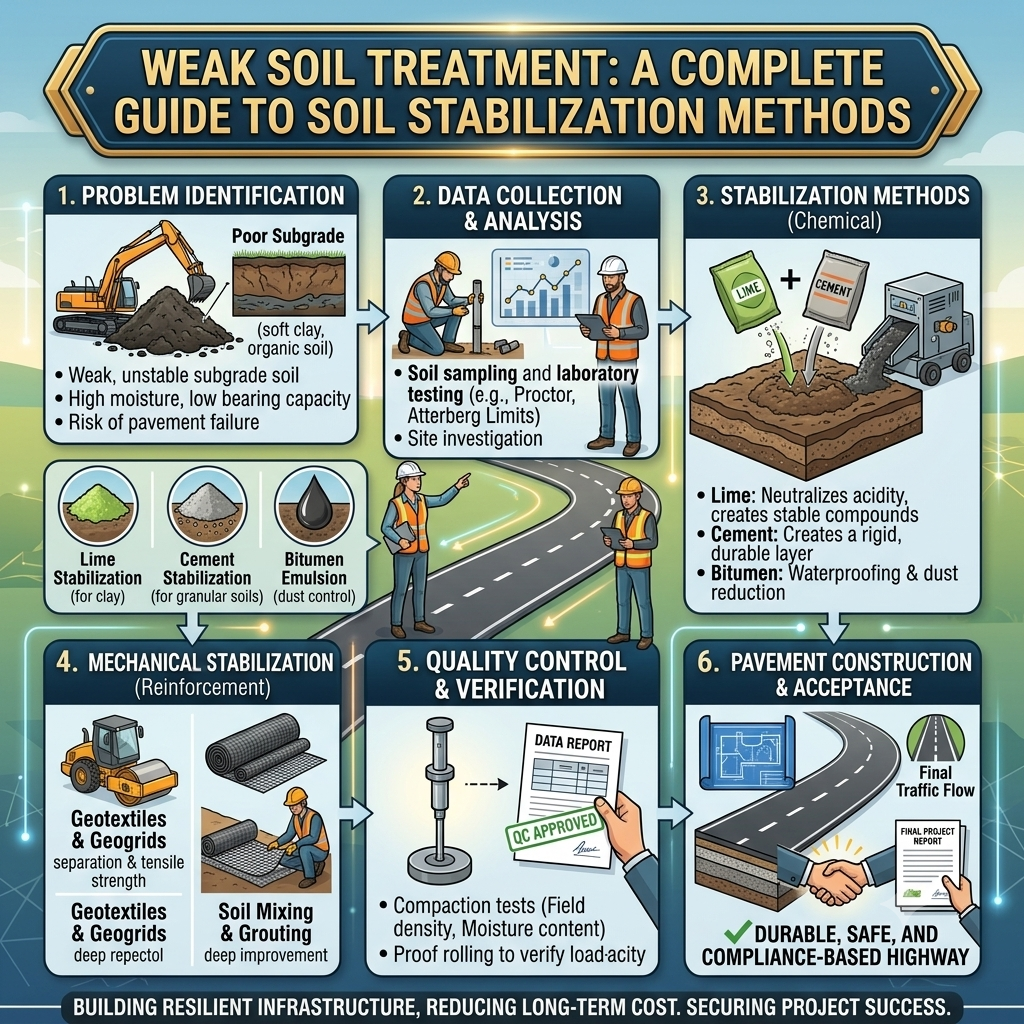
Introduction
Every successful road, highway, bridge, or building starts with a strong foundation. Soil carries the entire structural load, so its strength directly affects the safety and service life of any infrastructure. Engineers often encounter weak soil during road construction projects, especially in marshlands, clay-rich regions, reclaimed land, and areas with high groundwater levels. Without proper improvement, weak soil can cause settlement, pavement cracking, slope failure, and costly maintenance.
Weak Soil Treatment is the process of improving the engineering properties of poor-quality soil so that it can safely support structures and traffic loads. Modern civil engineers use a combination of mechanical, chemical, and geosynthetic techniques to increase soil strength, reduce compressibility, improve drainage, and enhance long-term stability.
This guide explains the causes of weak soil, its engineering characteristics, investigation methods, and the first stage of soil treatment techniques used in highway engineering. Whether you are a civil engineer, contractor, student, or project manager, understanding these principles will help you select the most effective soil improvement method for different site conditions.
What Is Weak Soil?
Weak soil refers to soil that cannot safely support structural or traffic loads without excessive settlement, deformation, or failure. Such soils usually have low bearing capacity, high compressibility, poor drainage, or excessive moisture.
Weak soils pose significant challenges in road engineering because pavement layers rely on the subgrade for long-term stability. If the subgrade lacks strength, the pavement may crack, rut, or settle prematurely.
Common Characteristics of Weak Soil
- Low bearing capacity
- High moisture content
- Excessive settlement
- Poor drainage
- Low shear strength
- High compressibility
- Low density
- Reduced load-carrying capacity
What Is Weak Soil Treatment?
Weak Soil Treatment involves improving unsuitable soil so that it meets the design requirements of a construction project. Engineers modify the soil’s physical or chemical properties to enhance its performance and durability.
The treatment method depends on several factors, including:
- Soil type
- Moisture content
- Project budget
- Traffic loading
- Groundwater conditions
- Construction schedule
- Environmental considerations
The primary objectives include:
- Increasing bearing capacity
- Reducing settlement
- Improving compaction
- Controlling moisture
- Enhancing drainage
- Increasing pavement life
Why Weak Soil Treatment Is Important
Ignoring poor soil conditions often leads to expensive structural failures and continuous maintenance.
Proper treatment provides several benefits.
Structural Benefits
- Improves foundation stability
- Increases pavement strength
- Reduces differential settlement
- Enhances load distribution
Economic Benefits
- Lowers maintenance costs
- Extends pavement service life
- Reduces reconstruction expenses
- Improves project efficiency
Environmental Benefits
- Minimizes material wastage
- Reduces excavation requirements
- Supports sustainable construction practices
Safety Benefits
- Prevents pavement deformation
- Reduces accident risks
- Improves riding comfort
- Maintains roadway performance
Causes of Weak Soil
Understanding the cause of weak soil helps engineers select the most suitable improvement technique.
High Moisture Content
Excess water reduces soil strength and makes compaction difficult.
Organic Matter
Organic soils contain decomposed vegetation that continues to break down over time, causing settlement.
Soft Clay Deposits
Clay soils often exhibit high plasticity and compressibility, making them unsuitable for heavy traffic loads.
Loose Sand
Loose sandy soils may experience excessive settlement under repeated loading.
Poor Drainage
Water accumulation weakens soil and accelerates pavement deterioration.
High Groundwater Level
Groundwater reduces effective stress within the soil, decreasing its bearing capacity.
Reclaimed Land
Recently filled areas often require additional treatment before construction begins.
Types of Weak Soils
Different soil types require different stabilization techniques.
Soft Clay
Characteristics:
- High plasticity
- Low strength
- High settlement
- Poor drainage
Typical treatment:
- Lime stabilization
- Cement stabilization
- Preloading
Organic Soil
Characteristics:
- Contains peat and decomposed vegetation
- Extremely compressible
- Very low strength
Typical treatment:
- Soil replacement
- Deep soil mixing
Peat Soil
Characteristics:
- High water content
- Very low bearing capacity
- Large long-term settlement
Typical treatment:
- Complete replacement
- Stone columns
- Geosynthetics
Loose Sand
Characteristics:
- Low density
- Settlement under vibration
- Liquefaction risk in seismic regions
Typical treatment:
- Vibro compaction
- Dynamic compaction
Expansive Clay
Characteristics:
- Swells during wet conditions
- Shrinks during dry conditions
- Causes pavement cracking
Typical treatment:
- Lime stabilization
- Moisture control
Engineering Properties of Weak Soil
Engineers evaluate several key properties before selecting a treatment method.
Bearing Capacity
Determines the maximum load the soil can safely support.
Shear Strength
Measures the soil’s resistance to sliding or failure.
Compressibility
Indicates the amount of settlement under loading.
Permeability
Represents how easily water flows through the soil.
Plasticity
Shows how soil behaves under changing moisture conditions.
Density
Higher density generally improves soil strength and stability.
Understanding these properties ensures that the chosen treatment method addresses the root cause of the soil weakness rather than just its symptoms.
Site Investigation and Soil Testing
A thorough site investigation provides the information needed to design an effective soil improvement program.
Field Investigations
Engineers commonly perform:
- Borehole drilling
- Trial pits
- Standard Penetration Test (SPT)
- Cone Penetration Test (CPT)
- Groundwater observation
Laboratory Tests
Typical laboratory tests include:
- Grain Size Analysis
- Atterberg Limits
- Moisture Content Test
- Proctor Compaction Test
- California Bearing Ratio (CBR)
- Direct Shear Test
- Triaxial Compression Test
- Consolidation Test
Why Soil Testing Matters
Accurate test results help engineers:
- Identify soil classification
- Measure engineering properties
- Select suitable treatment methods
- Estimate construction costs
- Improve long-term pavement performance
Soil Improvement Decision Flow Diagram
          Site Investigation
                  │
                  ▼
          Soil Sampling & Testing
                  │
                  ▼
      Determine Soil Properties
                  │
                  ▼
      Is the Soil Suitable?
           │             │
         Yes             No
           │              │
           ▼              ▼
     Start Construction   Select Soil Treatment
                              │
      ┌───────────────┬───────────────┬───────────────┐
      ▼               ▼               ▼
 Mechanical      Chemical        Geosynthetic
 Improvement    Stabilization    Reinforcement
Weak Soil Treatment Methods
1. Mechanical Compaction
Mechanical compaction is one of the simplest and most economical methods of improving weak soil. The process increases soil density by reducing air voids through the application of mechanical energy.
Equipment Used
- Vibratory rollers
- Sheep-foot rollers
- Smooth drum rollers
- Pneumatic rollers
- Plate compactors
Advantages
- Increases soil density
- Improves bearing capacity
- Reduces settlement
- Enhances pavement performance
- Low construction cost
Limitations
- Less effective in highly saturated soils
- Limited improvement depth
- Requires proper moisture control
Practical Application
Mechanical compaction works best for embankments, granular fills, and highway subgrade preparation where soil moisture remains close to the optimum level.
2. Soil Replacement
When soil conditions are extremely poor, engineers may remove the weak material and replace it with stronger engineered fill.
Procedure
- Excavate unsuitable soil.
- Dispose of weak material safely.
- Place approved granular material.
- Compact each layer to the specified density.
- Verify quality through field testing.
Suitable Replacement Materials
- Crushed stone
- Gravel
- Well-graded sand
- Granular sub-base material
Advantages
- Provides immediate improvement
- Delivers predictable performance
- Reduces long-term settlement
- Improves drainage
Limitations
- Higher construction cost
- Large excavation volume
- Increased transportation requirements
Practical Example
During highway construction across a marshy area, engineers often remove the upper layer of peat and replace it with compacted granular fill before constructing the pavement structure.
Key Takeaways
Successful Weak Soil Treatment begins with a clear understanding of soil behavior, engineering properties, and site conditions. Comprehensive investigations and laboratory testing enable engineers to identify the most appropriate stabilization method. Mechanical compaction and soil replacement remain effective solutions for many projects, especially where poor soil conditions affect pavement performance. Selecting the right treatment technique at the planning stage reduces settlement, improves structural stability, lowers maintenance costs, and extends the service life of roads and highways.
3. Lime Stabilization
Lime stabilization is one of the most widely used methods for improving clay-rich soils in highway and road construction. Quicklime or hydrated lime reacts with clay minerals, reducing plasticity while increasing strength and durability.
This technique works best for fine-grained soils with moderate to high plasticity.
Construction Procedure
- Spread lime uniformly over the prepared soil.
- Mix the lime thoroughly using a rotary mixer or reclaimer.
- Add water to achieve the optimum moisture content.
- Compact the stabilized layer with suitable rollers.
- Allow the layer to cure before placing the next pavement layer.
Advantages
- Increases bearing capacity.
- Reduces plasticity and swelling.
- Improves workability.
- Enhances long-term durability.
- Reduces shrinkage cracks.
Limitations
- Performs poorly in organic soils.
- Requires careful moisture control.
- Needs adequate curing time.
Practical Application
Road agencies commonly stabilize expansive clay subgrades with lime before constructing highways in regions with seasonal moisture changes.
4. Cement Stabilization
Cement stabilization improves weak soils by creating strong cementitious bonds between soil particles. Engineers often use this method when projects require high strength and rapid construction.
Suitable Soils
- Sandy soils
- Silty soils
- Gravelly soils
- Low-plasticity clay
Construction Steps
- Spread cement over the prepared soil.
- Blend the cement and soil uniformly.
- Add water to reach optimum moisture.
- Compact immediately.
- Cure the stabilized layer for the specified period.
Benefits
- High compressive strength.
- Improved durability.
- Better resistance to moisture.
- Increased load-bearing capacity.
- Reduced maintenance requirements.
Limitations
- Higher material cost than lime.
- Strict quality control required.
- Limited working time after mixing.
5. Fly Ash Stabilization
Fly ash is a by-product of thermal power plants that can improve soil properties when used alone or with lime or cement.
Its use also supports sustainable construction by recycling industrial waste.
Advantages
- Improves soil strength.
- Reduces plasticity.
- Lowers construction costs in some regions.
- Promotes environmentally responsible engineering.
Common Applications
- Highway embankments
- Road subgrades
- Industrial access roads
- Airport pavements
6. Geotextiles and Geogrids
Geosynthetics have transformed modern highway construction. Engineers install geotextiles and geogrids to reinforce weak soils, improve separation, and enhance drainage.
Geotextiles Perform
- Separation
- Filtration
- Drainage
- Reinforcement
- Erosion control
Geogrids Provide
- Tensile reinforcement
- Improved load distribution
- Reduced rutting
- Better pavement performance
Advantages
- Faster construction.
- Reduced aggregate thickness.
- Longer pavement life.
- Improved stability.
- Lower maintenance costs.
Practical Example
Many highway projects built over soft ground use geogrids beneath the granular sub-base to reduce settlement and increase pavement performance.
7. Stone Columns
Stone columns improve weak soils by installing compacted columns of crushed stone into soft ground.
These columns increase soil strength while providing drainage paths for excess pore water.
Construction Process
- Create vertical holes using specialized equipment.
- Fill the holes with crushed stone.
- Compact the stone in stages.
- Form a dense load-bearing column.
Advantages
- Faster consolidation.
- Higher bearing capacity.
- Reduced settlement.
- Improved drainage.
Suitable Projects
- Highway embankments
- Bridge approaches
- Industrial foundations
- Railway projects
8. Preloading and Surcharging
Preloading improves weak soil by placing temporary fill over the site before construction.
The additional load compresses the soil and accelerates settlement before the permanent structure is built.
Benefits
- Reduces post-construction settlement.
- Improves soil strength.
- Lowers long-term maintenance.
- Simple construction technique.
Limitations
- Requires additional time.
- Needs careful settlement monitoring.
- May require vertical drains to speed consolidation.
9. Deep Soil Mixing
Deep Soil Mixing (DSM) strengthens weak ground by mechanically blending soil with cementitious binders.
The process creates soil-cement columns with significantly higher strength.
Advantages
- Suitable for deep soft deposits.
- Minimal excavation.
- High structural capacity.
- Reduced settlement.
Applications
- Highway embankments
- Bridge foundations
- Port developments
- Retaining structures
10. Chemical Grouting
Chemical grouting injects specialized grout into weak or loose soil to fill voids and increase strength.
Common Grouting Materials
- Sodium silicate
- Polyurethane grout
- Acrylamide grout
- Cement grout
Advantages
- Improves permeability.
- Increases soil strength.
- Controls groundwater seepage.
- Stabilizes loose formations.
11. Vibro Compaction
Vibro compaction increases the density of loose granular soils through powerful vibrations.
Suitable Soils
- Loose sand
- Gravel
- Reclaimed land
Benefits
- Higher density.
- Reduced liquefaction risk.
- Improved bearing capacity.
- Better settlement control.
Comparison of Weak Soil Treatment Methods
| Treatment Method | Best Soil Type | Main Benefit | Typical Application |
|---|---|---|---|
| Mechanical Compaction | Granular Soil | Increased Density | Highway Embankments |
| Soil Replacement | Organic Soil | Immediate Improvement | Road Foundations |
| Lime Stabilization | Clay | Reduced Plasticity | Highway Subgrades |
| Cement Stabilization | Sand & Silt | High Strength | Heavy Traffic Roads |
| Fly Ash Stabilization | Fine-Grained Soil | Sustainable Improvement | Pavement Layers |
| Geotextiles & Geogrids | Soft Soil | Reinforcement | Flexible Pavements |
| Stone Columns | Soft Clay | Faster Consolidation | Embankments |
| Preloading | Compressible Soil | Settlement Reduction | Large Highway Projects |
| Deep Soil Mixing | Very Soft Soil | High Structural Strength | Bridges & Highways |
| Chemical Grouting | Loose Soil | Void Filling | Foundation Stabilization |
| Vibro Compaction | Loose Sand | Density Improvement | Reclaimed Land |
Best Practices for Weak Soil Treatment
- Perform a detailed geotechnical investigation before selecting a treatment method.
- Use laboratory and field test results to guide design decisions.
- Match the stabilization technique to the soil type and project requirements.
- Maintain optimum moisture during compaction and stabilization.
- Verify density and strength through regular quality control testing.
- Ensure proper curing for chemically stabilized soils.
- Monitor groundwater levels during construction.
- Document all field observations and test results.
- Adopt sustainable materials where technically appropriate.
- Plan long-term maintenance for treated ground.
Practical Recommendations
Civil Engineers
- Review soil investigation reports carefully before finalizing the stabilization method.
- Compare technical performance, cost, and environmental impact before selecting a treatment option.
- Monitor field quality continuously during construction.
Contractors
- Use calibrated equipment for mixing and compaction.
- Follow material specifications precisely.
- Avoid construction during unsuitable weather when stabilization quality may decline.
Engineering Students
- Study the engineering behavior of different soil types.
- Learn the purpose of common laboratory tests such as CBR, Proctor, and Atterberg Limits.
- Visit active road construction sites to observe stabilization techniques in practice.
- Develop a strong understanding of geotechnical principles before designing pavement structures.
General Discussion of IRC, AASHTO, and ICE Practices
Leading highway engineering organizations such as IRC (Indian Roads Congress), AASHTO (American Association of State Highway and Transportation Officials), and the Institution of Civil Engineers (ICE) emphasize similar principles for weak soil improvement:
- Base design decisions on comprehensive site investigations.
- Evaluate subgrade strength before pavement design.
- Select stabilization methods according to soil characteristics and anticipated traffic loads.
- Achieve specified compaction and quality standards for every construction layer.
- Provide adequate drainage to protect treated soils from moisture damage.
- Conduct continuous quality assurance and field testing throughout construction.
- Consider whole-life performance, sustainability, and future maintenance requirements during project planning.
Following these principles helps engineers build durable, safe, and cost-effective transportation infrastructure.
Frequently Asked Questions (FAQs)
1. What is weak soil in civil engineering?
Weak soil refers to soil with low bearing capacity, high compressibility, poor drainage, or inadequate shear strength, making it unsuitable for supporting structural loads without improvement.
2. Why is weak soil treatment important in road construction?
Weak soil treatment increases subgrade strength, minimizes settlement, improves pavement performance, and extends the service life of roads and highways.
3. Which soil stabilization method is best for clay?
Lime stabilization is one of the most effective methods for improving expansive and highly plastic clay soils.
4. When should engineers use cement stabilization?
Cement stabilization is suitable for sandy, silty, and low-plasticity soils where high strength and durability are required.
5. What role do geotextiles play in weak soil treatment?
Geotextiles separate soil layers, improve drainage, reinforce weak ground, and reduce contamination between aggregates and subgrade soils.
6. How do stone columns improve soft ground?
Stone columns increase bearing capacity, accelerate consolidation, improve drainage, and reduce settlement under heavy loads.
7. Can weak soil be improved without excavation?
Yes. Methods such as lime stabilization, cement stabilization, chemical grouting, deep soil mixing, and geosynthetic reinforcement improve weak soil without complete removal.
8. What tests help identify weak soil?
Common tests include the Standard Penetration Test (SPT), Cone Penetration Test (CPT), California Bearing Ratio (CBR), Proctor Compaction Test, Atterberg Limits, and laboratory shear strength tests.
9. Which weak soil treatment method is the most economical?
Mechanical compaction is generally the most economical option for suitable soils, while lime stabilization often provides a cost-effective solution for clay-rich subgrades.
10. How does proper drainage improve treated soil?
Efficient drainage prevents excess moisture from weakening the stabilized soil, preserves bearing capacity, and reduces long-term pavement deterioration.
Conclusion
Weak Soil Treatment plays a vital role in the success of road, highway, railway, and foundation projects. Every construction site presents unique ground conditions, so engineers must evaluate soil properties carefully before selecting an improvement method. Mechanical compaction, soil replacement, lime stabilization, cement stabilization, geosynthetics, stone columns, deep soil mixing, and grouting each offer specific advantages depending on the soil type, groundwater conditions, structural requirements, and project budget. Thorough site investigations, accurate laboratory testing, effective drainage, and strict quality control ensure that treated soil performs reliably throughout the design life of the infrastructure. Following recognized engineering practices and applying the appropriate stabilization technique reduces settlement, increases bearing capacity, enhances pavement durability, and minimizes future maintenance costs. For engineers, contractors, and students, understanding Weak Soil Treatment provides the technical knowledge needed to deliver safe, economical, and long-lasting transportation infrastructure while supporting sustainable construction practices.

Kamran Malik is a passionate civil engineering writer and researcher who specializes in construction, transportation, structural engineering, and infrastructure topics. Through his articles on CivilEngineerings.com, he simplifies complex engineering concepts and shares practical insights, industry trends, and educational resources for students, professionals, and engineering enthusiasts.