
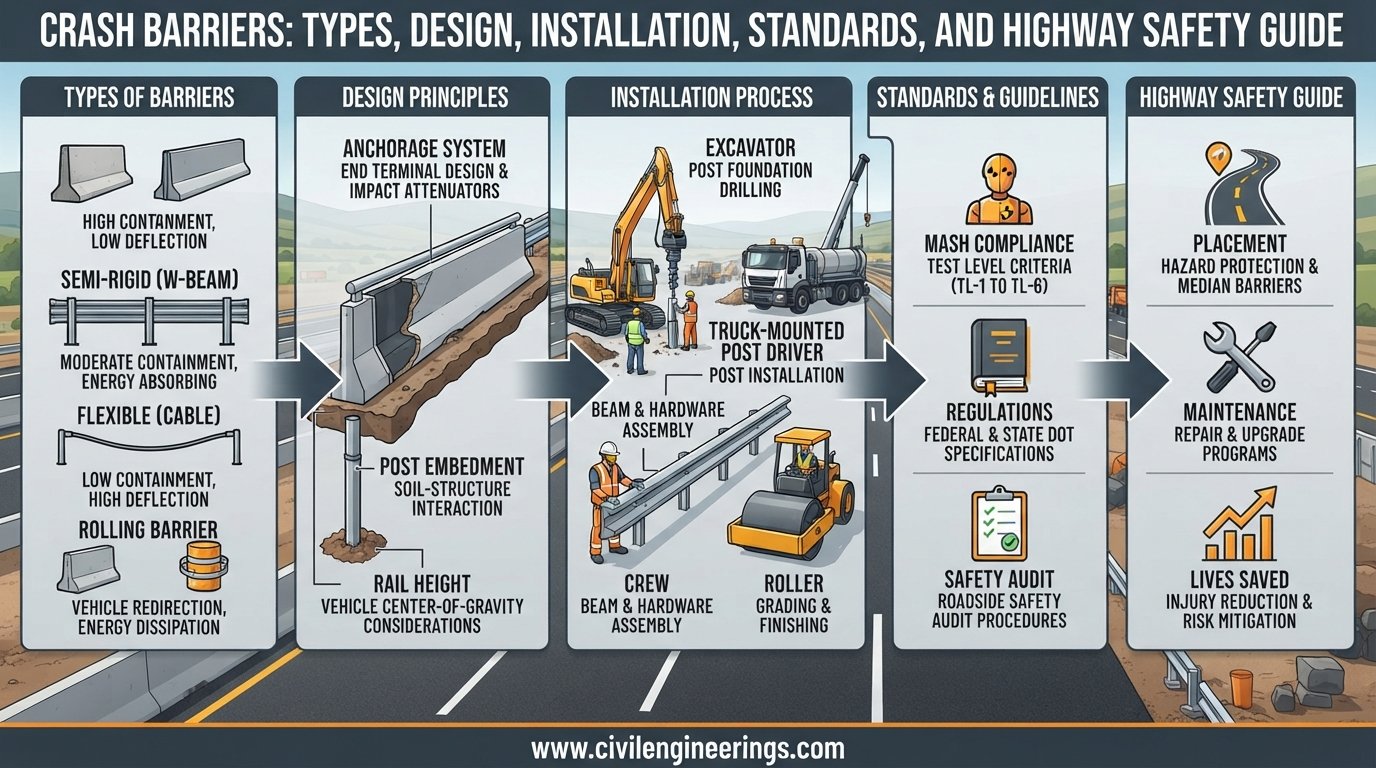
A vehicle leaving the roadway can turn a relatively ordinary driving error into a serious crash within seconds. Steep embankments, bridge piers, deep drains, trees, culvert headwalls, opposing traffic, and other roadside hazards can create consequences far worse than striking a properly designed safety barrier. This is where Crash Barriers become an important part of modern highway engineering.
Crash barriers are not simply steel rails placed along the edge of a road. They are engineered roadside safety systems designed to contain, redirect, slow, or otherwise control an errant vehicle while reducing the likelihood of a more severe collision. Their performance depends on the barrier type, terminal treatment, post spacing, soil conditions, installation geometry, vehicle characteristics, impact angle, and maintenance.
This guide explains the engineering principles behind crash barriers, their major types, selection criteria, installation requirements, terminal treatments, crashworthiness, common site mistakes, and practical recommendations for highway professionals. It also discusses IRC, AASHTO/MASH, FHWA, and ICE-related guidance so that students, designers, contractors, and road authorities can understand how these systems should be applied in real projects.
What Are Crash Barriers?
A crash barrier is a roadside or median safety system intended to reduce the severity of an errant-vehicle crash. Depending on its design, it may redirect a vehicle, contain it within the roadway corridor, absorb part of the impact energy, or prevent the vehicle from reaching a more dangerous roadside hazard.
The important point is that a barrier itself is an obstacle. Therefore, engineers should not install one simply because a road edge looks dangerous. The basic engineering question is whether hitting the barrier presents less risk than hitting the hazard behind it.
FHWA describes guardrail as a system intended to shield motorists from hazards such as steep slopes, bridge piers, retaining walls, utility poles, and other roadside objects. Its performance depends on the complete system rather than the rail alone.


Main Functions of Crash Barriers
A properly selected barrier generally performs one or more of these functions:
- Contains an errant vehicle.
- Redirects the vehicle toward a safer trajectory.
- Prevents vehicles from entering opposing traffic.
- Protects bridge piers and abutments.
- Protects steep embankments and drop-offs.
- Shields culverts, drainage structures, signs, and fixed objects.
- Separates traffic from work zones.
- Reduces the consequences of median crossover crashes.
- Protects road users at high-risk curves and bridge approaches.
A good design balances containment and occupant risk. A very rigid system may provide high containment but can produce greater impact severity. A flexible system may absorb more energy but requires sufficient deflection space.
Why Crash Barriers Are Important in Highway Engineering
Roadside safety begins with the principle of forgiving roadsides. Where practical, engineers should remove hazards, flatten slopes, relocate objects, or provide adequate recovery areas before considering a barrier.
However, not every hazard can be eliminated.
A bridge pier cannot normally be removed. A deep valley cannot simply be flattened. A high embankment may be necessary because of the road profile. A median may need positive separation between opposing traffic.
In these situations, a crash barrier becomes part of the roadside safety system.
The FHWA emphasizes that guardrails should be used where the consequence of striking the protected hazard is more severe than the likely consequence of striking the barrier.
Crash Barriers and Roadside Risk
When deciding whether to install a barrier, engineers should examine:
- Traffic volume
- Design speed
- Road geometry
- Roadside slope
- Hazard severity
- Clear-zone width
- Vehicle mix
- Heavy-vehicle percentage
- Median width
- Horizontal curvature
- Vertical alignment
- Available barrier deflection
- Soil and foundation conditions
- Crash history
This makes barrier selection a risk-management decision, not merely a construction activity.
Major Types of Crash Barriers
Crash barriers can be classified according to their structural behavior, material, location, and intended application.
Flexible Crash Barriers
Flexible barriers typically use wire ropes or cable systems supported by posts.
When struck, the system can undergo significant movement and absorb energy over a relatively large distance. This can reduce impact forces, although adequate deflection space is essential.
Cable barriers are commonly considered for median applications where there is sufficient width and suitable support conditions.
Their advantages include:
- High energy absorption potential
- Lower initial stiffness
- Useful median applications
- Relatively lightweight components
Their limitations include:
- Significant deflection
- Greater maintenance after impacts
- Sensitivity to post and anchorage conditions
- Unsuitability where the available deflection area is limited
Semi-Rigid Crash Barriers
Semi-rigid systems include steel beam barriers such as W-beam and Thrie-beam systems.
They use a combination of rail deformation, post movement, connections, and soil resistance to control vehicle motion.
W-beam guardrail is one of the most recognizable roadside safety systems. Thrie-beam systems generally provide a deeper beam profile and can be selected for applications requiring different containment or performance characteristics.
Rigid Crash Barriers
Rigid barriers normally have very limited deflection. Reinforced concrete median barriers are a common example.
They are particularly useful where there is little room for lateral movement, such as:
- Narrow medians
- Bridges
- Tunnels
- Constrained urban corridors
- Locations adjacent to opposing traffic
The trade-off is important: rigid barriers may provide strong containment but transmit higher forces to the vehicle compared with more flexible systems.
IRC technical guidance similarly recognizes rigid, semi-rigid, and flexible barriers and emphasizes that barrier selection should consider site-specific containment, redirection, and user safety requirements.
Roller and Specialty Barriers
Some modern systems use rollers or other specialized energy-management components. These can be particularly useful at locations such as sharp curves, narrow medians, tunnels, and mountainous roads where conventional systems may have limitations.
However, engineers should never select a specialty system based only on appearance or manufacturer claims. Its tested configuration, containment level, installation requirements, and approved application must match the project.
Crash Barrier Components
A crash barrier is a system, not simply a beam.
Rail or Barrier Face
The rail is the visible component that interacts with the vehicle.
For steel guardrail, the rail transfers impact forces along the system while allowing controlled deformation. Its profile, thickness, splice arrangement, mounting height, and connection details influence performance.
Posts
Posts transfer forces from the rail into the ground.
Post performance depends on:
- Material
- Shape
- Embedment depth
- Spacing
- Soil strength
- Installation method
- Connection details
Replacing a tested post arrangement with an unapproved alternative can alter the performance of the entire system.
Blockouts and Spacers
Blockouts can maintain the appropriate relationship between the rail and post. They also help reduce the possibility of a vehicle snagging directly on a post.
Connections and Fasteners
Bolts, washers, splice connections, and mounting hardware may appear minor, but they are critical to system behavior.
FHWA guidance stresses that accepted safety hardware should be installed according to the tested configuration and applicable manufacturer or agency requirements.
End Terminals
The exposed end of a guardrail requires special treatment.
A poorly treated guardrail end can become a dangerous roadside object. Modern terminals are designed to manage head-on or angled impacts through controlled deformation, redirection, or gating behavior.
Transitions
A transition connects two different safety systems, such as:
- W-beam to concrete barrier
- Guardrail to bridge parapet
- Flexible barrier to rigid barrier
- Roadside barrier to bridge railing
The transition must provide compatible stiffness and prevent vehicle snagging or pocketing.
How Crash Barriers Work During a Vehicle Impact
Understanding the impact mechanism helps engineers appreciate why installation details matter.
Consider a vehicle leaving the pavement at an angle.
First, the vehicle contacts the barrier. The rail begins to deform and transfer load into the posts and surrounding soil.
Next, the barrier attempts to redirect the vehicle. Depending on the system, the rail may deform, posts may yield or rotate, and soil resistance may contribute to energy dissipation.
The objective is not necessarily to stop the vehicle immediately.
Instead, the system aims to produce a controlled outcome that prevents the vehicle from reaching a more severe hazard.
Basic Energy Principle
The kinetic energy of a moving vehicle can be approximated by:
Where:
- = kinetic energy
- = vehicle mass
- = vehicle velocity
The equation demonstrates why speed is so important. If speed doubles, kinetic energy increases by a factor of four.
During a collision, energy is managed through vehicle deformation, barrier deformation, friction, soil movement, and other mechanisms.
For this reason, engineers cannot select a barrier based solely on its physical dimensions. The system must be appropriate for the expected impact conditions.


Crash Barrier Selection Criteria
Selecting the correct barrier requires a site-specific assessment.
Design Speed and Traffic Conditions
Higher-speed roads generally require carefully evaluated crashworthy systems.
Traffic composition also matters. A roadway carrying a large percentage of buses and heavy trucks may require a higher containment level than a low-volume passenger-car road.
Roadside Hazard
Engineers should identify exactly what the barrier is protecting.
For example, a barrier protecting a shallow drainage ditch may have different requirements from one protecting:
- A deep ravine
- A railway line
- A bridge pier
- Opposing traffic
- A major pedestrian area
Deflection Space
Flexible and semi-rigid barriers need space to move during impact.
If a W-beam barrier is installed immediately in front of a rigid wall, its ability to deform may be severely restricted.
Therefore, barrier selection must consider dynamic deflection, not simply the nominal location of the rail.
Terrain and Soil
Soil conditions affect post resistance.
Rock, loose granular soil, saturated ground, pavement, concrete slabs, and utility-filled corridors may require different installation approaches.
A system that performs correctly in one soil condition cannot automatically be assumed to perform identically elsewhere.
Crash Barrier Placement and Clear Zone
Barrier placement is one of the most frequently misunderstood aspects of roadside safety.
The designer should consider the relationship between:
- Edge of traveled way
- Shoulder
- Barrier face
- Post location
- Hazard
- Slope
- Drainage
- Available deflection
IRC material on crash barriers emphasizes appropriate placement, including sufficient distance between the barrier and embankment edge so that posts can develop the required support. It also highlights the importance of integrating terminals and transitions with the barrier system.
Barrier on Embankments
An embankment creates a special problem.
If posts are installed too close to the break point of a slope, the supporting soil may not provide sufficient resistance. The vehicle can also interact with the slope and barrier in an undesirable way.
IRC guidance cited for Indian highway applications recommends maintaining adequate space from the embankment edge, with specific values depending on roadway type and application. Project drawings and current agency specifications should always govern the final dimension.
Barrier Height
Barrier height must match the approved system.
It should not be casually increased or reduced in the field because of resurfacing, shoulder construction, or aesthetic considerations.
FHWA guidance notes that guardrail height measurement depends on the relationship between the rail and the pavement or surrounding terrain.
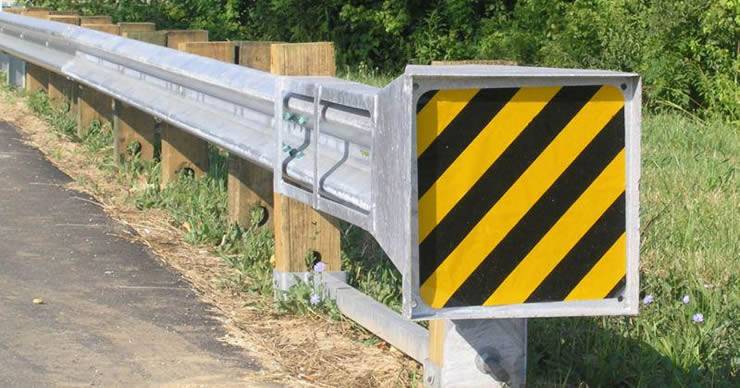
Crash Barrier End Terminals
The terminal is one of the most critical parts of a guardrail installation.
An ordinary exposed beam end can create a severe hazard during a direct impact. Modern terminals therefore use crashworthy designs intended to manage the vehicle’s interaction with the barrier.

Energy-Absorbing Terminals
Some terminals absorb impact energy by deforming or extruding the rail.
In a head-on impact, the terminal can progressively deform the guardrail while reducing the severity of the vehicle’s deceleration.
In an angled impact, some systems can gate or allow the vehicle to pass behind the terminal under specified conditions.
FHWA explains that the end terminal and guardrail face operate together as a complete system and that terminal behavior is central to crashworthiness.
Why Improper Terminals Are Dangerous
Common problems include:
- Exposed untreated rail ends
- Incorrect terminal type
- Missing components
- Wrong installation orientation
- Incorrect anchorage
- Improper grading around the terminal
- Mixing components from incompatible systems
- Damaged terminal components left unrepaired
A guardrail should therefore never be considered complete until its terminal and transition details have also been checked.
Crashworthiness and Crash Testing
Crashworthiness means that a roadside safety device performs acceptably when subjected to defined impact conditions.
Modern barrier systems are evaluated through controlled crash testing.
The AASHTO Manual for Assessing Safety Hardware (MASH) provides an important framework for evaluating roadside safety hardware in the United States. FHWA identifies MASH as the principal modern crash-testing framework for roadside hardware, alongside earlier NCHRP Report 350 criteria for older accepted systems.
Testing evaluates factors such as:
- Vehicle containment
- Redirection
- Structural integrity
- Vehicle trajectory
- Occupant risk
- Barrier deformation
- Vehicle penetration
- Rollover or vaulting potential
A field installation should correspond to the tested or otherwise approved system. Engineers should avoid treating individual components as universally interchangeable.
IRC, AASHTO, FHWA, and ICE Guidance
Different countries use different specifications, but the underlying engineering philosophy is similar: provide a crashworthy roadside system suited to the hazard and site.
IRC Guidance
For Indian highway projects, IRC:119, Guidelines for Traffic Safety Barriers, is an important reference for roadside and median barrier applications. IRC technical material also identifies IRC:5 and IRC:6 for relevant bridge design and loading considerations and discusses the use of metal, concrete, and flexible barrier systems. )
Project teams should also check current MoRTH circulars, project-specific specifications, and applicable revisions before construction.
AASHTO and MASH
AASHTO roadside safety guidance is closely associated with the Roadside Design Guide and MASH crash-testing framework.
FHWA
FHWA provides extensive technical guidance on guardrails, terminals, transitions, crash cushions, installation, and roadside hardware. Its guidance repeatedly emphasizes that the complete system must perform as intended—not merely the rail itself.
ICE and UK Practice
For UK-related projects, engineers should consider the Design Manual for Roads and Bridges (DMRB) and the relevant highway works specifications. The Institution of Civil Engineers identifies road restraint systems, including vehicle and pedestrian restraint, within the broader highway design and construction framework.
Always use the current edition applicable to the project jurisdiction.
Crash Barrier Installation: Step-by-Step
A practical installation sequence generally follows these stages.
Step 1: Survey the Location
Confirm:
- Road edge
- Shoulder width
- Terrain
- Hazard location
- Drainage
- Utilities
- Existing pavement
- Required barrier length
Step 2: Establish the Length of Need
Determine where the barrier must begin and end to adequately shield the hazard.
Do not simply install a short section directly opposite the object being protected.
Step 3: Confirm the Approved System
Verify the exact:
- Rail section
- Post type
- Post spacing
- Blockout
- Fasteners
- Terminal
- Transition
- Anchorage
- Height
Step 4: Prepare the Ground
Grade the area so the barrier and surrounding terrain comply with the approved installation requirements.
Poor grading can affect vehicle interaction with the system.
Step 5: Install Posts
Install posts to the specified spacing and embedment.
Avoid unauthorized field modifications.
Step 6: Install Rail and Connections
Attach the beam, splice sections correctly, and tighten fasteners according to project specifications.
Step 7: Install Terminals and Transitions
Treat every exposed end and connection to another barrier system correctly.
Step 8: Inspect the Completed Installation
Check alignment, height, post embedment, fasteners, terminals, grading, reflectors, and clearances.
FHWA specifically warns that installation and repair of roadside safety hardware should follow accepted configurations and applicable requirements.
Common Crash Barrier Installation Mistakes
Several mistakes repeatedly appear on highway projects.
Incorrect Barrier Height
Resurfacing can raise the pavement relative to an existing barrier. The resulting height may no longer match the approved configuration.
Insufficient Deflection Space
A semi-rigid barrier placed immediately beside a rigid obstruction may not have enough room to work.
Poor Terminal Treatment
An unfinished or incorrect guardrail end can create a serious hazard.
Weak Post Support
Posts installed too close to a slope break, in unsuitable soil, or without proper embedment may fail prematurely.
Mixing Unapproved Components
A rail from one system combined with a terminal or post from another system may not reproduce the tested performance.
Treating the Barrier as an Isolated Item
Barrier performance depends on the interaction between the rail, posts, soil, terminals, transitions, grading, and surrounding hazards.
Maintenance and Inspection of Crash Barriers
A crash barrier that has already been hit should be inspected promptly.
Look for:
- Bent or displaced rails
- Broken bolts
- Damaged posts
- Deformed terminals
- Missing components
- Corrosion
- Loose connections
- Settlement
- Damaged foundations
- Incorrect rail height
- Vegetation or debris interfering with operation
A damaged barrier should not be considered safe simply because the rail still appears continuous.
FHWA guidance specifically addresses the importance of timely guardrail repair and maintenance of roadside hardware.
Practical Recommendations for Students, Engineers, and Contractors
For Civil Engineering Students
Learn the complete barrier system rather than memorizing guardrail dimensions.
Understand:
- Vehicle dynamics
- Kinetic energy
- Roadside hazards
- Clear zones
- Barrier deflection
- Crash testing
- Terminal behavior
- Transition design
During site visits, observe why a barrier has been installed and what hazard it protects.
For Highway Engineers
Begin with hazard identification and risk assessment.
Do not select a barrier simply because it is inexpensive or commonly available. Confirm the required containment, working width, deflection, terminal configuration, soil conditions, and applicable crash-testing requirements.
Review barrier details during design-stage road safety audits and construction-stage inspections.
For Contractors
Treat the approved barrier drawing as a safety-critical document.
Do not substitute posts, bolts, terminals, spacers, or rail profiles without written approval from the responsible engineer or authority.
Maintain accurate records of installed components and immediately report site conditions that differ from the design assumptions.
Advantages and Limitations of Crash Barriers
Advantages
Crash barriers can:
- Reduce roadside crash severity.
- Protect motorists from fixed hazards.
- Prevent median crossover.
- Contain vehicles near steep slopes.
- Shield bridge structures.
- Provide positive protection in suitable work-zone applications.
- Improve safety on high-speed corridors.
Limitations
They cannot guarantee that every crash will be survivable.
Performance may vary with:
- Vehicle mass
- Impact speed
- Impact angle
- Vehicle orientation
- Road surface
- Barrier condition
- Terrain
- Installation quality
FHWA emphasizes that vehicle size, speed, and orientation can influence guardrail performance, which is why crash testing represents selected practical impact scenarios rather than every possible crash.
FAQs About Crash Barriers
What is the main purpose of a crash barrier?
The primary purpose is to reduce the consequences of an errant vehicle leaving the roadway. Depending on the system, it may contain, redirect, slow, or stop the vehicle before it reaches a more dangerous hazard.
What is the difference between a W-beam and Thrie-beam barrier?
Both are steel beam barrier systems, but they have different rail profiles and structural characteristics. The appropriate system depends on the required performance, approved design, site conditions, and governing specifications.
Are concrete barriers safer than steel guardrails?
Not automatically. Concrete barriers provide high containment and very little deflection, while steel systems can deform and absorb energy. The correct choice depends on the hazard, available space, traffic, containment requirements, and crashworthy system.
How far should a crash barrier be placed from the road?
There is no single universal distance. Placement depends on roadway geometry, shoulder conditions, barrier type, hazard location, working width, deflection requirements, and applicable standards. Project-specific IRC, AASHTO, DMRB, or agency requirements should control.
Why are guardrail terminals necessary?
An untreated guardrail end can create a dangerous impact point. A crashworthy terminal manages the end of the barrier and is designed to reduce the severity of impacts under defined test conditions.
Can damaged crash barriers be repaired by simply straightening them?
Usually, no. A collision can damage hidden or critical components such as posts, connections, terminals, and anchorage. The complete system should be inspected and repaired using approved replacement components.
What factors affect crash barrier performance?
Important factors include impact speed, vehicle type, impact angle, barrier geometry, post spacing, soil conditions, terminal design, available deflection, pavement condition, and installation quality.
Are crash barriers required on every steep road?
No. Barrier installation should follow a roadside risk assessment. Engineers should first consider whether the hazard can be removed, relocated, or made more forgiving. A barrier is appropriate when its expected safety benefit outweighs the risk of striking the barrier.
What is the role of MASH in crash barriers?
MASH provides crash-testing and evaluation criteria for roadside safety hardware. It helps assess whether barrier systems, terminals, transitions, and related devices perform acceptably under specified impact conditions.
Which standards should engineers use for crash barriers?
The governing standard depends on the country and project. Indian projects may use current IRC and MoRTH requirements; U.S. projects commonly reference AASHTO and MASH with applicable FHWA requirements; UK projects should consider the DMRB and relevant highway works specifications. Always verify the latest project-specific requirements.
Conclusion
Crash Barriers are an essential component of modern road safety engineering, but their effectiveness depends on much more than installing a steel beam or concrete wall beside the pavement. A successful system begins with identifying the roadside hazard and evaluating whether a barrier is genuinely needed. Engineers must then select an appropriate containment level, barrier type, terminal, transition, foundation arrangement, and deflection space.
Installation quality is equally important. Incorrect height, inadequate post support, poor grading, insufficient working width, incompatible components, and untreated ends can compromise an otherwise well-designed system. Standards such as IRC:119, AASHTO roadside guidance, MASH, FHWA requirements, and applicable DMRB provisions provide valuable frameworks for achieving consistent safety performance.
For students, the key lesson is to understand the engineering principles. Designers, it is to evaluate the complete roadside environment. For contractors, it is to install the approved system exactly as specified. When design, construction, inspection, and maintenance work together, crash barriers can significantly reduce the severity of run-off-road and median crashes.

Kamran Malik is a passionate civil engineering writer and researcher who specializes in construction, transportation, structural engineering, and infrastructure topics. Through his articles on CivilEngineerings.com, he simplifies complex engineering concepts and shares practical insights, industry trends, and educational resources for students, professionals, and engineering enthusiasts.