
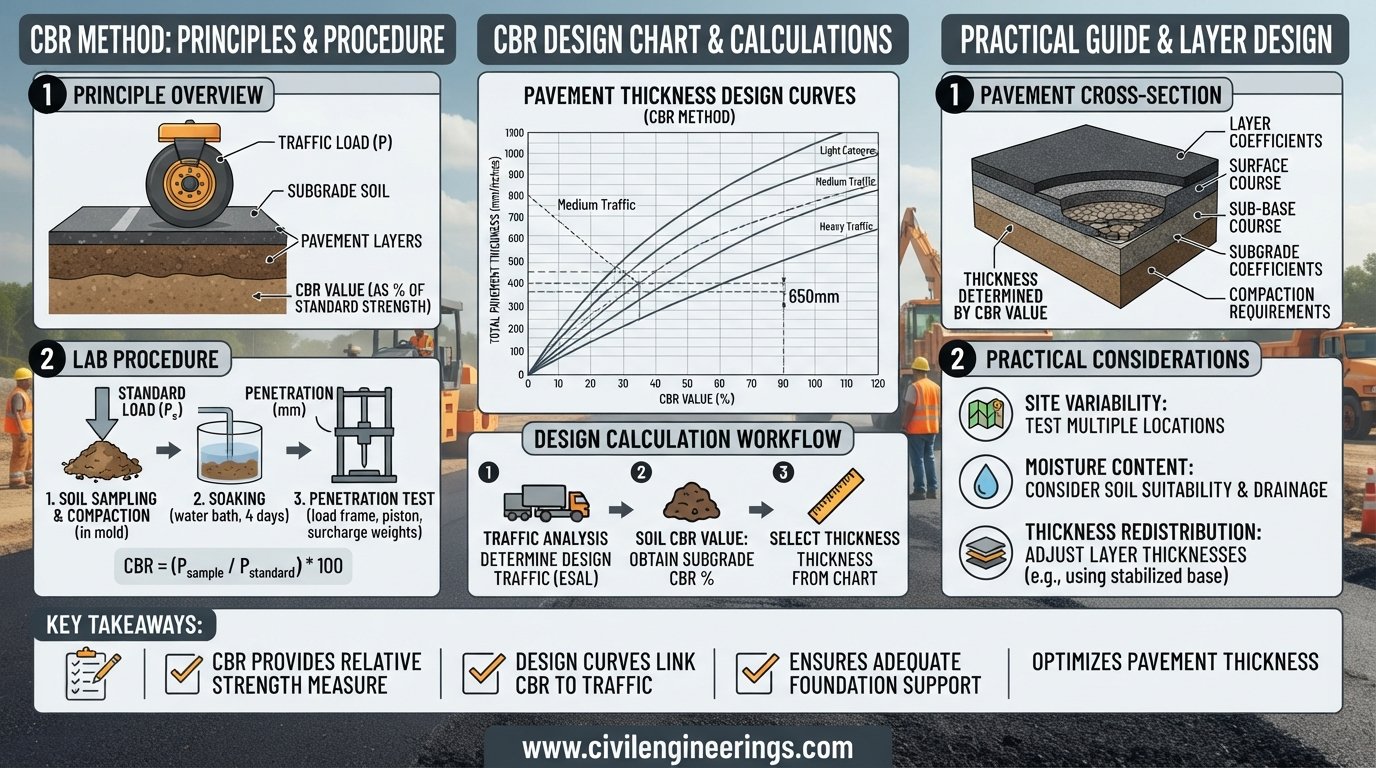
Designing a pavement is not simply a matter of selecting asphalt thickness. The performance of a flexible pavement depends heavily on the strength and condition of the soil supporting it. When the subgrade is weak, even a well-constructed surface can develop rutting, cracking, deformation, and premature failure. This is where the CBR Method of Pavement Design becomes highly useful.
The California Bearing Ratio (CBR) method provides an empirical approach for relating subgrade strength to the required thickness of pavement layers. It has been widely used for roads, highways, airfields, parking areas, and other transportation facilities. The method is particularly valuable where reliable subgrade CBR data are available and an established design chart or pavement design procedure is being followed.
This guide explains the CBR concept, laboratory testing, design procedure, formulas, traffic considerations, pavement thickness selection, common mistakes, practical examples, limitations, and recommendations for engineers and contractors. It also discusses how CBR-based design relates to modern pavement engineering practices and standards such as IRC and AASHTO.
What Is the CBR Method of Pavement Design?
The CBR Method of Pavement Design is an empirical pavement design procedure in which the strength of the subgrade, subbase, or base material is represented by its California Bearing Ratio.
CBR expresses the resistance of a soil or pavement material to penetration by a standard plunger relative to the resistance offered by a standard crushed-rock material.
In simple terms:
Higher CBR = stronger supporting soil = generally lower required pavement thickness.
Lower CBR = weaker subgrade = generally greater pavement thickness.
The CBR test was developed in California during the early development of modern pavement engineering and subsequently became widely adopted internationally. It remains an important geotechnical input even though many modern mechanistic-empirical pavement procedures use parameters such as resilient modulus directly.
The method is mainly associated with flexible pavement design, where pavement layers distribute wheel loads gradually before the stresses reach the natural or improved subgrade.
A typical flexible pavement consists of:
- Bituminous or asphalt surface layers
- Base course
- Subbase course
- Prepared subgrade
- Natural soil or embankment below the pavement formation
The CBR value helps engineers determine how much structural material is required above the supporting soil.
Why CBR Is Important in Pavement Engineering
The subgrade is the foundation of a road pavement. Its strength changes with soil type, density, moisture content, drainage, compaction, and seasonal conditions.
A pavement designed using an unrealistically high subgrade strength may be structurally inadequate. Conversely, assuming an excessively low CBR can result in unnecessary pavement thickness and higher construction costs.
CBR testing therefore helps engineers:
- Evaluate subgrade strength.
- Compare different soil materials.
- Estimate pavement structural requirements.
- Identify weak sections along a highway corridor.
- Determine whether soil improvement is necessary.
- Assess subbase and base materials.
- Support preliminary pavement thickness selection.
- Develop construction quality-control requirements.
The importance of subgrade strength is also recognized in modern pavement design. FHWA guidance notes that subgrade strength or stiffness is a direct input into many pavement design procedures and can significantly affect the structural requirements of flexible pavements.


California Bearing Ratio Test
The CBR test determines the penetration resistance of a compacted soil specimen under controlled conditions.
A cylindrical soil sample is compacted inside a standard mould. A penetration piston is then pushed into the specimen at a controlled rate while the corresponding load is recorded.
The standard test considers the load required at specified penetration levels, particularly:
- 2.5 mm penetration (0.1 inch)
- 5.0 mm penetration (0.2 inch)
The CBR value is calculated by comparing the measured penetration load with the standard load.
A simplified expression is:
CBR (%) = (Test load / Standard load) × 100
For the conventional reference values:
At 2.5 mm penetration:
CBR₂.₅ = (Test load at 2.5 mm / 13.24 kN) × 100
At 5.0 mm penetration:
CBR₅.₀ = (Test load at 5.0 mm / 19.96 kN) × 100
The appropriate test standard should always be checked because equipment, specimen preparation, correction procedures, and reporting requirements must follow the governing specification.
AASHTO T 193 covers laboratory determination of CBR for pavement subgrade, subbase, and base-course materials. It is primarily intended for materials with maximum particle sizes below 19 mm, subject to the standard’s provisions.
CBR Test Procedure
A practical laboratory sequence is as follows:
- Obtain a representative soil sample.
- Determine the required moisture condition.
- Prepare the material by removing or modifying oversized particles as required by the applicable standard.
- Compact the soil into the CBR mould.
- Determine the specimen density and moisture condition.
- Apply surcharge weights where required.
- Soak the specimen when a soaked CBR is required.
- Mount the specimen in the testing machine.
- Apply the penetration piston at the specified rate.
- Record load at increasing penetration.
- Plot the load-penetration relationship.
- Apply the required correction to the curve when necessary.
- Calculate CBR values at 2.5 and 5.0 mm penetration.
- Select the governing value according to the applicable test standard.
Pavement Interactive describes the conventional CBR test as a penetration test performed at approximately 1.3 mm/min, with load readings collected over a range of penetration values.
Soaked and Unsoaked CBR
Two broad conditions are commonly discussed:
Unsoaked CBR:
The specimen is tested without prolonged soaking. It can provide useful information where moisture conditions are controlled or where the design procedure specifically permits it.
Soaked CBR:
The compacted specimen is soaked before testing to simulate a critical wet condition. This is particularly important for subgrades susceptible to moisture-related weakening.
For highway design, the selected moisture condition should represent the condition reasonably expected during the pavement’s service life rather than simply using the highest laboratory strength.
IRC pavement guidance has historically placed significant emphasis on soaked CBR and critical moisture conditions for subgrade design. IRC:37-2018 also specifies procedures concerning laboratory CBR, placement density, and percentile selection for different traffic conditions.
Factors Affecting CBR Value
A CBR value is not an inherent constant of a soil. It can change substantially depending on how the specimen is prepared and the conditions under which it is tested.
Soil Type
Gravelly and well-graded granular soils generally provide higher CBR values than weak plastic clays and organic soils.
The CBR ranges reported in engineering references vary by material and testing condition, so they should be treated as indicative rather than universal design values.
Moisture Content
Water can significantly reduce the strength of many fine-grained soils.
A clayey subgrade that performs reasonably well during dry conditions may become considerably weaker after prolonged wetting. This is one reason soaked CBR can be critical for pavement design.
Dry Density
Higher compaction generally increases soil resistance, although the relationship depends on soil type and moisture condition.
This makes field compaction control extremely important. A laboratory CBR obtained at one density cannot automatically represent a poorly compacted field subgrade.
Soil Structure and Gradation
Particle size distribution, plasticity, cohesion, drainage characteristics, and soil fabric all influence penetration resistance.
Two soils with similar classifications may still produce substantially different CBR values.
Drainage
Poor drainage can increase moisture content in the subgrade and reduce its effective strength.
Consequently, CBR-based pavement design should never be considered independently from drainage design.


CBR Method of Pavement Design Procedure
The overall design process can be organized into a logical sequence.
Step 1: Conduct Site Investigation
Begin with a geotechnical investigation along the proposed road alignment.
The investigation should identify:
- Soil types
- Groundwater conditions
- Existing pavement conditions
- Embankment materials
- Weak soil zones
- Drainage characteristics
- Seasonal moisture variation
- Subgrade variability
CBR samples should represent the different soil types and pavement sections rather than being collected from only convenient locations.
Step 2: Determine Design CBR
Laboratory CBR values are obtained from representative specimens.
If the soil changes significantly along the alignment, separate pavement sections may need separate design values.
For example:
| Location | CBR (%) | General Condition |
|---|---|---|
| Chainage 1+000 | 8 | Moderate |
| Chainage 2+000 | 5 | Weak |
| Chainage 3+000 | 10 | Good |
| Chainage 4+000 | 3 | Very weak |
Using the highest value for the entire highway would be unsafe.
The design CBR should reflect the appropriate statistical or percentile approach specified by the governing design standard.
IRC:37-2018 discusses percentile-based subgrade CBR selection and identifies 90th-percentile CBR for high-volume roads, with different criteria depending on traffic level and road category.
Step 3: Determine Design Traffic
Subgrade strength alone does not determine pavement thickness.
The expected traffic loading must also be established.
Important inputs include:
- Initial commercial vehicles per day
- Traffic growth rate
- Design life
- Vehicle damage factor
- Lane distribution
- Directional distribution
- Axle-load characteristics
For Indian-style IRC flexible pavement procedures, traffic is commonly expressed in terms of million standard axles (MSA).
A generalized cumulative traffic relationship can be written as:
N = 365 × A × [(1 + r)ⁿ − 1] / r × D × F
where:
- N = cumulative design traffic
- A = initial commercial vehicles per day
- r = annual traffic growth rate
- n = design period
- D = distribution factor
- F = vehicle damage factor
The exact traffic equation and factors must follow the applicable design standard.
Step 4: Select the Design Chart or Procedure
Once the design CBR and traffic are known, the engineer selects the appropriate pavement thickness relationship.
Traditional CBR design methods use design charts that relate:
Subgrade CBR + Design Traffic → Total Pavement Thickness
Different standards and editions use different charts, traffic definitions, layer requirements, and performance criteria.
Therefore, an engineer should never mix a CBR curve from one design procedure with traffic assumptions from another without checking compatibility.
Step 5: Determine Total Pavement Thickness
The design chart gives the required total thickness above the subgrade.
The total thickness may include:
Total pavement thickness = Bituminous layers + Base + Subbase
The actual layer arrangement depends on the road classification, traffic, material properties, drainage, climatic conditions, and applicable specification.
Step 6: Select Individual Layer Thicknesses
The total thickness is then divided among:
- Surface course
- Binder or intermediate bituminous layer
- Base course
- Granular subbase
Minimum layer thickness requirements and material specifications must come from the governing standard.
A thick pavement is not automatically a good pavement. Layer quality, compaction, drainage, interfaces, and construction control are equally important.
Worked Example of CBR-Based Pavement Design
Consider a hypothetical rural highway with the following preliminary design information:
- Design CBR = 5%
- Initial commercial traffic = 1,000 vehicles/day
- Design life = 15 years
- Traffic growth = 7%
- Appropriate vehicle damage and lane distribution factors determined from the governing standard
- Flexible pavement selected
The engineer first calculates the cumulative design traffic.
Using the generalized traffic-growth relationship:
N = 365 × A × [(1 + r)ⁿ − 1] / r × D × F
The calculated traffic is then converted into the design traffic category required by the selected pavement design method.
Suppose the applicable design chart indicates that a subgrade with a 5% CBR and the calculated traffic level requires approximately 650 mm of total pavement structure.
The engineer does not simply construct a 650 mm-thick pavement without further checks.
Instead, the thickness is allocated among the pavement layers according to the applicable standard. For example, the preliminary structure might be considered as:
- Bituminous layers: 100 mm
- Granular base: 250 mm
- Granular subbase: 300 mm
Total = 650 mm
This is only an illustrative allocation. The actual layer thicknesses must be established using the governing pavement design standard, material properties, drainage requirements, construction constraints, and traffic category.
The example demonstrates an important engineering principle: CBR determines the strength condition of the supporting soil, but the complete pavement design requires traffic, materials, climate, drainage, and structural checks as well.
CBR Design Charts and Their Interpretation
Traditional CBR pavement design charts generally have:
- CBR values on one axis or represented by separate curves.
- Traffic or wheel loading on another axis.
- Required pavement thickness represented by the chart intersection.
The engineer locates the design CBR and design traffic, then reads the corresponding pavement thickness.
A lower CBR curve generally produces a greater pavement thickness for the same traffic level.
For example:
CBR = 2% → very weak support → greater pavement thickness
C.B.R = 5% → moderate support → intermediate thickness
CBR = 10% → stronger support → lower thickness
This relationship reflects the structural role of the subgrade.
However, design charts should not be copied from old textbooks or websites without checking their source and applicability. Historical CBR charts may correspond to obsolete traffic definitions or design assumptions.
Relationship Between CBR and Resilient Modulus
Modern pavement engineering increasingly uses resilient modulus (Mr) as a representation of subgrade stiffness under repeated traffic loading.
CBR and resilient modulus are not identical properties.
CBR is essentially an empirical penetration-strength index, whereas resilient modulus represents recoverable deformation under cyclic loading.
Some agencies use correlations to estimate resilient modulus from CBR when direct testing is unavailable. For example, IRC:37-2018 provides CBR-based relationships for estimating subgrade resilient modulus under specified conditions.
The important lesson is:
Do not treat every CBR-to-Mr equation as universally valid.
Correlations depend on soil type, testing method, stress conditions, moisture, and the design framework.
Similarly, an AASHTO-related conversion may differ from an IRC relationship. FHWA material also notes that CBR can be used as one of several inputs or correlations for estimating pavement-related geotechnical properties.
Advantages of the CBR Method
The CBR method remains popular because of several practical advantages.
Simple and Familiar
The test is comparatively straightforward, and many highway laboratories are equipped for CBR testing.
Economical
CBR testing generally costs less than advanced repeated-load testing.
Useful for Subgrade Investigation
It provides a convenient way to compare the relative strength of different soils.
Suitable for Preliminary Design
CBR-based procedures can provide a practical pavement thickness estimate during preliminary highway design.
Widely Established
CBR has been used internationally for decades and appears in numerous pavement specifications and testing standards.
Limitations of the CBR Method
CBR should not be treated as a complete representation of pavement behavior.
Empirical Nature
The method is based on empirical relationships rather than a complete mechanistic simulation of pavement response.
Sensitive to Moisture
CBR can change substantially with moisture content and saturation.
Limited Representation of Repeated Traffic
Actual highway traffic produces millions of load repetitions. A static penetration test does not fully reproduce that behavior.
Soil Variability
A few laboratory specimens may not represent an entire highway alignment.
Material Preparation Effects
Changing gradation or specimen preparation can influence measured strength. AASHTO specifically recognizes considerations associated with materials containing particles larger than 19 mm.
Not a Substitute for Engineering Judgment
A pavement design should also consider drainage, climate, material quality, traffic loading, construction quality, and expected distress mechanisms.


Practical Recommendations for Students, Engineers and Contractors
For Civil Engineering Students
Do not memorize only the CBR formula.
Understand the relationship between:
soil strength → CBR → design traffic → pavement thickness → pavement performance
Practice reading CBR design curves and work through different combinations of traffic and subgrade strength.
Also learn the laboratory procedure. A student who understands how the CBR specimen is prepared will better understand why moisture and density matter in pavement design.
For Highway Engineers
Treat the CBR value as a representative engineering parameter, not an isolated laboratory number.
Divide the project into homogeneous subgrade sections. Investigate unusual low values rather than averaging them away.
Always verify:
- Design moisture condition
- Compaction level
- CBR variability
- Drainage
- Groundwater
- Traffic assumptions
- Applicable design standard
- Material availability
Where appropriate, supplement CBR with resilient modulus, DCP, plate-load, geotechnical investigation, or other relevant testing.
For Site Engineers
Laboratory design can only perform well if construction achieves the assumed field conditions.
Pay particular attention to:
- Subgrade preparation
- Moisture conditioning
- Compaction
- Layer thickness
- Material segregation
- Drainage
- Proof rolling
- Soft-spot treatment
If the constructed subgrade is significantly weaker than the design assumption, notify the design team rather than simply proceeding with the next pavement layer.
For Contractors
Do not interpret the pavement design thickness as permission to compromise layer quality.
A pavement with correct thickness can still fail because of:
- Poor compaction
- Excessive moisture
- Weak construction joints
- Inadequate drainage
- Contaminated aggregate
- Variable layer thickness
- Poor-quality subgrade
Construction quality is part of pavement structural performance.
IRC, AASHTO and ICE Considerations
Different organizations provide different types of guidance, and engineers should understand their roles.
IRC:
Indian Roads Congress guidelines, particularly IRC:37 for flexible pavement design, provide a major framework for CBR-related subgrade evaluation and flexible pavement design in India. IRC guidance also addresses design traffic, subgrade characteristics, resilient modulus, pavement layers, and material considerations.
AASHTO:
AASHTO provides standardized testing procedures such as AASHTO T 193 for CBR. AASHTO pavement design frameworks may use CBR directly in some contexts or use relationships between CBR and other engineering parameters.
ASTM:
ASTM standards provide test methods, including laboratory and field CBR procedures. ASTM D4429, for example, addresses in-place CBR testing.
ICE:
The Institution of Civil Engineers (ICE) contributes professional guidance, engineering knowledge, and good-practice principles relevant to infrastructure delivery. However, ICE should not be treated as a replacement for the specific pavement design standard adopted by the road authority.
For a real project, the governing contract specification, national road authority requirements, and current edition of the applicable pavement design standard should take precedence over generalized online formulas.
Common Mistakes in CBR Pavement Design
Several errors repeatedly appear in academic exercises and field projects.
Using an unrepresentative CBR:
A single borehole or soil sample may not represent an entire road.
Ignoring moisture:
Dry-condition CBR can be misleading for moisture-sensitive soils.
Using outdated design charts:
Older CBR charts may use different traffic assumptions from current procedures.
Confusing test CBR with design CBR:
The laboratory result and statistically selected project design value are not necessarily the same.
Ignoring compaction:
A laboratory specimen prepared at target density may not represent an inadequately compacted field subgrade.
Mixing standards:
Do not combine a traffic equation from one standard with a thickness chart from another without technical validation.
Ignoring drainage:
A pavement supported by a wet subgrade may perform very differently from one supported by a properly drained subgrade.
FAQs About CBR Method of Pavement Design
What is the CBR Method of Pavement Design?
It is an empirical flexible pavement design approach that uses the California Bearing Ratio of the supporting soil, together with traffic and other design parameters, to determine pavement thickness.
What does a high CBR value indicate?
A high CBR generally indicates greater resistance to penetration and better supporting capacity compared with a soil having a lower CBR.
What is a good CBR value for road construction?
There is no single universally acceptable value. The required CBR depends on the road category, traffic, material, drainage, design standard, and whether the value represents subgrade, subbase, or base material.
Why is soaked CBR used in pavement design?
Soaked CBR can represent a weakened condition caused by prolonged moisture exposure. It is especially relevant for moisture-sensitive subgrades and designs where wet-season performance governs.
Which is better, CBR or resilient modulus?
Neither is universally “better.” CBR is a practical empirical strength index, while resilient modulus provides a more direct representation of repeated-load stiffness. The appropriate parameter depends on the adopted pavement design method.
How is CBR calculated?
The basic calculation compares the measured load required to produce a specified penetration with a standard reference load:
CBR = (Test load / Standard load) × 100
The applicable test standard determines the detailed calculation and interpretation procedure.
Can CBR be used for all pavement types?
CBR is primarily associated with flexible pavement and unbound material evaluation. Rigid pavement design normally relies on parameters such as modulus of subgrade reaction, elastic properties, and concrete strength rather than using CBR as the principal structural design parameter.
Does higher CBR always mean a thinner pavement?
Generally, stronger subgrade support permits a lower structural thickness for the same design traffic in empirical CBR procedures. However, minimum layer thickness, drainage, material requirements, environmental conditions, and other design controls can still govern.
How many CBR tests are required for a highway project?
There is no universal number. Testing frequency should reflect soil variability, project length, road importance, geotechnical conditions, and the governing specification. Homogeneous sections may require fewer tests than highly variable terrain.
Can CBR be improved?
Yes. Weak subgrade can sometimes be improved through moisture control, improved compaction, soil stabilization, replacement, mechanical modification, geosynthetics, drainage improvement, or other engineered solutions. The selected treatment should follow a geotechnical and pavement engineering assessment.
Conclusion
The CBR Method of Pavement Design remains one of the most practical and widely recognized approaches for preliminary and conventional flexible pavement design. Its fundamental concept is straightforward: pavement thickness must respond to the strength of the supporting subgrade and the traffic that the road is expected to carry.
However, good pavement engineering requires more than inserting a CBR value into a chart. Engineers must obtain representative samples, control moisture and compaction, establish an appropriate design CBR, calculate realistic traffic loading, select the correct design procedure, and verify pavement materials and drainage conditions. Modern practice may also supplement CBR with resilient modulus and other geotechnical measurements.
