
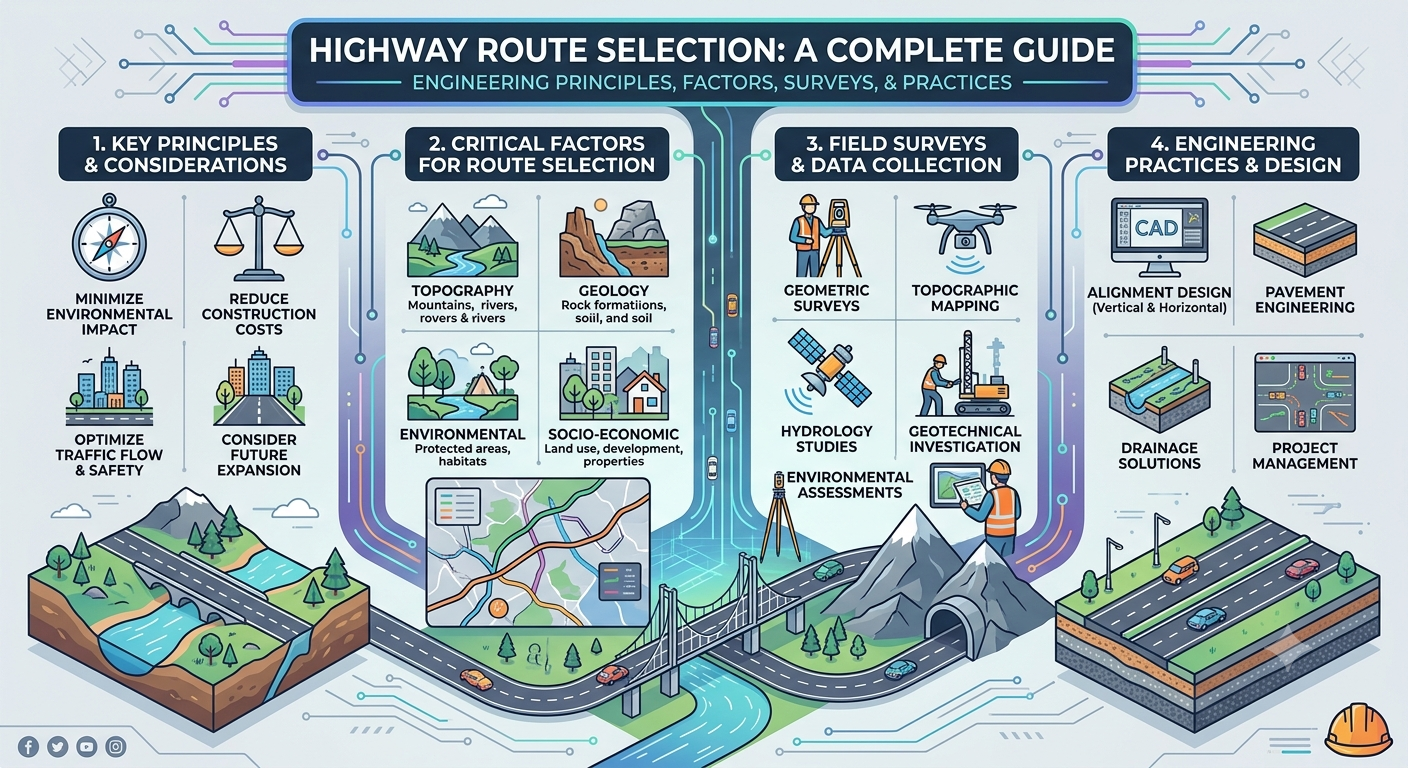
Highway Route Selection
Selecting the right route is one of the most important decisions in highway engineering. A well-planned highway alignment reduces construction costs, minimizes environmental impacts, improves road safety, and ensures efficient transportation for decades. Conversely, poor route selection can lead to excessive earthwork, costly maintenance, traffic congestion, and significant social and environmental challenges.
Highway Route Selection is the systematic process of identifying the most suitable path for a proposed highway by evaluating technical, economic, environmental, and social factors. Before any pavement is designed or construction begins, engineers conduct detailed surveys and analyses to determine the optimum alignment that satisfies current and future transportation needs.
Modern highway projects rely on advanced technologies such as Geographic Information Systems (GIS), Global Positioning System (GPS), drones, satellite imagery, and digital terrain models to complement traditional field surveys. However, engineering judgment remains essential for balancing safety, cost, sustainability, and constructability.
This guide explains the principles, objectives, route survey stages, and key factors influencing Highway Route Selection, along with practical recommendations for engineers, contractors, and students.
What Is Highway Route Selection?
Highway Route Selection is the process of identifying and evaluating alternative corridors to determine the most suitable alignment for a proposed highway. The selected route should provide safe, efficient, and economical transportation while minimizing adverse effects on communities and the environment.
The process begins with collecting data about the project area, including topography, geology, land use, traffic patterns, drainage conditions, and existing infrastructure. Engineers compare multiple route alternatives before recommending the alignment that best satisfies design objectives.
A successful route selection balances competing priorities such as construction cost, operational efficiency, environmental protection, and long-term maintenance.
Objectives of Highway Route Selection
The primary objective of highway route selection is to establish an alignment that delivers maximum transportation benefits with minimum overall cost.
Key objectives include:
- Provide the shortest practical connection between destinations.
- Ensure safe and comfortable vehicle operation.
- Reduce construction and maintenance costs.
- Minimize earthwork and excavation.
- Avoid environmentally sensitive areas.
- Reduce travel time and fuel consumption.
- Improve regional connectivity.
- Support future traffic growth.
- Limit disruption to existing communities and utilities.
Careful planning during this stage often prevents costly design modifications later in the project.
Importance of Highway Route Selection
Route selection influences nearly every aspect of a highway project. Decisions made during this phase affect construction feasibility, pavement design, drainage requirements, bridge locations, land acquisition, and long-term operational performance.
A properly selected highway route offers several advantages:
- Lower construction costs through efficient alignment.
- Reduced maintenance requirements.
- Improved road safety with better sight distance and geometry.
- Fewer environmental impacts.
- Enhanced travel efficiency.
- Reduced vehicle operating costs.
- Better integration with existing transportation networks.
- Increased economic development along the corridor.
Since highways are expected to serve users for several decades, investing time in route selection yields substantial long-term benefits.
Principles of Highway Route Selection
Engineers apply several guiding principles when evaluating potential highway alignments.
1. Directness
A highway should provide a reasonably direct connection between major destinations while avoiding unnecessary detours.
Shorter routes generally offer:
- Reduced travel time.
- Lower fuel consumption.
- Improved logistics.
- Greater user satisfaction.
However, the shortest route is not always the best if it crosses difficult terrain or environmentally sensitive areas.
2. Safety
Safety remains one of the highest priorities in highway engineering.
The selected route should:
- Provide adequate stopping sight distance.
- Minimize sharp curves.
- Limit steep gradients.
- Reduce conflict points.
- Ensure clear visibility at intersections.
Safe alignment contributes to fewer accidents and better driving conditions.
3. Economy
Economic considerations extend beyond initial construction costs.
Engineers evaluate:
- Earthwork quantities.
- Bridge requirements.
- Land acquisition costs.
- Utility relocation.
- Maintenance expenses.
- Vehicle operating costs.
- Lifecycle performance.
The most economical route is one that offers the lowest total cost over its design life rather than the lowest initial investment.
4. Environmental Compatibility
Modern highway projects must minimize impacts on natural ecosystems.
Preferred alignments avoid:
- Wetlands.
- Protected forests.
- Wildlife habitats.
- Flood-prone areas.
- Historical and cultural sites.
Environmental stewardship helps preserve natural resources while reducing project delays associated with regulatory approvals.
5. Future Expansion
Traffic volumes often increase significantly over time. Engineers therefore select routes that allow future widening or additional lanes without excessive reconstruction.
Planning for long-term growth improves the sustainability of transportation infrastructure.
Factors Affecting Highway Route Selection
Several technical and non-technical factors influence the final highway alignment.
1. Terrain and Topography
Terrain determines the complexity of highway construction.
Plain Terrain
Advantages include:
- Lower construction costs.
- Easier alignment.
- Minimal earthwork.
- Better visibility.
Rolling Terrain
Requires moderate cutting and filling with careful geometric design.
Mountainous Terrain
Presents challenges such as:
- Steep slopes.
- Landslide risks.
- Sharp curves.
- Tunnels and retaining structures.
Selecting an alignment that follows natural contours often reduces construction difficulty.
2. Soil and Geology
Subsurface conditions directly influence foundation stability and pavement performance.
Engineers investigate:
- Soil bearing capacity.
- Rock formations.
- Groundwater levels.
- Expansive clay deposits.
- Liquefaction potential.
- Slope stability.
Weak soils may require stabilization, increasing project costs.
3. Traffic Demand
Projected traffic volumes determine the required highway capacity and influence route selection.
Traffic studies consider:
- Current traffic counts.
- Population growth.
- Freight movement.
- Industrial development.
- Tourism.
- Future urban expansion.
High-demand corridors typically justify wider rights-of-way and higher design standards.
4. Drainage and Hydrology
Water is one of the greatest threats to highway infrastructure.
Engineers assess:
- Rivers.
- Streams.
- Floodplains.
- Drainage patterns.
- Rainfall intensity.
- Groundwater conditions.
An alignment with favorable drainage reduces maintenance costs and extends pavement life.
5. Environmental Considerations
Environmental assessments examine potential impacts on:
- Air quality.
- Water resources.
- Vegetation.
- Wildlife.
- Noise levels.
- Agricultural land.
Mitigation measures such as wildlife crossings, noise barriers, and erosion control may be incorporated where avoidance is not feasible.
6. Social and Economic Factors
Highway projects affect surrounding communities and regional development.
Important considerations include:
- Land acquisition.
- Residential displacement.
- Business accessibility.
- Employment opportunities.
- Utility relocation.
- Cultural heritage sites.
Community consultation during planning helps identify concerns and improve project acceptance.
Stages of Highway Route Surveys
Highway route selection is carried out through a series of progressively detailed surveys.
Stage 1: Map Study
The map study is the initial desk-based investigation using topographic maps, satellite imagery, aerial photographs, and GIS data.
Objectives
- Identify possible route corridors.
- Locate rivers, hills, and valleys.
- Examine existing road networks.
- Estimate route lengths.
- Identify major obstacles.
Modern GIS software enables engineers to compare multiple alternatives quickly before field investigations begin.
Stage 2: Reconnaissance Survey
A reconnaissance survey involves a rapid field inspection of potential routes identified during the map study.
Purpose
- Verify map information.
- Observe terrain conditions.
- Identify construction challenges.
- Assess drainage features.
- Locate existing utilities.
- Evaluate access to construction materials.
During this stage, engineers gather preliminary information rather than detailed measurements.
Typical Observations
- Soil type.
- Vegetation.
- Existing buildings.
- Streams and rivers.
- Rock outcrops.
- Utility corridors.
Reconnaissance surveys eliminate impractical alignments before investing in detailed investigations.
Stage 3: Preliminary Survey
The preliminary survey provides detailed engineering data for the most promising route alternatives.
Activities include:
- Topographic surveying.
- Longitudinal profiling.
- Cross-section measurements.
- Soil investigations.
- Hydrological studies.
- Traffic data collection.
- Preliminary geometric design.
Engineers compare the alternatives based on technical feasibility, construction cost, environmental impact, and operational performance before selecting the preferred alignment.
Simple Highway Route Selection Process Diagram
Transportation Need
        │
        ▼
    Map Study
        │
        ▼
Reconnaissance Survey
        │
        ▼
Preliminary Survey
        │
        ▼
Alternative Route Evaluation
        │
        ▼
Preferred Alignment
        │
        ▼
Final Location Survey
        │
        ▼
Detailed Design & Construction
Final Location Survey
After the preliminary survey identifies the preferred alignment, engineers carry out the Final Location Survey. This stage provides the precise data required for detailed design, cost estimation, and construction planning.
Unlike earlier surveys, the final location survey involves accurate measurements and establishes the highway centerline on the ground.
Objectives
- Fix the final highway alignment.
- Establish horizontal and vertical control points.
- Mark the centerline and right-of-way.
- Prepare detailed engineering drawings.
- Calculate earthwork quantities.
- Collect information for drainage and bridge design.
Activities Performed
The final survey generally includes:
- Centerline staking
- Bench mark establishment
- Detailed contour mapping
- Longitudinal profile preparation
- Cross-section surveys
- Soil sampling and testing
- Utility identification
- Boundary verification
The information collected during this stage becomes the foundation for pavement design, structural design, and construction documentation.
Engineering Considerations in Highway Route Selection
Selecting a highway route requires balancing multiple engineering requirements rather than focusing on a single factor. An ideal alignment should satisfy safety, durability, economy, and operational efficiency throughout its service life.
Geometric Design
The selected route should allow proper geometric elements, including:
- Adequate sight distance
- Safe horizontal curves
- Suitable vertical curves
- Comfortable gradients
- Proper lane width
- Appropriate shoulder width
Good geometric design improves driver comfort while reducing accident risks.
Earthwork Optimization
Earthwork often represents a significant portion of highway construction costs.
Engineers aim to:
- Balance cut and fill quantities.
- Reduce excessive excavation.
- Minimize embankment construction.
- Utilize locally available materials whenever practical.
Efficient earthwork planning lowers project costs and shortens construction schedules.
Drainage Design
An effective drainage system protects pavement layers from moisture damage.
Key considerations include:
- Surface runoff management
- Side drains
- Cross-drainage structures
- Culverts
- Bridge waterways
- Slope drainage
Poor drainage can lead to pavement deterioration, erosion, and increased maintenance costs.
Pavement Performance
Route selection influences pavement design because soil conditions, traffic loading, and environmental exposure vary along different alignments.
Engineers evaluate:
- Subgrade strength
- Expected traffic volume
- Heavy axle loads
- Climatic conditions
- Material availability
These factors determine pavement thickness and material selection.
Environmental Considerations
Modern highway projects place strong emphasis on environmental sustainability. A carefully selected route minimizes ecological disruption while meeting transportation needs.
Environmental Factors
During route evaluation, engineers assess:
- Forest areas
- Wetlands
- Rivers and lakes
- Wildlife habitats
- Agricultural land
- Air quality
- Noise impacts
- Water resources
Where impacts cannot be avoided, mitigation measures such as wildlife crossings, noise barriers, sediment control, and compensatory plantation programs may be incorporated.
Social and Economic Considerations
A highway influences communities long before construction begins. Therefore, route selection should account for both economic benefits and social impacts.
Social Factors
Engineers consider:
- Residential displacement
- Community connectivity
- Access to schools and hospitals
- Cultural and historical sites
- Public acceptance
Public consultation often provides valuable insights that improve project outcomes.
Economic Factors
A well-selected highway route can:
- Encourage industrial growth.
- Improve freight transportation.
- Increase tourism.
- Reduce travel time.
- Lower vehicle operating costs.
- Promote regional development.
Long-term economic benefits frequently outweigh the initial construction investment.
Practical Applications of Highway Route Selection
Highway route selection principles are applied in numerous transportation projects, including:
- National highways
- Expressways
- Rural roads
- Mountain highways
- Ring roads
- Bypass roads
- Industrial access roads
- Airport access highways
For example, when planning a bypass around a congested city, engineers compare several corridors. The preferred route should reduce travel time, minimize land acquisition, avoid densely populated areas, and provide opportunities for future expansion.
Similarly, in mountainous terrain, the selected alignment may follow natural contours to reduce excavation, improve stability, and limit the number of retaining structures.
Highway Route Selection Flow Diagram
Identify Transportation Need
            │
            ▼
     Collect Existing Data
            │
            ▼
        Map Study
            │
            ▼
  Reconnaissance Survey
            │
            ▼
   Preliminary Survey
            │
            ▼
Evaluate Alternative Routes
            │
            ▼
 Environmental & Economic Analysis
            │
            ▼
   Select Preferred Alignment
            │
            ▼
   Final Location Survey
            │
            ▼
Detailed Design & Construction
This systematic approach reduces uncertainty and supports informed engineering decisions.
Best Practices for Highway Route Selection
Successful highway projects follow proven engineering practices throughout the planning process.
Recommended best practices include:
- Perform comprehensive traffic studies.
- Conduct detailed geotechnical investigations.
- Use GIS and remote sensing for corridor analysis.
- Consider lifecycle costs rather than only initial construction expenses.
- Preserve environmentally sensitive areas whenever feasible.
- Coordinate with utility providers during planning.
- Incorporate climate resilience into design decisions.
- Engage stakeholders early to address community concerns.
- Maintain flexibility for future highway expansion.
- Document all technical evaluations for transparency and future reference.
Applying these practices enhances project quality and reduces long-term risks.
Practical Recommendations
Civil Engineers
- Compare multiple alignment alternatives before selecting the preferred route.
- Integrate topographic, geotechnical, environmental, and traffic data into decision-making.
- Design with future traffic growth and maintenance requirements in mind.
- Ensure proper coordination between survey, design, and construction teams.
Contractors
- Review route survey information thoroughly before mobilization.
- Protect survey control points during construction.
- Monitor earthwork operations to maintain design alignment.
- Follow quality assurance procedures for drainage and embankment works.
Engineering Students
- Study route selection alongside highway geometric design.
- Practice interpreting contour maps and longitudinal profiles.
- Learn the purpose of each survey stage.
- Explore modern technologies such as GPS, drones, GIS, and LiDAR used in transportation engineering.
Practical field experience combined with theoretical knowledge develops a strong understanding of highway planning.
General IRC and AASHTO Considerations
Highway route selection should comply with applicable national standards and accepted engineering practices.
General IRC Guidance
The Indian Roads Congress (IRC) emphasizes:
- Safe geometric design
- Efficient route alignment
- Proper drainage planning
- Environmental protection
- Traffic forecasting
- Sustainable construction practices
General AASHTO Guidance
The American Association of State Highway and Transportation Officials (AASHTO) provides recommendations covering:
- Highway alignment
- Design speed selection
- Horizontal and vertical geometry
- Sight distance requirements
- Roadside safety
- Pavement design principles
Although project-specific standards vary by country, both organizations promote safety, serviceability, durability, and cost-effective infrastructure development.
Frequently Asked Questions (FAQs)
1. What is Highway Route Selection?
Highway Route Selection is the process of identifying and evaluating alternative corridors to determine the most suitable alignment for a highway based on engineering, economic, environmental, and social considerations.
2. Why is Highway Route Selection important?
Proper route selection reduces construction costs, improves road safety, minimizes environmental impacts, and supports efficient transportation over the highway’s design life.
3. What are the main stages of highway route selection?
The process generally includes:
- Map Study
- Reconnaissance Survey
- Preliminary Survey
- Final Location Survey
Each stage provides progressively detailed information for selecting the best alignment.
4. Which factors influence highway route selection?
Major factors include terrain, geology, soil conditions, traffic demand, drainage, environmental impacts, land acquisition, construction costs, and future development.
5. How does GIS improve highway route selection?
GIS enables engineers to analyze terrain, land use, environmental constraints, transportation networks, and multiple route alternatives efficiently, leading to better planning decisions.
6. What is the difference between route selection and highway alignment?
Route selection identifies the most suitable transportation corridor, while highway alignment defines the precise horizontal and vertical position of the road within that corridor.
7. Why are environmental studies necessary before selecting a highway route?
Environmental assessments help avoid or reduce impacts on ecosystems, wildlife habitats, water resources, and nearby communities while ensuring compliance with regulatory requirements.
Conclusion
Highway Route Selection is one of the most influential stages in highway planning because it establishes the foundation for every subsequent design and construction activity. A carefully chosen route improves safety, reduces construction and maintenance costs, protects natural resources, and enhances long-term transportation efficiency. By evaluating terrain, traffic demand, soil conditions, drainage, environmental constraints, and community needs, engineers can identify alignments that deliver lasting value. Incorporating modern tools such as GIS, GPS, remote sensing, and drone surveys further strengthens decision-making while complementing sound engineering judgment. Whether you are an engineer, contractor, or student, mastering the principles of Highway Route Selection will help you develop highways that are safer, more economical, and better prepared to meet future transportation demands.

Kamran Malik is a passionate civil engineering writer and researcher who specializes in construction, transportation, structural engineering, and infrastructure topics. Through his articles on CivilEngineerings.com, he simplifies complex engineering concepts and shares practical insights, industry trends, and educational resources for students, professionals, and engineering enthusiasts.