
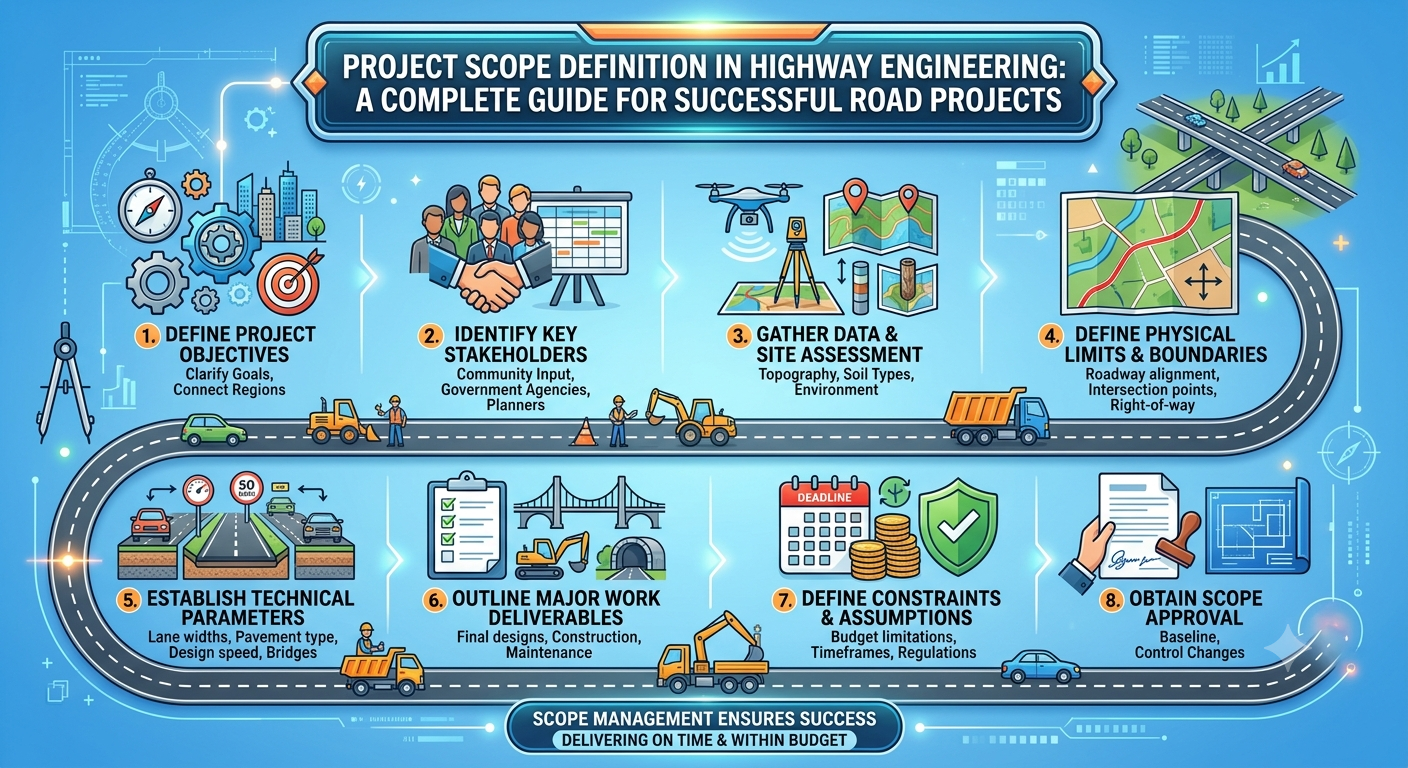
Project Scope Definition in Highway Engineering
Every successful highway or road construction project begins with a well-defined scope. Before engineers prepare drawings, contractors mobilize equipment, or construction activities commence, project stakeholders must have a clear understanding of what the project aims to achieve. This process is known as Project Scope Definition.
In Highway Engineering, project scope definition establishes the project’s boundaries, objectives, technical requirements, deliverables, budget expectations, and schedule. It acts as a roadmap that guides engineers, consultants, contractors, and project owners from planning through completion.
Poorly defined project scopes often result in budget overruns, construction delays, contractual disputes, and quality issues. Conversely, a comprehensive scope definition minimizes uncertainties, improves communication, and increases the likelihood of delivering a safe, durable, and cost-effective transportation facility.
This guide explores the concept of project scope definition, its importance in road engineering, key components, engineering principles, practical applications, and best practices used by transportation professionals worldwide.
What Is Project Scope Definition?
Project Scope Definition is the process of identifying, documenting, and approving all work required to complete a project successfully. It clearly specifies what is included in the project and, equally important, what is excluded.
Within Highway Engineering, scope definition provides a structured framework for designing, constructing, supervising, and maintaining transportation infrastructure. It aligns project expectations among clients, consultants, contractors, regulatory authorities, and the public.
A comprehensive scope document typically includes:
- Project purpose
- Design criteria
- Engineering requirements
- Construction activities
- Deliverables
- Budget limitations
- Project schedule
- Quality expectations
- Environmental considerations
- Risk assumptions
A clearly documented scope minimizes misunderstandings and provides a reliable reference throughout the project lifecycle.
Why Project Scope Definition Matters in Highway Engineering
Road projects involve multiple disciplines, including geotechnical engineering, pavement engineering, traffic engineering, drainage design, structural engineering, environmental assessment, and utility coordination. Without a clearly defined scope, coordinating these activities becomes difficult.
A well-prepared scope definition offers several benefits:
- Establishes realistic project objectives.
- Prevents unnecessary design revisions.
- Reduces the likelihood of scope creep.
- Improves cost estimation accuracy.
- Enhances communication among stakeholders.
- Supports efficient resource allocation.
- Simplifies project monitoring and reporting.
- Minimizes contractual disputes.
- Improves overall project quality.
For example, if the project scope specifies a four-lane divided highway with flexible pavement, stormwater drainage, pedestrian facilities, and intelligent traffic systems, every stakeholder understands the expected deliverables from the outset.
Objectives of Project Scope Definition
The primary objective of scope definition is to create a shared understanding of the project before detailed engineering begins.
Specific objectives include:
- Defining project goals and expected outcomes.
- Establishing technical and functional requirements.
- Identifying project limitations.
- Clarifying stakeholder roles and responsibilities.
- Supporting accurate budgeting and scheduling.
- Reducing uncertainty during construction.
- Providing a baseline for performance measurement.
- Facilitating effective decision-making throughout the project.
These objectives contribute to improved project governance and greater confidence among project participants.
Key Elements of a Project Scope Definition
A strong project scope document contains several essential components that guide planning, design, and execution.
1. Project Objectives
Project objectives describe what the project intends to achieve.
Examples include:
- Improve traffic capacity.
- Reduce travel time.
- Enhance road safety.
- Strengthen regional connectivity.
- Support economic development.
Objectives should follow the SMART principle, meaning they are Specific, Measurable, Achievable, Relevant, and Time-bound.
2. Project Deliverables
Deliverables are the tangible outputs expected upon project completion.
Typical deliverables for a highway project include:
- Alignment plans
- Pavement design
- Bridge structures
- Drainage systems
- Road signage
- Road markings
- Utility relocations
- Quality assurance reports
- Completion documentation
Clearly defined deliverables help prevent disagreements regarding project completion.
3. Project Boundaries
Project boundaries specify the physical and operational limits of the project.
These may define:
- Starting and ending chainages.
- Right-of-way limits.
- Construction zones.
- Environmental protection areas.
- Utility relocation extents.
Clearly established boundaries prevent unauthorized work and maintain focus on approved project activities.
4. Technical Requirements
Technical requirements establish the engineering standards and specifications that govern project execution.
These requirements may address:
- Design speed
- Pavement thickness
- Traffic loading
- Geometric standards
- Drainage capacity
- Material specifications
- Bridge loading criteria
- Road safety features
Compliance with applicable national standards ensures consistency, durability, and public safety.
5. Assumptions and Constraints
Every infrastructure project involves assumptions and limitations that influence planning and execution.
Common Assumptions
- Land acquisition will be completed on schedule.
- Funding will remain available throughout the project.
- Material supplies will be uninterrupted.
- Utility relocations will occur as planned.
Common Constraints
- Budget limitations
- Environmental regulations
- Weather conditions
- Restricted working hours
- Existing utilities
- Right-of-way restrictions
Documenting assumptions and constraints helps project teams identify potential risks early.
6. Stakeholder Responsibilities
Highway projects involve numerous stakeholders, each with defined responsibilities.
Client
- Defines project requirements.
- Provides funding.
- Approves key decisions.
Design Consultant
- Conducts engineering studies.
- Develops design documents.
- Prepares construction drawings.
Contractor
- Executes construction activities.
- Maintains quality standards.
- Ensures worker safety.
Supervision Consultant
- Monitors construction quality.
- Verifies compliance with specifications.
- Reviews contractor performance.
Clearly assigning responsibilities reduces confusion and improves accountability.
Project Scope Development Process
Project scope definition follows a systematic process that transforms project ideas into well-documented engineering plans.
Step 1: Identify Project Needs
Determine the transportation problem or opportunity requiring improvement.
Examples include:
- Increasing traffic demand
- Road deterioration
- Congestion reduction
- Safety improvements
Step 2: Conduct Preliminary Investigations
Engineering investigations may include:
- Topographic surveys
- Traffic studies
- Geotechnical investigations
- Environmental assessments
- Hydrological analyses
Reliable data supports informed decision-making.
Step 3: Define Project Objectives
Establish measurable goals aligned with stakeholder expectations and transportation policies.
Step 4: Identify Deliverables
Prepare a comprehensive list of expected engineering outputs, construction works, and project documentation.
Step 5: Define Scope Boundaries
Specify project limits to avoid ambiguity and prevent unauthorized expansion.
Step 6: Review and Obtain Approval
Present the scope document to stakeholders for review, revisions, and formal approval before proceeding to detailed design.
Approved scope documentation serves as the baseline for project execution.
Practical Example of Project Scope Definition
Consider a project involving the rehabilitation of a 25-kilometer national highway.
A simplified scope definition might include:
Project Objective
Upgrade the existing two-lane highway to improve traffic flow and safety.
Major Deliverables
- Pavement strengthening
- Shoulder widening
- Drainage improvement
- Bridge rehabilitation
- Installation of guardrails
- New traffic signs and road markings
- Street lighting at intersections
Project Exclusions
- Construction of bypasses
- Toll plaza development
- Commercial roadside facilities
This level of clarity ensures that all stakeholders understand the project’s intended outcomes and limitations.
Scope Definition Flow Diagram
The following simplified workflow illustrates the typical sequence of project scope development:
Project Need
      │
      ▼
Preliminary Studies
      │
      ▼
Stakeholder Consultation
      │
      ▼
Project Objectives
      │
      ▼
Scope Definition
      │
      ▼
Deliverables & Boundaries
      │
      ▼
Approval
      │
      ▼
Detailed Design & Execution
Scope Management Best Practices in Highway Engineering
Defining the project scope is only the beginning. Effective scope management ensures that the approved scope is maintained throughout the project lifecycle while allowing controlled changes when necessary. In highway projects, where multiple stakeholders, technical disciplines, and regulatory requirements are involved, proper scope management is essential for delivering projects on time and within budget.
1. Establish a Scope Baseline
Once the project scope is approved, it should become the official baseline against which all future work is measured. This baseline includes:
- Scope statement
- Work Breakdown Structure (WBS)
- Project deliverables
- Design criteria
- Technical specifications
Using a baseline helps project managers compare planned work with actual progress and identify deviations early.
2. Develop a Work Breakdown Structure (WBS)
A Work Breakdown Structure divides the project into manageable work packages, making planning, scheduling, budgeting, and monitoring more efficient.
Example WBS for a Highway Project
- Site Investigation
- Surveying and Mapping
- Earthworks
- Subgrade Preparation
- Pavement Construction
- Drainage Works
- Bridge Construction
- Road Furniture Installation
- Quality Testing
- Final Inspection
Breaking the project into smaller tasks improves accountability and simplifies resource management.
3. Implement a Formal Change Control Process
Even well-planned projects may require changes due to unforeseen site conditions, updated regulations, or client requests. However, every proposed change should undergo a structured review before approval.
A typical change control process includes:
- Submit a change request.
- Assess technical feasibility.
- Evaluate cost and schedule impacts.
- Review potential risks.
- Obtain stakeholder approval.
- Update project documentation.
This process minimizes uncontrolled changes and helps maintain project objectives.
4. Maintain Clear Communication
Regular communication among project stakeholders reduces misunderstandings and supports informed decision-making.
Effective communication methods include:
- Progress meetings
- Weekly status reports
- Site inspections
- Design review sessions
- Digital project management platforms
Transparent communication ensures that everyone remains aligned with the approved scope.
5. Monitor Scope Performance
Project managers should continuously compare completed work against the approved scope using measurable performance indicators.
Common monitoring tools include:
- Progress tracking reports
- Earned Value Management (EVM)
- Quality audits
- Construction inspections
- Risk assessments
Continuous monitoring enables corrective actions before issues escalate.
Common Challenges in Project Scope Definition
Even experienced project teams encounter challenges during scope development. Recognizing these issues early can significantly improve project outcomes.
Incomplete Site Investigations
Insufficient geotechnical, traffic, or environmental data may result in inaccurate designs and unexpected construction challenges.
Recommendation: Conduct comprehensive field investigations before finalizing the scope.
Unclear Project Objectives
Ambiguous objectives often lead to differing stakeholder expectations and frequent design revisions.
Recommendation: Develop measurable objectives that are agreed upon by all stakeholders.
Scope Creep
Scope creep refers to the gradual expansion of project requirements without corresponding adjustments to the budget, schedule, or resources.
Common Causes
- Additional client requests
- Design modifications during construction
- Poor documentation
- Inadequate stakeholder consultation
Prevention Strategies
- Define project boundaries clearly.
- Document all scope changes.
- Follow a formal approval process.
- Review change impacts before implementation.
Budget Constraints
Limited funding may restrict project features or delay construction activities.
Recommendation: Prioritize critical infrastructure elements and prepare realistic cost estimates during the planning phase.
Stakeholder Conflicts
Different stakeholder priorities can complicate project planning and execution.
Recommendation: Encourage collaboration through regular meetings and transparent communication.
Practical Applications of Project Scope Definition
Project scope definition is applied across every stage of a highway project.
Highway Expansion Projects
Engineers define:
- Additional lanes
- Pavement rehabilitation
- Drainage improvements
- Traffic management plans
Rural Road Development
Scope documents may include:
- Earthwork quantities
- Gravel or asphalt pavement
- Culvert construction
- Roadside safety features
Urban Road Improvements
Typical scope items include:
- Footpaths
- Bicycle lanes
- Street lighting
- Traffic signals
- Utility relocation
- Stormwater drainage
Each project requires a customized scope based on technical requirements, environmental conditions, and stakeholder expectations.
Engineering Principles Behind Effective Scope Definition
Successful highway projects rely on established engineering principles throughout the planning process.
Systems Thinking
Road infrastructure functions as an interconnected system. Designers must consider pavement, drainage, traffic operations, bridges, utilities, and environmental impacts together rather than independently.
Risk-Based Planning
Potential risks should be identified during scope development.
Examples include:
- Unstable soil conditions
- Flood-prone areas
- Material shortages
- Utility conflicts
- Traffic disruptions
Planning for these risks reduces uncertainty during construction.
Sustainability
Modern highway projects increasingly emphasize sustainable practices such as:
- Recycling construction materials
- Minimizing environmental impacts
- Improving stormwater management
- Reducing carbon emissions
- Preserving natural habitats
Including sustainability objectives within the project scope supports long-term infrastructure performance.
Practical Recommendations for Engineers, Contractors, and Students
Highway Engineers
- Begin scope development with reliable survey and investigation data.
- Define measurable project objectives.
- Coordinate with all engineering disciplines before finalizing the scope.
- Include realistic contingencies for unforeseen conditions.
- Review the scope periodically throughout the project lifecycle.
Contractors
- Study the approved scope thoroughly before bidding.
- Clarify ambiguities during the tender stage.
- Document all proposed changes.
- Avoid commencing additional work without formal approval.
- Maintain detailed construction records to support project documentation.
Engineering Students
- Learn how project scope integrates with project management principles.
- Study real-world highway project reports and feasibility studies.
- Understand the relationship between scope, cost, schedule, and quality.
- Practice preparing sample scope statements for transportation projects.
These experiences provide valuable insight into professional project planning and delivery.
General IRC and AASHTO Considerations
Project scope definition should align with recognized engineering practices and applicable design standards.
Indian Roads Congress (IRC)
IRC publications provide guidance on:
- Highway planning
- Geometric design
- Pavement design
- Road safety
- Construction specifications
- Maintenance practices
During scope development, engineers should identify the relevant IRC codes applicable to the project and ensure that proposed deliverables comply with those requirements.
American Association of State Highway and Transportation Officials (AASHTO)
AASHTO offers widely accepted recommendations for:
- Highway geometric design
- Pavement structural design
- Traffic loading
- Bridge design
- Materials and testing
- Transportation planning
Although national regulations govern project execution, AASHTO principles are frequently referenced in international highway engineering projects to promote safety, durability, and consistent engineering practices.
Frequently Asked Questions (FAQs)
1. What is project scope definition in highway engineering?
Project scope definition is the process of identifying, documenting, and approving all work, objectives, deliverables, boundaries, and technical requirements needed to complete a highway project successfully.
2. Why is project scope important in road construction?
A clearly defined scope minimizes misunderstandings, controls costs, reduces delays, improves communication, and establishes realistic expectations for all project stakeholders.
3. What is scope creep?
Scope creep is the uncontrolled expansion of project requirements after approval, often resulting in increased costs, schedule delays, and resource challenges.
4. What documents are included in a project scope?
Typical documents include the scope statement, project objectives, deliverables, Work Breakdown Structure (WBS), assumptions, constraints, technical specifications, and stakeholder responsibilities.
5. How does project scope affect project cost?
A well-defined scope enables accurate quantity estimation, budgeting, procurement planning, and resource allocation, reducing the likelihood of unexpected expenses.
6. Who is responsible for defining the project scope?
Project owners, highway engineers, consultants, planners, contractors, and other key stakeholders collaborate to develop and approve the project scope before detailed design begins.
7. How can scope creep be prevented?
Scope creep can be controlled by establishing a clear scope baseline, implementing formal change management procedures, documenting all modifications, and obtaining stakeholder approval before changes are implemented.
Conclusion
A well-developed Project Scope Definition is one of the most important foundations for successful Highway Engineering and road infrastructure projects. It establishes clear objectives, defines project boundaries, identifies deliverables, and aligns stakeholders before construction begins. By reducing uncertainty and providing a structured framework for planning and execution, an effective scope definition helps control costs, minimize delays, and improve overall project quality.
For engineers, contractors, and students, understanding scope definition is more than a project management skill—it is an essential engineering practice that supports efficient decision-making and successful infrastructure delivery. When combined with thorough site investigations, effective communication, sound risk management, and adherence to general IRC and AASHTO guidelines, a clearly defined scope contributes to safer, more durable, and sustainable transportation systems. Mastering Project Scope Definition enables professionals in Highway Engineering to deliver projects that meet technical standards, stakeholder expectations, and long-term performance goals.

Kamran Malik is a passionate civil engineering writer and researcher who specializes in construction, transportation, structural engineering, and infrastructure topics. Through his articles on CivilEngineerings.com, he simplifies complex engineering concepts and shares practical insights, industry trends, and educational resources for students, professionals, and engineering enthusiasts.