
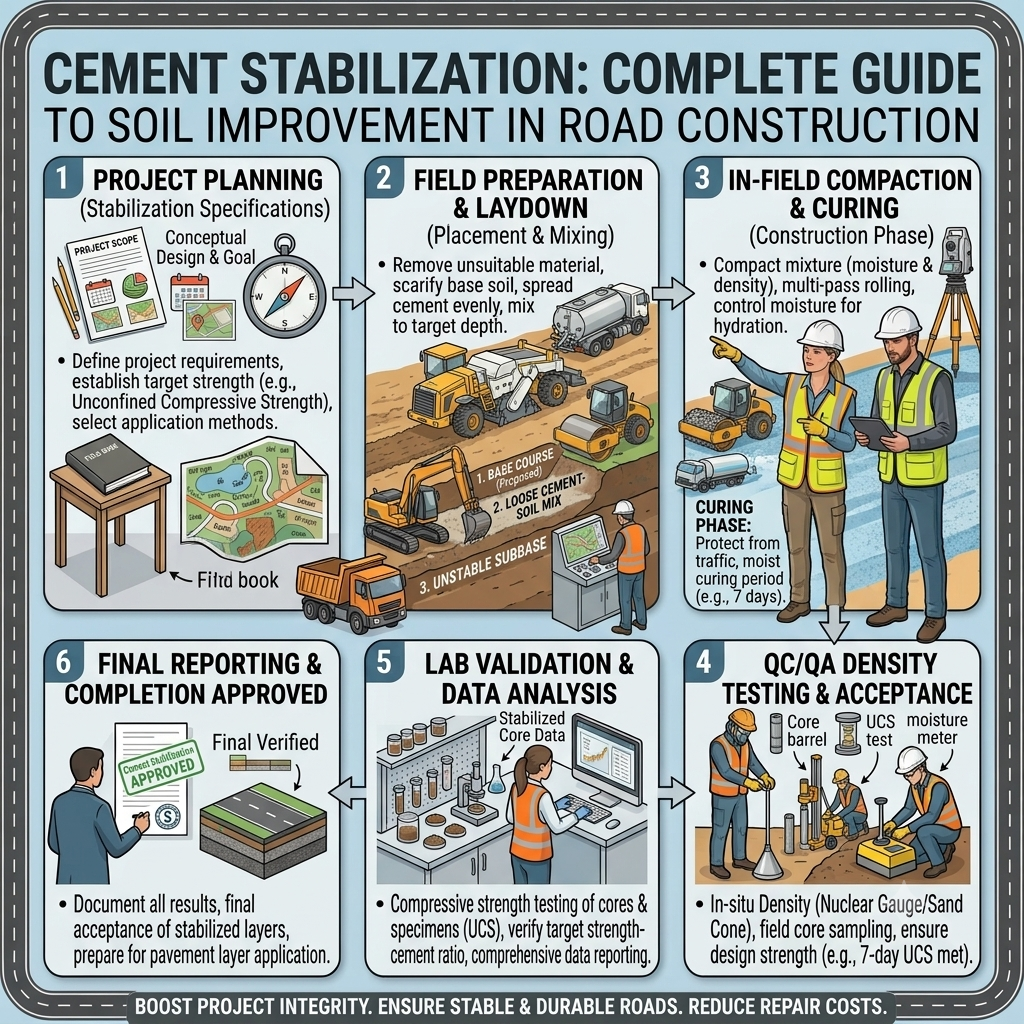
Introduction
Modern road construction demands a strong and durable foundation to withstand increasing traffic loads and changing environmental conditions. Many construction sites contain weak or moisture-sensitive soils that cannot support pavement structures without improvement. Engineers solve this challenge by using Cement Stabilization, one of the most reliable and cost-effective ground improvement techniques in highway engineering.
Cement Stabilization improves the engineering properties of natural soil by mixing it with Portland cement and water. The chemical reaction between cement and soil particles creates a stronger, denser, and more durable foundation. This process increases bearing capacity, reduces plasticity, limits shrinkage and swelling, and enhances resistance to moisture damage. As a result, stabilized soil provides an excellent base for highways, airport pavements, industrial roads, parking areas, and rural access roads.
Civil engineers, contractors, and transportation agencies widely adopt this technique because it reduces construction costs, minimizes the need for imported materials, and extends pavement service life. This guide explains the engineering principles, materials, methods, applications, and construction process of Cement Stabilization while following modern highway engineering practices.
What is Cement Stabilization?
Cement Stabilization is a soil improvement technique that enhances the strength and durability of weak soils by blending measured quantities of cement with in-place or borrowed soil and water. The hydration process forms cementitious compounds that bind soil particles into a stable mass.
Unlike simple mechanical compaction, cement stabilization changes the soil’s physical and chemical characteristics. The treated layer gains higher compressive strength, lower permeability, and improved resistance to repeated traffic loading.
Highway engineers commonly apply cement stabilization in:
- Highway subgrades
- Sub-base layers
- Base courses
- Rural roads
- Airport pavements
- Industrial yards
- Container terminals
- Parking facilities
Proper design and construction allow stabilized layers to perform effectively for many years with minimal maintenance.
Why Cement Stabilization is Important
Weak soils often lead to pavement failures such as rutting, cracking, settlement, and potholes. Cement stabilization addresses these problems by strengthening the soil before pavement construction begins.
Major Benefits
- Increases soil bearing capacity.
- Reduces pavement thickness requirements.
- Improves resistance to moisture damage.
- Controls shrinkage and swelling.
- Minimizes differential settlement.
- Extends pavement service life.
- Reduces maintenance costs.
- Uses locally available materials.
- Improves construction efficiency.
Practical Importance
Imagine a highway project crossing an area with clayey soil. During the rainy season, the soil absorbs water and loses strength, causing pavement deformation. By stabilizing the subgrade with cement, engineers create a stronger and more moisture-resistant foundation that supports heavy traffic throughout the pavement’s design life.
Engineering Principles of Cement Stabilization
The effectiveness of Cement Stabilization depends on the interaction between cement, water, and soil particles.
Hydration Reaction
When water mixes with cement, hydration begins immediately. This reaction produces compounds that harden over time and bind soil particles together.
Cementitious Bonding
Hydrated cement forms strong bonds between individual soil grains. These bonds increase soil strength and stiffness while reducing deformation under traffic loads.
Reduced Plasticity
Plastic soils often expand when wet and shrink when dry. Cement lowers the plasticity index, resulting in a more stable and predictable soil behavior.
Improved Load Distribution
A stabilized layer distributes wheel loads over a larger area, reducing stress on the underlying subgrade and improving pavement performance.
Enhanced Durability
The treated soil resists erosion, moisture infiltration, and repeated loading, making it suitable for long-term infrastructure projects.
Materials Used in Cement Stabilization
Successful stabilization depends on selecting suitable materials and maintaining proper proportions.
1. Soil
The existing soil serves as the primary construction material. Engineers evaluate its properties before deciding on the stabilization method.
Suitable soils include:
- Sandy soils
- Silty soils
- Clayey soils
- Gravelly soils
- Mixed soils
Very high organic soils generally require alternative treatment methods because organic matter interferes with cement hydration.
2. Cement
Ordinary Portland Cement (OPC) is the most commonly used stabilizing agent. Depending on project specifications and local availability, other cement types may also be suitable.
Typical cement content ranges from 3% to 10% by dry weight of soil, depending on soil characteristics and required strength.
3. Water
Water activates the hydration process and enables proper compaction.
Engineers carefully control moisture content because:
- Excess water reduces strength.
- Insufficient water limits hydration.
- Optimum moisture improves density and durability.
4. Optional Additives
Some projects use additional materials to improve performance.
Examples include:
- Lime
- Fly ash
- Slag
- Chemical stabilizers
- Fibers
The choice depends on soil type, project requirements, and environmental conditions.
Types of Cement Stabilization
Different highway projects require different stabilization methods.
Soil-Cement
Soil-cement combines pulverized soil, cement, and water to create a durable construction layer.
Common Applications
- Rural roads
- Highway subgrades
- Parking areas
- Industrial pavements
Advantages
- High strength
- Good durability
- Cost-effective construction
- Reduced maintenance
Cement Modified Soil
This method uses relatively small amounts of cement to improve workability and reduce soil plasticity rather than achieve high structural strength.
Typical applications include:
- Embankments
- Fill materials
- Temporary construction roads
Cement-Treated Base (CTB)
CTB forms a high-strength base layer beneath asphalt or concrete pavements.
It provides:
- Excellent load distribution
- High stiffness
- Reduced pavement deflection
- Long service life
Engineers frequently specify CTB for highways carrying heavy commercial traffic.
Step-by-Step Cement Stabilization Process
Step 1: Site Investigation
The process begins with a detailed field investigation.
Engineers examine:
- Soil classification
- Existing moisture content
- Groundwater conditions
- Traffic loading
- Drainage
- Construction constraints
Accurate site information leads to better design decisions.
Step 2: Laboratory Testing
Laboratory testing determines whether cement stabilization is suitable.
Common tests include:
- Grain Size Analysis
- Atterberg Limits
- Standard Proctor Test
- Modified Proctor Test
- California Bearing Ratio (CBR)
- Unconfined Compressive Strength (UCS)
The test results help engineers determine the optimum cement content and moisture level.
Step 3: Material Selection
After laboratory analysis, engineers select:
- Appropriate cement type
- Required cement percentage
- Water content
- Construction equipment
- Mixing method
Material selection influences both performance and project cost.
Step 4: Mixing Process
Workers spread the specified quantity of cement uniformly over the prepared soil.
Mixing may occur using:
- Rotary mixers
- Reclaimers
- Pulverizers
- Motor graders (for small projects)
Water is then added while mixing continues until the blend becomes uniform.
Step 5: Compaction
Compaction begins immediately after mixing to achieve maximum density before the cement starts to set.
Equipment commonly used includes:
- Vibratory rollers
- Padfoot rollers
- Pneumatic tire rollers
- Smooth drum rollers
Proper compaction increases strength, reduces air voids, and improves durability.
Step 6: Curing
Curing allows the hydration process to continue and develop the required strength.
Typical curing methods include:
- Water spraying
- Moist curing with wet burlap
- Plastic sheeting
- Bituminous curing membrane (where specified)
Curing periods commonly range from 7 to 28 days, depending on project requirements and environmental conditions.
Cement Stabilization Process Flow Diagram
                 SITE INVESTIGATION
                         │
                         ▼
                SOIL SAMPLING & TESTING
                         │
                         ▼
              DETERMINE CEMENT CONTENT
                         │
                         ▼
          SPREAD CEMENT ON PREPARED SOIL
                         │
                         ▼
          MIX SOIL + CEMENT + WATER
                         │
                         ▼
                  LEVEL THE SURFACE
                         │
                         ▼
                     COMPACTION
                         │
                         ▼
                       CURING
                         │
                         ▼
              STABILIZED SOIL LAYER
Practical Engineering Example
A contractor plans to construct a two-lane highway across a region dominated by medium-plastic clay. Laboratory testing indicates a low California Bearing Ratio (CBR), making the untreated soil unsuitable for supporting the proposed pavement.
Engineers recommend stabilizing the in-place soil with 5% Ordinary Portland Cement. After laboratory mix design confirms the optimum cement and moisture contents, the construction team spreads cement uniformly across the prepared surface, mixes it thoroughly with the soil and water using a reclaimer, and compacts the mixture with vibratory rollers. Following a controlled curing period, strength tests show a significant increase in compressive strength and bearing capacity, allowing the pavement structure to meet design requirements without importing large quantities of aggregate. This approach reduces project costs, shortens construction time, and improves long-term pavement performance.
Key Takeaways
Cement Stabilization transforms weak soils into strong and durable pavement foundations through controlled mixing, compaction, and curing. Success depends on careful site investigation, accurate laboratory testing, appropriate material selection, and proper construction practices. Understanding the engineering principles behind hydration, bonding, and load distribution enables engineers to design stabilized layers that resist moisture damage and heavy traffic. These early stages establish the foundation for long-lasting road infrastructure and prepare the project for quality control, field testing, and performance evaluation, which will be covered in Part 2.
Equipment Used in Cement Stabilization
The quality of a cement stabilization project depends not only on proper material selection but also on the use of suitable construction equipment. Modern highway projects rely on specialized machines to achieve uniform mixing, accurate grading, and optimum compaction.
Common Equipment
Soil Reclaimer or Recycler
A soil reclaimer pulverizes the existing soil and mixes cement and water uniformly throughout the treatment depth. Large highway projects commonly use reclaimers because they produce consistent results and improve construction speed.
Cement Spreader
A cement spreader distributes cement evenly over the prepared soil surface. Uniform spreading ensures that every section of the stabilized layer receives the designed cement content.
Water Tanker
A water tanker applies the required amount of water during mixing. Operators carefully control moisture content because excess or insufficient water affects the hydration process and final strength.
Motor Grader
A motor grader shapes the stabilized layer and establishes the required cross slope and elevation before compaction.
Rollers
Different rollers perform specific compaction tasks.
- Vibratory Roller – Compacts granular and mixed soils.
- Padfoot Roller – Works effectively on cohesive soils.
- Pneumatic Tyre Roller – Seals the surface and removes minor voids.
- Smooth Drum Roller – Produces the final finished surface.
Factors Affecting Cement Stabilization
Several engineering factors influence the strength and long-term performance of stabilized soil.
1. Soil Type
Different soils respond differently to cement treatment.
- Sandy soils generally achieve high strength.
- Silty soils stabilize effectively with proper moisture control.
- Clay soils require careful mix design.
- Organic soils usually perform poorly because organic matter interferes with cement hydration.
2. Cement Content
The cement percentage directly affects strength and durability.
- Too little cement produces inadequate strength.
- Excessive cement increases project cost and may cause shrinkage cracking.
Engineers determine the optimum cement content through laboratory testing rather than estimation.
3. Moisture Content
Moisture plays a critical role during mixing and compaction.
Maintaining the Optimum Moisture Content (OMC) allows the soil to achieve maximum dry density and promotes complete cement hydration.
4. Mixing Uniformity
Every portion of the soil should receive the same amount of cement and water.
Poor mixing creates weak zones that reduce the overall performance of the stabilized layer.
5. Compaction Quality
Compaction increases density and minimizes air voids.
Insufficient compaction lowers strength, increases permeability, and shortens pavement life.
6. Curing Conditions
Proper curing allows cement hydration to continue and develop the required strength.
High temperatures, wind, or inadequate moisture during curing may reduce the final performance of the stabilized layer.
Advantages of Cement Stabilization
Cement stabilization provides numerous engineering and economic benefits.
Engineering Advantages
- Increases bearing capacity.
- Improves compressive strength.
- Reduces plasticity.
- Minimizes swelling and shrinkage.
- Enhances resistance to moisture damage.
- Improves durability under repeated traffic loading.
- Reduces pavement deformation.
- Provides a stable construction platform.
Economic Advantages
- Reduces the need for imported aggregates.
- Lowers transportation costs.
- Shortens construction time.
- Extends pavement service life.
- Decreases maintenance requirements.
- Optimizes the use of locally available materials.
Limitations of Cement Stabilization
Although cement stabilization offers many benefits, engineers should recognize its limitations.
Common Limitations
- High organic soils respond poorly.
- Improper curing reduces strength.
- Excess cement may increase cracking.
- Poor mixing creates weak zones.
- Cold weather slows hydration.
- Strict quality control is essential throughout construction.
A detailed laboratory mix design helps minimize these limitations.
Quality Control and Field Testing
Quality control ensures that the stabilized layer meets the required engineering specifications.
Testing begins before construction and continues until project completion.
Laboratory Tests
Engineers commonly perform:
- Soil Classification Test
- Grain Size Analysis
- Atterberg Limits
- Standard Proctor Test
- Modified Proctor Test
- California Bearing Ratio (CBR)
- Unconfined Compressive Strength (UCS)
Field Tests
Typical field quality control includes:
- Field Density Test
- Moisture Content Test
- Thickness Measurement
- Surface Level Check
- Cement Content Verification
- Visual Uniformity Inspection
Acceptance Criteria
The stabilized layer should satisfy project requirements for:
- Strength
- Density
- Thickness
- Surface smoothness
- Moisture content
- Alignment
- Compaction
Continuous inspection prevents defects from progressing into later construction stages.
Best Practices for Cement Stabilization
Experienced highway engineers consistently follow proven construction practices.
Recommended Best Practices
- Conduct detailed geotechnical investigations before design.
- Perform laboratory mix design for every soil type.
- Spread cement uniformly across the treatment area.
- Maintain optimum moisture throughout mixing and compaction.
- Complete compaction before the initial cement setting begins.
- Protect the stabilized layer during curing.
- Carry out routine field quality tests.
- Follow approved construction specifications.
- Maintain accurate project documentation.
- Schedule construction during favorable weather whenever possible.
Practical Recommendations
Civil Engineers
- Base cement content on laboratory test results rather than assumptions.
- Verify field density regularly.
- Monitor curing conditions daily.
- Coordinate closely with laboratory personnel and contractors.
Contractors
- Calibrate spreading and mixing equipment before use.
- Train equipment operators thoroughly.
- Complete mixing and compaction within the specified time.
- Prevent construction traffic from damaging newly stabilized layers.
Engineering Students
- Understand soil classification systems.
- Learn the purpose of each laboratory test.
- Visit stabilization projects to observe field procedures.
- Compare laboratory results with actual construction performance.
General Discussion of IRC, AASHTO, and ICE Practices
Leading highway organizations such as the Indian Roads Congress (IRC), the American Association of State Highway and Transportation Officials (AASHTO), and the Institution of Civil Engineers (ICE) emphasize the importance of proper investigation, material selection, and quality assurance when using stabilized soils.
Their general guidance supports:
- Comprehensive geotechnical investigations before construction.
- Laboratory mix design to determine optimum cement content.
- Strict control of moisture and compaction during construction.
- Continuous field quality testing to verify compliance.
- Proper curing to achieve design strength.
- Drainage systems that protect stabilized layers from prolonged water exposure.
- Sustainable construction practices that maximize the use of local materials while maintaining long-term pavement performance.
These engineering principles contribute to durable, safe, and cost-effective highway infrastructure.
Cement Stabilization Construction Sequence
      SOIL INVESTIGATION
              │
              ▼
      LABORATORY TESTING
              │
              ▼
      MIX DESIGN APPROVAL
              │
              ▼
       SITE PREPARATION
              │
              ▼
      CEMENT SPREADING
              │
              ▼
    SOIL + CEMENT MIXING
              │
              ▼
      MOISTURE CONTROL
              │
              ▼
         COMPACTION
              │
              ▼
           CURING
              │
              ▼
   QUALITY CONTROL TESTING
              │
              ▼
   STABILIZED PAVEMENT LAYER
Frequently Asked Questions (FAQs)
1. What is Cement Stabilization?
Cement Stabilization is a soil improvement technique that mixes soil, cement, and water to increase strength, reduce plasticity, and improve durability for pavement construction.
2. Which soils are suitable for Cement Stabilization?
Sandy, silty, gravelly, and many clayey soils respond well to cement stabilization. Highly organic soils generally require alternative treatment methods.
3. How much cement is normally used?
Most highway projects use approximately 3% to 10% cement by the dry weight of soil, depending on laboratory test results and project requirements.
4. Why is moisture control important?
Correct moisture content ensures proper hydration, improves compaction, and allows the stabilized layer to achieve the required engineering strength.
5. What is the purpose of curing?
Curing allows cement hydration to continue, enabling the stabilized layer to gain strength and durability over time.
6. What tests verify the quality of Cement Stabilization?
Common tests include the California Bearing Ratio (CBR), Unconfined Compressive Strength (UCS), Proctor Compaction Test, Field Density Test, and Moisture Content Test.
7. Where is Cement Stabilization commonly used?
Engineers use it for highway subgrades, sub-base layers, airport pavements, industrial roads, parking areas, rural roads, and container terminals.
8. What are the main advantages of Cement Stabilization?
The technique improves bearing capacity, increases durability, reduces maintenance costs, minimizes moisture damage, and extends pavement service life.
9. Can Cement Stabilization reduce construction costs?
Yes. By improving existing soils, it often reduces the need to excavate and replace unsuitable materials, lowering transportation, material, and construction costs.
10. How does Cement Stabilization support sustainable construction?
It encourages the use of in-place soils, reduces demand for imported aggregates, lowers fuel consumption associated with hauling materials, and extends pavement life, reducing long-term resource use.
Conclusion
Cement Stabilization remains one of the most effective soil improvement methods used in modern road and highway engineering. By combining suitable soils with carefully controlled amounts of cement and water, engineers create a strong, durable, and moisture-resistant foundation capable of supporting heavy traffic for many years. Successful projects depend on detailed site investigations, laboratory mix design, proper moisture control, uniform mixing, timely compaction, and adequate curing.
Continuous quality control ensures that every stabilized layer meets design requirements and delivers reliable long-term performance. In addition to improving structural capacity, Cement Stabilization reduces maintenance needs, optimizes the use of local materials, and supports sustainable construction practices. Whether applied to highways, airport pavements, industrial facilities, or rural roads, this technique provides engineers and contractors with a practical and economical solution for enhancing weak soils and extending pavement service life. A solid understanding of Cement Stabilization enables students and professionals to design and construct safer, stronger, and more resilient transportation infrastructure.
