
Introduction
Every horizontal curve on a highway introduces centrifugal force that pushes vehicles toward the outside of the curve. If engineers ignore this force, drivers lose stability, tires experience higher friction demands, and accident risks increase. Highway engineers solve this challenge by providing Super Elevation, one of the most important geometric design elements in road engineering.
S.E improves vehicle stability by raising the outer edge of the pavement above the inner edge. This cross slope helps balance centrifugal force, reduces dependence on tire friction, and allows vehicles to negotiate curves safely at the design speed. Whether the project involves a rural highway, an urban arterial, or a mountain road, proper S.E design enhances safety, ride comfort, and pavement performance.
Civil engineers, transportation planners, and contractors must understand the principles, calculations, construction methods, and design considerations of S.E. This guide explains the topic in a practical and engineering-focused manner while following accepted highway design practices.
What is Super Elevation?
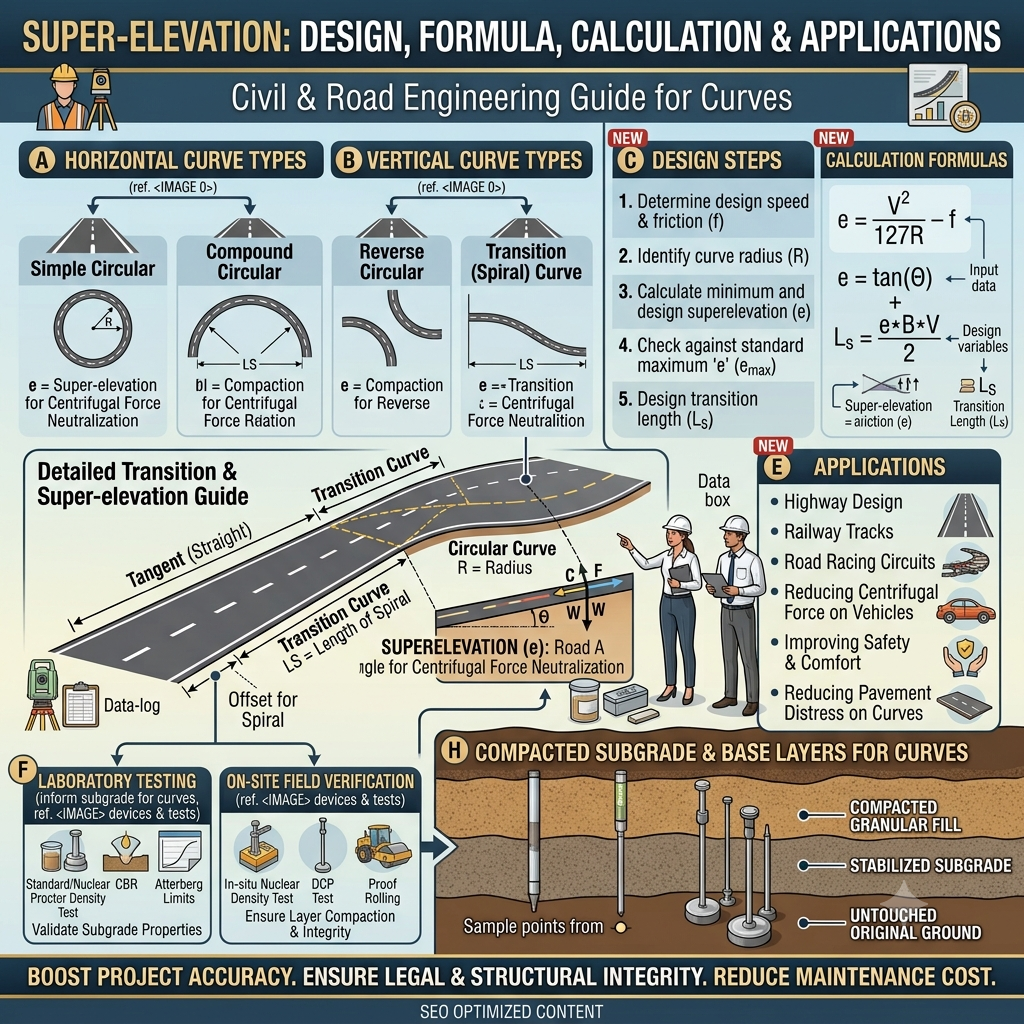
Super Elevation is the transverse slope provided on a horizontal curve by raising the outer edge of the pavement above the inner edge. Engineers introduce this slope to counteract the centrifugal force generated when vehicles travel around a curve.
On a straight road, both pavement edges usually remain at nearly the same elevation except for the normal camber used for drainage. A curved section requires a different arrangement because moving vehicles experience an outward force. The inclined pavement surface redirects part of that force toward the center of the curve, improving vehicle stability and reducing the possibility of skidding or overturning.
S.E is generally expressed as a ratio, percentage, or decimal value. For example:
- 1 in 20
- 5%
- 0.05
Higher-speed highways normally require greater S.E than low-speed urban roads, although designers always limit the maximum value according to the governing highway standards.
Why Super Elevation is Important
S.E plays a vital role in highway geometric design because it improves both safety and driving comfort.
1. Improves Vehicle Stability
The inclined pavement surface helps vehicles maintain balance while negotiating curves. Drivers experience better control, especially at higher operating speeds.
2. Reduces Skidding
A properly designed superelevation decreases the reliance on tire friction. Vehicles remain more stable during wet weather and emergency maneuvers.
3. Minimizes Overturning Risk
Heavy trucks, buses, and high-center-of-gravity vehicles benefit significantly from correctly designed super-elevation because it lowers the overturning tendency.
4. Enhances Passenger Comfort
Passengers experience smoother movement through curves because the roadway geometry aligns more effectively with vehicle dynamics.
5. Reduces Pavement Wear
Balanced wheel loads distribute stresses more uniformly across the pavement surface, helping reduce localized distress and extending pavement service life.
Engineering Principle Behind Super-Elevation
When a vehicle enters a horizontal curve, it experiences centrifugal force directed outward from the center of the curve.
The roadway must generate an opposing force to maintain equilibrium. Superelevation provides part of this resistance through the inclined pavement surface, while tire friction supplies the remaining resistance.
The relationship between these forces forms the basis of superelevation design.
Forces Acting on a Vehicle
- Vehicle weight (W)
- Centrifugal force (Fc)
- Normal reaction (N)
- Frictional force (F)
- Component of gravity due to pavement slope
Proper design balances these forces so that vehicles can safely negotiate curves at the selected design speed.
Components of Super-Elevation
Several geometric parameters influence superelevation design.
Design Speed
Higher design speeds generate greater centrifugal force. Engineers increase superelevation within permissible limits to maintain safe operation.
Radius of Curve
A smaller curve radius creates sharper turns and higher lateral forces. Such curves generally require greater superelevation than larger-radius curves.
Pavement Width
Road width influences pavement rotation during construction and affects the transition between normal camber and full superelevation.
Side Friction Factor
The side friction factor represents the friction available between vehicle tires and the pavement. Designers use this value together with superelevation to satisfy equilibrium requirements.
Climate
Regions receiving frequent rainfall or snowfall require careful design because reduced pavement friction affects vehicle stability.
Traffic Composition
Roads carrying a high percentage of heavy commercial vehicles demand careful geometric design because trucks respond differently to lateral forces than passenger cars.
Super-Elevation Formula
Highway engineers commonly use the following relationship during preliminary design:
[
e + f = \frac{V^2}{127R}
]
Where:
- e = Rate of superelevation
- f = Side friction factor
- V = Design speed (km/h)
- R = Radius of horizontal curve (m)
Explanation
The equation shows that increasing vehicle speed increases the required combination of superelevation and side friction.
Likewise, increasing the curve radius decreases the required superelevation.
Designers always ensure that both values remain within the limits recommended by applicable highway standards.
Practical Design Example
Suppose a highway curve has:
- Design speed = 80 km/h
- Radius = 400 m
Using the design relationship:
[
e + f = \frac{80^2}{127 \times 400}
]
[
e + f = 0.126
]
If the allowable side friction factor equals 0.08,
[
e = 0.126 – 0.08 = 0.046
]
Therefore,
Required Super Elevation = 4.6%
Engineers compare this value with the maximum allowable limit specified by the relevant highway design standards before finalizing the design.
Factors Affecting Super Elevation
Several engineering considerations influence the final value of super elevation.
Design Speed
Higher speeds require greater compensation for centrifugal force.
Curve Radius
Sharper curves demand larger super elevation values.
Terrain
Mountain roads often require careful balancing between safety, construction feasibility, and drainage.
Pavement Surface
Concrete and asphalt pavements provide different friction characteristics under varying weather conditions.
Rainfall
Heavy rainfall reduces tire-pavement friction, making proper super elevation even more important.
Vehicle Types
Routes serving freight corridors require special attention because heavy vehicles exhibit different stability characteristics.
Construction Constraints
Limited right-of-way, bridges, intersections, and urban development may restrict the maximum achievable pavement rotation.
Highway Cross-Section Diagrams
Normal Road Section
          Crown
            ▲
        ____/\____
       /          \
 Left Edge      Right Edge

Normal camber directs rainwater toward both sides.
Road with Super Elevation on a Curve
          Outer Edge
              ▲
             /
            /
___________/
          /
         /
 Inner Edge

Outer edge remains higher than the inner edge.
The pavement slope helps resist centrifugal force.
Forces Acting on a Vehicle
             Centrifugal Force →
                     ● Vehicle
                    /|
                   / |
                  /  |
                 ↓   |
             Vehicle Weight

Road slope provides inward support,
while tire friction assists in maintaining stability.
Practical Applications of Super Elevation
Super elevation plays an essential role in many transportation projects, including:
- National highways
- Expressways
- Mountain roads
- Urban arterial roads
- Interchanges
- Flyover ramps
- Cloverleaf loops
- Airport taxiways
- High-speed transportation corridors
Engineers adapt the super elevation rate according to traffic volume, design speed, climate, pavement type, and applicable design standards.
Key Takeaways
Super Elevation is a fundamental element of highway geometric design that enables vehicles to negotiate horizontal curves safely and comfortably. By raising the outer edge of the pavement, engineers reduce the effects of centrifugal force, improve vehicle stability, minimize skidding risks, and enhance ride quality. Accurate calculations, appropriate curve geometry, and consideration of factors such as design speed, curve radius, climate, and traffic composition are essential for successful super elevation design.
Methods of Providing Super Elevation
Highway engineers introduce Super Elevation gradually instead of changing the pavement slope abruptly. A gradual transition allows drivers to adapt naturally while maintaining vehicle stability and passenger comfort.
Several methods exist for developing super elevation, and the selected method depends on roadway width, terrain, traffic conditions, and applicable highway standards.
1. Rotation About the Center Line
In this method, engineers rotate both pavement edges around the road centerline.
Advantages
- Maintains a balanced pavement profile.
- Works well on two-lane highways.
- Produces a symmetrical appearance.
Applications
- Rural highways
- National highways
- Moderate traffic corridors
2. Rotation About the Inner Edge
Engineers keep the inner pavement edge fixed while raising the outer edge until the required super elevation is achieved.
Advantages
- Minimizes changes to roadside drainage.
- Simplifies construction in hilly terrain.
- Reduces excavation near embankments.
Applications
- Mountain roads
- Roads with retaining walls
- Narrow corridors
3. Rotation About the Outer Edge
This method keeps the outer pavement edge at the same elevation while lowering the inner edge.
Advantages
- Suitable where the outer edge connects to existing structures.
- Maintains fixed elevations near bridges.
Applications
- Bridge approaches
- Urban roads with utility constraints
Super Elevation Transition
The transition section connects the normal road camber with the fully developed super elevation.
A properly designed transition provides:
- Smooth vehicle movement
- Gradual load transfer
- Improved driver comfort
- Reduced steering corrections
Typical Transition Sequence
Normal Camber
      │
      ▼
Transition Begins
      │
      ▼
Gradual Pavement Rotation
      │
      ▼
Full Super Elevation
A sudden change in cross slope may cause discomfort, increase steering effort, and reduce vehicle stability. Engineers therefore calculate the transition length carefully based on design speed and roadway geometry.
Step-by-Step Design Procedure for Super Elevation
Highway designers follow a systematic procedure to determine the required super elevation.
Step 1: Select the Design Speed
The design speed depends on the road classification, terrain, expected traffic, and operating conditions.
Step 2: Determine the Curve Radius
The horizontal alignment establishes the radius of the curve. Smaller radii generally require higher super elevation values.
Step 3: Calculate the Required Super Elevation
Engineers apply the design equation:
e + f = V² / 127R
where e represents the super elevation rate and f represents the side friction factor.
Step 4: Check Maximum Permissible Limits
The calculated value should remain within the limits recommended by the applicable highway design standards.
Step 5: Design the Transition Length
A suitable transition allows the roadway to rotate gradually from the normal camber to the required super elevation.
Step 6: Prepare Construction Drawings
The final drawings specify:
- Cross sections
- Transition details
- Elevation levels
- Drainage provisions
- Construction tolerances
Advantages of Super Elevation
Properly designed Super Elevation offers numerous engineering and operational benefits.
Improves Road Safety
The inclined pavement helps vehicles negotiate curves with greater stability and lowers the likelihood of skidding.
Reduces Tire Wear
Balanced wheel loading decreases uneven tire wear and improves vehicle performance.
Enhances Driving Comfort
Drivers require fewer steering corrections, creating a smoother driving experience.
Increases Curve Capacity
Roads with proper super elevation can safely accommodate higher operating speeds within the design limits.
Extends Pavement Life
More uniform load distribution reduces localized pavement distress, helping extend the service life of the roadway.
Supports Heavy Vehicles
Trucks and buses remain more stable while traveling through horizontal curves, reducing rollover risk.
Limitations of Super Elevation
Although super elevation provides significant benefits, designers must also consider its limitations.
- Excessive values may affect slow-moving vehicles.
- Urban intersections often limit the available transition length.
- Snow and ice can reduce the effectiveness of the pavement slope.
- Poor drainage design may allow water to collect if construction quality is inadequate.
- Restricted right-of-way may limit pavement rotation.
Proper engineering judgment helps balance these challenges while maintaining safety and performance.
Common Design Mistakes
Several errors can reduce the effectiveness of super elevation.
Incorrect Design Speed
Using unrealistic design speeds may produce unsafe cross slopes.
Insufficient Transition Length
Abrupt pavement rotation creates discomfort and increases steering effort.
Ignoring Drainage
Poor drainage allows water to accumulate on curved sections, increasing hydroplaning risk.
Inadequate Survey Data
Inaccurate field measurements often lead to construction errors and costly revisions.
Poor Construction Quality
Improper grading or compaction can prevent the pavement from achieving the intended cross slope.
Lack of Quality Control
Failure to verify finished elevations may result in unsafe roadway geometry.
Best Practices
Experienced highway engineers follow several best practices when designing and constructing super elevation.
- Conduct detailed topographic and alignment surveys before design.
- Use accurate traffic forecasts to establish realistic design speeds.
- Verify curve geometry before calculating super elevation.
- Maintain smooth transitions between normal camber and full super elevation.
- Provide effective surface drainage throughout the curved section.
- Inspect pavement elevations during construction.
- Confirm cross slopes through field measurements before opening the roadway.
- Perform routine maintenance to preserve pavement shape and drainage.
Practical Recommendations
Civil Engineers
- Coordinate geometric design with drainage design from the beginning of the project.
- Verify survey data before preparing final construction drawings.
- Review vehicle operating speeds rather than relying solely on posted speed limits.
- Consider future traffic growth when selecting design parameters.
Contractors
- Follow approved cross-section drawings carefully.
- Use calibrated surveying equipment during construction.
- Check finished elevations at regular intervals.
- Maintain proper compaction throughout the pavement layers.
Engineering Students
- Understand the relationship between centrifugal force, side friction, and super elevation.
- Practice solving design problems using different curve radii and design speeds.
- Study field applications during site visits.
- Compare geometric design recommendations from recognized highway engineering manuals.
General Discussion of IRC, AASHTO, and ICE Practices
Recognized highway engineering organizations provide guidance on the design and application of Super Elevation.
In general:
- IRC recommends selecting super elevation based on design speed, curve radius, terrain, and traffic conditions while maintaining prescribed maximum limits.
- AASHTO emphasizes balancing super elevation with side friction to provide safe and comfortable vehicle operation across a wide range of speeds.
- ICE promotes sound engineering judgment, proper drainage design, accurate construction practices, and lifecycle performance when developing highway geometric designs.
Although regional standards differ, these organizations share common objectives: improving road safety, enhancing driving comfort, reducing pavement distress, and supporting long-term infrastructure performance.
Frequently Asked Questions (FAQs)
1. What is Super Elevation in highway engineering?
Super Elevation is the transverse slope provided on horizontal curves by raising the outer pavement edge above the inner edge to counteract centrifugal force and improve vehicle stability.
2. Why is Super Elevation necessary?
It helps vehicles negotiate curves safely, reduces skidding, improves riding comfort, and minimizes rollover risks, particularly for heavy vehicles.
3. What factors affect the design of Super Elevation?
Important factors include design speed, curve radius, side friction, terrain, climate, pavement type, traffic composition, and construction constraints.
4. How is Super Elevation calculated?
Engineers commonly use the relationship:
e + f = V² / 127R
where e is the super elevation rate, f is the side friction factor, V is the design speed, and R is the curve radius.
5. What is the difference between camber and Super Elevation?
Camber provides drainage on straight roads, whereas Super Elevation improves vehicle stability on horizontal curves by creating a transverse slope.
6. Can every road have Super Elevation?
No. Designers apply Super Elevation primarily on horizontal curves. Straight road sections usually retain a normal camber for drainage.
7. What happens if Super Elevation is inadequate?
Insufficient Super Elevation increases reliance on tire friction, raises skidding risks, reduces driving comfort, and may accelerate pavement deterioration.
8. Does Super Elevation improve pavement life?
Yes. Proper load distribution reduces localized stresses and helps extend pavement service life when combined with good drainage and quality construction.
9. Which standards guide Super Elevation design?
Highway agencies generally follow national geometric design standards. IRC, AASHTO, and ICE provide widely recognized guidance for safe and effective design practices.
Conclusion
Super Elevation remains one of the most important elements of highway geometric design because it directly influences road safety, vehicle stability, and driving comfort. By carefully balancing centrifugal force with pavement slope and side friction, engineers create curves that allow vehicles to travel safely under a wide range of operating conditions. Successful design requires accurate traffic data, proper curve geometry, reliable survey information, and well-planned construction practices. Engineers must also consider drainage, climate, heavy vehicle movement, and long-term maintenance to achieve durable results. Following the general guidance provided by organizations such as IRC, AASHTO, and ICE helps ensure that roadway designs meet accepted engineering principles and deliver consistent performance. Whether designing a new expressway, upgrading a mountain road, or studying transportation engineering, mastering Super Elevation strengthens your understanding of highway design and contributes to the development of safer, more efficient, and longer-lasting road infrastructure.
