
Introduction
Road Gradient Design plays a vital role in highway engineering because it directly influences vehicle safety, driving comfort, fuel efficiency, construction cost, and drainage performance. Every highway, expressway, mountain road, and urban street requires carefully designed gradients to allow vehicles to travel safely under different traffic and environmental conditions.
A road with an excessively steep slope increases fuel consumption, reduces vehicle speed, and creates safety hazards for heavy trucks. On the other hand, a road with an extremely flat gradient often causes water to accumulate on the pavement, leading to premature pavement deterioration and increased maintenance costs. Highway engineers must therefore achieve the right balance between safety, economy, constructability, and long-term performance.
Understanding Road Gradient Design is essential for civil engineers, transportation planners, contractors, surveyors, and engineering students. This guide explains the fundamental concepts, engineering principles, practical applications, and design considerations used in modern highway projects while following internationally accepted highway engineering practices.
What is Road Gradient Design?
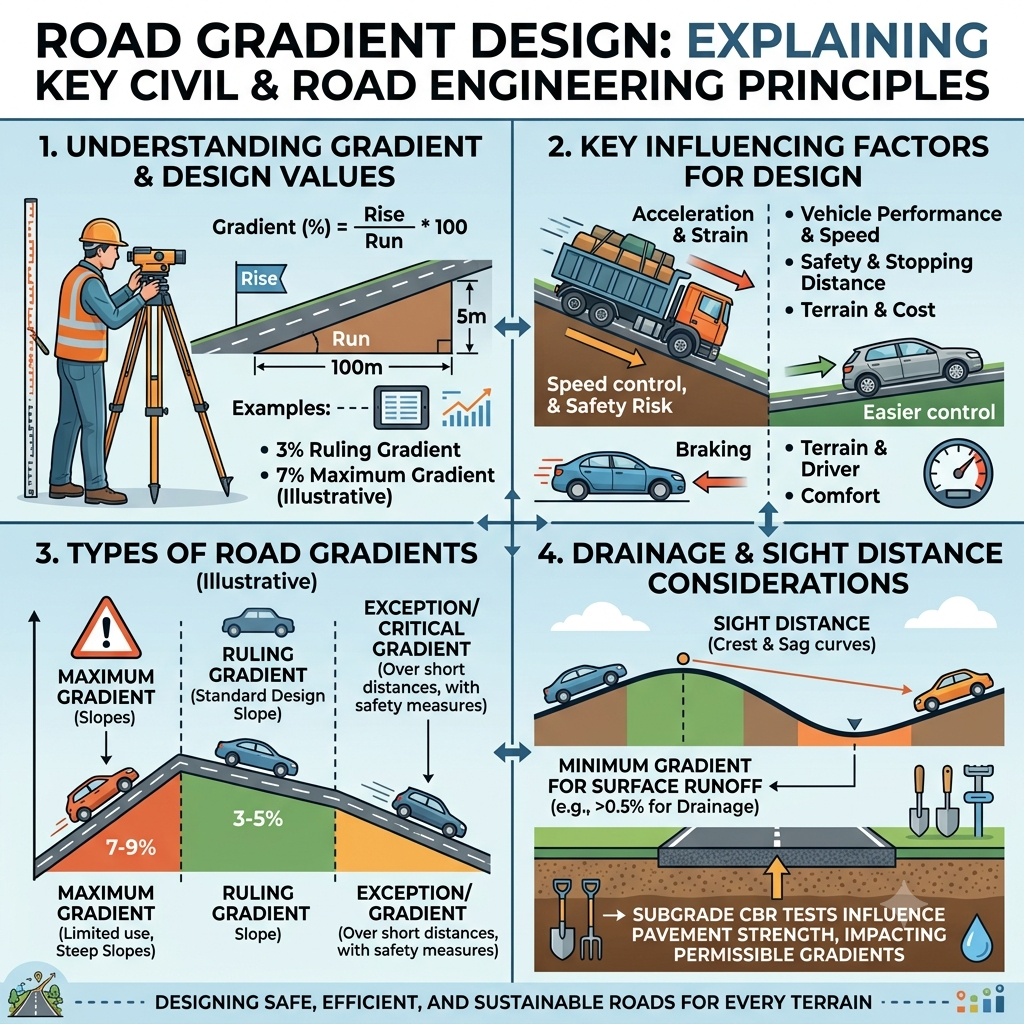
Road Gradient Design refers to the process of determining the longitudinal slope of a road along its centerline. Engineers express this slope as a percentage or ratio representing the change in elevation over a horizontal distance.
For example:
- A 5% gradient means the road rises or falls 5 meters over a horizontal distance of 100 meters.
- A gradient of 1 in 20 represents the same slope because one unit of vertical rise occurs for every twenty units of horizontal distance.
Designing an appropriate gradient ensures that vehicles can climb and descend safely without excessive engine strain, braking demand, or loss of control.
Formula
Gradient (%) = (Vertical Rise or Fall ÷ Horizontal Distance) × 100
Example
Vertical rise = 6 m
Horizontal distance = 120 m
Gradient = (6 ÷ 120) × 100 = 5%
Importance of Road Gradient Design
Road gradients affect almost every aspect of highway performance. Engineers evaluate gradients carefully because even a small change in slope influences construction costs, operating efficiency, and road safety.
1. Vehicle Safety
Steep slopes increase braking distances for descending vehicles and reduce climbing speeds for heavy trucks. Proper gradient selection minimizes accident risks and improves driver confidence.
2. Traffic Efficiency
Balanced gradients maintain uniform traffic flow by preventing heavy vehicles from slowing down significantly on uphill sections.
3. Fuel Economy
Vehicles consume more fuel while climbing steep slopes. Optimized gradients reduce fuel consumption and lower transportation costs over the highway’s service life.
4. Construction Cost
Flattening a steep terrain often requires extensive excavation, embankments, retaining walls, or bridges. Engineers balance earthwork costs with acceptable operating conditions.
5. Pavement Durability
Appropriate gradients promote effective drainage, preventing water accumulation that weakens pavement layers and shortens pavement life.
6. Driver Comfort
Gradual slopes provide smoother driving conditions and reduce driver fatigue, especially on long-distance highways.
Types of Road Gradients
Highway engineers classify gradients according to terrain, traffic conditions, and design standards. Each type serves a specific purpose during highway planning.
1. Ruling Gradient
The ruling gradient represents the desirable maximum gradient used under normal conditions. Engineers adopt this gradient whenever terrain and project constraints permit.
Characteristics
- Provides comfortable vehicle operation.
- Reduces fuel consumption.
- Supports higher traffic speeds.
- Minimizes vehicle wear.
- Improves road safety.
Practical Application
Engineers typically use ruling gradients on highways crossing plains and gently rolling terrain where land availability allows gradual elevation changes.
2. Limiting Gradient
The limiting gradient becomes necessary when terrain restrictions prevent the use of the ruling gradient. Engineers use it only for relatively short sections because prolonged steep slopes reduce vehicle performance.
Situations Where Limiting Gradients Are Used
- Hilly terrain
- Mountain roads
- Urban constraints
- Deep valleys
- Bridge approaches
Engineering Consideration
Engineers carefully evaluate traffic composition before adopting a limiting gradient. High percentages of heavy vehicles may require additional climbing lanes or revised alignment.
3. Exceptional Gradient
The exceptional gradient applies only under unavoidable circumstances and for very short distances. Engineers avoid this gradient whenever possible because it increases operational and safety risks.
Typical Situations
- Crossing rocky outcrops
- Passing through congested urban areas
- Approaching tunnels
- Restricted bridge connections
- Difficult mountainous locations
Best Practice
Exceptional gradients should remain as short as practical and include appropriate warning signs, speed control measures, and adequate sight distance.
4. Minimum Gradient
The minimum gradient ensures proper surface water drainage, especially in flat terrain where natural slopes are insufficient.
Without a minimum longitudinal gradient, rainwater may remain on the pavement, increasing the likelihood of hydroplaning, pavement deterioration, and maintenance issues.
Benefits
- Improves stormwater runoff.
- Prevents water ponding.
- Protects pavement layers.
- Enhances skid resistance.
- Extends pavement service life.
Factors Affecting Road Gradient Design
Several engineering, environmental, and operational factors influence gradient selection. Highway designers evaluate these variables collectively to achieve a safe and economical alignment.
Terrain
Terrain has the greatest influence on gradient design.
Plain Terrain
Engineers generally adopt gentle gradients because earthwork requirements remain relatively low.
Rolling Terrain
Moderate gradients often provide an economical balance between earthwork and vehicle performance.
Mountainous Terrain
Steeper gradients may become unavoidable due to natural topography, requiring additional safety measures.
Traffic Composition
Roads carrying a high percentage of trucks require gentler gradients because heavy vehicles lose speed rapidly while climbing.
Traffic studies commonly evaluate:
- Passenger cars
- Buses
- Heavy trucks
- Multi-axle trailers
- Agricultural vehicles
Design Speed
Higher design speeds require smoother vertical alignment and more gradual gradients to maintain safety and driver comfort.
Climate
Regions experiencing heavy rainfall require adequate longitudinal gradients to improve drainage and reduce water accumulation.
Cold regions also consider snow, ice, and frost conditions during gradient selection.
Soil Conditions
Weak soils increase embankment construction costs and settlement risks. Engineers may adjust highway alignment or gradient to improve stability and reduce maintenance.
Construction Cost
Earthwork represents a major portion of highway construction expenses.
Designers optimize gradients to balance:
- Excavation
- Embankments
- Retaining structures
- Bridge construction
- Drainage works
Environmental Considerations
Modern highway projects seek to minimize environmental impacts by reducing unnecessary excavation, preserving natural drainage patterns, and limiting disturbance to sensitive ecosystems.
Engineering Principles for Selecting Road Gradients
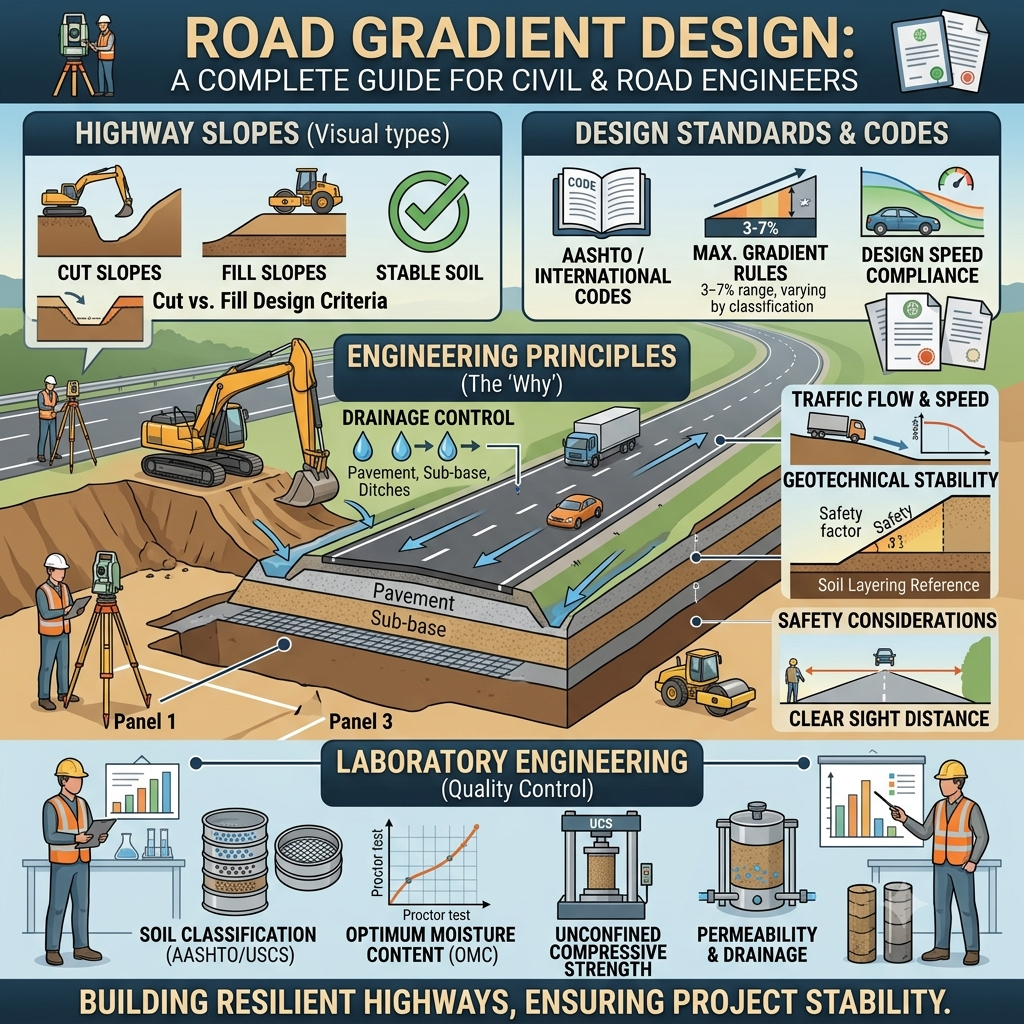
Professional highway engineers follow several key principles when designing longitudinal gradients.
Maintain Safe Vehicle Operation
Gradients should allow vehicles to climb and descend safely under expected traffic conditions.
Balance Earthwork
Engineers aim to minimize excessive cutting and filling while maintaining acceptable operating conditions.
Ensure Proper Drainage
Adequate longitudinal slopes prevent water accumulation and protect pavement structures.
Improve Driving Comfort
Smooth transitions between different gradients reduce discomfort and improve vehicle stability.
Consider Future Traffic Growth
Designs should accommodate projected increases in traffic volume and heavy vehicle percentages throughout the highway’s design life.
Practical Applications of Road Gradient Design
Road Gradient Design influences a wide range of transportation projects, including:
- National highways
- Expressways
- Rural roads
- Urban arterial roads
- Industrial access roads
- Airport service roads
- Mountain highways
- Bridge approaches
- Tunnel connections
- Residential streets
Each project requires gradient selection based on traffic demand, terrain, environmental conditions, and long-term maintenance objectives.
Highway Gradient Diagram
Longitudinal Road Gradient
               Uphill Gradient
                    ▲
                    │
                    │
                   /|
                  / |
                 /  |
________________/   |________________
                Road Centre Line

Gradient (%) = Rise ÷ Horizontal Distance × 100
Types of Road Gradients
Ruling Gradient
───────────────╱──────────────

Limiting Gradient
────────────╱────────────

Exceptional Gradient
──────────╱──────────

Minimum Gradient
──────────────────────────────
(Slight Slope for Drainage)
Key Takeaways
Road Gradient Design forms the backbone of safe and efficient highway vertical alignment. By selecting appropriate ruling, limiting, exceptional, and minimum gradients, engineers create roadways that improve safety, support efficient traffic movement, control construction costs, and provide effective drainage. Successful gradient design requires careful evaluation of terrain, traffic composition, design speed, climate, soil conditions, and environmental constraints. These early design decisions significantly influence pavement performance, vehicle operating costs, and the long-term sustainability of transportation infrastructure.
Road Gradient Design Process
Designing a safe and efficient road gradient requires a systematic engineering approach. Highway engineers evaluate terrain, traffic demand, drainage requirements, and construction costs before finalizing the vertical alignment.
Step 1: Conduct a Topographic Survey
The process begins with a detailed topographic survey of the proposed route. Surveyors collect elevation data, identify natural features, and prepare contour maps.
The survey records:
- Ground elevations
- Existing roads
- Rivers and streams
- Valleys
- Hills
- Buildings
- Utility corridors
Accurate survey data forms the foundation of successful gradient design.
Step 2: Analyze Traffic Characteristics
Engineers evaluate current and future traffic conditions before selecting appropriate gradients.
Important traffic data includes:
- Average Daily Traffic (ADT)
- Design traffic volume
- Percentage of heavy vehicles
- Vehicle operating speeds
- Future traffic growth
Roads carrying a large number of trucks usually require flatter gradients to maintain traffic flow and improve safety.
Step 3: Study Terrain Conditions
Terrain greatly influences the vertical alignment.
Plain Terrain
- Gentle gradients
- Lower earthwork costs
- Higher design speeds
Rolling Terrain
- Moderate gradients
- Balanced earthwork
- Good driving comfort
Mountainous Terrain
- Steeper gradients
- Retaining structures
- Additional safety measures
The design should follow natural landforms whenever practical to reduce excavation and embankment costs.
Step 4: Select Suitable Gradient
Engineers compare several alignment options before selecting the most economical and safest gradient.
The selected gradient should:
- Ensure safe vehicle operation.
- Minimize construction costs.
- Reduce fuel consumption.
- Support effective drainage.
- Improve long-term pavement performance.
Step 5: Design Vertical Curves
Roads should never change from one gradient to another abruptly.
Engineers introduce vertical curves to create smooth transitions.
Vertical curves improve:
- Driver comfort
- Vehicle stability
- Sight distance
- Drainage
- Road appearance
Step 6: Verify Design Standards
Before approving the design, engineers verify compliance with project specifications and recognized highway engineering practices.
The review includes:
- Gradient limits
- Vertical curve lengths
- Sight distance
- Drainage
- Earthwork balance
- Safety requirements
Road Gradient Calculation
Gradient calculations help engineers determine whether the proposed slope meets design requirements.
Formula
Gradient (%) = (Vertical Rise or Fall ÷ Horizontal Distance) × 100
Example 1
Vertical rise = 8 m
Horizontal distance = 200 m
Gradient = (8 ÷ 200) × 100
Gradient = 4%
This means the road rises 4 meters for every 100 meters of horizontal distance.
Example 2
A road climbs 15 meters over a horizontal distance of 300 meters.
G = (15 ÷ 300) × 100
Gradient = 5%
Gradient Ratio Conversion
| Gradient Ratio | Percentage |
|---|---|
| 1 in 10 | 10% |
| 1 in 20 | 5% |
| 1 in 25 | 4% |
| 1 in 30 | 3.33% |
| 1 in 40 | 2.5% |
| 1 in 50 | 2% |
Vertical Curves in Road Gradient Design
Vertical curves connect two different gradients smoothly.
Without these curves, vehicles experience sudden changes in slope, reducing comfort and safety.
Crest Curves
A crest curve forms where an ascending gradient meets a descending gradient.
Advantages
- Improves sight distance.
- Enhances driving comfort.
- Reduces accident risk.
- Improves highway appearance.
Practical Examples
- Hilltops
- Bridge approaches
- Elevated highways
Sag Curves
A sag curve forms where a descending gradient changes into an ascending gradient.
Benefits
- Smooth vehicle movement.
- Better night visibility.
- Improved drainage.
- Reduced vehicle impact.
Common Locations
- Valleys
- Underpasses
- Low embankments
Practical Engineering Example
Suppose engineers design a four-lane highway across rolling terrain.
The topographic survey identifies several hills and valleys.
Instead of following steep natural slopes, the design team:
- Reduces steep climbs through controlled excavation.
- Uses embankments to fill low areas.
- Introduces crest curves over hilltops.
- Installs sag curves in valleys.
- Provides roadside drainage along low sections.
This approach creates a safer, smoother highway while reducing long-term maintenance costs.
Common Mistakes in Road Gradient Design
Even well-planned projects can encounter problems if engineers overlook key design considerations.
Common mistakes include:
- Selecting excessively steep gradients.
- Ignoring drainage requirements.
- Using abrupt grade changes.
- Inadequate topographic surveys.
- Underestimating heavy vehicle traffic.
- Poor coordination between horizontal and vertical alignment.
- Neglecting future traffic growth.
- Failing to evaluate soil conditions.
Avoiding these mistakes improves safety, reduces maintenance, and increases pavement life.
Best Practices for Road Gradient Design
Professional highway engineers follow several best practices to deliver reliable and economical road projects.
- Conduct accurate topographic surveys.
- Analyze long-term traffic forecasts.
- Select gradients that balance safety and construction cost.
- Design smooth crest and sag curves.
- Provide adequate longitudinal drainage.
- Coordinate horizontal and vertical alignment.
- Minimize unnecessary earthwork.
- Perform regular design reviews.
- Use modern surveying and design software.
- Consider future road widening during planning.
Field Recommendations
Civil Engineers
- Verify survey data before starting detailed design.
- Review geotechnical reports carefully.
- Check drainage performance during design reviews.
- Coordinate closely with pavement and structural engineers.
- Inspect gradient transitions during construction.
Contractors
- Follow approved profile levels accurately.
- Use calibrated surveying equipment.
- Maintain proper compaction on embankments.
- Protect finished slopes from erosion.
- Monitor construction tolerances regularly.
Engineering Students
- Learn gradient calculations thoroughly.
- Practice preparing longitudinal profiles.
- Understand the relationship between gradients and vertical curves.
- Visit highway construction projects to observe field applications.
- Study pavement drainage and earthwork operations.
General Discussion of IRC, AASHTO, and ICE Practices
Leading highway engineering organizations such as IRC (Indian Roads Congress), AASHTO (American Association of State Highway and Transportation Officials), and ICE (Institution of Civil Engineers) promote similar principles for vertical alignment design.
These organizations generally recommend:
- Selecting gradients appropriate for terrain and traffic conditions.
- Providing smooth transitions with adequately designed vertical curves.
- Ensuring sufficient stopping and overtaking sight distances.
- Integrating drainage into the vertical alignment.
- Designing for future traffic demand and heavy vehicle movement.
- Maintaining strict quality control throughout construction.
- Prioritizing safety, durability, and lifecycle performance.
Although design values vary according to national standards and project requirements, these principles remain widely accepted across modern highway engineering practice.
Frequently Asked Questions (FAQs)
1. What is Road Gradient Design?
Road Gradient Design is the process of determining the longitudinal slope of a road to ensure safe, economical, and efficient vehicle movement while providing proper drainage.
2. Why is road gradient important?
A suitable gradient improves safety, fuel efficiency, driving comfort, drainage, and pavement durability while reducing construction and maintenance costs.
3. How is road gradient calculated?
The gradient is calculated using the formula:
Gradient (%) = (Vertical Rise or Fall ÷ Horizontal Distance) × 100
4. What is the difference between ruling and limiting gradients?
A ruling gradient is the preferred maximum slope used under normal conditions, whereas a limiting gradient is a steeper slope adopted only where terrain or site constraints make the ruling gradient impractical.
5. What is the purpose of a minimum gradient?
A minimum gradient ensures effective surface drainage by allowing rainwater to flow away from the pavement.
6. Why are vertical curves necessary?
Vertical curves provide smooth transitions between different gradients, improving safety, comfort, sight distance, and drainage.
7. Which factors influence road gradient selection?
Terrain, traffic volume, heavy vehicle percentage, design speed, soil conditions, climate, drainage requirements, construction costs, and environmental considerations all influence gradient selection.
8. What happens if a road gradient is too steep?
Steep gradients reduce vehicle speed, increase fuel consumption, place greater demands on braking systems, and elevate accident risks, particularly for heavy vehicles.
9. Which professionals use Road Gradient Design?
Civil engineers, highway engineers, transportation planners, surveyors, contractors, and infrastructure consultants rely on road gradient design throughout the planning and construction process.
10. How does proper gradient design improve pavement life?
Appropriate gradients enhance drainage, reduce water infiltration, minimize erosion, and decrease structural stress on pavement layers, resulting in longer service life and lower maintenance costs.
Conclusion
Road Gradient Design serves as one of the most important elements of highway engineering because it directly affects safety, traffic efficiency, construction economy, drainage, and pavement durability. A well-designed gradient allows vehicles to travel comfortably, reduces fuel consumption, improves storm water runoff, and supports long-term infrastructure performance. Engineers achieve the best results by combining accurate surveys, thorough traffic analysis, sound geotechnical evaluation, and carefully designed vertical curves. Following recognized engineering practices and maintaining strict quality control throughout planning and construction helps create reliable highways that meet present and future transportation needs. Whether you are a civil engineer, contractor, or engineering student, mastering Road Gradient Design will strengthen your understanding of modern highway design and contribute to safer, more sustainable road infrastructure.
