
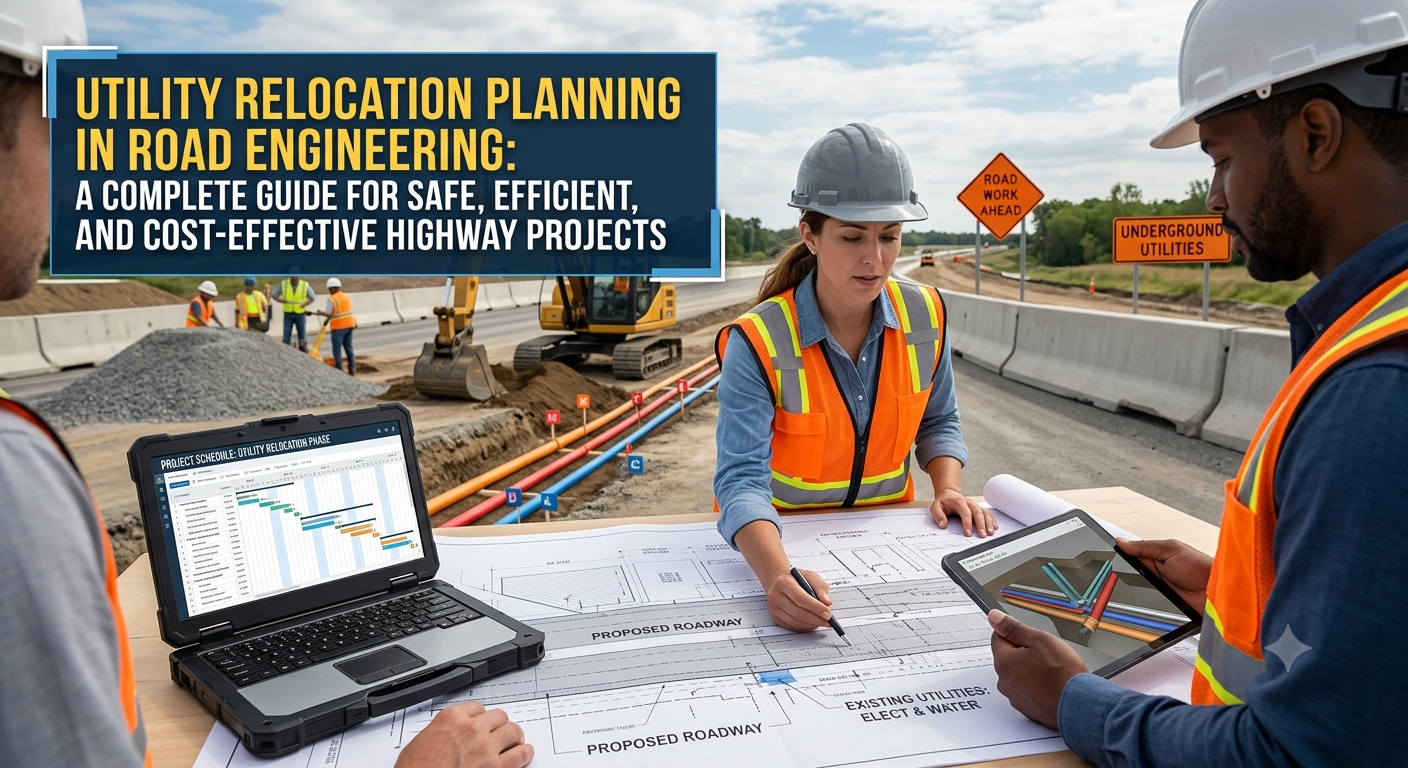
Utility Relocation Planning in Road Engineering
Modern road construction projects extend far beyond pavement design and earthwork. Beneath and above every roadway lies a complex network of utilities that support daily life, including water supply, sewer systems, electricity, telecommunications, natural gas, and stormwater infrastructure. Before any excavation begins, these utilities must be accurately identified, protected, relocated, or adjusted to avoid costly delays and safety hazards.
Utility Relocation Planning in Road Engineering is a systematic process that identifies existing utility assets, evaluates conflicts with proposed road improvements, and develops coordinated relocation strategies. Effective planning minimizes construction risks, reduces project delays, prevents service interruptions, and improves public safety.
Whether constructing a new highway, widening an urban road, or rehabilitating an existing pavement, utility relocation is often one of the most challenging phases of a transportation project. Successful relocation requires close collaboration among highway authorities, utility owners, consultants, contractors, and local agencies.
This guide explains the principles, planning process, engineering considerations, and practical applications of utility relocation planning, helping engineers, students, and contractors understand its importance in modern road infrastructure projects.
What Is Utility Relocation Planning in Road Engineering?
Utility Relocation Planning in Road Engineering is the process of identifying existing utility infrastructure that conflicts with a proposed roadway project and developing a coordinated plan to relocate, protect, modify, or adjust those facilities before construction begins.
Utilities may be located underground, above ground, or attached to existing structures such as bridges. If they interfere with the proposed road alignment, excavation, drainage system, or bridge construction, appropriate engineering solutions must be implemented.
The primary objective is to ensure that transportation improvements can proceed without damaging essential public services or creating safety risks.
Utility relocation planning is an essential component of:
- Highway construction
- Road widening projects
- Bridge construction
- Urban street improvements
- Intersection upgrades
- Railway overpasses
- Expressway development
Why Utility Relocation Planning Matters
Relocating utilities is far more than a construction task. It is a critical risk management activity that directly influences project cost, duration, safety, and public convenience.
Proper planning provides several important benefits:
- Prevents accidental damage to underground services.
- Minimizes interruptions to electricity, water, gas, and communication networks.
- Reduces unexpected construction delays.
- Improves worker safety during excavation.
- Supports efficient sequencing of construction activities.
- Lowers claims and dispute risks.
- Enhances coordination among stakeholders.
- Helps control project budgets.
Without proper utility planning, even a well-designed road project can experience significant delays caused by unforeseen underground conflicts.
Types of Utilities Encountered in Road Projects
Road engineers commonly deal with a wide variety of utility systems. Understanding their characteristics helps determine appropriate relocation methods.
Underground Utilities
Underground infrastructure often presents the greatest challenge because many assets are not visible on the surface.
Typical underground utilities include:
Water Supply Pipelines
Water mains distribute potable water to residential, commercial, and industrial areas. These pipelines often require temporary bypass arrangements before relocation.
Sewer Networks
Sanitary sewer lines transport wastewater to treatment facilities. Maintaining proper gravity flow during relocation requires careful elevation control.
Stormwater Drainage
Storm drains, culverts, and underground drainage pipes manage surface runoff. Road widening frequently requires these systems to be extended or redesigned.
Natural Gas Pipelines
Gas pipelines demand strict safety procedures due to the potential for leaks, fire, and explosions. Relocation work typically requires close supervision by the utility owner.
Telecommunications
Communication infrastructure includes fiber-optic cables, telephone lines, and internet networks. Damage to these systems can disrupt services for thousands of users.
Electrical Conduits
Underground power cables serve residential neighborhoods, commercial districts, and industrial facilities. Relocation requires careful coordination to prevent outages.
Overhead Utilities
Many road corridors also contain overhead infrastructure that may interfere with construction equipment or revised roadway geometry.
Examples include:
- Electrical transmission lines
- Distribution poles
- Street lighting systems
- Traffic signal cables
- Communication poles
- Fiber-optic aerial cables
These utilities may require pole relocation, cable adjustments, or increased vertical clearances.
Utility Relocation Planning Process
Successful utility relocation follows a structured engineering process that begins during project planning and continues through construction.
Step 1: Preliminary Investigation
The first stage involves collecting available information about existing utilities.
Typical activities include:
- Reviewing utility records
- Studying previous construction drawings
- Consulting utility agencies
- Conducting site inspections
- Reviewing GIS databases
- Evaluating proposed road alignment
Early identification of potential conflicts significantly reduces project uncertainty.
Step 2: Utility Survey and Mapping
Accurate utility mapping forms the foundation of successful relocation planning.
Modern survey methods include:
- Total station surveys
- GPS surveys
- Ground Penetrating Radar (GPR)
- Electromagnetic utility locators
- CCTV inspection of pipelines
- Geographic Information Systems (GIS)
The collected information is incorporated into utility maps showing:
- Horizontal location
- Vertical depth
- Utility type
- Material
- Diameter
- Ownership
Accurate mapping reduces the risk of damaging buried infrastructure during excavation.
Step 3: Conflict Identification
Once existing utilities are mapped, engineers compare their locations with the proposed road design.
Common conflicts include:
- Utilities crossing proposed pavement
- Pipelines beneath retaining walls
- Power poles within carriageway limits
- Water mains conflicting with drainage structures
- Communication ducts intersecting bridge foundations
Each conflict is assessed to determine whether the utility should remain in place, be protected, or be relocated.
Step 4: Coordination with Utility Owners
Utility relocation cannot be completed by highway engineers alone.
Coordination meetings typically involve:
- Water authorities
- Electric utilities
- Gas companies
- Telecommunications providers
- Municipal agencies
- Transportation departments
- Contractors
- Design consultants
These stakeholders work together to define responsibilities, relocation schedules, technical requirements, and approval procedures.
Regular communication minimizes misunderstandings and construction delays.
Step 5: Relocation Design
After conflicts are identified, engineers prepare detailed relocation designs.
The design considers:
- New utility alignment
- Structural protection
- Easement requirements
- Access for maintenance
- Utility clearances
- Road geometry
- Future expansion opportunities
Where possible, utilities are relocated outside future widening zones to reduce future disruptions.
Step 6: Construction Scheduling
Proper scheduling ensures utility relocation is completed before major roadway construction begins.
Typical sequence:
- Site investigation
- Utility survey
- Conflict analysis
- Design approval
- Utility relocation
- Testing and commissioning
- Road construction
Integrating utility work into the overall construction schedule reduces downtime and improves project efficiency.
Engineering Principles for Utility Relocation
Utility relocation planning relies on several fundamental engineering principles.
Safety First
Protecting workers, nearby communities, and existing infrastructure is the highest priority throughout planning and construction.
Maintain Service Continuity
Essential public services should remain operational whenever possible. Temporary bypass systems or phased relocation techniques are often used to avoid prolonged interruptions.
Minimize Future Conflicts
Relocated utilities should be positioned to accommodate planned road expansions and future infrastructure projects.
Provide Adequate Clearance
Engineers maintain appropriate horizontal and vertical separation between utilities and other structures to facilitate maintenance and reduce operational risks.
Optimize Lifecycle Costs
Although relocation may increase initial project costs, proper planning reduces long-term maintenance expenses, emergency repairs, and future reconstruction.
Utility Relocation Workflow Diagram
The following simplified workflow illustrates the typical planning process:
Road Project Planning
          │
          ▼
Collect Existing Utility Records
          │
          ▼
Utility Survey & Mapping
          │
          ▼
Identify Utility Conflicts
          │
          ▼
Coordinate with Utility Owners
          │
          ▼
Prepare Relocation Design
          │
          ▼
Obtain Approvals
          │
          ▼
Relocate Utilities
          │
          ▼
Testing & Commissioning
          │
          ▼
Begin Road Construction
This structured approach helps reduce risks, improve coordination, and keep road projects on schedule.
Challenges in Utility Relocation Planning
Despite careful preparation, utility relocation remains one of the most demanding aspects of road construction. Many challenges arise because utility networks have been developed over decades, often by different organizations using varying documentation standards.
1. Inaccurate or Outdated Utility Records
Older utility drawings may not accurately represent the current location, depth, or condition of underground infrastructure. In some cases, utilities installed years ago were never documented properly, increasing the risk of unexpected discoveries during excavation.
Recommended Solution
- Verify records through field investigations.
- Conduct trial pits where necessary.
- Use Ground Penetrating Radar (GPR) and electromagnetic locating equipment.
- Update utility databases after verification.
2. Congested Utility Corridors
Urban roads often contain numerous underground services occupying limited space. Water mains, gas pipelines, electrical ducts, telecommunications cables, and drainage systems frequently intersect within the same corridor.
Engineering Approach
- Prepare three-dimensional utility layouts.
- Prioritize essential services.
- Optimize vertical and horizontal clearances.
- Coordinate relocation schedules among utility owners.
3. Maintaining Public Services
Interrupting electricity, water supply, internet connectivity, or gas distribution can significantly affect residential areas, businesses, hospitals, and emergency services.
Best Practice
Whenever feasible, install temporary bypass systems or relocate utilities in phases to maintain uninterrupted service.
4. Limited Construction Space
Dense urban environments often provide little room for relocating utilities due to nearby buildings, retaining walls, sidewalks, or existing transportation infrastructure.
Engineers may need to redesign utility alignments while ensuring compliance with safety and maintenance requirements.
5. Project Schedule Delays
Utility relocation frequently becomes a critical path activity. Delays in obtaining approvals, procuring materials, or coordinating with utility agencies can postpone the entire road project.
Effective planning should include realistic timelines, contingency allowances, and regular progress reviews.
Practical Applications of Utility Relocation Planning
Utility relocation is required in a wide range of transportation projects.
Highway Widening Projects
When additional lanes are added to an existing highway, utilities located within the proposed roadway footprint must often be relocated before earthworks begin.
Example
A four-lane highway is expanded to six lanes. Existing water pipelines and communication ducts located beneath the proposed pavement edge are shifted outside the new right-of-way to accommodate the widened carriageway.
Bridge Construction
Bridge foundations, abutments, and approach embankments may conflict with underground pipelines or overhead transmission lines.
Relocation planning ensures that foundation construction proceeds safely without disrupting essential utility services.
Urban Road Improvements
City streets commonly contain closely spaced underground utilities. During road reconstruction, engineers often redesign drainage systems while simultaneously relocating communication cables and electrical conduits.
Proper sequencing minimizes traffic disruption and public inconvenience.
Intersection Upgrades
New roundabouts, flyovers, signalized intersections, and grade-separated interchanges frequently require adjustments to lighting systems, traffic signal cables, utility poles, and underground services.
Early coordination reduces construction delays and simplifies traffic management.
Engineering Best Practices
Successful Utility Relocation Planning in Road Engineering depends on technical expertise, proactive communication, and disciplined project management.
The following practices consistently improve project outcomes:
Conduct Utility Investigations Early
Utility identification should begin during the preliminary design stage rather than after construction contracts are awarded.
Early investigations reduce redesign costs and improve schedule reliability.
Use Modern Detection Technologies
Advanced technologies improve the accuracy of utility mapping.
Common tools include:
- Ground Penetrating Radar (GPR)
- Electromagnetic cable locators
- GPS surveying
- GIS-based asset management systems
- Drone surveys for overhead utilities
- 3D utility modeling
These technologies reduce uncertainty and enhance construction safety.
Promote Stakeholder Collaboration
Successful projects rely on continuous communication among:
- Highway authorities
- Utility owners
- Design consultants
- Contractors
- Municipal agencies
- Environmental specialists
Regular coordination meetings help resolve conflicts before construction begins.
Protect Existing Utilities
Not every utility requires relocation. In many situations, protective measures provide a more economical solution.
Examples include:
- Reinforced concrete encasement
- Steel casing pipes
- Protective slabs
- Temporary shoring systems
- Utility support frames
Selecting the appropriate protection method depends on utility type, traffic loading, and construction activities.
Maintain Accurate Documentation
After relocation is complete, updated “as-built” drawings should record:
- Final utility alignment
- Depth
- Material specifications
- Access points
- Coordinates
- Installation date
Accurate records simplify future maintenance and reduce uncertainty for subsequent infrastructure projects.
Practical Recommendations for Engineers, Contractors, and Students
Civil and Transportation Engineers
- Integrate utility investigations into the early design process.
- Consider future road expansion when selecting relocation corridors.
- Evaluate alternative alignments to minimize relocation costs.
- Verify field conditions before finalizing construction drawings.
- Incorporate utility risks into project schedules and budgets.
Contractors
- Confirm utility locations before excavation begins.
- Follow approved excavation procedures around sensitive infrastructure.
- Maintain close communication with utility representatives.
- Use appropriate protective measures during construction.
- Immediately report unexpected utility discoveries to project engineers.
Engineering Students
Develop a practical understanding of utility coordination alongside pavement and geometric design.
Students should become familiar with:
- Utility mapping techniques
- Underground detection methods
- Construction sequencing
- Risk management
- Infrastructure coordination
- Project documentation
Site visits and internships provide valuable exposure to real-world utility relocation challenges.
General IRC and AASHTO Considerations
Highway agencies around the world emphasize proper utility coordination as an essential element of road project delivery.
General IRC Perspective
The Indian Roads Congress (IRC) recommends integrating utility planning with roadway design to improve safety, reduce conflicts, and facilitate future maintenance. General guidance encourages early coordination with utility agencies, proper drainage planning, adequate clearances, and systematic documentation throughout the project lifecycle.
General AASHTO Perspective
The American Association of State Highway and Transportation Officials (AASHTO) promotes comprehensive utility management practices during highway planning and construction. General recommendations include accurate utility investigations, conflict analysis, stakeholder coordination, risk mitigation, and adherence to appropriate safety clearances while considering long-term infrastructure performance.
Although specific requirements vary by country and jurisdiction, both IRC and AASHTO emphasize early planning, multidisciplinary coordination, and quality assurance as key factors in successful utility relocation.
Frequently Asked Questions (FAQs)
1. What is Utility Relocation Planning in Road Engineering?
Utility Relocation Planning in Road Engineering is the systematic process of identifying existing utility infrastructure, assessing conflicts with proposed road works, and planning the relocation, protection, or adjustment of those utilities before construction begins.
2. Why is utility relocation necessary during road construction?
Utilities that conflict with the proposed roadway alignment, drainage structures, bridges, or excavation zones must be relocated or protected to ensure construction can proceed safely and efficiently without disrupting essential public services.
3. Which utilities are commonly relocated?
Typical utilities include water supply pipelines, sanitary sewers, stormwater drains, natural gas pipelines, underground electrical cables, telecommunications networks, fiber-optic cables, utility poles, and overhead power lines.
4. How are underground utilities located?
Engineers use existing utility records, GPS surveys, Ground Penetrating Radar (GPR), electromagnetic locating devices, trial pits, and Geographic Information Systems (GIS) to accurately identify underground infrastructure.
5. What are the biggest challenges in utility relocation?
Common challenges include inaccurate utility records, congested underground corridors, maintaining uninterrupted public services, limited construction space, obtaining approvals, and coordinating multiple utility owners.
6. How can utility relocation delays be minimized?
Delays can be reduced through early utility investigations, accurate mapping, regular coordination meetings, realistic scheduling, timely approvals, and continuous communication among all stakeholders.
7. Who is responsible for utility relocation planning?
Utility relocation is typically a shared responsibility involving highway authorities, utility owners, consulting engineers, contractors, surveyors, and local government agencies, each contributing to planning, approvals, design, and implementation.
Conclusion
Effective Utility Relocation Planning in Road Engineering is fundamental to the successful delivery of modern transportation projects. By accurately identifying existing utilities, evaluating potential conflicts, and coordinating with utility owners from the earliest planning stages, project teams can significantly reduce construction risks, avoid costly delays, and maintain essential public services throughout the construction process.
A well-executed utility relocation strategy improves safety, supports efficient construction sequencing, and minimizes long-term maintenance issues. Combining detailed field investigations, advanced utility detection technologies, comprehensive documentation, and proactive stakeholder collaboration leads to better project outcomes and more resilient infrastructure. Whether working on highway expansions, bridge projects, or urban road improvements, mastering Utility Relocation Planning in Road Engineering enables engineers, contractors, and students to deliver safer, more efficient, and sustainable transportation networks.
