
Introduction
Every successful road begins with a strong foundation, and every strong foundation starts with understanding the soil beneath it. Engineers cannot design safe pavements, embankments, bridges, or retaining structures without knowing the engineering properties of the ground. Soil Sampling provides the information required to evaluate soil strength, moisture, density, compressibility, permeability, and bearing capacity before construction starts.
In road engineering, soil conditions directly influence pavement thickness, construction cost, drainage design, and long-term performance. A poorly executed sampling program can lead to settlement, pavement cracking, slope instability, and expensive repairs. For this reason, soil sampling remains one of the most critical activities during site investigation.
This guide explains the fundamentals of Soil Sampling, including its objectives, methods, sample types, equipment, engineering principles, and practical applications. Whether you are a civil engineer, highway consultant, contractor, or engineering student, this article will help you understand why proper sampling forms the backbone of successful transportation infrastructure.
What Is Soil Sampling?
Soil Sampling is the process of collecting representative soil specimens from the ground for field observation and laboratory testing. Engineers use these samples to determine the physical and mechanical properties of soil before designing roads, highways, bridges, embankments, and other civil engineering structures.
A soil sample represents the actual ground conditions at a specific location and depth. The quality of the collected sample directly affects the accuracy of laboratory results and engineering decisions.
For highway projects, soil sampling supports pavement design, earthwork planning, slope stability analysis, drainage evaluation, and foundation design.
Simple Definition
Soil sampling is the systematic collection of soil specimens to evaluate their engineering characteristics and suitability for construction purposes.
Why Soil Sampling Is Important in Road Engineering
Road pavements transfer traffic loads to the underlying soil. If the supporting soil lacks sufficient strength, the pavement may fail even when high-quality construction materials are used.
Proper soil sampling enables engineers to identify potential problems before construction begins and select appropriate design solutions.
Key Benefits of Soil Sampling
- Determines soil bearing capacity.
- Identifies weak or unsuitable soil layers.
- Supports pavement thickness design.
- Improves embankment stability.
- Reduces construction risks.
- Minimizes maintenance costs.
- Enhances road safety.
- Optimizes construction materials.
- Improves project planning.
Practical Example
Consider a proposed highway passing through an area with soft clay deposits. Without soil sampling, engineers may assume that the ground can support the pavement. During construction, excessive settlement could occur, leading to pavement deformation and cracking.
A proper sampling program identifies the weak soil in advance. Engineers can then stabilize the soil, replace unsuitable material, or redesign the pavement structure before construction starts.
Objectives of Soil Sampling
Every soil investigation follows specific engineering objectives. Collecting samples without clear goals wastes time and resources.
The primary objectives include:
Determine Soil Classification
Laboratory testing helps classify soil according to grain size distribution and plasticity characteristics.
Evaluate Bearing Capacity
Engineers determine whether the soil can safely support pavement loads and highway embankments.
Measure Moisture Content
Natural moisture significantly influences compaction, strength, and stability.
Assess Compressibility
Compressible soils may settle under traffic loads, affecting pavement performance.
Determine Shear Strength
Shear strength controls slope stability and foundation performance.
Evaluate Permeability
Permeability affects drainage design and groundwater movement beneath pavements.
Support Pavement Design
Subgrade strength data allows engineers to determine the required thickness of pavement layers.
Types of Soil Samples
The intended laboratory tests determine the type of sample engineers collect.
The two main categories are disturbed and undisturbed samples.
Disturbed Soil Samples
A disturbed sample loses its natural structure during collection. Although the soil fabric changes, its composition remains suitable for many laboratory tests.
Suitable Tests
- Grain size analysis
- Moisture content
- Atterberg limits
- Soil classification
- Specific gravity
Advantages
- Easy to collect.
- Lower cost.
- Faster sampling.
- Suitable for routine investigations.
Limitations
- Natural structure changes.
- Not suitable for strength or consolidation tests.
Undisturbed Soil Samples
An undisturbed sample preserves the natural arrangement of soil particles as much as possible.
These samples provide reliable data for advanced engineering analysis.
Suitable Tests
- Triaxial compression
- Direct shear
- Consolidation
- Permeability
- Unconfined compression
Advantages
- Preserves natural structure.
- Produces accurate engineering results.
- Supports foundation and pavement design.
Limitations
- Higher collection cost.
- Requires specialized equipment.
- Demands careful handling and transportation.
Soil Sampling Methods
Different soil conditions require different sampling techniques. Engineers select the method based on soil type, investigation depth, and project requirements.
1. Open Excavation Method
This method involves digging shallow pits or trenches to expose soil layers.
Applications
- Shallow foundations
- Small road projects
- Borrow pit investigations
- Visual soil inspection
Advantages
- Simple procedure.
- Direct observation of soil layers.
- Low equipment cost.
Limitations
- Limited depth.
- Unsafe in unstable soils.
2. Auger Sampling
Augers remove soil by rotating a helical blade into the ground.
Types of Augers
- Hand auger
- Power auger
- Continuous flight auger
Applications
- Road investigations
- Residential construction
- Preliminary surveys
Advantages
- Quick sampling.
- Economical.
- Easy transportation.
Limitations
- Disturbs soil.
- Unsuitable for coarse gravel and hard rock.
3. Split Spoon Sampling
Engineers perform split spoon sampling during the Standard Penetration Test (SPT).
A hammer drives the split spoon sampler into the soil, allowing engineers to recover disturbed samples while measuring soil resistance.
Advantages
- Provides SPT N-values.
- Suitable for many soil types.
- Widely accepted worldwide.
Common Applications
- Highway projects
- Bridge foundations
- Building investigations
4. Shelby Tube Sampling
Shelby tubes collect high-quality undisturbed samples from cohesive soils.
A thin-walled steel tube pushes smoothly into the soil with minimal disturbance.
Applications
- Clay deposits
- Soft soils
- Foundation investigations
- Pavement design
Advantages
- Excellent sample quality.
- Preserves natural soil structure.
- Reliable laboratory testing.
5. Rotary Drilling Method
Rotary drilling allows engineers to collect samples from deeper soil layers and rock formations.
The rotating drill bit penetrates the ground while drilling fluid removes cuttings from the borehole.
Applications
- Deep highway investigations
- Bridge projects
- Mountain roads
- Large infrastructure developments
Advantages
- Greater investigation depth.
- Suitable for various ground conditions.
- Efficient for large-scale projects.
Soil Sampling Equipment
The quality of soil sampling depends on using appropriate equipment and maintaining it properly.
Common Equipment
- Hand auger
- Mechanical auger
- Shelby tube sampler
- Split spoon sampler
- Rotary drilling rig
- Sampling tubes
- Core barrels
- Sample bags
- Moisture-proof containers
- GPS device
- Measuring tape
- Field notebook
- Labels and waterproof markers
- Personal protective equipment (PPE)
Proper labeling and storage prevent contamination and ensure reliable laboratory results.
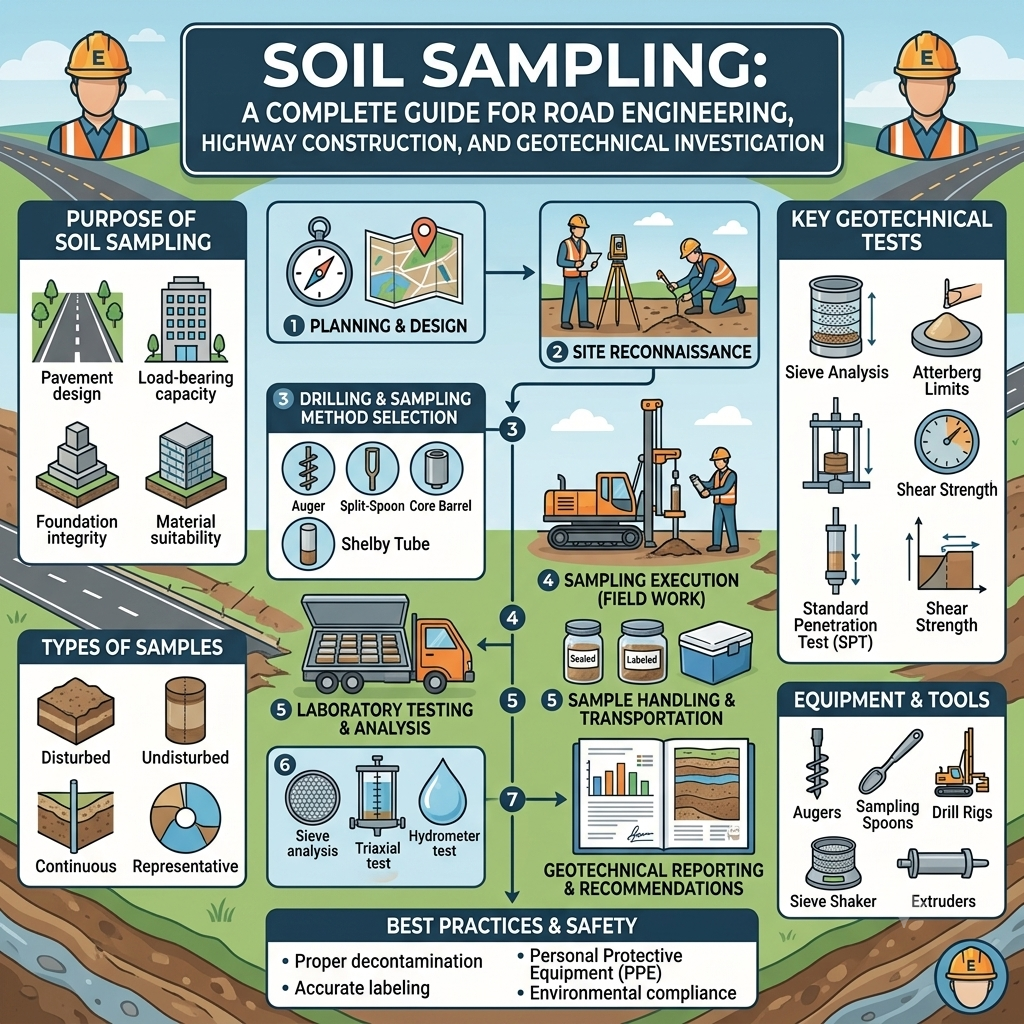
Soil Sampling Process Flow Diagram
          Project Planning
                 │
                 ▼
      Site Reconnaissance
                 │
                 ▼
      Select Sampling Locations
                 │
                 ▼
       Choose Sampling Method
                 │
                 ▼
        Collect Soil Samples
                 │
                 ▼
      Label and Preserve Samples
                 │
                 ▼
     Transport to Laboratory
                 │
                 ▼
      Laboratory Testing
                 │
                 ▼
     Engineering Analysis
                 │
                 ▼
      Highway Design Decisions
Engineering Principles Behind Soil Sampling
Successful soil sampling follows several fundamental engineering principles:
- Collect representative samples from different depths.
- Avoid contamination during sampling and handling.
- Preserve moisture content whenever required.
- Record field observations accurately.
- Use suitable sampling methods for the soil type.
- Label every sample immediately after collection.
- Transport samples carefully to maintain their condition.
- Follow standardized investigation procedures to improve reliability.
These principles help engineers obtain dependable data for designing safe, durable, and economical highway infrastructure.
Key Takeaways
Soil Sampling forms the foundation of every successful road and highway project. Accurate sampling allows engineers to understand soil behavior, evaluate subgrade strength, classify materials, and design durable pavement structures. Selecting the appropriate sampling method and equipment improves the accuracy of laboratory results while reducing construction risks. By following systematic procedures and engineering best practices, project teams can make informed design decisions that enhance safety, performance, and long-term infrastructure reliability.
Step-by-Step Soil Sampling Procedure
A systematic soil sampling procedure ensures that laboratory results accurately represent field conditions. Every stage requires careful planning, precise execution, and proper documentation. Engineers should follow established procedures to obtain reliable data for pavement and foundation design.
Step 1: Review Project Requirements
Engineers first identify the purpose of the investigation. Project objectives determine the sampling depth, sampling interval, and laboratory tests.
Key considerations include:
- Highway classification
- Traffic volume
- Proposed pavement type
- Soil variability
- Existing geological information
Step 2: Conduct Site Reconnaissance
A site visit helps engineers understand existing ground conditions before drilling or excavation begins.
During reconnaissance, engineers observe:
- Surface drainage
- Vegetation
- Existing roads
- Rock outcrops
- Water bodies
- Signs of erosion
- Existing structures
Field observations help determine suitable sampling locations.
Step 3: Mark Sampling Locations
Surveyors establish sampling points using GPS equipment, total stations, or engineering drawings.
Sampling locations should represent:
- Cut sections
- Fill sections
- Bridge locations
- Culvert sites
- Embankments
- Low-lying areas
Uniform spacing improves the accuracy of the investigation.
Step 4: Select the Appropriate Sampling Method
Engineers choose the sampling method according to:
- Soil type
- Investigation depth
- Required laboratory tests
- Equipment availability
For example:
- Augers suit shallow investigations.
- Shelby tubes collect undisturbed clay samples.
- Split spoon samplers support Standard Penetration Tests (SPT).
- Rotary drilling reaches deep soil and rock layers.
Step 5: Collect Soil Samples
Engineers collect samples carefully to prevent contamination and preserve natural moisture whenever required.
Each sample should represent the soil layer from which it was taken.
Important records include:
- Borehole number
- Sample number
- Depth
- Date
- Groundwater level
- Soil description
- Collector’s name
Step 6: Label and Preserve Samples
Every sample must receive a durable label immediately after collection.
Typical label information includes:
- Project name
- Sample identification
- Borehole number
- Sampling depth
- Collection date
- Sample type
Undisturbed samples require protective sealing to prevent moisture loss during transportation.
Step 7: Transport Samples to the Laboratory
Improper transportation can damage even the best-quality samples.
Engineers should:
- Protect samples from vibration.
- Avoid excessive heat.
- Prevent moisture changes.
- Store samples securely.
- Deliver them promptly for testing.
Field Testing During Soil Investigation
Field testing provides immediate information about ground conditions and supports laboratory analysis.
Common Field Tests
Standard Penetration Test (SPT)
Measures soil resistance by driving a split spoon sampler into the ground.
Applications include:
- Foundation design
- Pavement design
- Soil strength estimation
Cone Penetration Test (CPT)
A cone-shaped probe penetrates the soil while sensors record resistance.
Advantages include:
- Continuous soil profile
- Fast testing
- High accuracy
- Minimal disturbance
Field Density Test
Determines the degree of soil compaction.
Common methods include:
- Sand Cone Method
- Nuclear Density Gauge
- Core Cutter Method
Plate Load Test
Engineers evaluate the bearing capacity of soil using a loaded steel plate.
The test supports:
- Pavement design
- Foundation design
- Settlement analysis
Laboratory Testing of Soil Samples
Laboratory testing determines the engineering properties needed for design calculations.
Physical Tests
- Moisture Content Test
- Specific Gravity Test
- Grain Size Analysis
- Atterberg Limits
- Bulk Density Test
Mechanical Tests
- California Bearing Ratio (CBR)
- Direct Shear Test
- Triaxial Compression Test
- Unconfined Compression Test
- Consolidation Test
Hydraulic Tests
- Constant Head Permeability Test
- Falling Head Permeability Test
Engineering Applications of Soil Sampling
Soil sampling influences almost every aspect of highway engineering.
Pavement Design
Subgrade strength determines pavement thickness and material selection.
Embankment Construction
Engineers evaluate soil suitability before constructing highway embankments.
Foundation Design
Bridge piers, retaining walls, and culverts require reliable soil data for safe foundation design.
Slope Stability
Soil properties help engineers analyze slope safety and reduce landslide risks.
Drainage Design
Permeability results influence drainage systems and groundwater management.
Material Selection
Borrow pits and quarry materials undergo sampling to verify their suitability for construction.
Common Mistakes to Avoid
Even experienced professionals can compromise investigation quality by overlooking basic practices.
Avoid these common mistakes:
- Collecting too few samples.
- Ignoring changes in soil layers.
- Using damaged sampling equipment.
- Failing to preserve moisture content.
- Incorrect sample labeling.
- Delaying laboratory testing.
- Mixing samples from different depths.
- Incomplete field records.
- Choosing an unsuitable sampling method.
- Neglecting groundwater observations.
Eliminating these mistakes improves the reliability of engineering decisions.
Best Practices for Soil Sampling
Experienced geotechnical engineers consistently follow these best practices:
- Develop a detailed sampling plan before fieldwork.
- Use calibrated and well-maintained equipment.
- Collect representative samples from all significant soil layers.
- Record field observations immediately.
- Preserve undisturbed samples carefully.
- Photograph boreholes and sampling locations.
- Verify sample labels before transportation.
- Maintain proper chain-of-custody records.
- Coordinate closely with laboratory personnel.
- Review test results alongside field observations.
Following these practices enhances data quality and reduces project risks.
Practical Recommendations
Civil Engineers
- Review geological maps before planning investigations.
- Match sampling intervals with project complexity.
- Confirm laboratory results against field observations.
- Consider seasonal groundwater variations during design.
Contractors
- Protect boreholes during investigation.
- Handle samples with care.
- Keep drilling equipment properly maintained.
- Coordinate closely with geotechnical consultants.
Engineering Students
- Learn the purpose of each sampling method.
- Practice accurate field logging techniques.
- Understand laboratory testing procedures.
- Visit active highway investigation sites whenever possible.
Real-world experience strengthens theoretical knowledge and improves engineering judgment.
General Discussion of IRC, AASHTO, and ICE Practices
Leading highway engineering organizations such as the Indian Roads Congress (IRC), the American Association of State Highway and Transportation Officials (AASHTO), and the Institution of Civil Engineers (ICE) emphasize the importance of thorough geotechnical investigations before finalizing highway designs.
Although specific procedures vary by region, these organizations generally recommend:
- Conducting representative soil sampling across the entire project corridor.
- Performing field and laboratory testing using recognized engineering standards.
- Designing pavements based on subgrade strength and anticipated traffic loading.
- Maintaining detailed investigation records.
- Applying appropriate quality assurance procedures.
- Integrating geotechnical findings into pavement, drainage, and foundation design.
Following these widely accepted engineering principles helps improve highway safety, durability, and long-term performance.
Frequently Asked Questions (FAQs)
1. What is soil sampling in civil engineering?
Soil sampling is the process of collecting representative soil specimens for field examination and laboratory testing to determine engineering properties.
2. Why is soil sampling important before road construction?
It identifies soil strength, bearing capacity, moisture content, and other characteristics that influence pavement design and construction methods.
3. What is the difference between disturbed and undisturbed soil samples?
Disturbed samples lose their natural structure during collection, while undisturbed samples preserve the original soil arrangement for advanced engineering tests.
4. Which soil sampling method is best for clay soils?
Shelby tube sampling usually provides high-quality undisturbed samples from cohesive clay deposits.
5. How deep should soil samples be collected for highway projects?
Sampling depth depends on project requirements, pavement design, embankment height, and foundation depth. Engineers determine appropriate depths during the investigation plan.
6. Which laboratory test is most important for pavement design?
The California Bearing Ratio (CBR) test plays a key role because it evaluates subgrade strength for flexible pavement design.
7. Can poor soil sampling affect highway performance?
Yes. Inaccurate sampling can lead to incorrect design assumptions, resulting in settlement, pavement cracking, and higher maintenance costs.
8. What equipment is commonly used for soil sampling?
Common equipment includes augers, Shelby tubes, split spoon samplers, rotary drilling rigs, sample containers, GPS devices, and field logging tools.
9. How should engineers preserve undisturbed soil samples?
Engineers should seal samples immediately, protect them from vibration and moisture loss, and transport them carefully to the laboratory.
10. Who performs soil sampling on highway projects?
Qualified geotechnical engineers, engineering geologists, drilling crews, and trained field technicians typically conduct soil sampling under professional supervision.
Conclusion
Soil Sampling serves as the foundation of every successful highway and road construction project. Accurate soil investigation enables engineers to understand ground conditions, evaluate subgrade strength, select suitable construction materials, and design safe, durable pavement structures. From choosing the correct sampling method to preserving samples and interpreting laboratory results, every step contributes to reliable engineering decisions. Thorough soil sampling also reduces construction risks, prevents premature pavement failures, and improves the long-term performance of transportation infrastructure. Engineers, contractors, and students who understand the principles of Soil Sampling can make informed technical decisions that enhance safety, optimize project costs, and extend pavement service life. By following recognized engineering practices and maintaining high standards during site investigations, project teams create a solid foundation for sustainable, efficient, and resilient road networks.
