
Introduction
The Standard Penetration Test (SPT) ranks among the most widely used in-situ soil investigation methods in geotechnical engineering. Civil engineers rely on this field test to estimate soil strength, evaluate subsurface conditions, and support the safe design of foundations, highways, bridges, retaining walls, and other infrastructure projects. Before any major construction begins, engineers need accurate information about the ground beneath the proposed structure. The Standard Penetration Test provides that information quickly, economically, and with proven reliability.
Whether the project involves a residential building, an expressway, a railway embankment, or a high-rise tower, engineers use SPT results to determine the bearing capacity of soil and assess settlement characteristics. Although modern site investigation techniques continue to evolve, the Standard Penetration Test remains an essential part of geotechnical investigations because of its simplicity, extensive historical database, and broad acceptance across the construction industry.
This guide explains the Standard Penetration Test in detail, covering its definition, objectives, engineering principles, equipment, field procedure, practical applications, and factors that influence test results. The content serves civil engineers, contractors, site supervisors, and engineering students who want a thorough understanding of this fundamental soil testing method.
What is the Standard Penetration Test?
The Standard Penetration Test (SPT) is an in-situ geotechnical field test that measures the resistance of soil to penetration by driving a standard split-spoon sampler into the ground using a standard hammer. Engineers perform the test inside a borehole during subsurface investigations.
The primary output of the test is the SPT N-value, which represents the number of hammer blows required to drive the sampler through a specified penetration distance. Engineers use this value to estimate soil density, consistency, bearing capacity, and other engineering properties.
Because the test is simple, cost-effective, and applicable to a wide range of soil types, it has become one of the most frequently specified field investigations for civil engineering projects.
Key Purposes
- Determine soil strength.
- Assess foundation conditions.
- Estimate settlement potential.
- Evaluate relative density of granular soils.
- Determine consistency of cohesive soils.
- Support pavement and highway design.
- Assist in geotechnical design decisions.
History and Importance of the Standard Penetration Test
Engineers introduced the Standard Penetration Test during the early twentieth century to provide a practical method for evaluating soil conditions during site investigations. Over time, extensive research established empirical relationships between SPT N-values and important engineering properties.
Today, consulting engineers, government agencies, and contractors continue to specify the test because it offers consistent results when performed according to standardized procedures.
Why the Standard Penetration Test Matters
The test helps engineers:
- Select suitable foundation types.
- Design safe embankments.
- Evaluate highway subgrades.
- Investigate bridge foundation conditions.
- Assess liquefaction potential in seismic regions.
- Improve construction planning.
- Reduce geotechnical risks.
The Standard Penetration Test has earned worldwide acceptance because engineers can compare current results with decades of published data and engineering experience.
Objectives of the Standard Penetration Test
The Standard Penetration Test serves several important engineering objectives beyond simply measuring soil resistance.
1. Determine Soil Bearing Capacity
Engineers estimate the ability of soil to support structural loads without excessive settlement.
2. Evaluate Soil Density
The test helps determine whether granular soils are loose, medium dense, dense, or very dense.
3. Assess Clay Consistency
For cohesive soils, engineers use SPT results to estimate whether the soil is soft, medium stiff, stiff, or hard.
4. Support Foundation Design
SPT data assists in selecting shallow foundations, deep foundations, or ground improvement techniques.
5. Estimate Settlement
Engineers evaluate the likely settlement behavior of soil under structural loading.
6. Aid Highway Engineering
Transportation engineers use SPT data to assess subgrade conditions for highways, expressways, airport pavements, and railway embankments.
Principle of the Standard Penetration Test
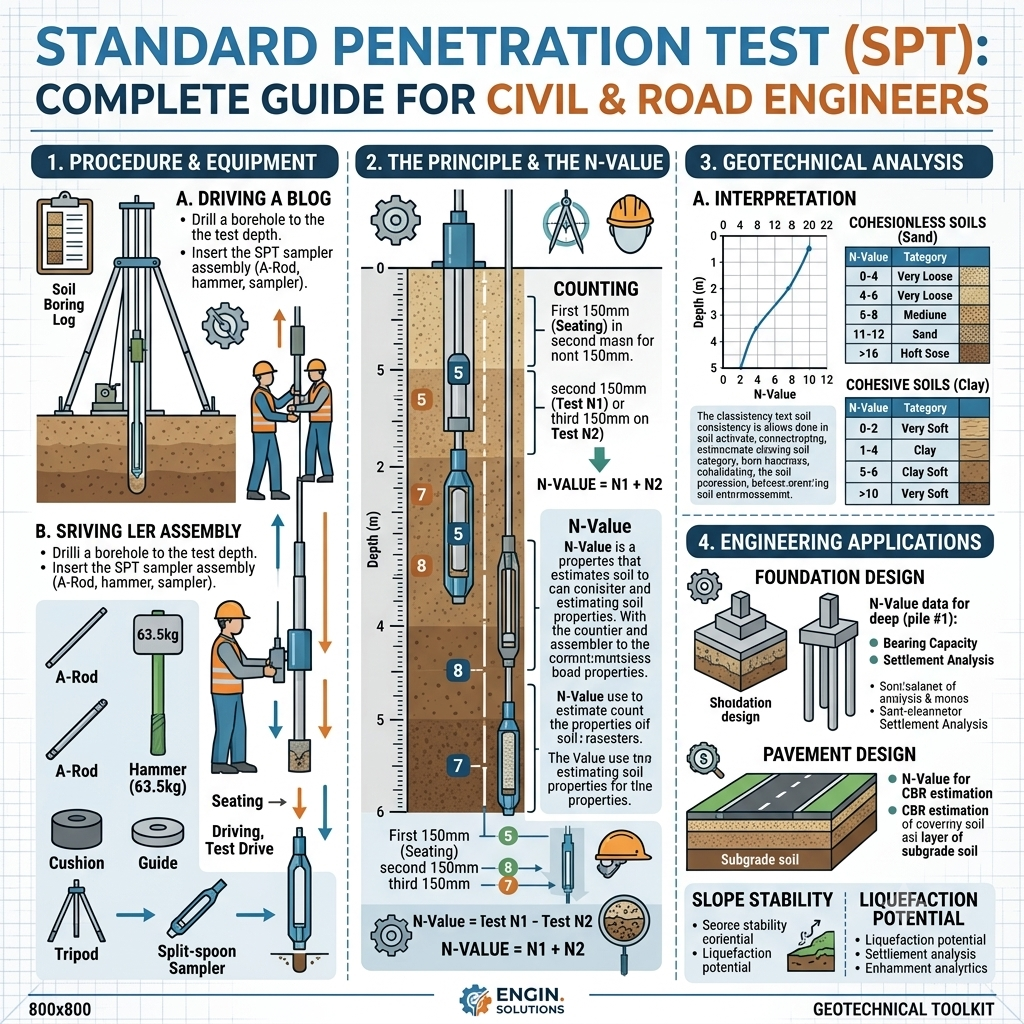
The Standard Penetration Test operates on a straightforward engineering principle. A standard hammer repeatedly strikes a drill rod connected to a split-spoon sampler positioned at the bottom of a borehole. Each hammer blow drives the sampler deeper into the soil.
The resistance offered by the soil reflects its strength and compactness.
Standard Test Parameters
- Hammer weight: 63.5 kg (140 lb)
- Hammer drop height: 760 mm (30 in)
- Sampler penetration: 450 mm
- Seating drive: First 150 mm
- N-value calculation: Blows for the last 300 mm
Engineers ignore the blows required for the first 150 mm because this portion seats the sampler in undisturbed soil. The total blows needed for the remaining 300 mm represent the SPT N-value.
Engineering Interpretation
A higher N-value generally indicates:
- Stronger soil.
- Greater density.
- Higher bearing capacity.
- Lower compressibility.
A lower N-value usually indicates:
- Weaker soil.
- Loose sand.
- Soft clay.
- Greater settlement potential.
Equipment Used in the Standard Penetration Test
Accurate results depend on properly calibrated equipment and correct field procedures.
Borehole Drilling Equipment
Engineers first drill a borehole to the desired testing depth using suitable drilling methods.
Split-Spoon Sampler
The split-spoon sampler collects disturbed soil samples while measuring penetration resistance.
Drive Hammer
A 63.5 kg standard hammer delivers controlled impacts from a 760 mm free fall.
Drill Rods
Steel drill rods transmit hammer energy from the surface to the sampler.
Anvil
The anvil transfers the hammer impact efficiently to the drill rods.
Measuring Tape
Field personnel use measuring tapes or graduated rods to monitor penetration depth accurately.
Safety Equipment
Testing teams should wear:
- Safety helmets
- Gloves
- Steel-toe boots
- Eye protection
- High-visibility clothing
Regular equipment inspection improves testing accuracy and worker safety.
Standard Penetration Test Procedure
Proper field execution ensures reliable and repeatable results.
1: Borehole Preparation
Engineers drill a borehole to the specified investigation depth while maintaining borehole stability. They clean the bottom of the borehole before testing.
2: Sampler Placement
The split-spoon sampler attaches to the drill rods and is lowered carefully until it rests on the borehole bottom.
3: Seating Drive
The standard hammer drives the sampler through the first 150 mm. Engineers record these blows separately because they do not contribute to the final N-value.
4: Penetration Measurement
The hammer continues driving the sampler for an additional 300 mm. Field engineers record the number of blows required for each 150 mm interval.
5: Calculate the N-Value
The total blows required for the last 300 mm equal the Standard Penetration Test N-value.
Example
Suppose the recorded blows are:
- First 150 mm (Seating): 8 blows
- Second 150 mm: 12 blows
- Third 150 mm: 16 blows
Then:
SPT N-value = 12 + 16 = 28
This value indicates the soil offers moderate to high resistance to penetration.
Standard Penetration Test Field Diagram
          Rope & Pulley
               │
      63.5 kg Hammer
               │
            Anvil
               │
          Drill Rods
               │
      ─────────────────
        Ground Surface
      ─────────────────
               │
           Borehole
               │
               │
      Split-Spoon Sampler
               │
         Soil Formation
Testing Sequence
Drill Borehole
       │
       ▼
Clean Borehole Bottom
       │
       ▼
Lower Split-Spoon Sampler
       │
       ▼
Drive Sampler with Standard Hammer
       │
       ▼
Record Blow Counts
       │
       ▼
Calculate SPT N-Value
Factors Affecting Standard Penetration Test Results
Several factors influence the accuracy and interpretation of SPT results. Engineers should understand these variables before making design decisions.
Hammer Energy
Inconsistent hammer energy directly affects penetration resistance.
Borehole Diameter
Large or irregular boreholes can alter soil confinement around the sampler.
Rod Length
Long drill rods absorb more impact energy, influencing measured blow counts.
Groundwater Level
High groundwater conditions may reduce apparent soil resistance in certain soil types.
Operator Skill
Experienced field personnel improve test consistency by following standardized procedures.
Soil Type
The Standard Penetration Test performs best in sands, silts, and many cohesive soils. Gravelly soils or soils containing large cobbles may produce misleading N-values.
Equipment Condition
Worn hammers, damaged samplers, or bent drill rods reduce testing reliability.
Key Takeaways
The Standard Penetration Test remains one of the most trusted field investigations in geotechnical engineering because it provides valuable information about soil strength, density, and bearing capacity using a straightforward procedure. Proper equipment, standardized testing methods, and careful interpretation ensure reliable results that support safe foundation design, highway construction, bridge engineering, and other infrastructure projects. Understanding the principles, procedure, and factors affecting the Standard Penetration Test forms the foundation for accurate subsurface investigations and informed engineering decisions.
Interpretation of Standard Penetration Test (SPT) N-Values
The SPT N-value represents the number of hammer blows required to drive the split-spoon sampler through the final 300 mm of penetration. Engineers use this value to estimate soil density, strength, and stiffness. However, they should always interpret the N-value together with laboratory test results, borehole logs, groundwater conditions, and geological information.
Typical Interpretation for Cohesionless Soils (Sand)
| SPT N-Value | Relative Density | Engineering Condition |
|---|---|---|
| 0–4 | Very Loose | Very low bearing capacity |
| 4–10 | Loose | Low strength |
| 10–30 | Medium Dense | Suitable for many shallow foundations |
| 30–50 | Dense | High bearing capacity |
| Above 50 | Very Dense | Excellent foundation support |
Typical Interpretation for Cohesive Soils (Clay)
| SPT N-Value | Consistency | Engineering Behavior |
|---|---|---|
| 0–2 | Very Soft | High settlement potential |
| 2–4 | Soft | Low shear strength |
| 4–8 | Medium | Moderate strength |
| 8–15 | Stiff | Good foundation support |
| 15–30 | Very Stiff | High stability |
| Above 30 | Hard | Excellent load-bearing characteristics |
Engineering Note: Engineers often apply corrections for hammer energy, borehole diameter, rod length, and overburden pressure before using SPT values in design calculations.
Engineering Applications of the Standard Penetration Test
The Standard Penetration Test plays an essential role in nearly every geotechnical investigation. Engineers rely on SPT data to make informed decisions during the planning, design, and construction of infrastructure projects.
1. Foundation Design
Engineers estimate allowable bearing capacity and select suitable foundation systems such as isolated footings, raft foundations, or piles.
Practical Example
A commercial building site records an SPT N-value of 32 at the proposed foundation depth. This result indicates dense soil, allowing engineers to consider shallow foundations instead of more expensive deep foundation systems.
2. Highway and Pavement Engineering
Road engineers use SPT results to evaluate subgrade strength and determine pavement thickness.
Reliable subgrade information helps:
- Improve pavement performance
- Reduce settlement
- Minimize maintenance costs
- Increase pavement life
3. Bridge Engineering
Bridge foundations often support extremely heavy loads.
SPT investigations help engineers:
- Evaluate pier locations
- Determine pile lengths
- Estimate foundation settlement
- Assess scour-related risks
4. Retaining Wall Design
Retaining walls rely on stable soil conditions.
SPT data assists engineers in:
- Calculating earth pressure
- Selecting foundation depth
- Evaluating slope stability
5. Liquefaction Assessment
In earthquake-prone regions, engineers use corrected SPT values to evaluate the likelihood of soil liquefaction.
Loose saturated sands with low corrected N-values generally exhibit a higher liquefaction risk than dense sands.
6. Embankment Construction
Highway embankments require adequate subsoil strength.
SPT investigations help determine whether:
- Ground improvement is necessary
- Soil replacement is required
- Additional reinforcement should be provided
Advantages of the Standard Penetration Test
The Standard Penetration Test remains popular because it combines simplicity, reliability, and practicality.
Major Advantages
- Simple field procedure.
- Economical compared with many advanced investigation methods.
- Widely accepted throughout the construction industry.
- Provides disturbed soil samples for identification.
- Applicable to many soil types.
- Extensive historical database supports engineering correlations.
- Useful for foundation, highway, railway, airport, and bridge projects.
- Requires relatively simple equipment.
- Produces quick field results.
Because of these advantages, the Standard Penetration Test continues to serve as the standard in many site investigations worldwide.
Limitations of the Standard Penetration Test
Despite its popularity, the test has certain limitations that engineers should recognize.
Common Limitations
- Produces disturbed rather than undisturbed soil samples.
- Results depend on operator technique.
- Gravel and cobbles may produce misleading blow counts.
- Very soft soils may provide unreliable resistance values.
- Highly cemented soils may produce unusually high N-values.
- Energy losses influence measured results.
- Engineers often need correction factors before design.
For critical projects, engineers frequently combine SPT results with laboratory testing and other field investigations such as Cone Penetration Testing (CPT).
Best Practices for Accurate SPT Results
Consistent testing procedures improve the reliability of SPT data.
Recommended Best Practices
- Calibrate testing equipment regularly.
- Maintain the standard hammer weight and drop height.
- Keep boreholes clean before testing.
- Use properly maintained split-spoon samplers.
- Record groundwater levels accurately.
- Document drilling methods and equipment.
- Apply standard correction factors where appropriate.
- Perform tests at specified depth intervals.
- Review field records before leaving the site.
- Compare SPT results with laboratory findings for confirmation.
Following these practices helps engineers produce dependable geotechnical data.
Practical Recommendations
Civil Engineers
- Never rely solely on SPT N-values when designing major structures.
- Interpret field data together with laboratory test results.
- Apply recognized correction procedures before performing design calculations.
- Review geological conditions along the entire project alignment.
Contractors
- Protect boreholes from collapse and contamination.
- Ensure equipment remains in good working condition.
- Follow standardized testing procedures at every location.
- Maintain complete field documentation.
Engineering Students
- Understand the purpose behind every testing step instead of memorizing procedures.
- Learn how corrected N-values differ from field N-values.
- Practice reading borehole logs and geotechnical reports.
- Visit active site investigations to observe testing techniques in real conditions.
General Discussion of IRC, AASHTO, and ICE Practices
Leading engineering organizations such as the Indian Roads Congress (IRC), the American Association of State Highway and Transportation Officials (AASHTO), and the Institution of Civil Engineers (ICE) recognize the importance of reliable geotechnical investigations before infrastructure construction.
Although specific design methods vary, these organizations generally recommend:
- Conducting thorough site investigations before design.
- Following standardized field procedures.
- Using calibrated equipment.
- Recording complete borehole information.
- Applying correction factors where required.
- Combining field investigations with laboratory testing.
- Considering local geological conditions during interpretation.
- Maintaining quality assurance throughout the investigation process.
These principles help engineers achieve safe, economical, and durable designs.
Common Mistakes to Avoid During SPT
Many field errors reduce the accuracy of Standard Penetration Test results.
Avoid these common mistakes:
- Using damaged sampling equipment.
- Ignoring groundwater conditions.
- Recording incorrect penetration depths.
- Performing tests in unstable boreholes.
- Failing to maintain standard hammer drop height.
- Neglecting correction factors.
- Interpreting N-values without geological context.
- Depending on a single borehole for large projects.
Careful supervision and proper documentation significantly improve data quality.
Frequently Asked Questions (FAQs)
1. What is the purpose of the Standard Penetration Test?
The Standard Penetration Test measures soil resistance to penetration, helping engineers evaluate soil strength, density, bearing capacity, and foundation suitability.
2. What does the SPT N-value represent?
The N-value represents the total number of hammer blows required to drive the split-spoon sampler through the final 300 mm of penetration after the initial seating drive.
3. Which soil types are most suitable for the Standard Penetration Test?
The test performs best in sands, silts, and many cohesive soils. Very gravelly soils and soils containing large cobbles may produce unreliable results.
4. Why do engineers ignore the first 150 mm of penetration?
The initial 150 mm seats the sampler in undisturbed soil. Engineers calculate the N-value using only the blows required for the remaining 300 mm.
5. Can the Standard Penetration Test estimate bearing capacity?
Yes. Engineers often use empirical correlations between corrected SPT N-values and allowable bearing capacity, together with laboratory testing and engineering judgment.
6. What factors influence SPT results?
Hammer energy, rod length, borehole diameter, groundwater conditions, equipment condition, operator technique, and soil type all affect test results.
7. Is the Standard Penetration Test suitable for highway projects?
Yes. Transportation engineers frequently use SPT investigations to evaluate subgrade strength, pavement support conditions, embankment stability, and bridge foundation requirements.
8. What is the difference between the Standard Penetration Test (SPT) and the Cone Penetration Test (CPT)?
The SPT uses a split-spoon sampler driven by a standard hammer and provides disturbed soil samples along with blow counts. The CPT pushes an instrumented cone into the ground continuously, delivering detailed resistance measurements without collecting standard disturbed samples.
9. How often should engineers perform SPT during a site investigation?
The testing interval depends on project requirements, soil variability, and applicable standards. Engineers typically perform tests at regular depth intervals and whenever noticeable changes in soil strata occur.
Conclusion
The Standard Penetration Test remains one of the most trusted and widely adopted field investigations in geotechnical engineering because it delivers practical, reliable, and cost-effective information about subsurface conditions. Engineers use the test to estimate soil strength, bearing capacity, relative density, and settlement characteristics before designing foundations, highways, bridges, retaining walls, and other critical infrastructure. Although the test has certain limitations, proper equipment calibration, standardized field procedures, and careful interpretation significantly improve the quality of the results. Engineers should always evaluate Standard Penetration Test data together with geological observations, groundwater information, laboratory testing, and professional engineering judgment to achieve safe and economical designs. By following recognized engineering practices and maintaining strict quality control during site investigations, engineers, contractors, and students can confidently use the Standard Penetration Test as a reliable tool for successful infrastructure development.
