
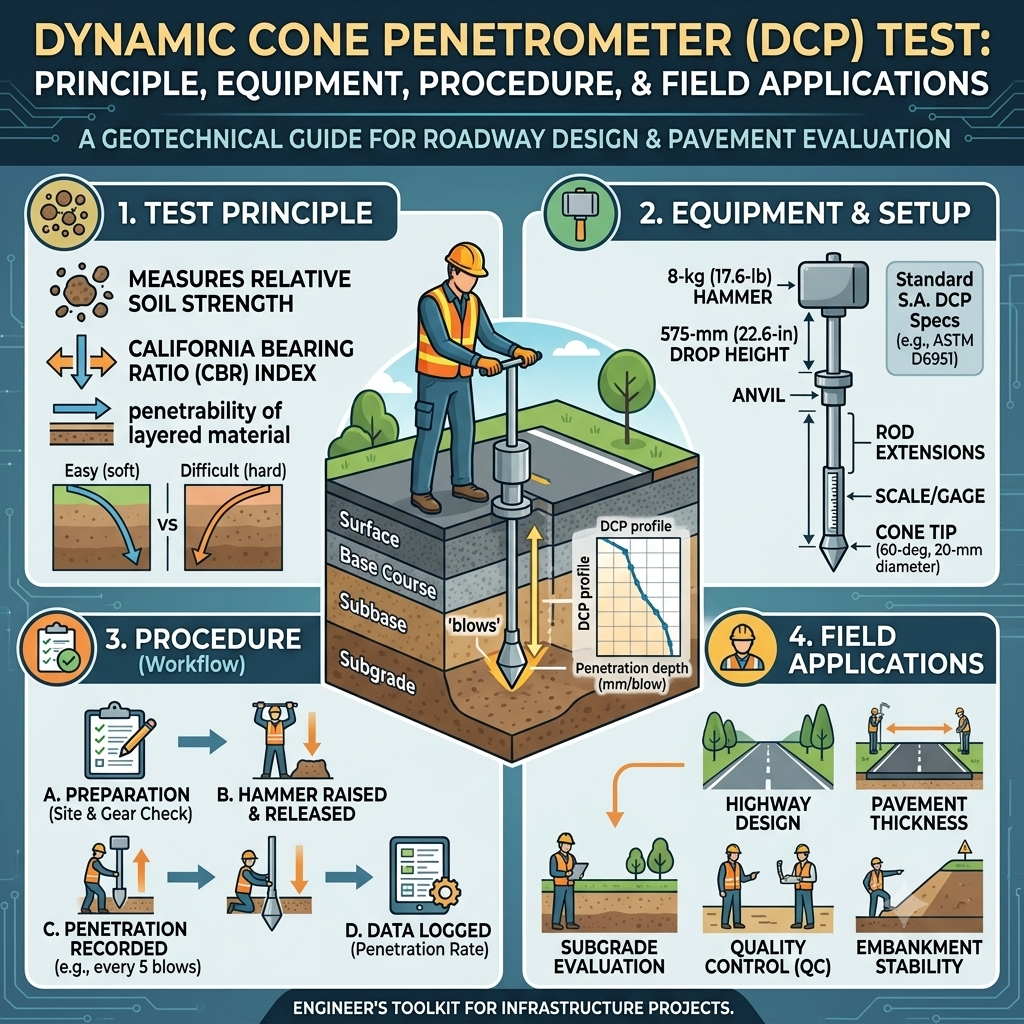
Introduction
The strength of subgrade soil directly influences the performance and service life of every road, highway, airport runway, and pavement structure. Before engineers design pavement layers or begin construction, they must evaluate the load-bearing capacity of the underlying soil. Several field and laboratory tests help determine soil strength, but the Dynamic Cone Penetrometer Test stands out because it offers a quick, economical, and reliable method for assessing in-situ soil resistance.
The Dynamic Cone Penetrometer Test enables engineers to estimate subgrade strength, identify weak soil zones, evaluate compaction quality, and correlate penetration results with the California Bearing Ratio (CBR). Unlike laboratory testing, this field test delivers immediate results, making it highly valuable during road construction, pavement rehabilitation, quality control, and geotechnical investigations.
Civil engineers, highway agencies, contractors, and consultants frequently use the Dynamic Cone Penetrometer (DCP) because it is portable, easy to operate, and suitable for remote construction sites. When combined with proper engineering judgment, DCP results support better pavement design decisions and reduce construction risks.
This guide explains the Dynamic Cone Penetrometer Test in detail, including its engineering principles, equipment, testing procedure, field applications, and best practices.
What is the Dynamic Cone Penetrometer Test?
The Dynamic Cone Penetrometer Test (DCP Test) is an in-situ field test that measures the penetration resistance of soil by driving a steel cone into the ground using repeated hammer blows.
The test evaluates the strength and stiffness of natural soil, compacted fills, granular layers, and pavement foundations. Engineers commonly use the penetration rate to estimate the California Bearing Ratio (CBR), which helps determine the structural capacity of the pavement foundation.
Unlike laboratory tests that require sample collection and preparation, the DCP test measures soil strength directly in the field. This feature makes it one of the most practical tools for road engineering projects.
Primary Objectives
- Evaluate subgrade strength.
- Assess pavement foundation quality.
- Estimate CBR values.
- Identify weak soil layers.
- Verify field compaction.
- Support pavement rehabilitation decisions.
Importance of the Dynamic Cone Penetrometer Test
Road performance depends heavily on the quality of the foundation beneath the pavement. Weak soils often lead to rutting, settlement, cracking, and premature pavement failure.
The Dynamic Cone Penetrometer Test helps engineers detect these issues before construction progresses.
Why Engineers Prefer the DCP Test
- Fast field testing
- Low equipment cost
- Immediate results
- Portable equipment
- Minimal site disturbance
- Suitable for remote locations
- Reliable strength assessment
Practical Example
During the construction of a rural highway, engineers may perform DCP tests at regular intervals along the proposed alignment. If one section shows significantly higher penetration per hammer blow than nearby locations, it indicates weaker soil. Engineers can then stabilize the subgrade, replace unsuitable material, or revise the pavement design before construction continues.
Early identification of weak zones reduces repair costs and improves pavement durability.
Principle of the Dynamic Cone Penetrometer Test
The Dynamic Cone Penetrometer Test works on a simple engineering principle.
A standard hammer falls from a fixed height and strikes an anvil connected to a steel rod with a conical tip. Each hammer impact drives the cone deeper into the soil.
Engineers measure the penetration after every blow or group of blows.
Engineering Principle
- Strong soil resists penetration.
- Weak soil allows deeper penetration.
- Lower penetration per blow indicates higher strength.
- Greater penetration per blow indicates lower strength.
The measured penetration rate is known as the DCP Index, usually expressed in millimetres per blow (mm/blow).
Engineers use empirical correlations to estimate CBR values from the DCP Index.
Equipment Used in the Dynamic Cone Penetrometer Test
A standard Dynamic Cone Penetrometer consists of several simple but precisely manufactured components.
Main Components
Steel Cone
- Hardened steel
- Typically 20 mm diameter
- Cone angle approximately 60°
The cone penetrates the soil during testing.
Drive Rod
The steel rod transfers hammer energy directly to the cone.
Sliding Hammer
A standard hammer, commonly weighing about 8 kg, slides vertically along the rod and falls from a specified height to generate impact energy.
Anvil
The anvil receives the hammer impact and transfers the force to the drive rod.
Measuring Scale
A graduated scale records cumulative penetration after each hammer blow.
Simplified DCP Equipment Diagram
            Sliding Hammer
           ┌───────────────┐
           │      8 kg     │
           └──────┬────────┘
                  │
               Guide Rod
                  │
               Steel Rod
                  │
             Graduated Scale
                  │
              Hardened Cone
                 /\
                /  \
               /____\
             Soil Surface
────────────────────────────────
Each component plays a critical role in producing consistent and repeatable test results.
Standard Guidelines and Engineering References
Several highway organizations recognize the Dynamic Cone Penetrometer Test as an effective method for evaluating pavement foundations and subgrade conditions.
Although project requirements vary by country, engineers generally follow guidance based on:
- IRC recommendations for pavement investigation and quality evaluation.
- AASHTO practices for pavement design and subgrade assessment.
- ASTM and other internationally accepted field testing procedures.
- ICE guidance for geotechnical investigations and infrastructure projects.
Engineers should always consult the latest project specifications and national standards before conducting field tests.
Dynamic Cone Penetrometer Test Procedure
A systematic testing procedure ensures reliable and repeatable results.
Step 1: Site Selection
Engineers identify representative locations along the project alignment.
They avoid areas containing large rocks, buried utilities, or obvious surface disturbances that could affect penetration measurements.
Step 2: Equipment Setup
The operator assembles the DCP equipment and positions the cone vertically on the prepared test surface.
The cone must remain perfectly aligned to prevent bending of the rod and inaccurate readings.
Step 3: Driving the Cone
The hammer is lifted to the specified height and released without applying additional force.
Each hammer impact drives the cone deeper into the soil.
The operator maintains a consistent hammer drop throughout the test.
Step 4: Recording Penetration
After every blow or predetermined number of blows, engineers measure the cumulative penetration.
Typical field records include:
- Blow number
- Cumulative penetration
- Penetration per blow
- Soil observations
- Moisture conditions
- Test location
Accurate field records improve data interpretation during pavement design.
Step 5: Completing the Test
The operator continues driving the cone until one of the following conditions occurs:
- Required testing depth is reached.
- Penetration resistance becomes excessive.
- Equipment reaches its operating limit.
- Project specifications require termination.
After completing the test, engineers clean the equipment and inspect the cone for wear before conducting additional tests.
Field Testing Flow Diagram
Select Test Location
          │
          ▼
Prepare Test Surface
          │
          ▼
Assemble DCP Equipment
          │
          ▼
Drive Cone into Soil
          │
          ▼
Measure Penetration
          │
          ▼
Record Data
          │
          ▼
Continue Until Target Depth
This systematic workflow helps maintain consistency across multiple testing locations.
Factors Affecting Test Results
Several field conditions influence the accuracy of the Dynamic Cone Penetrometer Test.
Understanding these factors allows engineers to interpret results correctly.
Soil Moisture
Higher moisture generally reduces soil strength and increases penetration.
Soil Type
Granular soils, silts, clays, and stabilized materials respond differently to impact loading.
Density
Well-compacted soils resist penetration more effectively than loose soils.
Particle Size
Large gravel or cobbles may obstruct the cone and produce inconsistent readings.
Operator Technique
Consistent hammer release, proper alignment, and accurate measurements improve repeatability.
Equipment Condition
Worn cones, damaged rods, or inaccurate measuring scales can introduce significant errors.
Engineers should inspect and maintain equipment regularly to ensure dependable results.
Key Takeaways
The Dynamic Cone Penetrometer Test provides a fast, economical, and reliable method for evaluating in-situ soil strength and pavement foundation quality. By understanding the test principle, using properly maintained equipment, and following a consistent field procedure, engineers can identify weak subgrade zones, verify compaction quality, and support sound pavement design decisions. Accurate testing during the early stages of road construction reduces construction risks, improves quality control, and contributes to longer-lasting pavement structures.
Data Interpretation
Completing the field test marks the beginning of the engineering analysis. Engineers study the recorded penetration values to evaluate soil strength, detect weak zones, and estimate the bearing capacity of the pavement foundation.
The primary parameter obtained from the Dynamic Cone Penetrometer Test is the DCP Index, which represents the average penetration of the cone for each hammer blow.
Understanding the DCP Index
The DCP Index is expressed as:
DCP Index = Penetration (mm) ÷ Number of Hammer Blows
A lower DCP Index indicates stronger and denser soil because the cone penetrates less with each impact. Conversely, a higher DCP Index indicates weaker soil with lower resistance to penetration.
General Interpretation
| DCP Index (mm/blow) | Soil Strength | Engineering Assessment |
|---|---|---|
| 0–5 | Very High | Excellent foundation material |
| 5–10 | High | Suitable for heavy pavements |
| 10–20 | Moderate | Acceptable for most highways |
| 20–40 | Low | Improvement may be necessary |
| Above 40 | Very Low | Stabilization or replacement recommended |
Note: Actual acceptance criteria depend on project specifications, soil type, and national standards.
Correlation Between DCP and CBR
One of the biggest advantages of the Dynamic Cone Penetrometer Test is its ability to estimate the California Bearing Ratio (CBR) without performing time-consuming laboratory testing.
Researchers have developed empirical relationships between the DCP Index and CBR for different soil types. These correlations allow pavement engineers to estimate subgrade strength quickly during field investigations.
Why CBR Matters
The California Bearing Ratio helps engineers:
- Design pavement thickness.
- Select pavement materials.
- Evaluate existing roads.
- Plan rehabilitation projects.
- Determine load-carrying capacity.
Practical Example
Suppose a DCP test indicates high penetration values over a 150-meter section of a proposed highway. The estimated CBR falls below the design requirement. Engineers may choose to:
- Stabilize the subgrade with lime or cement.
- Replace unsuitable material.
- Increase pavement thickness.
- Improve drainage before construction.
This proactive approach prevents premature pavement distress and reduces maintenance costs.
Applications of the Dynamic Cone Penetrometer Test
The Dynamic Cone Penetrometer Test has become one of the most versatile field tests in transportation and geotechnical engineering.
1. Highway Construction
Engineers use the DCP test to evaluate natural subgrade conditions before pavement construction.
2. Pavement Rehabilitation
Existing roads often contain weak sections that require strengthening. The DCP identifies these locations quickly.
3. Quality Control During Construction
Contractors perform DCP testing after compaction to verify that embankments and subgrades meet project requirements.
4. Airport Pavements
Airport authorities use the test to assess runway shoulders, taxiways, and pavement foundations.
5. Rural Road Projects
The equipment’s portability makes it ideal for remote construction sites where laboratory facilities are unavailable.
6. Earthwork Projects
Engineers assess compacted fills, embankments, and foundation layers using DCP testing.
7. Disaster Assessment
Following floods or landslides, engineers evaluate weakened road foundations before reopening traffic.
Advantages of the Dynamic Cone Penetrometer Test
The popularity of the Dynamic Cone Penetrometer Test comes from its combination of simplicity, speed, and reliability.
Major Advantages
- Fast field testing.
- Low equipment cost.
- Portable and lightweight.
- Immediate results.
- Minimal site preparation.
- Suitable for remote locations.
- Useful for quality control.
- Correlates with CBR.
- Reduces laboratory testing requirements.
- Supports pavement design decisions.
Limitations of the Dynamic Cone Penetrometer Test
Although the DCP is highly effective, engineers should recognize its limitations.
Common Limitations
- Correlations with CBR vary among soil types.
- Very coarse aggregates can obstruct the cone.
- Extremely hard layers may prevent penetration.
- High moisture variations can influence results.
- Operator technique affects consistency.
- The test does not replace comprehensive geotechnical investigations.
Proper interpretation requires engineering judgment and supporting field observations.
Engineering Best Practices
Following established best practices improves the reliability of DCP testing and the quality of engineering decisions.
Before Testing
- Review project specifications.
- Calibrate equipment.
- Inspect the cone for wear.
- Select representative test locations.
- Record weather conditions.
During Testing
- Maintain vertical alignment.
- Release the hammer consistently.
- Measure penetration accurately.
- Record every hammer blow.
- Note changes in soil type.
After Testing
- Calculate the DCP Index carefully.
- Compare results with project requirements.
- Verify unusual values using additional tests.
- Clean and maintain the equipment.
- Archive field records for future reference.
Consistent procedures improve repeatability and increase confidence in the results.
Practical Recommendations
Civil Engineers
- Use DCP results together with laboratory data whenever possible.
- Investigate sudden changes in penetration resistance.
- Consider moisture conditions when interpreting results.
- Correlate DCP data with pavement performance.
Contractors
- Test compacted layers before placing the next layer.
- Train field technicians in proper testing procedures.
- Protect testing locations from unnecessary disturbance.
- Maintain testing equipment regularly.
Engineering Students
- Learn the relationship between DCP and CBR.
- Practice field testing under supervision.
- Understand how soil type influences penetration.
- Study pavement failures caused by weak subgrades.
Common Mistakes to Avoid
Many inaccurate results stem from simple procedural errors. Avoiding these mistakes improves test reliability.
- Using damaged or worn cones.
- Failing to keep the rod vertical.
- Recording incorrect penetration values.
- Ignoring groundwater conditions.
- Performing tests on disturbed soil.
- Skipping equipment inspection.
- Using DCP results without engineering judgment.
- Assuming one correlation applies to every soil type.
General Discussion on IRC, AASHTO, and ICE Practices
Highway organizations such as IRC, AASHTO, and ICE recognize the importance of field investigations in pavement engineering. Although their detailed procedures differ, they promote several common principles:
- Conduct site investigations before pavement design.
- Evaluate subgrade strength using appropriate field and laboratory tests.
- Verify compaction during construction.
- Document all field observations.
- Combine DCP results with geotechnical investigations.
- Follow approved quality assurance procedures.
- Maintain calibrated equipment.
- Apply engineering judgment when interpreting field data.
These recommendations improve pavement performance and reduce the likelihood of premature failures.
Frequently Asked Questions (FAQs)
1. What is the purpose of the Dynamic Cone Penetrometer Test?
The test evaluates the in-situ strength of soil and pavement layers by measuring penetration resistance under repeated hammer impacts.
2. What does the DCP Index represent?
The DCP Index represents the average penetration of the cone per hammer blow and indicates the relative strength of the soil.
3. Can the Dynamic Cone Penetrometer Test replace the California Bearing Ratio test?
The DCP test provides an estimate of CBR through empirical correlations. It supports rapid field evaluations but does not always replace laboratory CBR testing where project specifications require direct measurement.
4. Which soils are suitable for DCP testing?
The test performs well in compacted fills, granular soils, silts, and many clay soils. Very coarse or rocky materials may affect accuracy.
5. Why is moisture content important during testing?
Moisture significantly influences soil strength. Wet soils usually show greater penetration than dry soils of the same density.
6. How often should DCP tests be performed during road construction?
The testing frequency depends on project specifications, but engineers commonly perform tests at regular intervals and whenever soil conditions change.
7. What equipment is required for a Dynamic Cone Penetrometer Test?
A standard setup includes a steel cone, drive rod, sliding hammer, anvil, guide rod, and measuring scale.
8. What are the main advantages of the Dynamic Cone Penetrometer Test?
The test offers rapid results, low operating costs, portability, simple operation, and reliable estimates of subgrade strength.
9. What factors influence DCP results?
Soil type, moisture content, density, particle size, equipment condition, and operator technique all affect penetration measurements.
10. Why do highway engineers use the Dynamic Cone Penetrometer Test?
Engineers use the test to assess subgrade quality, estimate CBR, verify compaction, identify weak layers, and support pavement design and rehabilitation decisions.
Conclusion
The Dynamic Cone Penetrometer Test has become one of the most practical and dependable field methods for evaluating subgrade strength in road and highway engineering. Its simple equipment, rapid testing process, and ability to estimate California Bearing Ratio (CBR) make it an essential tool for geotechnical investigations, pavement design, construction quality control, and rehabilitation projects. Engineers can identify weak soil layers, verify compaction quality, and make informed design decisions without waiting for lengthy laboratory results.
Although the test provides valuable field data, the best outcomes come from combining DCP results with sound engineering judgment, laboratory investigations, and project-specific requirements. Highway agencies and contractors worldwide continue to rely on the Dynamic Cone Penetrometer Test because it improves decision-making, reduces construction risks, and supports the development of durable, safe, and cost-effective transportation infrastructure. By following recognized engineering practices and maintaining consistent testing procedures, professionals can maximize the accuracy and usefulness of this important field test.

Kamran Malik is a passionate civil engineering writer and researcher who specializes in construction, transportation, structural engineering, and infrastructure topics. Through his articles on CivilEngineerings.com, he simplifies complex engineering concepts and shares practical insights, industry trends, and educational resources for students, professionals, and engineering enthusiasts.