
Introduction
The strength of a road begins beneath its surface. Before engineers design a pavement structure, they must understand how well the underlying soil can support traffic loads. A weak foundation often leads to cracks, rutting, potholes, and premature pavement failure. For this reason, geotechnical investigations play a crucial role in every highway and road construction project.
One of the most widely used methods for evaluating soil strength is the California Bearing Ratio Test. Engineers use this test to measure the load-bearing capacity of subgrade soils and granular materials. The test provides valuable data for pavement design, helping engineers determine the appropriate thickness of pavement layers based on soil performance.
The California Bearing Ratio Test remains a standard practice in highway engineering because it offers reliable results, simple procedures, and cost-effective soil evaluation. Civil engineers, contractors, consultants, and engineering students rely on this test during road planning, pavement design, quality control, and construction.
This guide explains the complete concept of the California Bearing Ratio Test, including its engineering principles, equipment, testing procedure, practical applications, and best practices. Whether you are preparing for a civil engineering examination or managing a road construction project, understanding this test will improve your knowledge of pavement engineering.
What is the California Bearing Ratio Test?
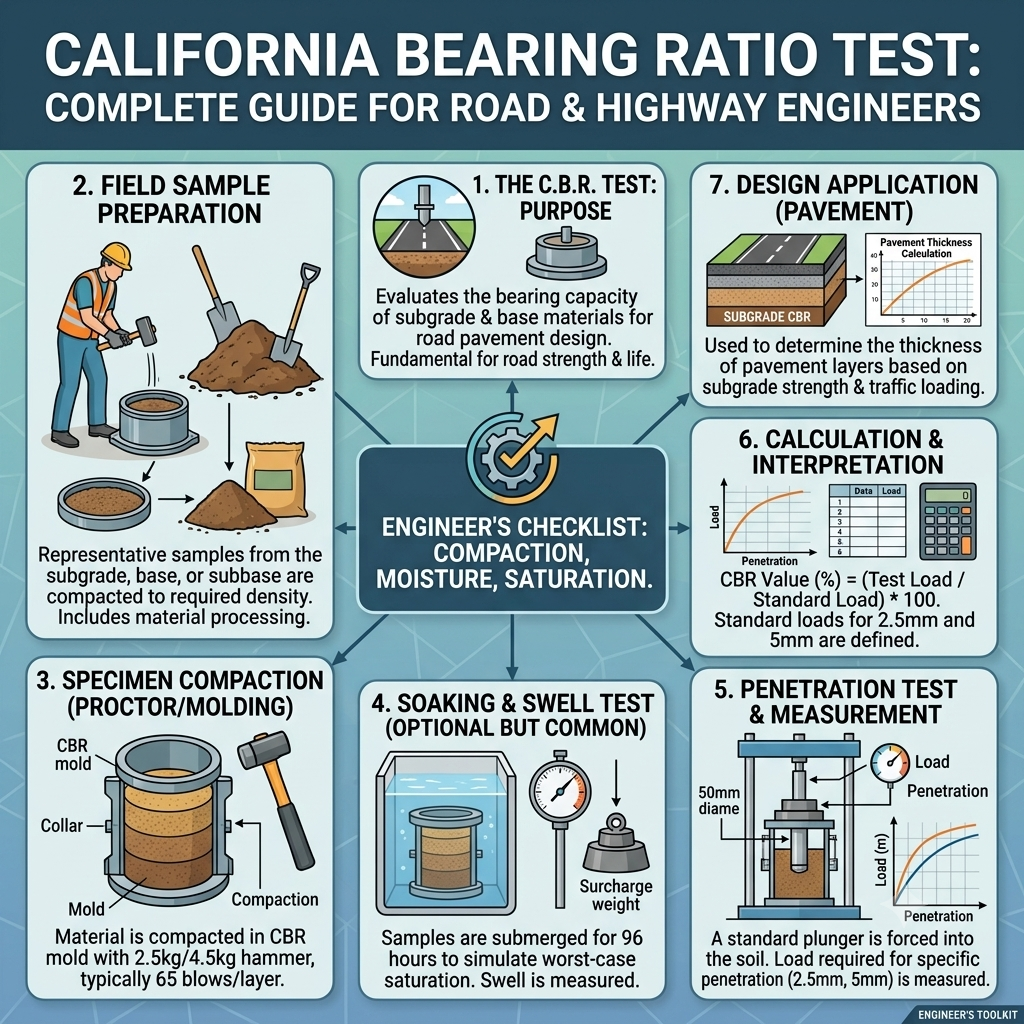
The California Bearing Ratio Test (CBR Test) is a laboratory or field test that determines the bearing capacity of soil by comparing its resistance to penetration with the resistance of a standard crushed stone material.
The test measures the pressure required to push a standard plunger into a compacted soil sample at a constant rate. Engineers compare this pressure with standard reference values and express the result as a percentage known as the CBR value.
Simple Definition
The California Bearing Ratio Test evaluates the strength of subgrade soil for pavement design by measuring its resistance to penetration under controlled conditions.
Higher CBR values indicate stronger soil with greater load-bearing capacity, while lower values suggest weaker soil that requires pavement improvement or stabilization.
History and Development of the California Bearing Ratio Test
The California Bearing Ratio Test originated in the late 1920s through the California Division of Highways in the United States. Engineers needed a practical method to evaluate soil strength for highway construction. The CBR method quickly gained acceptance because it produced consistent results and simplified pavement design.
Today, transportation agencies around the world use the test in accordance with their national standards and specifications. Highway authorities continue to rely on CBR values when designing flexible pavements because the method provides a reliable estimate of subgrade support.
Why the California Bearing Ratio Test is Important
Every pavement transfers traffic loads to the soil beneath it. If the soil cannot support these loads, pavement distress develops much earlier than expected.
The California Bearing Ratio Test helps engineers avoid these problems by identifying weak soils before construction begins.
Major Benefits
- Determines subgrade strength.
- Assists in pavement thickness design.
- Supports quality control during construction.
- Identifies unsuitable foundation soils.
- Helps evaluate soil stabilization methods.
- Reduces the risk of premature pavement failure.
- Improves long-term pavement performance.
Practical Example
Suppose two highway projects use different soil types. One site contains dense gravel, while the other contains soft clay. Without soil testing, both roads might receive the same pavement thickness. However, the clay subgrade would likely deform under heavy traffic.
By conducting the California Bearing Ratio Test, engineers can increase pavement thickness or stabilize the weaker soil, ensuring both roads achieve the desired service life.
Engineering Principle Behind the CBR Test
The California Bearing Ratio Test follows a simple engineering principle.
A cylindrical steel plunger penetrates a compacted soil specimen at a constant rate of 1.25 mm per minute. During penetration, the testing machine measures the force required to push the plunger into the soil.
Engineers compare the measured load with the standard load required to penetrate crushed stone.
The comparison produces the California Bearing Ratio value.
Engineering Concept
Stronger soils resist penetration more effectively than weaker soils.
Therefore:
- Higher penetration resistance = Higher CBR value
- Lower penetration resistance = Lower CBR value
This relationship allows pavement designers to estimate the structural support provided by the subgrade.
Equipment Required for the CBR Test
Accurate testing depends on properly calibrated equipment and correct laboratory procedures.
Essential Equipment
- CBR mould with collar and base plate
- Spacer disc
- Loading frame
- Penetration plunger (50 mm diameter)
- Dial gauges
- Loading weights (surcharge weights)
- Compaction rammer
- Filter papers
- Soaking tank
- Oven
- Balance
- Mixing tray
- Moisture cans
- Straight edge
Why Calibration Matters
Testing equipment should undergo regular calibration to ensure accurate load and penetration measurements. Even small measurement errors can affect pavement design decisions.
Soil Sample Preparation
Proper sample preparation plays a vital role in obtaining reliable CBR values.
Engineers prepare the specimen according to the project specifications and the intended field conditions.
Sample Collection
Representative soil samples should come from the actual construction site. The sample must accurately reflect the soil that will support the pavement.
Moisture Conditioning
Engineers add water to achieve the required moisture content before compaction.
Compaction
The soil is compacted inside the mould using the specified compaction effort.
The level of compaction should represent field construction conditions as closely as possible.
Soaked and Unsoaked Samples
Engineers commonly perform two types of CBR tests:
Unsoaked CBR Test
Used where soil remains relatively dry throughout the year.
Soaked CBR Test
The specimen remains submerged in water, typically for four days, before testing. This method represents the weakest expected field condition and is commonly used for highway pavement design.
California Bearing Ratio Test Procedure
The testing procedure follows a systematic sequence to ensure consistency and repeatability.
Step 1: Collecting the Soil Sample
Collect representative soil from the proposed road alignment or borrow area.
Remove stones, roots, and organic matter before testing.
Step 2: Preparing the Sample
Adjust the moisture content according to laboratory requirements.
Mix the soil thoroughly until moisture becomes uniform throughout the sample.
Step 3: Compaction
Place the soil into the CBR mould in layers.
Compact each layer using the specified number of hammer blows or compaction energy.
Level the surface after completing compaction.
Step 4: Soaking the Sample
For soaked CBR testing:
- Place filter paper on the soil surface.
- Install surcharge weights.
- Immerse the mould in water.
- Allow the specimen to soak for approximately four days.
After soaking, record the amount of swell before beginning the penetration test.
Step 5: Penetration Test
Position the mould beneath the loading frame.
Lower the penetration plunger until it just touches the soil surface.
Apply penetration at a constant rate of 1.25 mm per minute.
Record the applied load at regular penetration intervals.
Step 6: Recording Load Values
Continue recording the load until the required penetration depth is reached.
The recorded values later help determine the CBR percentage during data analysis.
Accurate data recording ensures dependable pavement design calculations.
Simple CBR Test Flow Diagram
        Soil Sampling
              │
              ▼
     Moisture Adjustment
              │
              ▼
      Soil Compaction
              │
              ▼
      Soaking (If Required)
              │
              ▼
     Penetration Testing
              │
              ▼
      Load Measurement
              │
              ▼
      CBR Value Calculation
              │
              ▼
      Pavement Design
Engineering Workflow Diagram
Site Investigation
        │
        ▼
 Soil Classification
        │
        ▼
 California Bearing Ratio Test
        │
        ▼
 Determine Subgrade Strength
        │
        ▼
 Pavement Thickness Design
        │
        ▼
 Road Construction
Best Practices During Testing
- Use representative soil samples from the project site.
- Maintain the specified moisture content before compaction.
- Compact the specimen uniformly.
- Keep the penetration rate constant throughout the test.
- Calibrate testing equipment regularly.
- Record load readings carefully without interruption.
- Avoid disturbing the specimen during handling.
- Follow the applicable laboratory testing standards consistently.
Key Takeaways
The California Bearing Ratio Test serves as one of the most trusted methods for evaluating subgrade strength in road and highway engineering. Engineers use the test to measure soil resistance to penetration, assess pavement support, and make informed design decisions. Proper sample preparation, correct compaction, controlled testing procedures, and accurate data collection all contribute to reliable CBR values. By understanding the engineering principles and following best practices, civil engineers, contractors, and students can improve pavement performance, reduce maintenance costs, and construct safer, longer-lasting roads.
California Bearing Ratio (CBR) Formula
After completing the penetration test, engineers calculate the California Bearing Ratio by comparing the measured load with the standard load for crushed stone.
CBR Formula
CBR (%) = (Measured Load / Standard Load) × 100
Standard Loads
| Penetration Depth | Standard Load |
|---|---|
| 2.5 mm | 1370 kg (13.24 kN) |
| 5.0 mm | 2055 kg (19.96 kN) |
Engineers normally calculate the CBR value at both 2.5 mm and 5.0 mm penetration. In most cases, the 2.5 mm value represents the final CBR result. If the value at 5.0 mm exceeds the value at 2.5 mm, engineers usually repeat the test to verify the results. If the second test confirms the higher 5.0 mm value, they may adopt it for pavement design.
Example Calculation
Suppose the recorded load at 2.5 mm penetration is 685 kg.
Using the formula:
CBR = (685 / 1370) × 100
CBR = 50%
A CBR value of 50% indicates that the tested material provides good support for pavement layers and can carry relatively heavy traffic loads.
Interpretation of CBR Values
The CBR value helps engineers evaluate the quality of subgrade soil and determine the required pavement thickness.
Typical Interpretation
| CBR Value (%) | Soil Strength | Engineering Assessment |
|---|---|---|
| Less than 3 | Very Poor | Extensive stabilization required |
| 3–5 | Poor | Thick pavement recommended |
| 5–10 | Fair | Suitable for light traffic roads |
| 10–20 | Good | Suitable for medium traffic |
| 20–50 | Very Good | Suitable for highways |
| Above 50 | Excellent | High-quality granular material |
Higher CBR values generally indicate stronger soils that require thinner pavement structures, while lower values suggest weaker soils that need stabilization or thicker pavement layers.
Typical CBR Values for Different Soil Types
The following table provides approximate CBR values commonly observed under standard testing conditions.
| Soil Type | Typical CBR (%) |
|---|---|
| Soft Clay | 2–5 |
| Silty Clay | 3–8 |
| Clayey Sand | 8–15 |
| Sandy Soil | 10–25 |
| Well-Graded Sand | 20–40 |
| Gravel | 30–80 |
| Crushed Stone | 80–100 |
Actual values vary depending on moisture content, density, and field conditions.
Factors Affecting California Bearing Ratio Test Results
Several variables influence the final CBR value. Engineers must control these factors carefully to obtain accurate and repeatable results.
1. Moisture Content
Moisture significantly affects soil strength.
Higher water content generally reduces bearing capacity, particularly in clayey soils.
2. Degree of Compaction
Well-compacted soil exhibits greater density and higher resistance to penetration.
Poor compaction often results in lower CBR values.
3. Soil Type
Granular soils usually provide higher CBR values than cohesive soils because they resist deformation more effectively.
4. Density
Higher dry density increases soil strength and improves pavement support.
5. Soaking Condition
Soaked specimens typically produce lower CBR values because water weakens many soil types.
6. Particle Gradation
Well-graded aggregates compact efficiently and usually achieve higher CBR values than poorly graded materials.
Applications of the California Bearing Ratio Test
The California Bearing Ratio Test supports many civil engineering projects beyond highway construction.
Common Applications
- Flexible pavement design
- Highway construction
- Airport runway design
- Rural road development
- Industrial yard pavements
- Parking areas
- Railway formation evaluation
- Quality control during earthworks
- Soil stabilization projects
- Pavement rehabilitation
Practical Example
Before constructing a six-lane highway, engineers perform CBR tests along the entire alignment. Areas with low CBR values receive lime stabilization, while stronger sections require only standard pavement thickness. This approach optimizes construction costs and improves long-term pavement performance.
Advantages of the California Bearing Ratio Test
The CBR test has remained popular for decades because it offers several practical benefits.
Advantages
- Simple testing procedure.
- Economical compared to advanced laboratory methods.
- Widely accepted in highway engineering.
- Reliable for flexible pavement design.
- Suitable for laboratory and field testing.
- Easy interpretation of results.
- Supports quality assurance during construction.
- Applicable to a wide range of soil types.
Limitations of the California Bearing Ratio Test
Although the CBR test provides valuable information, engineers should recognize its limitations.
Limitations
- Primarily developed for flexible pavement design.
- Results depend heavily on moisture conditions.
- Requires careful sample preparation.
- Does not represent repeated traffic loading directly.
- Less suitable for unusual soil types without additional testing.
- Field conditions may differ from laboratory conditions.
For major infrastructure projects, engineers often combine CBR testing with additional geotechnical investigations.
Practical Recommendations
Civil Engineers
- Conduct CBR testing at representative locations along the project alignment.
- Use soaked CBR values for conservative pavement design where seasonal rainfall is significant.
- Verify laboratory results with field investigations.
- Combine CBR data with traffic analysis and geotechnical reports.
Contractors
- Maintain proper moisture during compaction.
- Use approved construction materials.
- Perform routine quality control testing.
- Protect prepared subgrade from rainfall before paving.
Engineering Students
- Understand the relationship between soil strength and pavement performance.
- Practice laboratory testing procedures.
- Learn how CBR values influence pavement thickness.
- Study the effects of compaction and moisture on soil behavior.
Best Practices for Accurate CBR Testing
- Collect representative soil samples.
- Calibrate laboratory equipment regularly.
- Maintain uniform compaction energy.
- Follow the specified penetration rate of 1.25 mm per minute.
- Record observations carefully.
- Test duplicate samples when required.
- Compare laboratory results with field conditions.
- Maintain complete testing documentation.
General Discussion of IRC, AASHTO, and ICE Practices
Leading highway engineering organizations recognize the importance of evaluating subgrade strength before pavement construction.
General engineering guidance from IRC (Indian Roads Congress), AASHTO (American Association of State Highway and Transportation Officials), and ICE (Institution of Civil Engineers) emphasizes:
- Conducting detailed geotechnical investigations before pavement design.
- Determining subgrade strength using standardized laboratory and field testing methods.
- Considering expected traffic loading and environmental conditions during pavement design.
- Maintaining strict quality control during earthworks and compaction.
- Verifying material properties before construction.
- Designing pavement structures that provide long-term performance and safety.
Following these widely accepted engineering principles improves pavement durability and reduces maintenance costs.
Frequently Asked Questions (FAQs)
1. What is the purpose of the California Bearing Ratio Test?
The California Bearing Ratio Test measures the strength of subgrade soil and helps engineers design pavement thickness for roads, highways, and airfields.
2. Why is the CBR value important in pavement design?
The CBR value indicates the load-bearing capacity of soil. Engineers use it to determine the required thickness of pavement layers.
3. What is the standard penetration rate in the CBR test?
The penetration plunger moves at a constant rate of 1.25 mm per minute.
4. Which CBR value is normally used for pavement design?
Engineers usually adopt the value obtained at 2.5 mm penetration unless the 5.0 mm value is consistently higher.
5. What is the difference between soaked and unsoaked CBR tests?
The soaked test evaluates soil under saturated conditions, while the unsoaked test represents relatively dry field conditions.
6. Which soil generally has the highest CBR value?
Crushed stone and well-compacted gravel usually produce the highest CBR values because they offer excellent resistance to penetration.
7. Can engineers perform the CBR test in the field?
Yes. Engineers can perform both laboratory and field CBR tests depending on project requirements.
8. How does moisture affect CBR results?
Higher moisture content generally reduces soil strength, especially in clay-rich soils, leading to lower CBR values.
9. Is the California Bearing Ratio Test suitable for rigid pavement design?
The CBR test primarily supports flexible pavement design, but engineers may also use it as part of broader geotechnical investigations for rigid pavements.
10. Why do engineers combine CBR testing with other soil investigations?
Additional tests provide information about compressibility, shear strength, settlement, and drainage characteristics that the CBR test alone cannot fully evaluate.
Conclusion
The California Bearing Ratio Test remains one of the most trusted methods for evaluating subgrade strength in road and highway engineering. Its straightforward procedure, economical testing process, and practical results make it an essential tool for pavement design and construction quality control. By measuring the soil’s resistance to penetration, engineers can determine suitable pavement thickness, identify weak subgrade conditions, and select effective soil improvement methods before construction begins. Accurate sample preparation, controlled moisture content, proper compaction, and standardized testing procedures all contribute to dependable CBR values. Although engineers often supplement the test with additional geotechnical investigations for major infrastructure projects, the California Bearing Ratio Test continues to play a vital role in designing durable, safe, and cost-effective pavements. Civil engineers, contractors, consultants, and engineering students who understand this test can make better engineering decisions, improve pavement performance, and extend the service life of transportation infrastructure.
