
Introduction
Roads rarely follow perfectly straight paths. Engineers introduce Road Curves to guide vehicles safely around natural and man made obstacles while maintaining smooth traffic movement. Mountains, rivers, valleys, buildings, property boundaries, and environmental constraints often make straight alignments impossible. Well-designed curves allow vehicles to change direction or elevation gradually without compromising safety or driving comfort.
In highway engineering, Road Curves play a vital role in geometric design. A properly designed curve reduces accident risks, improves vehicle stability, enhances driver comfort, and minimizes maintenance costs. Poorly designed curves, on the other hand, can increase crash rates, reduce visibility, and accelerate pavement deterioration.
Understanding road curves is essential for civil engineers, highway designers, contractors, surveyors, and engineering students. This guide explains the types of road curves, their design principles, influencing factors, practical applications, and engineering considerations using industry-recognized practices.
What Are Road Curves?
Road Curves are intentionally designed changes in the alignment or gradient of a roadway that allow vehicles to change direction or elevation smoothly and safely.
Highway engineers use curves whenever a straight alignment becomes impractical because of terrain, existing developments, environmental restrictions, or safety considerations. Every curve must balance safety, vehicle dynamics, construction cost, and driver comfort.
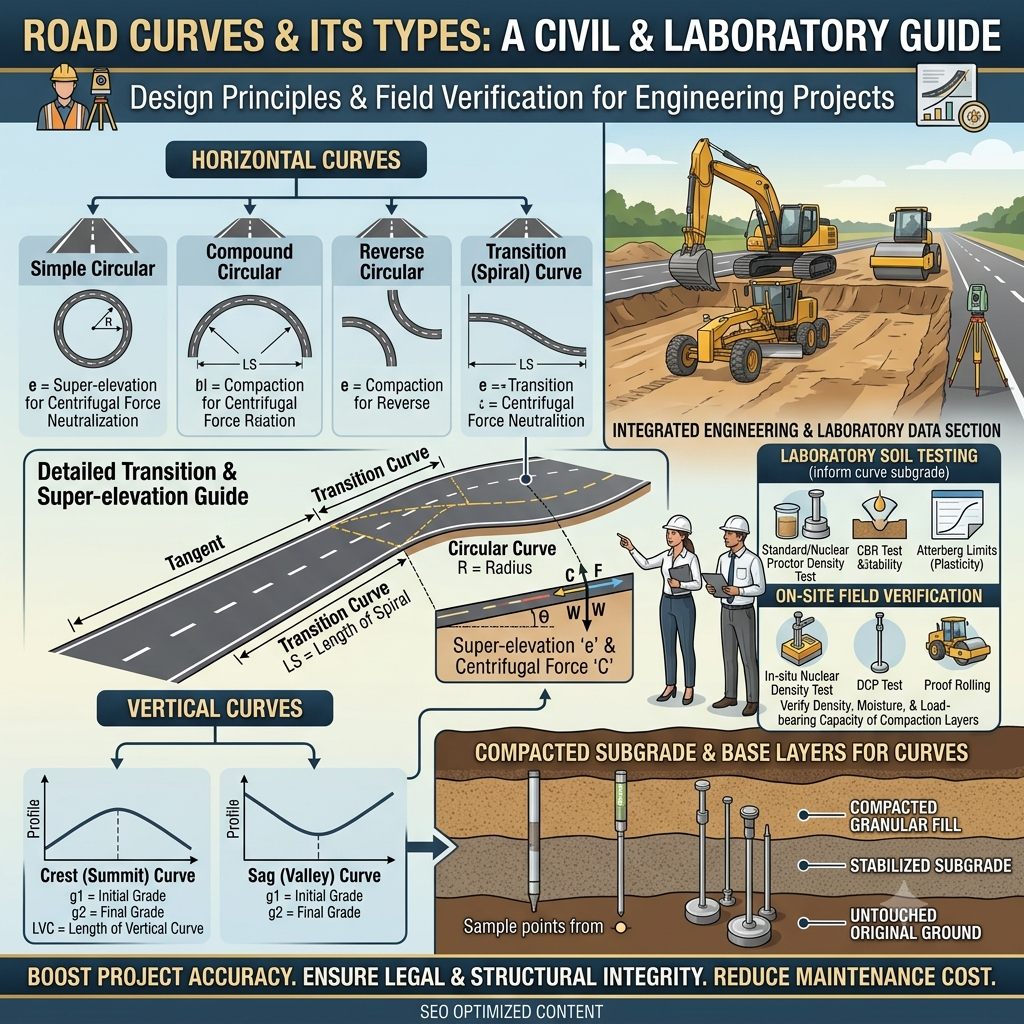
Road curves generally fall into two main categories:
- Horizontal Curves – Change the direction of the road in the horizontal plane.
- Vertical Curves – Change the slope or gradient of the road in the vertical plane.
A third category, Transition Curves, connects straight sections with circular curves, providing a gradual change in curvature.
Why Road Curves Are Important
Road curves are more than geometric features—they are essential safety elements of highway design.
Key Benefits of Properly Designed Road Curves
- Improve vehicle stability during turning.
- Enhance driver comfort.
- Reduce accident risks.
- Maintain safe operating speeds.
- Improve traffic flow.
- Minimize sudden steering movements.
- Protect pavement from uneven loading.
- Adapt road alignments to natural terrain.
Practical Example
Imagine a highway crossing a mountainous region. Constructing a perfectly straight road would require massive excavation and extremely high costs. Engineers instead design a series of carefully calculated curves that follow the natural landscape while maintaining safe travel conditions.
Types of Road Curves
1. Horizontal Curves
Horizontal curves change the direction of a road while keeping the roadway at approximately the same elevation.
These curves help vehicles navigate bends safely without abrupt steering movements.
Common Types of Horizontal Curves
Simple Circular Curve
A simple circular curve has a constant radius throughout its length.
It is widely used on:
- Rural highways
- Urban roads
- Collector roads
- Residential streets
Advantages
- Easy to design.
- Simple to construct.
- Economical for moderate deflection angles.
- Suitable for standard highway projects.
Compound Curve
A compound curve consists of two or more circular arcs with different radii that bend in the same direction.
Engineers commonly use compound curves where site constraints prevent the use of a single-radius curve.
Applications
- Mountain roads
- Urban corridors
- Bridge approaches
- Restricted terrain
Reverse Curve
A reverse curve consists of two consecutive curves bending in opposite directions.
These curves require careful design because vehicles change steering direction quickly.
Typical Locations
- Hill roads
- Interchanges
- Urban streets
- Access roads
Horizontal Curve Diagram
Straight Road
───────────────╮
               │
               )
              )
             )
─────────────╯
Straight Road
2. Vertical Curves
Vertical curves connect two different roadway grades to create a smooth transition in elevation.
Without vertical curves, vehicles would encounter sudden grade changes, reducing comfort and visibility.
Types of Vertical Curves
Summit (Crest) Curve
A summit curve forms where an uphill grade meets a downhill grade.
Characteristics
- Convex shape
- Limited stopping sight distance if too sharp
- Common on hills and ridges
Sag Curve
A sag curve forms where a downhill grade transitions into an uphill grade.
Characteristics
- Concave shape
- Better daytime visibility
- Requires careful nighttime headlight design
Vertical Curve Diagram
Summit Curve

        /\
      /    \
_____/      \_____

Sag Curve

_____\      /_____
      \    /
       \__/
3. Transition Curves
Transition curves provide a gradual change from a straight section of road to a circular curve.
Instead of introducing curvature suddenly, engineers increase the curvature progressively.
This gradual transition improves vehicle stability and reduces steering shock.
Common Transition Curve
- Spiral (Clothoid) Curve
Advantages
- Smooth steering movement.
- Improved passenger comfort.
- Better vehicle stability.
- Easier superelevation development.
- Reduced tire wear.
- Safer operation at higher speeds.
Transition Curve Diagram
Straight
──────────────╲
               ╲
                )
                 )
                  )
Engineering Principles of Road Curves
Designing road curves requires a combination of geometric design, vehicle dynamics, and safety analysis.
1. Design Speed
The selected design speed influences:
- Minimum curve radius
- Superelevation
- Sight distance
- Transition length
Higher design speeds require larger curve radii.
2. Centrifugal Force
When a vehicle moves around a curve, centrifugal force acts outward.
Engineers counteract this force by providing:
- Adequate curve radius
- Proper superelevation
- Suitable pavement friction
Balancing these factors helps prevent skidding and overturning.
3. Driver Comfort
Drivers should experience gradual steering movements rather than sudden directional changes.
Transition curves and smooth alignments improve comfort and reduce driver fatigue.
4. Vehicle Stability
Road curves must safely accommodate:
- Passenger cars
- Heavy trucks
- Buses
- Emergency vehicles
Designers consider wheelbase, turning characteristics, and vehicle speed to ensure stable movement through the curve.
Factors Affecting Road Curve Design
Several engineering factors influence the design of safe and efficient road curves.
Terrain
Mountainous terrain often requires sharper curves than flat plains due to natural constraints.
Design Speed
As vehicle speed increases, engineers increase the curve radius to maintain safety and comfort.
Traffic Volume
Highways carrying heavy traffic or large numbers of trucks require more generous curve geometry than lightly trafficked roads.
Vehicle Characteristics
Large commercial vehicles need greater turning space than passenger cars, influencing curve radius and lane width.
Sight Distance
Drivers must have sufficient visibility to stop safely or react to hazards before entering or while traveling through a curve.
Climate
Rain, snow, ice, and fog reduce tire friction and visibility. Engineers account for these conditions when selecting design parameters.
Construction Cost
Although larger-radius curves generally improve safety, they may require additional land acquisition, earthwork, or bridge construction. Designers strive to achieve a practical balance between safety, performance, and project cost.
Practical Applications of Road Curves
Road curves are indispensable across various transportation facilities, including:
- National highways
- Expressways
- Mountain roads
- Urban arterial roads
- Residential streets
- Airport access roads
- Industrial parks
- Bridge approaches
- Interchanges
- Scenic routes
Each application demands a tailored design that reflects expected traffic, terrain, speed, and safety requirements.
Key Takeaways
Road Curves are fundamental elements of highway geometric design. They enable safe changes in direction and elevation while improving driving comfort, traffic efficiency, and overall road safety. Horizontal, vertical, and transition curves each serve distinct engineering purposes, and their design depends on factors such as design speed, terrain, vehicle characteristics, traffic volume, and sight distance. Applying sound engineering principles during the planning stage creates durable, efficient, and safer road networks that meet both current and future transportation demands.
Superelevation in Road Curves
Superelevation is one of the most important design features of horizontal road curves. It refers to the upward tilt of the outer edge of the pavement relative to the inner edge. This inclination helps counteract the centrifugal force acting on moving vehicles and improves their stability while negotiating curves.
Without proper superelevation, vehicles may skid outward, especially during wet weather or at higher speeds.
Objectives of Superelevation
- Improve vehicle stability on curves.
- Reduce the risk of skidding and overturning.
- Increase passenger comfort.
- Distribute wheel loads more evenly.
- Minimize pavement wear.
- Enhance driving safety.
Factors Affecting Superelevation
Engineers determine the required superelevation based on:
- Design speed
- Radius of the curve
- Traffic composition
- Pavement surface condition
- Climatic conditions
- Side friction factor
Practical Example
Consider a highway with a design speed of 100 km/h. A sharp horizontal curve requires a greater degree of superelevation than a gentle curve because vehicles experience higher centrifugal forces at higher speeds.
Superelevation Diagram
Outer Edge
      /
     /
____/____________________
   /
  /
Inner Edge
The outer edge is raised to help vehicles maintain balance while traveling through the curve.
Extra Widening on Curves
Vehicles require additional roadway width while turning because the rear wheels do not follow the exact path of the front wheels. This phenomenon is known as off-tracking.
Engineers provide extra widening on curves to accommodate vehicle movement safely.
Why Extra Widening Is Necessary
- Large trucks occupy more space while turning.
- Drivers require additional clearance.
- Opposing vehicles need safe passing space.
- Steering corrections become easier.
Factors Influencing Extra Widening
- Curve radius
- Vehicle dimensions
- Traffic volume
- Number of lanes
- Design speed
Providing adequate widening improves safety and reduces side-swipe collisions.
Sight Distance on Road Curves
Safe visibility is essential for every road user. Drivers must clearly see obstacles, intersections, or stopped vehicles ahead to react in time.
Road curves often restrict visibility because of embankments, vegetation, buildings, retaining walls, or natural terrain.
Types of Sight Distance
Stopping Sight Distance (SSD)
The minimum distance required for a driver to perceive a hazard, react, and stop the vehicle safely.
Overtaking Sight Distance (OSD)
The distance required for a vehicle to safely overtake another without conflicting with oncoming traffic.
Decision Sight Distance
Provides additional distance for drivers to identify unexpected situations and make safe decisions.
Improving Sight Distance
Engineers enhance visibility by:
- Increasing curve radius.
- Removing roadside obstructions.
- Controlling vegetation.
- Flattening side slopes.
- Installing warning signs.
- Providing adequate lighting where necessary.
Sight Distance Diagram
Driver
   🚗
───────────────)
              )
             )
            X  Obstruction

Improved Curve

🚗──────────────────────────)
                           )
                          )
                       Clear Visibility
Construction Best Practices for Road Curves
Proper construction ensures that the designed geometry performs as intended throughout the road’s service life.
Best Practices
- Verify survey control points before construction.
- Follow approved alignment coordinates.
- Maintain specified curve radii.
- Construct superelevation gradually through transition curves.
- Achieve required compaction in embankments.
- Maintain proper pavement thickness.
- Ensure smooth pavement surfaces.
- Install drainage systems before paving.
- Calibrate surveying equipment regularly.
- Conduct continuous quality inspections.
Attention to detail during construction significantly improves ride quality and long-term pavement performance.
Common Mistakes in Road Curve Design and Construction
Even a well-designed road can experience problems if construction practices are poor.
Common Mistakes
- Selecting an inadequate curve radius.
- Providing insufficient superelevation.
- Ignoring transition curves.
- Neglecting sight distance requirements.
- Using inaccurate survey data.
- Constructing uneven pavement surfaces.
- Failing to install effective drainage.
- Allowing vegetation to obstruct visibility.
- Opening the road before completing safety features.
Avoiding these mistakes reduces maintenance costs and improves road safety.
Practical Field Recommendations
Civil Engineers
- Review survey data before approving the final alignment.
- Verify curve geometry during construction.
- Inspect superelevation development at regular intervals.
- Coordinate closely with surveyors and quality control teams.
- Monitor pavement smoothness before project completion.
Contractors
- Use experienced survey crews for setting out curves.
- Follow construction drawings accurately.
- Maintain moisture content during embankment compaction.
- Prevent heavy equipment from damaging completed pavement layers.
- Complete road markings and signage before opening the road.
Engineering Students
- Practice setting out simple and circular curves using surveying instruments.
- Understand the relationship between speed, radius, and superelevation.
- Study pavement behavior on curved sections.
- Visit active highway projects to observe curve construction techniques.
- Review real-world accident case studies to understand the importance of geometric design.
General IRC, AASHTO, and ICE Guidance
Leading highway engineering organizations emphasize similar principles for designing safe and durable road curves.
General Engineering Recommendations
- Select design speeds appropriate to the road classification.
- Provide sufficient curve radius for safe vehicle operation.
- Develop superelevation gradually through transition curves.
- Ensure adequate stopping sight distance on all curves.
- Design pavement widths to accommodate expected traffic.
- Maintain proper drainage to protect pavement performance.
- Install road signs, chevron markers, and guardrails where necessary.
- Conduct regular inspections and maintenance to preserve safety.
Although the exact values vary by region and project type, these principles are widely accepted in highway engineering practice and support safe roadway performance.
Importance of Regular Maintenance on Road Curves
Well-designed curves still require routine maintenance to remain safe throughout their service life.
Maintenance Activities
- Repair pavement cracks promptly.
- Clean roadside drainage systems.
- Repaint lane markings.
- Replace damaged guardrails.
- Remove vegetation that blocks visibility.
- Repair pavement edge failures.
- Inspect embankment stability.
- Maintain reflective road signs.
Preventive maintenance extends pavement life and reduces long-term rehabilitation costs.
Frequently Asked Questions (FAQs)
1. What are road curves in highway engineering?
Road curves are designed changes in the horizontal or vertical alignment of a roadway that allow vehicles to change direction or elevation safely and comfortably.
2. What are the main types of road curves?
The three primary types are horizontal curves, vertical curves, and transition curves. Each serves a specific purpose in highway geometric design.
3. Why is superelevation provided on horizontal curves?
Superelevation counteracts centrifugal force, improves vehicle stability, reduces skidding, and enhances driving safety.
4. What is the purpose of transition curves?
Transition curves gradually connect straight sections with circular curves, providing a smooth change in curvature and allowing drivers to steer comfortably.
5. Why is extra widening necessary on curves?
Extra widening provides additional roadway space for large vehicles and compensates for wheel off-tracking, improving safety and operational efficiency.
6. How does design speed affect road curve design?
Higher design speeds require larger curve radii, longer transition curves, and carefully designed superelevation to maintain safe vehicle movement.
7. What factors influence road curve design?
Terrain, traffic volume, vehicle characteristics, design speed, sight distance, climate, drainage, and construction cost all influence curve design.
8. Why is sight distance important on curves?
Adequate sight distance allows drivers to detect hazards early, react appropriately, and stop safely, significantly reducing accident risks.
9. Which professionals are responsible for road curve design?
Transportation engineers, highway engineers, surveyors, geotechnical engineers, and construction specialists collaborate to design and build safe road curves.
10. Which standards guide the design of road curves?
Highway engineers generally follow recognized guidance from organizations such as IRC, AASHTO, and ICE, along with national highway specifications applicable to their projects.
Conclusion
Road Curves are fundamental components of safe and efficient highway design. They enable roads to adapt to changing terrain while maintaining smooth traffic flow, driver comfort, and vehicle stability. Proper selection of curve radius, superelevation, transition curves, extra widening, and adequate sight distance significantly reduces accident risks and improves pavement performance. Careful surveying, accurate geometric design, quality construction, and regular maintenance ensure that curved road sections remain reliable throughout their service life. By applying sound engineering principles and following established guidance from organizations such as IRC, AASHTO, and ICE, engineers and contractors can deliver durable road infrastructure that meets modern transportation demands. Understanding Road Curves also equips engineering students and professionals with the knowledge required to design safer, more sustainable highways for future generations.
