
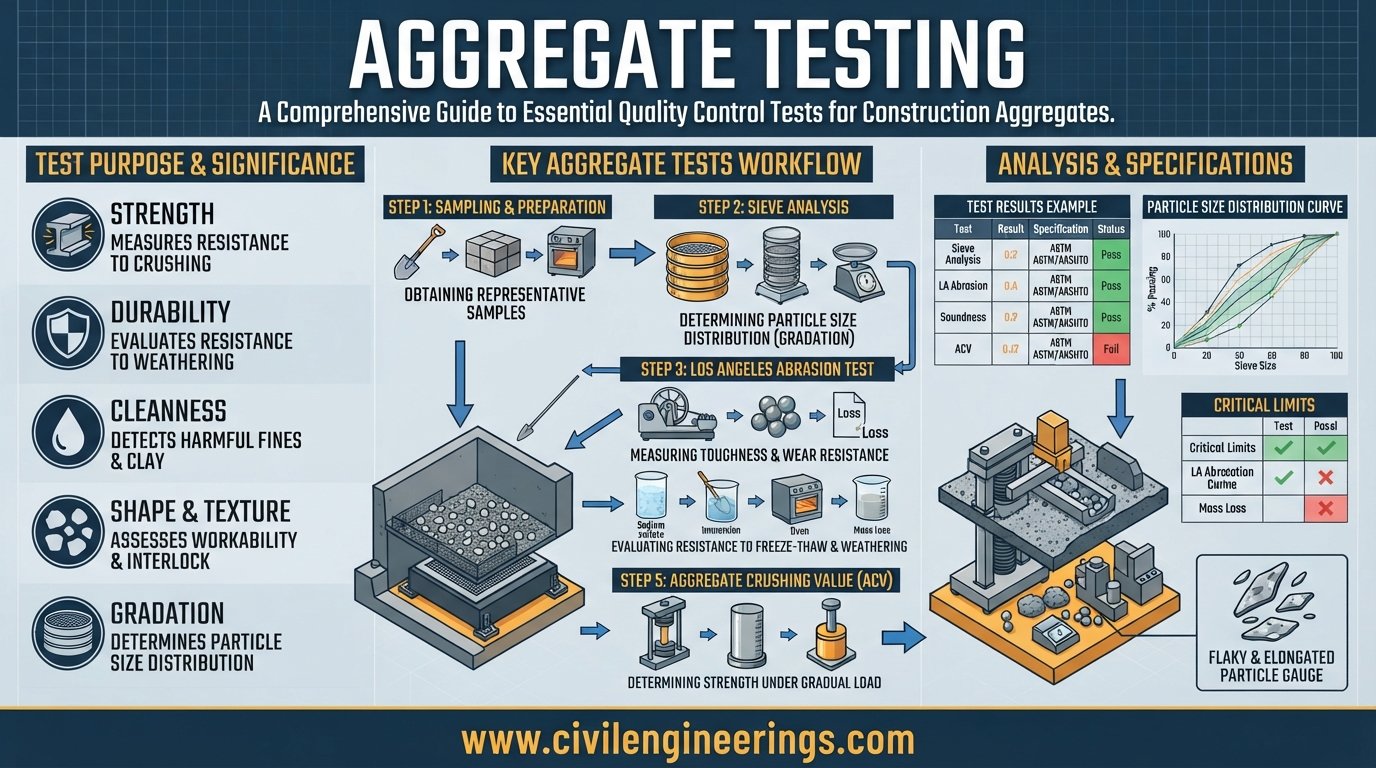
Aggregate is one of the most important components of concrete, asphalt mixtures, base courses, subbase layers, and other civil engineering works. Although aggregate often appears to be a simple crushed stone or sand, its particle size, shape, strength, cleanliness, density, and durability can significantly influence the performance of finished infrastructure.
Aggregate Testing provides engineers with the information needed to determine whether a material is suitable for its intended application. A poorly graded or weak aggregate can contribute to excessive deformation, rutting, cracking, segregation, poor compaction, premature pavement deterioration, and reduced concrete durability.
For this reason, aggregate testing should not be treated as a laboratory formality. It is an essential part of material selection, quality assurance, mix design, and construction quality control. This guide explains the major aggregate tests used in civil and highway engineering, their principles, important formulas, practical interpretation, common mistakes, and recommendations for students, engineers, and contractors.
What Is Aggregate Testing?
Aggregate testing is the systematic examination of coarse and fine aggregates to determine their physical, mechanical, geometric, and durability characteristics.
Aggregates may come from crushed rock, natural gravel, manufactured sources, recycled materials, or other approved mineral deposits. Before these materials are incorporated into a pavement or concrete structure, engineers need to establish whether their properties satisfy the project specification.
Typical aggregate properties investigated through laboratory testing include:
- Particle-size distribution
- Gradation
- Specific gravity
- Water absorption
- Bulk density
- Crushing resistance
- Impact resistance
- Abrasion resistance
- Soundness
- Particle shape
- Flakiness
- Elongation
- Cleanliness
- Percentage of deleterious materials
The exact tests required depend on the intended application. Highway aggregates, for example, may require greater emphasis on abrasion, toughness, particle shape, and polishing resistance than an aggregate intended for a relatively lightly loaded application.
ASTM standards include procedures for sieve analysis, density and absorption, soundness, clay lumps, material finer than 75 μm, abrasion, and other aggregate characteristics. (ASTM Store)


Why Is Aggregate Testing Important?
The quality of aggregate directly affects the behavior of construction materials.
In concrete, aggregate occupies a large proportion of the mixture. Its grading, surface texture, absorption, strength, and cleanliness influence workability, paste demand, density, strength, and durability.
In asphalt pavement, aggregate forms the structural skeleton of the mixture. Particle shape and angularity affect interlock, while abrasion resistance helps the aggregate withstand traffic and environmental action.
For pavement base and subbase materials, gradation and particle strength influence compaction, stability, drainage, and load distribution.
Quality Assurance and Quality Control
Aggregate testing allows engineers to compare supplied material with project requirements.
Quality assurance generally focuses on confirming that materials and processes meet specified requirements, while quality control involves routine monitoring during production and construction.
A contractor may therefore test:
- The quarry source before approval
- Stockpiled aggregate
- Material delivered to the site
- Aggregate entering an asphalt plant
- Aggregate used in concrete batching
- Recycled aggregate before incorporation
Testing also helps identify changes in quarry production. A material source that initially complies with requirements may change because of variations in rock strata, crushing operations, moisture, screening efficiency, or stockpile management.
Major Types of Aggregate Tests
Aggregate testing can be broadly divided into four groups:
- Gradation and physical property tests
- Strength and toughness tests
- Durability tests
- Particle shape and cleanliness tests
No single test provides a complete assessment of aggregate quality. A good engineering decision normally considers several test results together.
Sieve Analysis and Aggregate Gradation Test
Sieve analysis determines the particle-size distribution of fine or coarse aggregate.
The test separates a representative dry sample through a series of sieves with progressively smaller openings. The mass retained on each sieve is measured and converted into percentages.
ASTM C136/C136M is one commonly referenced method for determining the particle-size distribution of fine and coarse aggregates. ASTM also lists C117 for material finer than 75 μm determined by washing.
Basic Calculation
For a sieve fraction:
Percentage retained = (Mass retained on sieve / Total sample mass) × 100
Then:
Percentage passing = 100 − Cumulative percentage retained
For example, if a 5,000 g aggregate sample has 750 g retained cumulatively above a particular sieve:
Cumulative retained = (750 / 5,000) × 100 = 15%
Therefore:
Percentage passing = 100 − 15 = 85%
The results are normally plotted as a particle-size distribution curve.
Why Gradation Matters
Good gradation can improve particle packing and reduce excessive voids. In asphalt mixtures, it affects aggregate interlock and binder demand. In concrete, grading influences workability, paste requirements, segregation, and overall mixture economy.
A poorly controlled gradation can cause:
- Excessive voids
- Segregation
- Difficult compaction
- Increased binder or cement demand
- Unstable asphalt mixtures
- Variable concrete workability


Specific Gravity and Water Absorption Test
Specific gravity describes the density of aggregate relative to water. Water absorption indicates how much water an aggregate can absorb into its pores.
These properties are important in concrete mix design, asphalt mix design, aggregate proportioning, and moisture correction.
ASTM C127 covers relative density and absorption of coarse aggregate, while ASTM C128 covers fine aggregate. (ASTM Store)
Specific Gravity of Aggregate
For coarse aggregate, a commonly used bulk specific gravity relationship is:
Bulk specific gravity = A / (B − C)
Where:
- A = oven-dry mass of aggregate
- B = saturated surface-dry mass in air
- C = apparent mass of aggregate submerged in water
The exact calculation and conditioning procedure must follow the applicable test standard.
Water Absorption Formula
Water absorption (%) = [(B − A) / A] × 100
Where:
- A = oven-dry mass
- B = saturated surface-dry mass
Higher absorption generally indicates a more porous aggregate, although the engineering significance depends on the aggregate type and application.
Engineering Significance
High absorption can affect:
- Effective water content
- Asphalt binder absorption
- Concrete water demand
- Moisture corrections
- Freeze-thaw durability
- Aggregate handling
Therefore, absorption should be considered during mixture proportioning rather than simply recorded as a laboratory number.
Aggregate Crushing Value Test
The Aggregate Crushing Value (ACV) test evaluates the resistance of aggregate to crushing under a gradually applied compressive load.
The test is particularly useful for understanding the relative strength of aggregate used in pavement construction.
After loading, the crushed material is sieved, and the percentage passing the specified sieve is determined.
Formula
Aggregate Crushing Value (%) = (Weight of fines produced / Original sample weight) × 100
A lower crushing value generally indicates greater resistance to crushing.
However, acceptance criteria should always come from the applicable project specification rather than from a universal number.
Practical Application
ACV is useful when assessing aggregates for:
- Road bases
- Subbase materials
- Pavement layers
- Concrete
- General construction
It should be interpreted alongside abrasion and impact results because aggregates can behave differently under gradual compression and sudden loading.
Aggregate Impact Value Test
The Aggregate Impact Value (AIV) measures the resistance of aggregate to sudden impact or shock.
This property is particularly relevant to pavement materials exposed to dynamic traffic loading.
During the test, aggregate is subjected to repeated impact from a standardized hammer arrangement. The resulting fines are separated and weighed.
Formula
Aggregate Impact Value (%) = (Weight of fines / Original sample weight) × 100
A lower value generally indicates better resistance to impact.
The test is different from the crushing value test. Crushing involves gradually applied loading, whereas impact testing represents a more sudden loading condition.
Los Angeles Abrasion Test
The Los Angeles abrasion test evaluates aggregate resistance to degradation caused by abrasion and impact.
It is widely used for aggregates intended for road and pavement applications.
ASTM C131/C131M covers small-size coarse aggregate, while ASTM C535 covers larger-size coarse aggregate in the Los Angeles machine. ASTM notes that the test is widely used as an indicator of relative aggregate quality for sources with similar mineral characteristics.


Principle of the Test
A measured aggregate sample is placed inside a rotating steel drum together with a specified abrasive charge. Rotation causes impact and abrasion.
After the specified testing cycle, the material is removed and sieved. The loss is calculated from the difference between the initial and final mass according to the applicable test procedure.
A representative calculation is:
Los Angeles abrasion loss (%) = [(W₁ − W₂) / W₁] × 100
Where:
- W₁ = original dry sample mass
- W₂ = mass retained after the prescribed test and sieving
The exact charge, grading, number of revolutions, and sieve arrangement must be taken from the applicable standard.
Why It Matters
High abrasion resistance is important where aggregate experiences repeated:
- Wheel loading
- Surface friction
- Particle-to-particle impact
- Crushing and degradation
- Construction handling
A high abrasion loss may indicate that an aggregate is unsuitable for a demanding pavement application, subject to the governing specification.
Soundness Test of Aggregate
The soundness test examines aggregate resistance to weathering-related deterioration.
ASTM C88/C88M uses repeated immersion in saturated sodium sulfate or magnesium sulfate solutions followed by drying. The process creates internal stresses intended to simulate certain weathering effects. (ASTM Store)
Importance of Soundness
An aggregate may have adequate initial strength but still deteriorate under repeated environmental exposure.
Soundness testing is therefore relevant where aggregates may experience:
- Repeated wetting and drying
- Severe environmental conditions
- Freezing and thawing
- Salt exposure
- Moisture-related deterioration
ASTM specifically cautions that soundness results can have limited precision and should not necessarily be used alone to reject aggregate without considering other evidence related to the intended service environment. (ASTM Store)
Flakiness Index and Elongation Index
Particle shape strongly influences aggregate performance.
Flaky particles are relatively thin compared with their nominal size. Elongated particles are relatively long.
Flaky and elongated particles can reduce particle interlock and may create orientation-related weaknesses in some pavement and concrete applications.
Flakiness Index
The flakiness index is generally expressed as the percentage by mass of particles whose thickness is below the specified limit for the relevant size fraction.
Flakiness Index (%) = (Mass of flaky particles / Total sample mass) × 100
Elongation Index
The elongation index represents the proportion of aggregate particles exceeding the specified length criterion.
Elongation Index (%) = (Mass of elongated particles / Total sample mass) × 100
The precise particle-size ranges and gauge dimensions depend on the adopted standard.


Bulk Density and Unit Weight Test
Bulk density, or unit weight, represents the mass of aggregate occupying a known bulk volume, including the voids between particles.
ASTM C29/C29M is a commonly referenced method for determining bulk density and voids in aggregate. (ASTM Store)
The basic relationship is:
Bulk density = Mass of aggregate / Volume of container
Unit weight information is useful for:
- Concrete batching
- Storage calculations
- Aggregate stockpile estimation
- Void calculations
- Mixture proportioning
- Comparing loose and compacted conditions
Engineers should distinguish between loose and rodded or compacted unit weight because particle arrangement changes the volume occupied by the material.
Material Finer Than 75 Microns
Excessive dust, clay, and very fine particles can interfere with aggregate performance.
The material finer than 75 μm can be determined by washing according to ASTM C117. ASTM identifies this test as a method for determining material passing the 75-μm sieve by washing. (ASTM Store)
Excess fines may:
- Increase water demand
- Interfere with cement-aggregate bonding
- Coat larger particles
- Affect asphalt coating
- Reduce mixture stability
- Increase shrinkage or durability concerns in certain applications
The engineer should distinguish harmless mineral fines from clay-like or deleterious material.
Clay Lumps, Friable Particles, and Organic Impurities
Aggregates should not contain excessive amounts of weak or harmful contaminants.
ASTM C142/C142M addresses clay lumps and friable particles, while ASTM C40/C40M addresses organic impurities in fine aggregate. (ASTM Store)
Weak particles may break during:
- Crushing
- Mixing
- Compaction
- Traffic loading
- Concrete placement
Organic contamination can interfere with cement hydration and may adversely affect concrete performance.
Consequently, visual inspection alone should not replace laboratory testing when material quality is uncertain.
Aggregate Testing for Highway Construction
Highway aggregate selection requires a performance-based approach.
For flexible pavements, engineers may pay particular attention to:
- Gradation
- Los Angeles abrasion
- Aggregate impact resistance
- Crushing resistance
- Flakiness and elongation
- Polishing resistance where relevant
- Water absorption
- Cleanliness
- Soundness
Base and subbase materials, gradation, particle strength, durability, fines content, and moisture-related characteristics become especially important.
For concrete pavement, aggregate quality must also be evaluated for durability, absorption, particle shape, soundness, and compatibility with the concrete mixture.
The correct requirements should come from the contract documents and governing road authority specification. IRC publications, AASHTO methods, ASTM standards, national highway specifications, and other recognized standards may be referenced depending on the project jurisdiction.
Aggregate Testing Standards: IRC, AASHTO, ASTM, and ICE
There is no single worldwide aggregate testing standard that applies to every project.
IRC Standards
In India and on projects using Indian specifications, relevant IRC publications and associated specifications may establish aggregate requirements for pavement and highway works.
AASHTO Standards
AASHTO test methods are extensively used in transportation engineering in the United States and internationally. They cover aggregate gradation, abrasion, durability, specific gravity, soundness, and other pavement-material properties.
ASTM Standards
ASTM provides widely recognized laboratory test methods. For example, ASTM’s current aggregate standards include methods for gradation, density and absorption, soundness, material finer than 75 μm, and Los Angeles abrasion. (ASTM Store)
ICE References
The Institution of Civil Engineers (ICE) provides engineering knowledge, professional guidance, specifications, and technical resources, but engineers should not automatically treat ICE as the governing test-method authority for every aggregate test.
Best practice: identify the governing contract specification first, then use the referenced test method. Do not mix requirements from different standards without checking their applicability.
Common Aggregate Testing Mistakes
Several mistakes can reduce the reliability of test results even when the laboratory equipment itself is accurate.
Poor Sampling
A laboratory test is only as representative as the sample submitted.
Sampling from one convenient location in a large stockpile can produce misleading results if segregation has occurred.
Incorrect Sample Preparation
Improper drying, contamination, inadequate separation, or incorrect sample reduction can alter results.
ASTM C702/C702M, for example, addresses practices for reducing aggregate samples to testing size. (ASTM Store)
Ignoring Moisture Condition
Aggregate moisture can significantly affect mass-based calculations and mixture proportions.
Engineers should clearly identify whether material is:
- Oven dry
- Air dry
- Saturated surface dry
- Wet
Using the Wrong Acceptance Limit
A test result should not be judged using an arbitrary value found in an unrelated textbook or website.
Acceptance limits vary according to:
- Aggregate size
- Intended application
- Traffic category
- Pavement layer
- Concrete exposure
- Governing specification
- Adopted test method
Relying on One Test
A low abrasion value does not automatically prove that aggregate is suitable for every application.
Good engineering decisions consider the complete property profile.
Practical Aggregate Testing Workflow
A reliable project workflow can follow these steps:
Source approval → Representative sampling → Sample preparation → Required laboratory tests → Result verification → Specification comparison → Source acceptance/rejection → Routine production monitoring
For a new quarry, the engineer should establish baseline properties before large-scale production begins.
During construction, periodic testing can confirm that production remains consistent.
If a significant change occurs in:
- Quarry face
- Crushing plant
- Screening arrangement
- Aggregate source
- Stockpile
- Material appearance
additional testing may be justified.
Practical Recommendations for Students, Engineers, and Contractors
For Civil Engineering Students
Learn the principle behind each test, not just the apparatus and formula.
Understand why a low abrasion value is desirable, why grading affects voids, and how absorption influences concrete or asphalt mix calculations.
Practice interpreting laboratory results rather than memorizing isolated limits.
For Highway Engineers
Select tests according to the expected pavement distress mechanisms.
For heavily trafficked roads, pay particular attention to abrasion, toughness, particle shape, gradation, and durability. Consider actual service conditions and aggregate performance history whenever available.
ASTM itself notes that Los Angeles abrasion results should be interpreted carefully when comparing materials with substantially different mineralogical characteristics. (ASTM Store)
For Site Engineers
Do not accept aggregate solely because it visually resembles approved material.
Check:
- Delivery source
- Stockpile condition
- Visible contamination
- Particle size
- Segregation
- Moisture
- Laboratory test status
- Material certificates
Coordinate field observations with laboratory results.
For Contractors
Maintain separate stockpiles for different sizes and sources. Prevent contamination from soil, organic material, construction debris, and incompatible aggregates.
Control crushing and screening operations because changes in plant settings can alter particle-size distribution and particle shape.
For Consultants and Government Engineers
Require traceable sampling and testing records. Establish clear acceptance criteria before construction begins.
When results are marginal, investigate the complete material history instead of accepting or rejecting a source based on one number.
How to Interpret an Aggregate Test Report
A professional aggregate test report should normally identify:
- Project name
- Sample identification
- Material source
- Sampling date
- Test date
- Sample description
- Applicable test method
- Test result
- Specification requirement
- Laboratory identification
- Technician or responsible personnel
- Remarks and limitations
For example, an aggregate report might contain sieve analysis, specific gravity, absorption, abrasion, impact, and shape-test results. These results should be reviewed together.
A result should always be connected to the correct test method and specification edition.
Frequently Asked Questions About Aggregate Testing
What is the purpose of aggregate testing?
Aggregate testing determines whether aggregate has suitable gradation, strength, toughness, durability, density, shape, and cleanliness for its intended construction application.
Which aggregate test is most important?
There is no universally most important test. The required tests depend on the application. Highway pavement aggregate may require abrasion, impact, crushing, gradation, shape, and durability testing, while concrete aggregate may require additional emphasis on absorption, soundness, and deleterious materials.
What does aggregate crushing value indicate?
Aggregate crushing value indicates resistance to crushing under gradually applied compressive loading. A lower value generally represents stronger resistance to crushing.
What does aggregate impact value measure?
Aggregate impact value measures resistance to sudden impact or shock. It is particularly relevant when aggregate is exposed to dynamic loading.
What is the purpose of the Los Angeles abrasion test?
The Los Angeles abrasion test evaluates aggregate resistance to degradation caused by abrasion and impact. ASTM C131/C131M and C535 address different aggregate size ranges. (ASTM Store)
Why is aggregate gradation important?
Gradation controls the distribution of particle sizes. It affects packing, voids, workability, compaction, stability, cement or binder demand, and mixture performance.
What is the difference between flakiness and elongation?
Flakiness relates primarily to particles that are unusually thin, while elongation relates to particles that are unusually long. Both describe aggregate particle shape.
Why is aggregate water absorption tested?
Water absorption provides an indication of aggregate porosity and helps engineers account for moisture movement during concrete and asphalt mixture design.
Can one aggregate test determine overall aggregate quality?
No. Aggregate performance depends on multiple characteristics. A comprehensive assessment combines appropriate physical, mechanical, durability, shape, and cleanliness tests.
Which standard should be used for aggregate testing?
The governing project specification should identify the applicable standard. Depending on the project, this may involve ASTM, AASHTO, IRC, national highway specifications, BS/EN standards, or another recognized system.
Conclusion
Aggregate Testing is fundamental to reliable civil and highway construction because aggregate quality influences the strength, stability, durability, workability, and long-term performance of concrete and pavement systems. Tests such as sieve analysis, specific gravity, water absorption, crushing value, impact value, Los Angeles abrasion, soundness, flakiness, elongation, bulk density, and cleanliness testing each examine a different aspect of aggregate behavior.
The most effective quality-control strategy is not to depend on one favorable laboratory result. Engineers should evaluate representative samples, use the correct test methods, compare results with the governing specification, and monitor material consistency throughout production and construction.
For students, understanding the engineering principle behind every test is more valuable than memorizing formulas. For engineers and consultants, correct interpretation matters as much as accurate testing. Contractors should focus on representative sampling, stockpile control, source consistency, and prevention of contamination.
Ultimately, good aggregate testing converts an apparently simple construction material into a measurable engineering input—and that evidence helps produce safer, stronger, and more durable infrastructure.
