
Introduction
Strong aggregates are the backbone of durable roads, pavements, and concrete structures. Even when an aggregate looks hard and durable, its behavior under sustained compressive loading can tell a very different story. Weak particles may fracture during compaction, under repeated wheel loads, or when they become part of a heavily loaded concrete or pavement system. This is where the Aggregate Crushing Value Test becomes important.
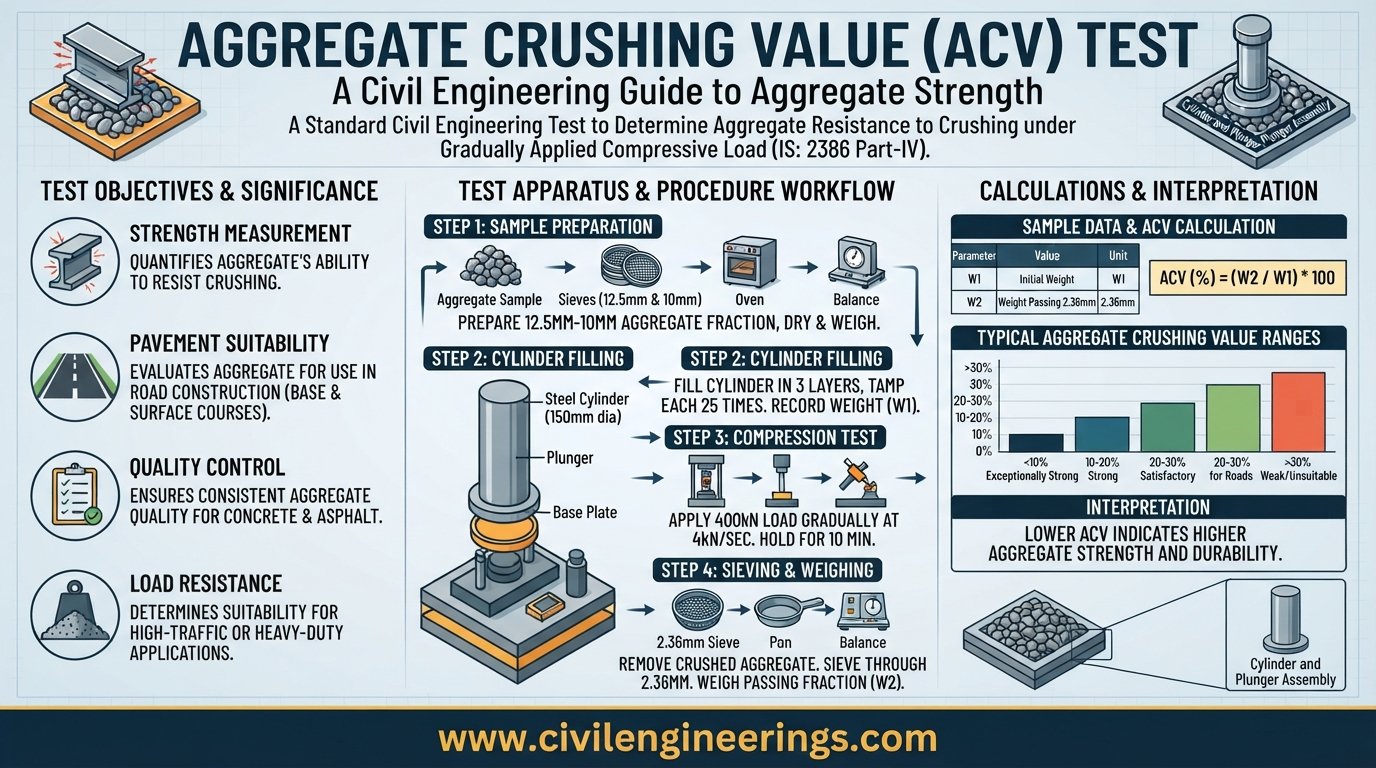
The Aggregate Crushing Value (ACV) test provides a relative measure of the resistance of coarse aggregate to crushing under a gradually applied compressive load. A lower crushing value generally indicates better resistance to crushing and, therefore, a stronger aggregate for applications where compressive degradation is important.
This guide explains the Aggregate Crushing Value Test in practical detail, including its definition, objective, apparatus, sample preparation, test procedure, formula, worked calculation, interpretation, precautions, common errors, applications, limitations, and relationship with other aggregate tests. It also discusses relevant Indian and British standards and explains what engineers should consider when selecting aggregates for road and concrete construction.
What Is the Aggregate Crushing Value Test?
The Aggregate Crushing Value Test is a laboratory test used to determine the relative resistance of coarse aggregate to crushing when subjected to a gradually increasing compressive load.
During the test, a prepared aggregate sample is placed inside a steel cylinder and compressed through a plunger. The crushed material is subsequently sieved. The percentage of material passing the specified fine sieve is calculated relative to the original sample mass.
In simple terms:
Higher ACV = greater crushing and generally weaker aggregate.
Lower ACV = less crushing and generally stronger aggregate.
The test therefore acts as an index of aggregate crushing resistance rather than a direct measurement of the compressive strength of an individual aggregate particle.
The standard Indian method is covered by IS 2386 (Part IV):1963, Methods of Test for Aggregates for Concrete—Mechanical Properties. The British method is covered by BS 812-110:1990, which describes ACV as a relative measure of resistance to crushing under gradually applied compressive load.
Objective of the Aggregate Crushing Value Test
The primary objective is to determine the resistance of coarse aggregate to crushing under a gradually applied compressive load.
The test is useful for:
- Assessing the mechanical quality of coarse aggregate.
- Comparing aggregate sources.
- Evaluating aggregate suitability for pavement construction.
- Supporting quality control during aggregate production.
- Identifying comparatively weak aggregate materials.
- Checking whether aggregate complies with project specifications.
- Comparing laboratory results between different sources or production lots.
For highway engineers, the result is particularly useful because aggregate particles within a pavement experience repeated stresses from construction equipment and traffic. If the particles crush excessively, they can generate additional fines and alter the intended gradation.
This can affect drainage, compaction, interlock, stiffness, and long-term pavement performance.
Principle of the Aggregate Crushing Value Test
The principle is straightforward.
A known mass of aggregate is subjected to a specified compressive load. The load causes some aggregate particles to fracture and generate smaller particles. After loading, the crushed sample is sieved through the specified sieve.
The mass of material passing that sieve represents the fines produced by crushing.
The ACV is calculated as:
Aggregate Crushing Value (%) = (B / A) × 100
Where:
- A = mass of the original test sample
- B = mass of material passing the specified sieve after crushing
The lower the percentage of crushed material, the greater the aggregate’s resistance to crushing.
Engineering Meaning of the Result
Suppose an aggregate produces only a small quantity of fines under the specified loading condition. This suggests that its particles resisted fracture relatively well.
If a large percentage passes the fine sieve after loading, substantial particle breakdown has occurred. Such aggregate may be unsuitable for applications requiring high resistance to compressive degradation.
However, engineers should not interpret ACV as a universal measure of aggregate quality. Aggregate performance depends on several properties, including mineralogy, particle shape, abrasion resistance, toughness, durability, soundness, absorption, and the actual stresses imposed by the pavement or concrete system.
Apparatus Required for the Test
A typical Aggregate Crushing Value Test requires the following equipment:
Steel Crushing Cylinder
The apparatus includes a robust steel cylinder capable of containing the aggregate sample during loading.
The cylinder works together with a base plate and plunger to transmit the compressive force to the aggregate.
Plunger
The plunger fits inside the cylinder and transfers the load from the compression testing machine onto the aggregate.
Its surface should be clean, smooth, and properly aligned.
Base Plate
The base plate supports the cylinder during the test and provides a stable loading arrangement.
Compression Testing Machine
A compression testing machine applies the required load at a controlled rate.
For the conventional IS 2386 procedure, the load is applied uniformly until the specified total load is reached.
Tamping Rod
A metal tamping rod is used to compact the aggregate into the cylinder in layers.
Uniform tamping is important because inconsistent compaction can influence the amount of crushing.
Standard Sieves
Typical sieves associated with the Indian procedure include:
- 12.5 mm sieve
- 10 mm sieve
- 2.36 mm sieve
BIS documentation for aggregate quality-control testing identifies these sieves along with the cylinder, tamping rod, weighing balance, oven, and compression testing machine. (BIS)
Weighing Balance
The balance must provide adequate accuracy for measuring both the original sample and the crushed fraction.
Drying Oven
An oven is used to bring the aggregate to the specified dry condition before testing.
Other Accessories
The laboratory may also require:
- Sample trays
- Brushes
- Scoop
- Steel scale
- Containers
- Labels
- Protective equipment
- Cleaning equipment


Sample Preparation for Aggregate Crushing Value Test
Correct sample preparation is one of the most important stages of the test.
For the conventional Indian method, the test uses a specified coarse aggregate size fraction. The commonly used laboratory procedure prepares material passing the 12.5 mm sieve and retained on the 10 mm sieve.
The sample should be representative of the aggregate source being evaluated.
Drying the Aggregate
The aggregate is dried according to the applicable test procedure and allowed to cool before weighing.
Moisture can influence the measured mass and introduce inconsistency between test determinations.
Obtaining the Required Size Fraction
The aggregate is separated using the appropriate sieves.
Material outside the specified grading should not simply be mixed into the test portion because the particle size distribution influences the crushing response.
Preparing Duplicate Test Portions
Two test determinations are normally performed using representative portions of the same aggregate material.
Duplicate testing provides a useful check on repeatability and reduces the risk of relying on one anomalous result.
Aggregate Crushing Value Test Procedure
The following sequence summarizes the conventional laboratory procedure.
Fill the Cylinder in Layers
Place the cylinder on its base plate.
Divide the prepared aggregate into approximately three equal portions.
Place the first portion into the cylinder and compact it using the specified number of blows from the tamping rod.
Repeat the process for the second and third portions.
The objective is to achieve consistent packing rather than excessive compaction.
Level the Aggregate Surface
After placing and tamping the final layer, level the surface of the aggregate.
Avoid disturbing the compacted material unnecessarily.
Insert the Plunger
Place the plunger carefully over the aggregate.
The plunger should sit correctly and remain properly aligned with the cylinder.
Misalignment can produce uneven loading and potentially affect the result.
Apply the Compressive Load
Place the complete assembly in the compression testing machine.
Apply the load uniformly according to the applicable standard.
Under the traditional IS 2386 procedure, the total load is brought to approximately 40 tonnes (about 400 kN) at a controlled rate, reaching the specified load over approximately 10 minutes. (Law Resource)
The important engineering principle is controlled loading. Sudden impact or uncontrolled loading changes the nature of the test and can make the result unsuitable for comparison with standard values.
Remove and Sieve the Crushed Material
Release the load after completing the loading stage.
Carefully remove the entire aggregate from the cylinder.
Transfer the complete material to the specified sieve, commonly the 2.36 mm IS sieve for the standard determination.
Sieve until no significant additional material passes.
Weigh the Crushed Fraction
Collect the material passing the 2.36 mm sieve and weigh it accurately.
This mass is represented by B in the ACV formula.
Careful material recovery is essential. Losing fine particles during transfer or sieving can produce an artificially low crushing value.


Aggregate Crushing Value Formula
The standard calculation is:
ACV (%) = (B / A) × 100
Where:
A = original mass of the surface-dry test sample
B = mass of crushed material passing the specified sieve
Worked Example
Assume the following results are obtained:
- Original sample mass, A = 3000 g
- Material passing 2.36 mm sieve, B = 690 g
Therefore:
ACV = (690 / 3000) × 100
ACV = 23.0%
Suppose a second determination gives:
- Original sample mass = 3020 g
- Material passing 2.36 mm = 710 g
Then:
ACV = (710 / 3020) × 100
ACV ≈ 23.5%
The mean is approximately:
Mean ACV = (23.0 + 23.5) / 2
Mean ACV ≈ 23.25%
The applicable standard determines how the final result is reported. The Indian method specifies reporting the mean of the two determinations according to its prescribed rounding convention. (Law Resource)
How to Interpret Aggregate Crushing Value Results
A lower ACV generally indicates better resistance to crushing.
For example:
- Low ACV: relatively strong resistance to crushing.
- Moderate ACV: acceptable performance may depend on the intended application.
- High ACV: greater particle breakdown and potentially poorer suitability for demanding applications.
However, engineers should never approve or reject an aggregate solely from a generic ACV number.
The controlling project specification should always take precedence.
Typical Engineering Interpretation
In many traditional road-engineering references, lower ACV values are associated with higher-quality aggregates for demanding pavement applications.
Some older Indian practice references cite maximum values such as 30% for certain concrete pavement applications and 45% for certain wearing-surface applications. These figures should not be treated as universal acceptance criteria because requirements vary with the governing specification, pavement layer, aggregate type, and project conditions.
A project engineer should therefore check the applicable road authority, contract specification, or material standard before establishing an acceptance limit.
Why Lower ACV Is Usually Preferred
Consider two aggregates:
- Aggregate A: ACV = 18%
- Aggregate B: ACV = 36%
Under the same test conditions, Aggregate A produced less crushed material.
If all other factors are comparable, Aggregate A demonstrates better resistance to crushing.
That does not automatically mean Aggregate A will outperform Aggregate B in every pavement. Abrasion, impact, polishing, moisture susceptibility, durability, particle shape, and mineralogy can also control field performance.
Factors Affecting Aggregate Crushing Value
Several factors can influence the test result.
Mineralogical Composition
The mineral composition of the aggregate strongly affects its resistance to fracture.
Dense, strong rock types often resist crushing better than weak, highly weathered, porous, or friable materials.
Particle Shape
Flaky or elongated particles may behave differently from more equidimensional particles.
Particle arrangement within the cylinder can influence stress concentration and fracture.
Aggregate Size and Grading
ACV is associated with a specified aggregate size fraction.
Changing the size fraction can change the measured result. The Indian standard itself notes that different aggregate sizes can produce different crushing values. (Law Resource)
Moisture Condition
Improper moisture control can influence mass and particle behavior.
For repeatable laboratory testing, sample preparation and conditioning should follow the applicable standard.
Compaction
Uneven tamping produces inconsistent packing.
One test specimen may contain more voids while another is more tightly packed, resulting in different stress distributions.
Loading Rate
The load must be applied according to the prescribed procedure.
Applying the load too quickly can introduce behavior closer to impact or dynamic loading rather than the intended gradually applied compressive condition.
Common Errors in the Aggregate Crushing Value Test
Even a simple laboratory test can produce misleading results if quality control is poor.
Loss of Fine Material
This is one of the most common practical problems.
If fines are lost while transferring or sieving the crushed aggregate, the calculated ACV will be lower than the actual value.
Incorrect Aggregate Grading
Using material outside the specified size fraction can make results difficult to compare with standard values.
Inconsistent Tamping
Different numbers of blows or significantly different compaction effort between specimens can affect particle arrangement.
Incorrect Loading Rate
The compression machine should apply the load uniformly and in accordance with the specified procedure.
Poor Equipment Alignment
The plunger should remain correctly positioned.
A tilted or poorly aligned plunger can introduce non-uniform loading.
Inaccurate Weighing
Balances should be checked and maintained.
Small weighing errors can become significant when the crushed fraction is used directly in the calculation.
Reporting Only One Result
Duplicate testing provides a valuable check.
Where the applicable standard requires two determinations, both individual results should be recorded before calculating the final reported value.
Precautions and Safety Measures
Laboratory personnel should follow appropriate safety procedures throughout the test.
Important precautions include:
- Inspect the compression machine before testing.
- Check the cylinder and plunger for damage.
- Confirm proper alignment before applying load.
- Keep hands away from moving machine components.
- Use appropriate personal protective equipment.
- Avoid standing unnecessarily close to the machine during loading.
- Handle oven-dried aggregates carefully.
- Prevent loss of fines during transfer.
- Clean sieves without damaging the mesh.
- Record masses immediately and accurately.
- Keep the work area free from loose aggregate.
- Follow the laboratory’s machine-specific safety procedures.
A compression testing machine stores substantial mechanical energy. Operators should never attempt to adjust the specimen while significant load is being applied.
Applications of Aggregate Crushing Value Test
The ACV test has several practical applications in civil engineering.
Road Construction
Aggregate is a major component of pavement layers.
Crushing-resistant aggregate helps maintain particle interlock and intended grading under construction and service loads.
Pavement Base and Subbase Assessment
Engineers can use ACV alongside other mechanical and durability tests to compare aggregate sources for pavement layers.
Concrete Aggregate Evaluation
Coarse aggregate forms a major portion of concrete volume.
Its mechanical properties influence the behavior of concrete, particularly where aggregate quality becomes a controlling factor.
Quarry Quality Control
Aggregate producers can periodically test material from different production zones or crushing operations.
Changes in ACV can indicate changes in source rock or production material.
Aggregate Source Selection
During project development, engineers may compare several quarry sources.
ACV can form part of a broader aggregate characterization program.
Aggregate Crushing Value vs Other Aggregate Tests
ACV should not be confused with other mechanical tests.
ACV vs Aggregate Impact Value
The Aggregate Crushing Value Test evaluates resistance to gradually applied compressive loading.
The Aggregate Impact Value Test evaluates resistance to sudden impact.
These loading mechanisms are different. An aggregate may therefore perform differently in the two tests.
ACV vs Los Angeles Abrasion Test
The Los Angeles abrasion test evaluates degradation caused by abrasion and impact in a rotating drum with an abrasive charge.
In the United States, ASTM C131/C131M and AASHTO T 96 are commonly associated with Los Angeles abrasion testing. These are not simply alternative names for the ACV test.
Therefore, an engineer should not substitute a Los Angeles abrasion result for an ACV result unless the governing specification explicitly permits it.
ACV vs Ten Percent Fines Value
The Ten Percent Fines Value (TFV) is another aggregate strength-related test.
It determines the load required to produce a specified amount of fines rather than simply reporting the percentage of fines produced under one fixed loading condition.
BS 812-110 specifically notes that its ACV method is not suitable for aggregates with an ACV higher than 30 and points toward the ten-percent-fines method in such cases.


IRC, IS, AASHTO and BS/ICE Reference Considerations
Engineers should always distinguish between a test method and an acceptance specification.
IS 2386
IS 2386 Part IV provides the Indian test methodology for mechanical properties of aggregates, including aggregate crushing value.
BIS continues to list IS 2386 Part 4:1963 in its standards database, while IS 383 provides aggregate requirements for concrete and references aggregate crushing value/ten-percent-fines testing within its quality-control framework. (Bureau of Indian Standards)
BS 812-110
BS 812-110:1990 specifically addresses determination of Aggregate Crushing Value. Its standard test is based on a specified aggregate size range and gradually applied compressive loading.
AASHTO and ASTM
There is no need to describe ASTM or AASHTO procedures as direct equivalents of the traditional ACV test without checking the applicable specification.
US highway practice commonly relies on other aggregate degradation and durability tests, including Los Angeles abrasion under ASTM C131/C131M and AASHTO T 96.
Therefore, when a project specification calls for ACV, the laboratory should use the specified ACV standard rather than automatically replacing it with an ASTM abrasion test.
IRC and ICE
For road projects, IRC publications and project specifications should be consulted for the required aggregate quality criteria and pavement application.
Similarly, ICE publications and engineering guidance can provide broader professional context for materials, pavement engineering, construction quality, and infrastructure performance, but they should not be assumed to replace the specific laboratory test standard named in a contract.
The safest professional approach is:
Test method → governing material specification → project acceptance criterion → documented laboratory result.
Practical Recommendations for Students, Engineers and Contractors
For Civil Engineering Students
Understand the principle before memorizing the formula.
Remember that ACV measures the percentage of crushed material produced under a specified compressive loading condition.
For laboratory examinations, focus on:
- Objective
- Apparatus
- Sample grading
- Layering and tamping
- Loading procedure
- 2.36 mm sieve
- Formula
- Calculation
- Result interpretation
- Precautions
For Highway Engineers
Do not evaluate aggregate strength from ACV alone.
Combine ACV with:
- Aggregate impact value
- Los Angeles abrasion
- Soundness
- Water absorption
- Specific gravity
- Flakiness and elongation
- Polishing characteristics where relevant
- Petrographic or mineralogical information
Then compare the results with the actual pavement-layer specification.
For Site Engineers
Pay particular attention to aggregate source consistency.
A quarry may produce material from different geological zones with different properties. Visual inspection alone cannot guarantee uniform mechanical quality.
Maintain proper material test records and link laboratory results with stockpile and source identification.
For Contractors
Avoid changing aggregate sources without approval.
Even when the replacement material appears visually similar, its crushing resistance and other engineering properties may differ significantly.
Material source changes should trigger the required approval and testing process.
Limitations of the Aggregate Crushing Value Test
The ACV test is useful, but it has limitations.
First, it is a relative index test, not a complete description of aggregate behavior in the field.
Second, the test examines a specific size fraction and loading condition. Field pavements experience more complicated combinations of compression, shear, impact, abrasion, moisture, temperature, and repeated loading.
Third, particle shape and grading can affect the result.
Fourth, a low ACV does not automatically guarantee excellent abrasion resistance or durability.
For these reasons, ACV should form part of a broader aggregate quality-control program rather than being treated as the only indicator of material suitability.
Frequently Asked Questions
What is the Aggregate Crushing Value Test?
The Aggregate Crushing Value Test measures the relative resistance of coarse aggregate to crushing under a gradually applied compressive load.
What does a low aggregate crushing value indicate?
A low ACV generally indicates that the aggregate produces less crushing under the specified test conditions and therefore has better resistance to compressive degradation.
What is the formula for aggregate crushing value?
The basic formula is:
ACV (%) = (Weight of material passing the specified sieve / Original sample weight) × 100
Which sieve is used for the ACV test?
For the conventional IS 2386 procedure, the crushed material is commonly sieved through a 2.36 mm IS sieve.
What aggregate size is used in the Indian ACV test?
The conventional procedure uses aggregate passing the 12.5 mm sieve and retained on the 10 mm sieve.
What load is used in the Aggregate Crushing Value Test?
The traditional IS procedure applies a total load of approximately 40 tonnes, or about 400 kN, using a controlled loading rate.
Is Aggregate Crushing Value the same as Aggregate Impact Value?
No. ACV evaluates resistance to gradually applied compressive loading, while Aggregate Impact Value evaluates resistance to sudden impact.
Is ACV the same as the Los Angeles abrasion test?
No. The Los Angeles test evaluates degradation from abrasion and impact in a rotating drum. ACV evaluates crushing under a gradually applied compressive load.
What does a high ACV mean?
A high ACV means a larger percentage of the test sample was reduced to material passing the specified sieve. Generally, this indicates lower resistance to crushing.
Can ACV alone determine whether aggregate is suitable for a road?
No. Engineers should consider the complete project specification and other aggregate properties, including abrasion resistance, impact resistance, durability, particle shape, soundness, absorption, and mineralogical characteristics.
Conclusion
The Aggregate Crushing Value Test is a practical laboratory method for evaluating the resistance of coarse aggregate to crushing under a gradually applied compressive load. Its greatest value comes from its simplicity: a known aggregate mass is subjected to controlled loading, the resulting fines are measured, and the percentage provides a useful comparative index.
A lower ACV generally indicates stronger resistance to crushing, while a higher value indicates greater particle breakdown. However, engineers should avoid treating one ACV result as a complete measure of aggregate quality. Pavement and concrete performance depends on a combination of strength, toughness, abrasion resistance, durability, particle shape, grading, moisture behavior, and mineralogy.
For reliable engineering decisions, the sample must be representative, the specified grading must be followed, compaction and loading must remain controlled, and no fines should be lost during handling or sieving. Results should then be evaluated against the governing IS, BS, IRC, contract, or project specification rather than a generic limit.
Used correctly alongside other aggregate tests, the Aggregate Crushing Value Test remains a valuable tool for laboratory quality control, aggregate source evaluation, pavement engineering, and construction material assessment.
References and Standards
- IS 2386 (Part IV):1963 — Methods of Test for Aggregates for Concrete, Part IV: Mechanical Properties.
- IS 383 — Coarse and Fine Aggregate for Concrete — Specification.
- BS 812-110:1990 — Testing Aggregates — Methods for Determination of Aggregate Crushing Value.
- BS 812-111 — Ten Percent Fines Value.
- ASTM C131/C131M — Los Angeles Abrasion and Impact in Small-Size Coarse Aggregate.
- AASHTO T 96 — Resistance to Degradation of Small-Size Coarse Aggregate by Abrasion and Impact in the Los Angeles Machine.
- Relevant IRC pavement and aggregate specifications should be checked for project-specific acceptance requirements.
- Relevant ICE technical guidance and project specifications may be consulted for broader infrastructure and materials-engineering context.

Kamran Malik is a passionate civil engineering writer and researcher who specializes in construction, transportation, structural engineering, and infrastructure topics. Through his articles on CivilEngineerings.com, he simplifies complex engineering concepts and shares practical insights, industry trends, and educational resources for students, professionals, and engineering enthusiasts.