
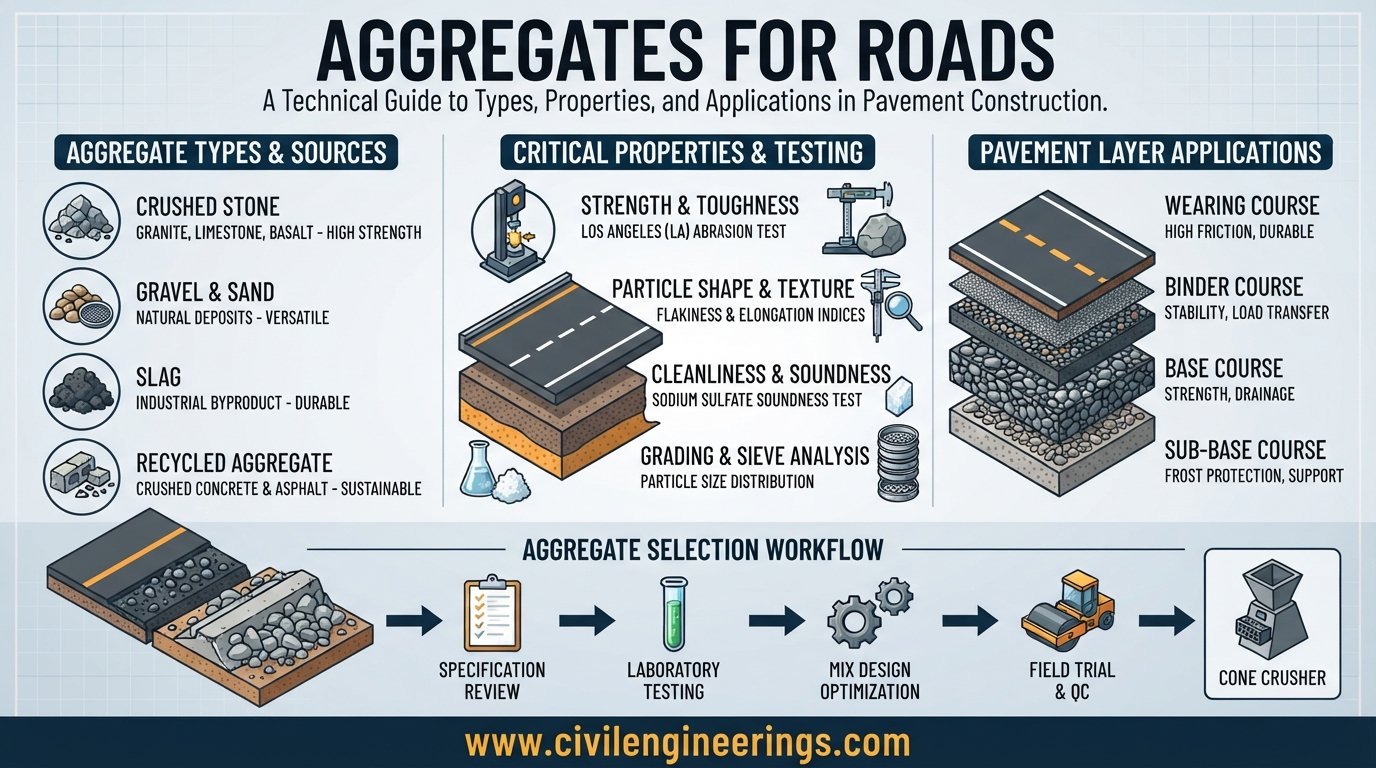
A road may look like a continuous layer of asphalt or concrete, but much of its structural performance depends on something less visible: aggregates. From the granular sub-base and base course to asphalt mixtures and concrete pavements, aggregates carry loads, provide interlock, resist wear, and help control drainage. Poor-quality or poorly graded material can lead to rutting, travelling, potholes, deformation, stripping, and premature pavement failure.
Understanding Aggregates for Roads is therefore essential for anyone involved in highway design, construction, testing, or quality control. The right aggregate is not simply the hardest stone available. Engineers must consider particle size distribution, shape, texture, strength, abrasion resistance, soundness, cleanliness, water absorption, angularity, and compatibility with the pavement layer.
This guide explains the types of road aggregates, their engineering properties, common laboratory tests, applications in different pavement layers, aggregate gradation, quality control, storage, selection criteria, and practical site considerations. It also discusses general IRC, AASHTO, ASTM, and ICE-related practices so that students and professionals can connect laboratory theory with real highway construction.
What Are Aggregates for Roads?
Aggregates are granular mineral materials used as structural and functional components in road and pavement construction. They may consist of crushed rock, crushed gravel, natural sand, manufactured aggregate, recycled concrete aggregate, slag, or other approved mineral materials.
In a pavement system, aggregate may form a relatively thick unbound layer or become part of an asphalt or cement concrete mixture. Its function changes according to its position in the pavement.
For example:
- Sub-base aggregate provides foundation support and drainage.
- Base-course aggregate contributes substantially to structural load distribution.
- Asphalt aggregate provides skeleton strength, stability, texture, and skid resistance.
- Concrete aggregate forms the bulk mineral skeleton of the concrete pavement.
- Surface-treatment aggregate contributes directly to tire-pavement friction and surface durability.
FHWA notes that aggregate base and subbase layers help distribute stresses, provide drainage, and support the pavement structure. (Federal Highway Administration)


Why Aggregates Are Important in Road Construction
Aggregates often represent a large proportion of the total pavement material by volume. Their characteristics therefore have a direct effect on pavement behavior.
Load Distribution
A well-graded and properly compacted aggregate layer develops particle-to-particle contact. Under traffic loading, this interlock allows the layer to distribute wheel loads over a larger area.
Angular crushed particles generally provide greater internal friction than smooth rounded particles.
This is especially important in granular base layers and asphalt mixtures where resistance to permanent deformation is required.
Drainage and Moisture Control
Water is one of the major causes of pavement deterioration. Aggregate gradation determines how easily water can move through a granular layer.
Dense-graded material contains a controlled combination of coarse particles and fines. Open-graded aggregate contains fewer intermediate particles and can provide greater interconnected void space.
FHWA identifies grading, fines content, and hydraulic conductivity as important factors controlling drainage behavior in granular pavement layers. (Federal Highway Administration)
Surface Friction
At the pavement surface, aggregate characteristics influence skid resistance. Angular, durable and polish-resistant particles can maintain useful microtexture and macrotexture under traffic.
FHWA notes that aggregate characteristics are particularly important for asphalt surface texture and friction, with fractured coarse particles improving stability and friction-related performance. (Federal Highway Administration)
Pavement Durability
Road aggregates experience repeated loading, impact, abrasion, moisture changes, temperature changes, and environmental exposure.
A weak aggregate may break down during:
- Crushing and processing
- Transportation
- Mixing
- Placement
- Compaction
- Traffic loading
The resulting fines can alter gradation and drainage and may reduce pavement performance.
Types of Aggregates Used for Roads
The selection of aggregate depends on the pavement layer, traffic, climate, drainage conditions, and project specifications.
Crushed Stone Aggregate
Crushed stone is produced by mechanically crushing suitable rock obtained from quarries.
Common source rocks include:
- Basalt
- Granite
- Limestone
- Dolomite
- Trap rock
- Quartzite
- Other approved hard rocks
Crushing creates angular faces that can provide strong mechanical interlock.
Crushed stone is widely used in:
- Granular sub-base
- Wet mix macadam
- Aggregate base
- Asphalt concrete
- Bituminous macadam
- Concrete pavement
Crushed Gravel
Natural gravel can be processed and crushed to produce aggregate with improved particle shape and fractured faces.
Crushing is particularly useful when the original gravel contains rounded particles that would otherwise provide less interlock.
Natural Sand and Gravel
Natural aggregates are obtained from deposits such as riverbeds, pits, and other geological sources.
Their rounded particle shape may improve workability, but the suitability of natural aggregate depends on the pavement application and governing specification.
Manufactured Aggregates
Manufactured aggregates are produced by processing industrial or mineral materials.
Examples can include:
- Steel slag
- Expanded materials
- Processed quarry by-products
- Certain approved recycled materials
Their use requires careful evaluation because chemical stability, expansion, durability, and environmental properties can vary significantly.
Recycled Aggregates
Recycled concrete aggregate and other processed reclaimed materials can be used in suitable pavement applications when they meet project requirements.
FHWA reports that processed reclaimed concrete material can exhibit high angularity, good stability, and useful drainage characteristics, although properties such as absorption and composition must be considered. (Federal Highway Administration)
Classification of Road Aggregates by Size
Aggregate is commonly divided into coarse, fine, and filler fractions.
Coarse Aggregate
Coarse aggregate is the larger particle fraction retained above the relevant sieve used by the governing specification.
It provides:
- Structural skeleton
- Interparticle friction
- Load transfer
- Stability
- Surface texture
The exact size limits depend on the material specification and pavement mix.
Fine Aggregate
Fine aggregate occupies spaces between larger particles and contributes to gradation, packing, workability, and mixture stability.
In asphalt mixtures, the fine fraction also affects void structure and aggregate interlock.
Mineral Filler
Very fine mineral material passing the designated fine sieve is often called mineral filler.
Examples include suitably processed:
- Limestone dust
- Rock dust
- Cementitious mineral powder
- Other approved mineral fillers
Filler influences the mastic and void structure of asphalt mixtures.
Essential Properties of Aggregates for Roads
The best aggregate is not defined by one test. Engineers evaluate a combination of physical, mechanical, chemical, and geometric properties.
Strength
Aggregate must withstand the stresses generated during construction and service.
Weak particles can crush under heavy wheel loads, particularly in base courses and heavily trafficked pavement layers.
Aggregate strength may be evaluated through tests such as crushing, impact, or other project-specific mechanical tests.
Toughness
Toughness represents the ability of aggregate to resist impact and sudden loading.
This property becomes important when aggregates experience:
- Heavy traffic
- Construction impact
- Repeated loading
- Crushing and handling
Hardness and Abrasion Resistance
Aggregates must resist wear caused by repeated contact and movement.
The Los Angeles Abrasion Test is widely used to evaluate resistance to degradation by abrasion and impact. FHWA identifies AASHTO T 96 and ASTM C131/C535 among established aggregate degradation procedures. (Federal Highway Administration)
Durability and Soundness
Durability describes the ability of aggregate to withstand environmental exposure without excessive deterioration.
Soundness testing evaluates resistance to weathering effects using sulfate solutions.
Aggregates with poor durability can deteriorate under repeated wetting and drying or freezing and thawing where those conditions apply.
Particle Shape
Particle shape strongly affects aggregate performance.
Desirable particles are generally:
- Angular
- Rough-textured
- Relatively equidimensional
- Free from excessive flatness and elongation
Flat and elongated particles can break more easily and may cause segregation during handling.
FHWA specifically identifies angular, nearly equidimensional particles with rough surfaces as desirable for granular base applications. (Federal Highway Administration)
Surface Texture
A rough surface texture generally increases mechanical interlock and can improve aggregate-binder interaction.
For surface courses, texture also affects pavement friction.
Specific Gravity
Specific gravity helps engineers convert between mass and volume and is important in asphalt and concrete mixture design.
A simplified relationship is:
where:
- = specific gravity
- = density of aggregate
- = density of water
Water Absorption
Absorption represents the amount of water that aggregate can take into its permeable pores.
High absorption can influence:
- Asphalt binder demand
- Concrete water correction
- Durability
- Moisture susceptibility
- Aggregate handling
Therefore, aggregate moisture condition should be considered during mixture production.
Cleanliness
Road aggregate should be substantially free from harmful quantities of:
- Clay
- Silt
- Organic matter
- Vegetation
- Clay lumps
- Friable particles
- Other deleterious materials
Contamination can reduce bonding and alter pavement performance.
Aggregate Gradation for Road Pavements
Gradation describes the distribution of aggregate particle sizes.
It is normally determined using sieve analysis.
A typical sieve analysis involves:
- Drying the representative sample.
- Weighing the sample.
- Passing it through a series of standard sieves.
- Weighing the material retained on each sieve.
- Calculating cumulative retained and percentage passing.
- Plotting or comparing the gradation against the specified envelope.
The percentage passing a sieve can be calculated as:
where:
- = percentage passing
- = total dry sample mass
- = cumulative mass retained


Dense-Graded Aggregates
Dense-graded aggregate contains a broad range of particle sizes.
Smaller particles fill the voids between larger particles, producing a relatively dense structure after compaction.
Typical advantages include:
- High stability
- Good load distribution
- Efficient packing
- Lower interconnected voids
Open-Graded Aggregates
Open-graded materials contain relatively fewer intermediate sizes.
They can provide interconnected voids and higher permeability.
Such materials are useful where drainage is a specific design objective, but they require appropriate structural and construction considerations.
Gap-Graded Aggregates
Gap-graded materials intentionally omit or reduce certain particle sizes.
They are used in specific mixture designs, including selected asphalt applications.
The gradation should never be selected simply because it produces maximum density. The required void structure, permeability, stability, friction, binder demand, and construction method must also be considered.
Important Tests for Aggregates Used in Roads
Laboratory testing confirms whether a proposed aggregate source meets the project requirements.
Sieve Analysis
Purpose: Determine particle-size distribution.
Typical standard: AASHTO T 27 / ASTM C136 for appropriate aggregate applications.
It is fundamental for controlling aggregate gradation.
Los Angeles Abrasion Test
The Los Angeles abrasion test measures resistance to degradation from abrasion and impact.
A simplified expression for percentage loss is:
where:
- = original mass
- = mass retained after the specified test procedure
Lower loss generally indicates better resistance to degradation, but acceptance limits must always come from the applicable specification.


Aggregate Impact Test
The Aggregate Impact Value evaluates aggregate resistance to sudden impact.
It is commonly considered when assessing aggregate toughness.
Crushing Value Test
The aggregate crushing value indicates resistance to crushing under gradually applied compressive loads.
Soundness Test
The soundness test evaluates resistance to weathering-related deterioration.
AASHTO T 104 and ASTM C88 are commonly associated with sulfate soundness evaluation. (Federal Highway Administration)
Flakiness and Elongation Tests
These tests assess undesirable particle shapes.
Excessive flat or elongated particles can:
- Break during compaction
- Create weak orientations
- Increase segregation
- Reduce interlock
- Complicate asphalt mixture handling
Sand Equivalent Test
The sand equivalent test is used to assess the relative proportion of clay-like fines and dust compared with sand-sized material.
FHWA identifies AASHTO T 176 / ASTM D2419 as relevant procedures for this purpose. (Federal Highway Administration)
Water Absorption and Specific Gravity
These tests provide information required for material characterization and mixture calculations.
They are especially important for asphalt and concrete mix proportioning.
Uses of Aggregates in Different Road Layers

Aggregates in Granular Sub-Base
The granular sub-base provides a transition between the subgrade and stronger pavement layers.
Its functions can include:
- Load distribution
- Drainage
- Frost protection where applicable
- Separation
- Reduction of stress on subgrade
- Providing a stable construction platform
Gradation and fines content are particularly important.
Aggregates in Base Course
The base course generally experiences significant structural stresses.
High-quality aggregate should provide:
- High stability
- Good compaction
- Adequate strength
- Resistance to degradation
- Controlled gradation
- Suitable drainage characteristics
FHWA describes granular base as an important load-bearing and strengthening component beneath pavement surfaces. (Federal Highway Administration)
Aggregates in Asphalt Pavements
Aggregates often make up the majority of the asphalt mixture.
They form the load-carrying skeleton around which asphalt binder and mineral fines are distributed.
Important properties include:
- Coarse aggregate angularity
- Fine aggregate angularity
- Gradation
- Toughness
- Durability
- Polish resistance
- Cleanliness
- Particle shape
IRC material and construction guidance likewise links bituminous pavement performance with aggregate grading and quality requirements. (Indian Railway Catering)
Aggregates in Concrete Pavements
In Portland cement concrete pavement, aggregate influences:
- Workability
- Strength
- Shrinkage
- Thermal behavior
- Durability
- Aggregate interlock
- Surface characteristics
FHWA notes that aggregate gradation, shape, texture, absorption, durability, and deleterious materials can substantially affect concrete behavior. (Federal Highway Administration)
How to Select the Right Aggregate for a Road Project
Aggregate selection should begin with the pavement function rather than simply choosing the cheapest available source.
Consider Traffic Loading
Heavy commercial traffic requires greater resistance to:
- Crushing
- Abrasion
- Permanent deformation
- Polishing
A low-volume access road may have different material requirements from a heavily trafficked motorway.
Consider Climate
The aggregate must suit the environmental exposure.
Important considerations include:
- Rainfall
- Temperature
- Freeze-thaw conditions
- Wetting and drying
- Drainage
- Seasonal moisture
Consider Pavement Layer
A suitable aggregate for sub-base may not meet the requirements for a high-quality asphalt wearing course.
Surface aggregates generally face greater demands for friction, polishing resistance, and durability.
Consider Local Availability
Transporting aggregate over long distances can significantly increase project cost and environmental impacts.
However, proximity should never override engineering requirements.
A locally available aggregate that fails durability or strength criteria may ultimately cost more because of premature pavement deterioration.
Aggregate Quality Control During Road Construction
Laboratory approval alone does not guarantee field performance.
Control the Aggregate Source
Material should come from an approved and consistent source.
Changes in quarry geology can alter:
- Gradation
- Specific gravity
- Abrasion resistance
- Particle shape
- Absorption
- Chemical characteristics
Regular sampling is therefore important.
Prevent Stockpile Contamination
Stockpile areas should be clean, firm, stable, and appropriately drained.
Aggregate should not become contaminated by:
- Soil
- Mud
- Vegetation
- Construction debris
- Other aggregate sizes
TxDOT emphasizes contamination control and suitable stockpile-area preparation, while highway specifications commonly require separate storage of different aggregate sizes and sources. (Texas Department of Transportation)
Prevent Segregation
Segregation occurs when particles separate according to size.
It can happen during:
- Truck loading
- Truck unloading
- Conveyor transfer
- Stockpiling
- Loader operation
- Paver feeding
The result is a non-uniform material that may not meet the intended gradation.
Maintain Moisture Control
Moisture affects:
- Compaction
- Aggregate handling
- Asphalt production
- Concrete batching
- Stockpile behavior
Site personnel should account for actual aggregate moisture rather than relying on assumed values.
Common Problems Caused by Poor Aggregate Selection
Excessive Fines
Too many fines may reduce drainage and increase moisture sensitivity.
Excessive Flat and Elongated Particles
These particles may fracture under loading and can make the mixture difficult to compact uniformly.
Weak Aggregate
Weak material may degrade under construction traffic or repeated wheel loading.
Poorly Graded Aggregate
An unsuitable gradation can produce excessive voids, segregation, inadequate stability, or drainage problems.
Polishing Aggregate
Some surface aggregates can lose texture under repeated tire action. This can reduce skid resistance.
Dirty Aggregate
Clay coatings and excessive dust can interfere with asphalt-aggregate or cement-aggregate bonding.
IRC, AASHTO, ASTM, and ICE References
Road aggregate requirements should always be checked against the contract documents and governing national specification rather than applying one universal numerical limit.
IRC
Indian Roads Congress publications cover road pavement design, construction, materials, and related highway practices. The IRC publication catalogue includes specifications and codes covering areas such as Water Bound Macadam and bituminous pavement construction. (Indian Railway Catering)
IRC material investigations can include tests such as gradation, aggregate impact value, combined flakiness and elongation, and water absorption for granular sub-base evaluation. (Indian Railway Catering)
AASHTO
AASHTO methods are widely used for aggregate characterization, including:
- T 27 — Sieve Analysis
- T 96 — Los Angeles Abrasion
- T 104 — Soundness
- T 176 — Sand Equivalent
- Other procedures applicable to specific aggregate properties
FHWA documentation provides examples of these AASHTO procedures and their corresponding ASTM methods. (Federal Highway Administration)
ASTM
ASTM standards provide widely adopted test methods and material specifications covering aggregate gradation, abrasion, soundness, particle shape, absorption, and other characteristics.
ICE
ICE publications and UK highway practice can provide useful engineering context for aggregate selection, pavement construction, drainage, and material management. However, the project-specific highway authority specification should take precedence over generic guidance.
Important: IRC, AASHTO, ASTM, and ICE references should be treated as technical frameworks. Acceptance limits vary by application, traffic category, pavement type, climate, and jurisdiction.
Practical Recommendations for Students, Engineers, and Contractors
For Civil Engineering Students
Do not memorize aggregate tests in isolation.
Instead, understand the relationship:
Aggregate property → pavement behavior → laboratory test → acceptance requirement
For example:
Poor abrasion resistance → particle breakdown → gradation change → reduced pavement performance → Los Angeles abrasion testing.
This approach makes highway-materials concepts much easier to understand.
For Highway Engineers and Consultants
Evaluate aggregate performance as part of the complete pavement system.
Do not select material solely because it satisfies one strength test. Review:
- Gradation
- Shape
- Angularity
- Durability
- Abrasion
- Absorption
- Cleanliness
- Moisture
- Traffic demand
- Climate
- Pavement layer
Source variability should also be monitored throughout construction.
For Site Engineers and Contractors
Maintain strict control over:
- Approved aggregate source
- Stockpile cleanliness
- Separate aggregate sizes
- Moisture condition
- Segregation
- Laboratory testing
- Batching accuracy
- Field compaction
- Delivery documentation
- Material traceability
A good quarry material can still produce poor pavement if it becomes contaminated or segregated before placement.
Frequently Asked Questions About Aggregates for Roads
What are aggregates for roads?
Aggregates for roads are granular mineral materials used in pavement layers and mixtures. They can include crushed stone, crushed gravel, sand, manufactured aggregates, and approved recycled materials.
Which aggregate is best for road construction?
There is no single best aggregate for every road. The appropriate material must satisfy the strength, durability, gradation, shape, cleanliness, and friction requirements of its specific pavement application.
Why is crushed aggregate preferred for road construction?
Crushed aggregate generally provides angular faces and better particle interlock than naturally rounded particles. This can improve stability and resistance to movement in many pavement applications.
What is aggregate gradation?
Aggregate gradation is the distribution of different particle sizes within an aggregate sample. It is normally established through sieve analysis and strongly affects density, stability, drainage, workability, and mixture performance.
Which test checks aggregate abrasion resistance?
The Los Angeles Abrasion Test is commonly used to evaluate resistance to degradation caused by abrasion and impact. AASHTO T 96 and ASTM C131/C535 are commonly associated with this testing. (Federal Highway Administration)
Why are flakiness and elongation important?
Excessive flat and elongated particles can break during construction, reduce effective interlock, increase segregation, and adversely affect pavement performance.
Can recycled aggregate be used in roads?
Yes. Approved recycled materials, such as processed reclaimed concrete aggregate, can be used in appropriate pavement applications when they meet the relevant engineering and environmental requirements. (Federal Highway Administration)
What aggregate is used in granular sub-base?
Granular sub-base may use properly graded crushed stone, gravel, recycled aggregate, or other approved materials. The exact grading and performance requirements depend on the governing specification and pavement design.
How does aggregate affect asphalt pavement?
Aggregate controls much of the asphalt mixture’s structural skeleton. Its gradation, angularity, texture, toughness, durability, and polish resistance influence stability, deformation resistance, surface friction, and durability.
How should road aggregate be stored?
Aggregate should be stored on clean, stable and suitably drained areas. Different sizes and sources should generally be separated, and handling should minimize contamination and segregation. (BuildSpec)
Conclusion
Aggregates for Roads are far more than simply crushed stones placed beneath asphalt. They form the structural skeleton of granular pavement layers and asphalt mixtures and play an important role in concrete pavement performance. Their gradation, angularity, particle shape, strength, toughness, abrasion resistance, durability, absorption, cleanliness, and surface texture all influence how a pavement performs under traffic and environmental conditions.
Good aggregate selection begins with understanding the pavement layer and its intended function. Engineers should combine laboratory testing with source evaluation, field inspection, stockpile management, moisture control, and construction quality assurance. Tests such as sieve analysis, Los Angeles abrasion, impact, soundness, absorption, sand equivalent, and flakiness/elongation provide valuable evidence, but no individual test should determine aggregate suitability on its own.
For students, the key is to connect each aggregate property with pavement behavior. Engineers and consultants, the focus should be performance and specification compliance. For contractors, consistent handling, storage, grading, and compaction are equally important. When these factors are controlled together, aggregate becomes a reliable foundation for safer, stronger, more durable, and more economical roads.
