
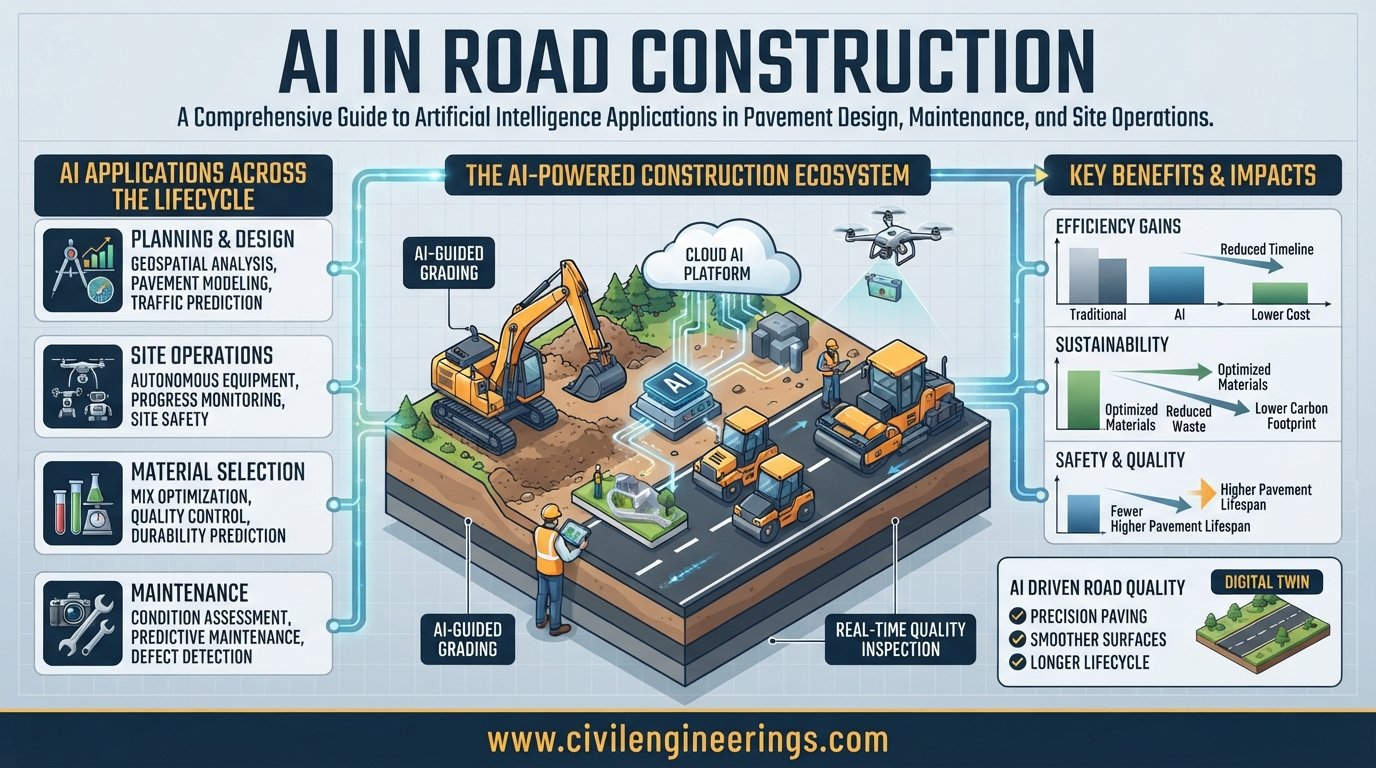
Road construction is entering a new phase in which data, sensors, automation, and artificial intelligence are becoming as important as conventional surveying, materials testing, and construction equipment. From identifying pavement cracks to optimizing asphalt compaction, AI in Road Construction is changing how engineers plan, execute, inspect, and maintain transportation infrastructure.
Artificial intelligence can process large volumes of information from drones, cameras, GPS, LiDAR, BIM models, weather stations, construction equipment, and pavement-management databases. Instead of relying entirely on periodic manual observations, engineers can use these data streams to identify patterns, predict problems, and support faster decisions.
The technology is not intended to replace engineering judgment. Its greatest value comes from combining computational intelligence with established engineering principles, specifications, field experience, and quality-control procedures. FHWA is currently promoting responsible AI adoption across surface transportation, including planning, operations, maintenance, and investment decisions. (Highways)
This article explains how AI works in road construction, where it is being applied, its engineering benefits and limitations, implementation requirements, and what students, engineers, contractors, and infrastructure agencies should prepare for next.
What Is AI in Road Construction?
AI in Road Construction refers to the use of artificial intelligence, machine learning, computer vision, predictive analytics, robotics, and related digital technologies to support or automate engineering and construction activities associated with roads and highways.
Traditional construction systems often depend on scheduled inspections and manually collected information. An AI-enabled system can continuously process information and provide predictions or recommendations.
A simplified workflow is:
Data Collection → Data Processing → AI Analysis → Prediction/Decision → Engineering Action → Feedback
For example, cameras mounted on an inspection vehicle can capture thousands of pavement images. A computer-vision model can identify cracks, potholes, rutting, or surface deterioration. Engineers can then use those results to prioritize maintenance.
The underlying principle is straightforward:
Better-quality data + appropriate algorithms + engineering judgment = better-informed decisions.
FHWA’s work on highway automation has already identified remote sensing, 3D design, machine control, automation, and field inspection as important technology areas for improving highway construction. (Federal Highway Administration)
How Artificial Intelligence Works in Road Projects
AI does not operate independently. It depends on reliable information and a clearly defined engineering objective.
Data Collection
Road projects generate enormous quantities of data, including:
- Topographic survey data
- GPS and GNSS coordinates
- LiDAR point clouds
- Drone imagery
- Satellite imagery
- Pavement photographs
- Traffic counts
- Material test results
- Asphalt temperature
- Compaction measurements
- Equipment productivity
- Weather information
- BIM and CAD models
- Construction schedules
- Inspection records
- Historical pavement-condition data
Digital as-built systems are particularly valuable because they organize geometric, attribute, document, LiDAR, imagery, and other asset information into structured digital records. (Federal Highway Administration)
Machine Learning and Pattern Recognition
Machine-learning algorithms learn relationships from historical or labeled data.
For pavement inspection, an algorithm might learn to distinguish between:
- Longitudinal cracks
- Transverse cracks
- Alligator cracking
- Potholes
- Rutting
- Patches
- Surface defects
Computer vision can then classify new images based on the patterns learned during model training.
Prediction and Decision Support
AI becomes particularly useful when the objective is prediction.
A simplified predictive relationship can be represented as:
Where:
- = predicted engineering outcome
- = influencing variables
- = relationship learned by the AI model
For pavement deterioration, variables could include traffic loading, pavement age, climate, structural condition, drainage, material properties, and previous maintenance.
AI does not eliminate the need for mechanistic or empirical engineering methods. Instead, it can complement them by identifying relationships within large datasets.
Major Applications of AI in Road Construction
AI can influence almost every stage of a road’s lifecycle, from preliminary investigation to maintenance.
AI for Surveying and Site Investigation
Surveying is one of the areas where AI can reduce repetitive work.
Drones equipped with high-resolution cameras and LiDAR can capture large areas quickly. Photogrammetry can convert imagery into orthomosaics, digital surface models, and 3D point clouds.
AI can help classify:
- Existing pavement
- Earthwork areas
- Stockpiles
- Drainage features
- Excavation zones
- Construction equipment
- Site boundaries
- Potential hazards
The resulting information can support quantity calculations and progress monitoring.


AI for Road Design and Alignment Optimization
Road alignment involves horizontal geometry, vertical profile, earthwork, drainage, land acquisition, safety, and environmental constraints.
AI-assisted design can evaluate numerous alternatives more rapidly than conventional trial-and-error workflows.
A system may compare alternatives based on:
- Cut and fill quantities
- Construction cost
- Travel distance
- Gradient
- Curve geometry
- Drainage requirements
- Environmental constraints
- Land acquisition
- Safety considerations
The engineer still establishes design criteria and constraints. AI can assist by searching a large design space and highlighting promising alternatives.
AI for Earthwork and Construction Planning
Earthwork is often one of the largest components of highway construction.
AI can analyze historical productivity and current site information to estimate:
- Excavator productivity
- Haul-truck cycles
- Loader utilization
- Fuel consumption
- Equipment idle time
- Cut-and-fill balance
- Expected production rates
For example, if a project requires 50,000 m³ of excavation, a predictive model could estimate production under different equipment combinations and haul distances.
A simplified productivity relationship is:
Where:
- = production rate
- = equipment capacity
- = fill or utilization factor
- = efficiency factor
- = cycle time
AI can improve the estimation of variables such as efficiency and cycle time by learning from actual project data.
AI for Asphalt Paving
Asphalt construction presents an excellent opportunity for intelligent systems because temperature, delivery time, paving speed, layer thickness, and compaction interact continuously.
AI systems can analyze:
- Asphalt temperature
- Paver speed
- Material delivery
- Roller location
- Number of passes
- Weather conditions
- Surface temperature
- Compaction response
Research on intelligent road construction has demonstrated how real-time sensing and computational intelligence can assist compactor operators and coordinate construction processes. (ScienceDirect)
AI for Intelligent Compaction
Compaction quality strongly affects pavement performance.
Insufficient compaction can contribute to inadequate density, moisture susceptibility, deformation, and premature deterioration.
FHWA has documented intelligent compaction technologies capable of estimating asphalt density in real time using systems incorporating artificial neural-network technology. Such systems can help identify compaction problems while the asphalt remains workable. (Federal Highway Administration)
An AI-assisted roller can potentially consider:
- Roller position
- Number of passes
- Material temperature
- Compaction response
- Roller speed
- Vibration settings
- Previous roller paths
Instead of simply following a predetermined pattern, intelligent systems can adjust operations according to measured conditions.


AI for Pavement Inspection and Quality Control
Pavement inspection is among the most promising applications of artificial intelligence.
Computer Vision for Crack Detection
Conventional pavement surveys can require considerable time and manpower.
AI-based computer vision can analyze images collected by inspection vehicles, drones, or cameras.
Modern systems can identify and classify different forms of pavement distress. The 2024 National Academies publication on AI applications for automatic pavement condition evaluation documents the transition from manual surveys toward automated pavement distress identification using AI technologies. (National Academies)
A simplified workflow is:
Camera → Image → Pre-processing → AI Model → Distress Detection → Classification → Severity Assessment → GIS Database
This information can support pavement management systems and maintenance prioritization.


Automated Quality Inspection
AI can also assist with construction quality control by comparing actual construction conditions with design requirements.
Possible applications include:
- Pavement thickness verification
- Surface smoothness assessment
- Lane alignment checks
- Concrete surface inspection
- Road-marking verification
- Drainage construction monitoring
- Earthwork quantity verification
- Construction progress assessment
However, AI-based measurements should be validated against the governing project specifications and accepted testing procedures.
AI for Construction Progress Monitoring
Construction managers need accurate information about what has actually been completed.
Instead of depending solely on manually prepared progress reports, AI can combine drone imagery, photographs, machine data, BIM models, schedules, and site records.
A digital workflow can compare:
Planned Model vs. Actual Site Condition
AI can then flag:
- Delayed activities
- Incomplete work
- Unexpected site changes
- Material delivery problems
- Equipment utilization issues
- Safety concerns
BIM strengthens this process because it creates an information-rich digital environment connecting planning, design, construction, operation, and maintenance. (Federal Highway Administration)
AI for Predictive Road Maintenance
One of the biggest advantages of AI is its ability to support predictive maintenance.
Traditional maintenance often reacts after deterioration becomes visible. Predictive maintenance attempts to determine where deterioration is likely to occur and when intervention should take place.
Pavement Deterioration Prediction
A simplified deterioration model can be expressed as:
Where:
- = pavement condition index
- = traffic loading
- = climate effects
- = material and structural characteristics
- = environmental conditions
- = drainage and related factors
The actual model may be far more complex.
FHWA has specifically identified AI and machine learning as potential tools for improving pavement-management data reliability, processing, and analysis. (Federal Highway Administration)
Deep-learning research has also investigated automated highway pavement preventive-maintenance decisions using historical distress data to support rehabilitation planning. (ScienceDirect)
AI, Robotics and Autonomous Road Construction Equipment
The combination of AI, sensors, GNSS, machine control, and robotics is moving road construction toward higher levels of automation.
Autonomous or semi-autonomous equipment can potentially perform tasks such as:
- Asphalt paving
- Roller operation
- Material handling
- Road marking
- Crack sealing
- Site monitoring
- Equipment navigation
Recent field demonstrations show that this is moving beyond laboratory research. In 2026, an AI-powered autonomous asphalt-paving demonstration in Oman used a coordinated fleet of intelligent pavers and rollers for road construction. (Xuzhou Machinery Group)
Earlier research and field demonstrations have also tested unmanned machinery fleets for highway construction. (Tsinghua University Civil Engineering)
The important engineering distinction is that automation and AI are related but not identical. Automation may execute a predefined sequence. AI can interpret data, recognize patterns, predict conditions, or adapt decisions.
Benefits of AI in Road Construction
Improved Construction Productivity
AI can identify bottlenecks and optimize equipment utilization.
Better coordination can reduce:
- Idle time
- Unnecessary machine movement
- Waiting periods
- Rework
- Material delays
Better Pavement Quality
Continuous monitoring can identify deviations earlier.
This is particularly valuable during asphalt paving because temperature and compaction conditions change rapidly.
Improved Worker Safety
AI-based computer vision can detect people, vehicles, equipment, barriers, and unsafe interactions.
Autonomous machinery may also reduce human exposure to hazardous activities.
Automation research in highway construction has identified improved efficiency and safety as major objectives. (Federal Highway Administration)
Reduced Rework
Early detection of defects can prevent small errors from becoming expensive corrections.
Better Asset Management
AI can connect construction records with long-term pavement performance.
This creates a lifecycle approach rather than treating construction and maintenance as completely separate activities.
Challenges and Limitations of AI in Road Construction
AI offers major opportunities, but engineers should avoid treating it as a universal solution.
Poor Data Quality
An AI model is only as reliable as its training and input data.
Missing, biased, inconsistent, or incorrectly labeled data can produce unreliable results.
High Initial Cost
Implementation may require:
- Sensors
- Cameras
- Drones
- GNSS systems
- Cloud infrastructure
- Software
- Data storage
- AI development
- Staff training
For smaller contractors, the initial investment can be a significant barrier.
Model Reliability
An algorithm trained under one climate or pavement type may not perform equally well elsewhere.
A model developed using one road network should therefore be validated before widespread deployment.
Cybersecurity and Data Privacy
Connected construction equipment and cloud systems introduce cybersecurity risks.
Project owners should establish controls for:
- Data access
- Authentication
- Equipment connectivity
- Cloud storage
- Software updates
- Backup systems
- Critical infrastructure security
Human Oversight
AI should support engineering decisions rather than blindly replace them.
A highway engineer must still understand specifications, material behavior, construction tolerances, site conditions, safety requirements, and contractual responsibilities.
AI and IRC, AASHTO and ICE Practices
AI should not be viewed as a replacement for established engineering standards.
For road projects, engineers may work within frameworks involving:
- IRC standards and guidelines for highway geometry, pavement, materials, traffic, and construction practices.
- AASHTO standards and guides for transportation design, pavement engineering, materials, and asset management.
- ICE guidance and professional principles relating to infrastructure engineering, project delivery, digital engineering, risk, and professional responsibility.
The precise governing requirements depend on the project jurisdiction, contract documents, road authority, and applicable specifications.
AI should therefore be integrated into existing quality-management systems rather than operating outside them.
For example, if an AI system identifies inadequate pavement compaction, the engineer should verify the finding using the project’s approved testing and acceptance procedures before taking contractual action.
Practical AI Implementation Strategy for Road Projects
Start With a Specific Problem
Do not begin with the question, “How can we use AI?”
Start with:
What engineering problem is costing us time, money, quality, or safety?
Potential starting points include pavement inspection, progress monitoring, equipment utilization, or asphalt quality.
Establish a Reliable Data Pipeline
Create standards for:
- Data collection
- File formats
- Location referencing
- Quality control
- Data storage
- Metadata
- Access permissions
Integrate BIM, GIS and Asset Data
AI becomes more useful when information is connected.
FHWA’s digital and BIM initiatives emphasize structured, accessible, interoperable information across the infrastructure lifecycle. (Federal Highway Administration)
Validate Before Full Deployment
A pilot project should compare AI results with accepted engineering measurements.
Useful metrics include:
Other useful measures include precision, recall, false-positive rate, processing time, productivity improvement, and cost savings.
Keep Engineers in the Loop
The strongest implementation model is generally:
AI Recommendation → Engineer Review → Engineering Decision → Field Action → Verification
This provides both computational efficiency and professional oversight.
Practical Recommendations for Students, Engineers and Contractors
For Civil Engineering Students
Students should develop basic knowledge of:
- Python
- Statistics
- Machine learning
- Computer vision
- GIS
- BIM
- Remote sensing
- Pavement engineering
- Data visualization
The most valuable combination is not “AI instead of civil engineering.” It is AI + strong civil engineering fundamentals.
For Highway Engineers
Start collecting structured historical data.
Document pavement condition, material properties, traffic, weather, maintenance history, construction quality, and performance. These datasets become extremely valuable for predictive models.
Engineers should also understand model uncertainty and validation rather than accepting AI-generated results automatically.
For Site Engineers
Use AI where it reduces repetitive monitoring.
Examples include:
- Drone progress surveys
- Automated quantity checks
- Equipment tracking
- Safety monitoring
- Pavement image inspection
- Construction documentation
Field verification remains essential.
For Contractors
Contractors should evaluate AI investments according to measurable project outcomes.
Before purchasing an AI-enabled system, determine:
- What problem does it solve?
- What data does it require?
- How accurate is it?
- How does it integrate with existing equipment?
- Who validates the results?
- What training is required?
- What is the expected return on investment?
Future of AI in Road Construction
The future is likely to involve increasingly connected construction ecosystems rather than isolated AI tools.
A future highway project could combine:
BIM + GIS + IoT Sensors + Drones + Computer Vision + GNSS + Autonomous Equipment + Cloud Analytics + Digital As-Builts
Such systems could create a continuous information loop from design through construction and asset management.
Autonomous paving and intelligent compaction are already progressing from research toward practical deployment. FHWA’s current AI programs also emphasize responsible development, deployment, safety, security, and trustworthy AI for transportation. (ITS Joint Program Office)
The long-term objective should not simply be to make machines autonomous. It should be to make road projects safer, more predictable, more measurable, more sustainable, and more efficient.
Frequently Asked Questions About AI in Road Construction
1. What is AI in road construction?
AI in road construction is the application of artificial intelligence, machine learning, computer vision, predictive analytics, robotics, and related technologies to improve road planning, design, construction, inspection, maintenance, and asset management.
2. How is AI used in highway construction?
AI can support surveying, alignment optimization, earthwork planning, asphalt paving, intelligent compaction, construction monitoring, pavement inspection, quality control, predictive maintenance, and autonomous equipment.
3. Can AI detect road cracks?
Yes. Computer-vision systems can analyze pavement images and identify various distress types, including cracks and potholes. The results should be validated according to the applicable inspection and acceptance requirements.
4. Can AI improve asphalt compaction?
AI-assisted intelligent-compaction systems can analyze information such as roller position, material temperature, compaction response, and previous passes to support better compaction decisions. FHWA has documented neural-network-based technology for real-time asphalt-density estimation. (Federal Highway Administration)
5. Will AI replace civil engineers?
AI is more likely to automate repetitive data-processing and monitoring tasks than eliminate the need for civil engineers. Engineering judgment, design responsibility, field verification, safety management, and professional decision-making remain essential.
6. What data does AI need for road construction?
Depending on the application, AI may use pavement images, drone imagery, LiDAR, GNSS data, traffic information, material test results, weather data, BIM models, equipment telemetry, construction records, and historical pavement-performance data.
7. Is AI suitable for small road contractors?
It can be, particularly when cloud-based or equipment-integrated solutions address a specific problem. Contractors should begin with applications offering measurable productivity, quality, safety, or documentation benefits.
8. How does AI support pavement maintenance?
AI can analyze historical pavement condition and other variables to identify deterioration patterns, predict future condition, prioritize maintenance, and support rehabilitation planning.
9. What is the biggest limitation of AI in road construction?
Data quality is one of the most important limitations. Poor training data, inconsistent measurements, inadequate validation, changing environmental conditions, and inappropriate model assumptions can produce unreliable results.
10. What is the future of AI in highway engineering?
The future will likely involve greater integration of AI with BIM, GIS, drones, digital twins, intelligent construction equipment, computer vision, IoT sensors, autonomous machinery, and digital asset-management systems.
Conclusion
AI in Road Construction is moving from an emerging technology concept toward a practical engineering tool. Its applications now extend from drone-based surveying and automated pavement inspection to intelligent compaction, construction monitoring, predictive maintenance, and autonomous paving.
The greatest opportunity is not simply faster construction. AI can help engineers make decisions using larger and more timely datasets, detect defects earlier, reduce unnecessary work, improve construction consistency, and manage roads throughout their entire lifecycle. Current transportation research and deployment programs demonstrate that artificial intelligence is increasingly being considered across planning, construction, maintenance, and asset management. (Highways)
Nevertheless, successful implementation requires more than sophisticated algorithms. Reliable field data, appropriate engineering standards, cybersecurity, validation, trained personnel, and professional judgment remain fundamental. AI should strengthen established civil-engineering practice rather than replace it.
For students, engineers, contractors, consultants, and infrastructure agencies, the practical lesson is clear: learning how to combine civil engineering expertise with data, automation, and AI will become increasingly valuable as roads evolve into smarter, more connected infrastructure systems.

Kamran Malik is a passionate civil engineering writer and researcher who specializes in construction, transportation, structural engineering, and infrastructure topics. Through his articles on CivilEngineerings.com, he simplifies complex engineering concepts and shares practical insights, industry trends, and educational resources for students, professionals, and engineering enthusiasts.