
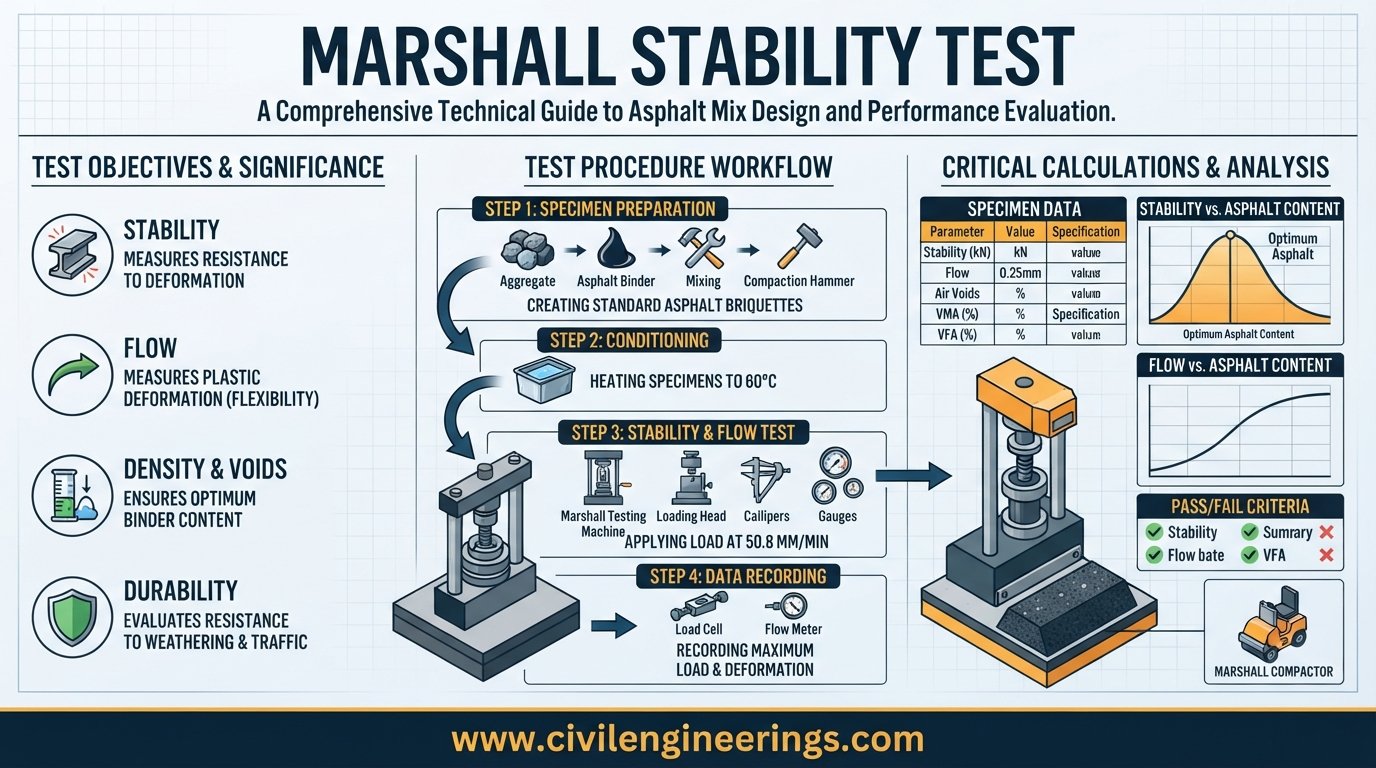
A durable asphalt pavement must withstand repeated wheel loads without excessive deformation, cracking, or loss of structural integrity. One of the most widely used laboratory methods for evaluating the strength and deformation characteristics of asphalt mixtures is the Marshall Stability Test. It provides engineers with important information about how a compacted bituminous mixture behaves when subjected to controlled loading at elevated temperature.
The test is especially important during Marshall mix design, where engineers assess stability, flow, density, air voids, voids in mineral aggregate (VMA), and voids filled with bitumen (VFB) to establish an appropriate binder content. ASTM D6927 describes Marshall stability and flow testing for compacted asphalt specimens, while AASHTO T 245 is commonly associated with the Marshall method. (ASTM Store)
This guide explains the principle, apparatus, specimen preparation, complete testing procedure, calculations, result interpretation, common errors, applications, and practical recommendations for students, engineers, contractors, and quality-control teams.
What Is the Marshall Stability Test?
The Marshall Stability Test is a laboratory test used to determine the maximum load that a compacted asphalt mixture specimen can withstand before significant failure or plastic deformation occurs.
The test also measures Marshall flow, which represents the deformation of the specimen corresponding to the selected maximum load.
In simple terms:
- Stability indicates the load-carrying resistance of the asphalt mixture.
- Flow indicates how much the specimen deforms under the test loading.
- Density and volumetric properties help engineers determine whether the mixture has an appropriate internal structure.
ASTM D6927 defines Marshall stability typically as the peak resistance load obtained while the specimen is loaded at a constant deformation rate. The standard also recognizes that some mixtures may show a less clearly defined failure point. (ASTM Store)
The method is principally associated with dense-graded asphalt mixtures and cylindrical specimens approximately 102 mm in diameter. ASTM D6927-22 states that the method applies to dense-graded asphalt mixtures with maximum aggregate size up to 25 mm. (ASTM Store)
Why Is Marshall Stability Important?
A pavement mixture must achieve a reasonable balance between strength and flexibility.
A mixture with insufficient stability may experience:
- Rutting
- Shoving
- Plastic deformation
- Corrugation
- Shear failure
On the other hand, excessively stiff or low-flow mixtures may become susceptible to cracking because they cannot accommodate deformation effectively.
Therefore, the highest Marshall stability value alone should not automatically be considered the best mix. Stability must be evaluated together with flow, air voids, VMA, VFB, density, binder content, and the requirements of the applicable specification.


Principle of the Marshall Stability Test
The fundamental principle is straightforward.
A cylindrical asphalt mixture specimen is prepared using controlled aggregate gradation, asphalt binder content, mixing temperature, and compaction effort. The specimen is then conditioned at the specified temperature and placed horizontally between the curved loading heads of a Marshall testing apparatus.
A compressive load is applied at a controlled deformation rate.
As loading continues, the specimen initially resists deformation. The applied load increases until the mixture reaches its maximum resistance. This maximum load is recorded as the Marshall stability.
At the same time, the deformation corresponding to the selected stability point is recorded as Marshall flow.
Basic Test Relationship
The primary measured parameters are:
Marshall Stability = Maximum load resisted by the specimen
Marshall Flow = Deformation corresponding to the selected stability point
The Marshall quotient can also be calculated as:
Where:
- = Marshall Quotient, kN/mm
- = Marshall stability, kN
- = Marshall flow, mm
The Marshall quotient provides an indication of the mixture’s stiffness or resistance to deformation, but it should not be interpreted as a complete measure of pavement performance.
Marshall Stability Test Apparatus
A reliable test requires properly calibrated equipment and carefully controlled specimen preparation.
The principal equipment generally includes the following.
Marshall Testing Machine
The loading frame applies a controlled deformation to the specimen. Traditional equipment may use a proving ring and dial gauge, while modern systems can use a load cell, displacement transducer, and electronic data acquisition.
ASTM D6927 recognizes both traditional and automated Marshall testing arrangements. (ASTM Store)
Marshall Compaction Mould
The mould is used to produce the cylindrical test specimen. Standard Marshall specimens are approximately 101.6 mm in diameter and nominally 63.5 mm thick.
Marshall Hammer
The hammer provides controlled impact compaction during specimen preparation. The required number of blows depends on the applicable mix-design procedure and project specification.
Breaking Head
The breaking head consists of curved loading segments that apply the load around the specimen’s circumference.
Flow Meter or Displacement Measurement System
The flow measurement system records deformation during loading.
Traditional systems may use a mechanical flow dial, while automated systems use displacement sensors.
Water Bath
A temperature-controlled water bath conditions specimens before testing. A commonly used Marshall procedure conditions specimens at approximately 60 ± 1°C, although the exact conditioning requirements should always follow the governing standard or project specification. (Law Resource)
Balance, Thermometers and Ancillary Equipment
Other laboratory equipment includes:
- Weighing balance
- Thermometers
- Heating oven
- Mixing bowls
- Mixing tools
- Specimen extraction equipment
- Compaction pedestal
- Measuring devices
- Specific-gravity equipment
Equipment calibration is essential because load, temperature, deformation, and specimen dimensions directly affect the test result.
Marshall Specimen Preparation
Specimen preparation is one of the most important stages of the test. A technically correct loading procedure cannot compensate for a poorly prepared specimen.
Aggregate Selection and Gradation
The selected aggregate should satisfy the specified gradation envelope.
The engineer determines the proportions of:
- Coarse aggregate
- Fine aggregate
- Mineral filler
- Asphalt binder
The aggregate should be clean, properly dried, and representative of the material proposed for pavement construction.
Selection of Binder Content
Several trial asphalt contents are normally evaluated.
For formal Marshall mix design, ASTM D6927 indicates that results should be based on at least three specimens at each binder-content increment, with binder content commonly varied in 0.5% increments over the selected range. (ASTM Store)
For example, a laboratory may investigate:
- 4.0% binder
- 4.5% binder
- 5.0% binder
- 5.5% binder
- 6.0% binder
The actual range depends on the aggregate, binder, mixture type, previous experience, and specification.
Heating and Mixing
Aggregate and binder are heated to appropriate temperatures according to the selected materials and applicable specification.
The heated aggregate is thoroughly mixed with the asphalt binder to achieve uniform coating.
Poor mixing can create local differences in binder distribution, leading to misleading stability and flow results.
Compaction
The hot mixture is placed into the Marshall mould and compacted using the specified compaction procedure.
Compaction effort must remain consistent between specimens.
Differences in:
- Number of blows
- Hammer operation
- Mixture temperature
- Compaction timing
- Operator technique
can significantly influence specimen density and therefore Marshall properties.
Marshall Stability Test Procedure
Once the specimens have been prepared, the actual stability and flow test can be performed.
Step 1: Measure Specimen Dimensions
Measure the specimen diameter, height, and relevant dimensions.
Determine the specimen mass and bulk specific gravity according to the applicable procedure.
Step 2: Condition the Specimen
Place the specimen in the specified temperature-controlled water bath.
A commonly used procedure conditions the specimen in water at approximately 60°C for 30–40 minutes. Some procedures allow alternative conditioning arrangements, so the laboratory should follow the governing standard rather than mixing requirements from different methods. (Law Resource)
Step 3: Prepare the Marshall Testing Head
Clean the loading heads and ensure that the equipment is correctly aligned.
The flow measurement device is adjusted to its initial position.
Temperature control also matters because the specimen and testing components should remain within the prescribed range.
Step 4: Position the Specimen
Remove the specimen from conditioning and place it between the Marshall breaking-head segments.
The specimen is positioned so that the load is applied perpendicular to its cylindrical axis.
The test should be started promptly after removal from conditioning because excessive delay can change specimen temperature.
Step 5: Apply the Load
Apply the load at a constant deformation rate.
A commonly specified rate is:
which is equivalent to approximately 2 inches per minute. ASTM D6927 describes the test in terms of controlled deformation loading. (ASTM Store)
Step 6: Record Maximum Load
Continue loading until the maximum resistance is reached.
The highest measured load represents the Marshall stability, subject to the correction requirements of the applicable standard.
Step 7: Record Flow
Record the deformation corresponding to the selected stability point.
The result is reported as the Marshall flow.
Step 8: Repeat the Test
Repeat the test on the required number of specimens.
For mix-design work, averaging multiple specimens at each binder content improves reliability and helps identify abnormal results. ASTM D6927 recommends a minimum of three specimens at each binder-content increment for mix-design testing. (ASTM Store)


Marshall Stability Test Formula and Calculations
The basic test result is obtained directly from the maximum load and corresponding deformation. However, several calculations are normally associated with Marshall mix design.
Marshall Stability
If the measured load is already corrected for specimen dimensions according to the applicable standard:
Where:
- = Marshall stability
- = measured maximum load
If the specimen does not have the standard thickness, a correction factor may be required.
Therefore:
Where:
- = corrected stability
- = measured stability
- = correction factor
The exact correction procedure and factors should come from the governing test standard.
Marshall Flow
Flow is the deformation measured at the selected stability point.
It is commonly expressed in millimetres.
For example, if a specimen reaches maximum stability at a deformation of 3.4 mm:
Marshall Quotient
The Marshall quotient can be calculated as:
Suppose:
- Stability = 12.4 kN
- Flow = 3.2 mm
Then:
The quotient can help compare mixture stiffness characteristics, but it should be used alongside other volumetric and performance parameters.
Example of Marshall Stability Test Results
Consider a laboratory evaluating five asphalt binder contents.
| Binder Content | Stability | Flow |
|---|---|---|
| 4.0% | 10.2 kN | 2.4 mm |
| 4.5% | 11.8 kN | 2.8 mm |
| 5.0% | 13.1 kN | 3.2 mm |
| 5.5% | 12.7 kN | 3.8 mm |
| 6.0% | 11.4 kN | 4.5 mm |
The data suggest that stability increases initially as binder content increases, reaches a peak, and then decreases.
This behavior is common in Marshall mix design.
At low binder content, insufficient asphalt may limit cohesion and durability. As binder increases, the mixture can develop better cohesion and improved particle binding. Beyond an optimum range, excess binder may reduce aggregate interlock and increase plastic deformation.
However, the binder content corresponding to maximum stability is not automatically the optimum binder content.
The final selection must consider the complete set of required criteria, including:
- Stability
- Flow
- Bulk density
- Air voids
- VMA
- VFB
- Binder content
- Aggregate gradation
- Project-specific requirements
ASTM notes that stability, flow, density, air voids, and related volumetric properties can be plotted against binder content during mix design. (ASTM Store)
Interpretation of Marshall Stability and Flow
High Marshall Stability
High stability generally indicates greater resistance to the applied loading under the specific laboratory conditions.
However, excessively high stability does not necessarily mean superior pavement performance.
A mixture can be strong but too stiff, poorly workable, or susceptible to cracking.
Low Marshall Stability
Low stability may indicate inadequate aggregate interlock, unsuitable gradation, insufficient cohesion, excessive binder, poor compaction, or inappropriate material characteristics.
The engineer should investigate the underlying cause rather than simply increasing binder.
High Marshall Flow
Excessive flow indicates greater deformation under the test loading.
Such behavior may suggest a mixture that is too plastic and potentially susceptible to rutting or shoving.
Low Marshall Flow
Very low flow may indicate an overly stiff or brittle mixture.
This can raise concerns about cracking and inadequate flexibility.
ASTM D6927 specifically notes that flow above acceptable limits may indicate a mixture is too plastic or unstable, while flow below acceptable limits can indicate excessive brittleness. (ASTM Store)


Factors Affecting Marshall Stability
Several factors influence the measured result.
Aggregate Gradation
Well-graded aggregate can provide effective particle interlock and improve resistance to deformation.
Gap grading, excessive fines, or unsuitable aggregate proportions can alter stability and flow.
Aggregate Shape and Texture
Angular, rough-textured aggregate generally provides greater interlock than smooth, rounded particles.
Aggregate strength and abrasion resistance also influence mixture performance.
Asphalt Binder Content
Binder content has a major effect on both stability and flow.
Too little binder can produce poor cohesion and inadequate durability. Excess binder may increase deformation.
Binder Grade
The rheological properties of the binder influence mixture stiffness, particularly at elevated pavement temperatures.
A binder that is appropriate for one climate or traffic condition may not be appropriate for another.
Compaction
Insufficient compaction increases air voids and can reduce mixture density.
Excessive or inconsistent compaction can also distort the intended mixture structure.
Test Temperature
Asphalt binder becomes considerably softer at elevated temperatures.
Consequently, temperature control during specimen conditioning and testing is critical.
Loading Rate
The loading rate influences measured resistance. Changing the specified deformation rate can make results incomparable with standard results.
Specimen Geometry
Specimen diameter and thickness affect stress distribution and measured stability.
ASTM D6927 emphasizes specimen geometry and recognizes correction requirements where specimen thickness differs from the nominal dimension. (ASTM Store)
Applications of the Marshall Stability Test
The Marshall method remains useful in several pavement-engineering activities.
Asphalt Mix Design
The primary application is determining and evaluating asphalt mixture proportions.
Engineers use Marshall results together with volumetric properties to select an appropriate binder content.
Quality Control
Marshall stability and flow can be used to monitor asphalt production and identify changes in mixture characteristics.
ASTM notes that significant changes between test sets may indicate sampling problems, incorrect testing, altered grading, binder-content changes, testing errors, or plant-process problems. (ASTM Store)
Comparison of Asphalt Mixtures
Engineers can compare different combinations of:
- Aggregate sources
- Gradations
- Asphalt binders
- Mineral fillers
- Modifiers
- Recycled materials
Research and Development
The method is widely used in laboratory research involving modified asphalt, reclaimed asphalt pavement, waste materials, fibers, polymers, and other mixture modifications.
For example, IRC guidance on waste-plastic-modified bituminous mixes has included Marshall stability, flow, air voids, VMA, VFB, and retained stability among mixture requirements. (Law Resource)
IRC, AASHTO, ASTM and ICE References
Different countries and agencies may specify different requirements, so engineers should never copy acceptance limits from one specification into another project without verification.
ASTM
ASTM D6927-22 is the current active ASTM edition identified by ASTM for the Marshall Stability and Flow Test of asphalt mixtures. It covers resistance to plastic flow using compacted cylindrical specimens and describes traditional and automated testing approaches. (ASTM Store)
AASHTO
AASHTO T 245, commonly referenced as the resistance-to-plastic-flow test using the Marshall apparatus, forms part of the established Marshall mix-design framework. (Pavement Interactive)
IRC
In Indian road engineering practice, Marshall mix design is referenced within IRC/MoRTH specifications and related guidance. IRC material also identifies IRC:111 in connection with bituminous mix design requirements. (Indian Railway Catering)
The applicable edition and project specification should always be checked before establishing acceptance criteria.
ICE
The Institution of Civil Engineers (ICE) is primarily a professional engineering institution rather than a direct equivalent of ASTM or AASHTO for prescribing a universal Marshall test procedure. Its infrastructure material discussions emphasize engineering performance, resilience, appropriate specifications, and consideration of environmental and service conditions. (Institution of Civil Engineers (ICE))
For an actual project, the contract specification, national road authority requirements, and referenced laboratory standards should take precedence.
Common Errors in the Marshall Stability Test
Poor laboratory technique can produce apparently precise but misleading results.
Incorrect Specimen Temperature
Testing a specimen outside the specified temperature range can substantially change asphalt stiffness and stability.
Inconsistent Compaction
Different compaction effort produces different density and air-void structures.
Delayed Testing
Excessive delay after removing a specimen from the conditioning bath can cause temperature loss and inconsistent results.
Incorrect Loading Rate
The loading rate must be controlled. A faster or slower rate can change the measured resistance.
Poor Specimen Geometry
Uneven specimen faces or incorrect thickness can cause nonuniform stress distribution.
Uncalibrated Equipment
Load cells, proving rings, flow gauges, thermometers, and displacement sensors should be properly calibrated.
Ignoring Outliers
An unusual result should not simply be deleted because it does not match the expected trend.
Investigate:
- Sampling
- Mixing
- Compaction
- Temperature
- Equipment
- Material segregation
- Operator technique
before rejecting a data point.
Best Practices for Reliable Marshall Test Results
For dependable laboratory results:
- Use representative aggregate and binder samples.
- Maintain accurate aggregate gradation.
- Control mixing and compaction temperatures.
- Apply consistent compaction effort.
- Use properly calibrated equipment.
- Maintain the specified conditioning temperature.
- Minimize the time between conditioning and loading.
- Maintain the prescribed loading rate.
- Test multiple specimens at each binder content.
- Record every specimen result rather than only the average.
- Investigate abnormal variation.
- Interpret stability and flow together with volumetric properties.
- Follow the current project-specific standard.
- Do not compare results obtained using substantially different preparation or compaction methods as though they were identical.
ASTM specifically warns that differences between laboratory and plant-compacted mixtures can arise from differences in mixing efficiency and aging, while poor sampling and testing technique can also cause significant variation. (ASTM Store)
Practical Recommendations for Students, Engineers and Contractors
For Civil Engineering Students
Understand the physical meaning behind every measurement instead of memorizing only the procedure.
Focus on the relationship between:
Binder content → density → air voids → stability → flow → mixture performance
Practice plotting stability and flow against asphalt content. This makes Marshall mix design much easier to understand.
For Highway Engineers
Do not select an asphalt mixture based solely on maximum stability.
Consider traffic loading, climate, binder grade, aggregate characteristics, volumetric requirements, moisture susceptibility, and expected pavement temperature.
Marshall testing is a useful tool, but modern pavement design may require additional performance tests where rutting, fatigue, moisture damage, or thermal cracking governs.
For Contractors
Maintain consistency between laboratory-designed and plant-produced mixtures.
Monitor:
- Aggregate stockpiles
- Gradation
- Binder content
- Mixing temperature
- Production temperature
- Compaction
- Sampling locations
- Laboratory testing
A well-designed mix can still perform poorly if production and field compaction do not reproduce the intended mixture characteristics.
Limitations of the Marshall Stability Test
The Marshall test is useful, but it should not be treated as a complete predictor of pavement performance.
It primarily evaluates mixture behavior under a specific laboratory loading and conditioning system.
Modern traffic can involve:
- Heavy axle loads
- Slow-moving vehicles
- High tire pressures
- Repeated dynamic loading
- Extreme temperatures
- Moisture exposure
These conditions may require additional performance-based testing.
Marshall stability therefore works best as one component of a broader asphalt mixture evaluation system.
ASTM itself notes that Marshall results are characteristics of the compacted specimens and that field-core results may not be directly comparable with laboratory mix-design specimens. (ASTM Store)
Frequently Asked Questions About the Marshall Stability Test
1. What is the Marshall Stability Test?
It is a laboratory test used to determine the maximum load resistance and deformation characteristics of compacted asphalt mixture specimens.
2. What does Marshall stability indicate?
Marshall stability indicates the maximum resistance of the tested asphalt specimen to the specified loading condition before the selected failure point.
3. What is Marshall flow?
Marshall flow is the deformation of the asphalt specimen corresponding to the selected Marshall stability point.
4. What is the standard loading rate for the Marshall test?
A commonly specified deformation rate is 50.8 mm/min, equivalent to approximately 2 inches per minute. The applicable standard should always be checked before testing. (Pavement Interactive)
5. Why is the Marshall specimen heated before testing?
Heating and conditioning bring the asphalt mixture to a controlled temperature representative of the test method. This is important because asphalt binder stiffness changes significantly with temperature.
6. How many specimens are normally tested?
For Marshall mix design, ASTM D6927 indicates a minimum of three specimens at each binder-content increment. (ASTM Store)
7. Is higher Marshall stability always better?
No. Excessively high stability may be accompanied by inadequate flexibility or low flow. The mixture must satisfy the complete set of applicable design requirements.
8. What is Marshall Quotient?
Marshall Quotient is calculated by dividing stability by flow:
It provides an indication of mixture stiffness but should not be used as the sole performance criterion.
9. What causes low Marshall stability?
Potential causes include unsuitable aggregate gradation, weak aggregate, insufficient cohesion, inappropriate binder content, excessive air voids, poor compaction, unsuitable binder properties, or testing errors.
10. Can Marshall stability alone determine optimum bitumen content?
No. Optimum binder content should be selected using the complete Marshall mix-design framework, including stability, flow, density, air voids, VMA, VFB, and the requirements of the governing specification. (ASTM Store)
Conclusion
The Marshall Stability Test remains an important laboratory method for understanding the load resistance and deformation behavior of asphalt mixtures. Its value extends beyond obtaining a single stability number. When properly conducted, it helps engineers examine the relationship between asphalt binder content, aggregate structure, density, air voids, flow, and mixture strength.
Reliable results depend heavily on specimen preparation, temperature control, compaction consistency, equipment calibration, loading rate, and representative sampling. Engineers should also avoid selecting an asphalt mixture simply because it produces the highest Marshall stability. A successful pavement mixture requires a balanced combination of stability, flow, volumetric properties, durability, workability, and resistance to expected field conditions.
For students, the test provides a practical introduction to asphalt mix behavior. For engineers and consultants, it remains valuable for mix design and quality control. Contractors can use it to identify production changes before they become pavement defects. Most importantly, the test should always be interpreted according to the current applicable ASTM, AASHTO, IRC/MoRTH, or project specification, rather than relying on generic acceptance values.
