Introduction
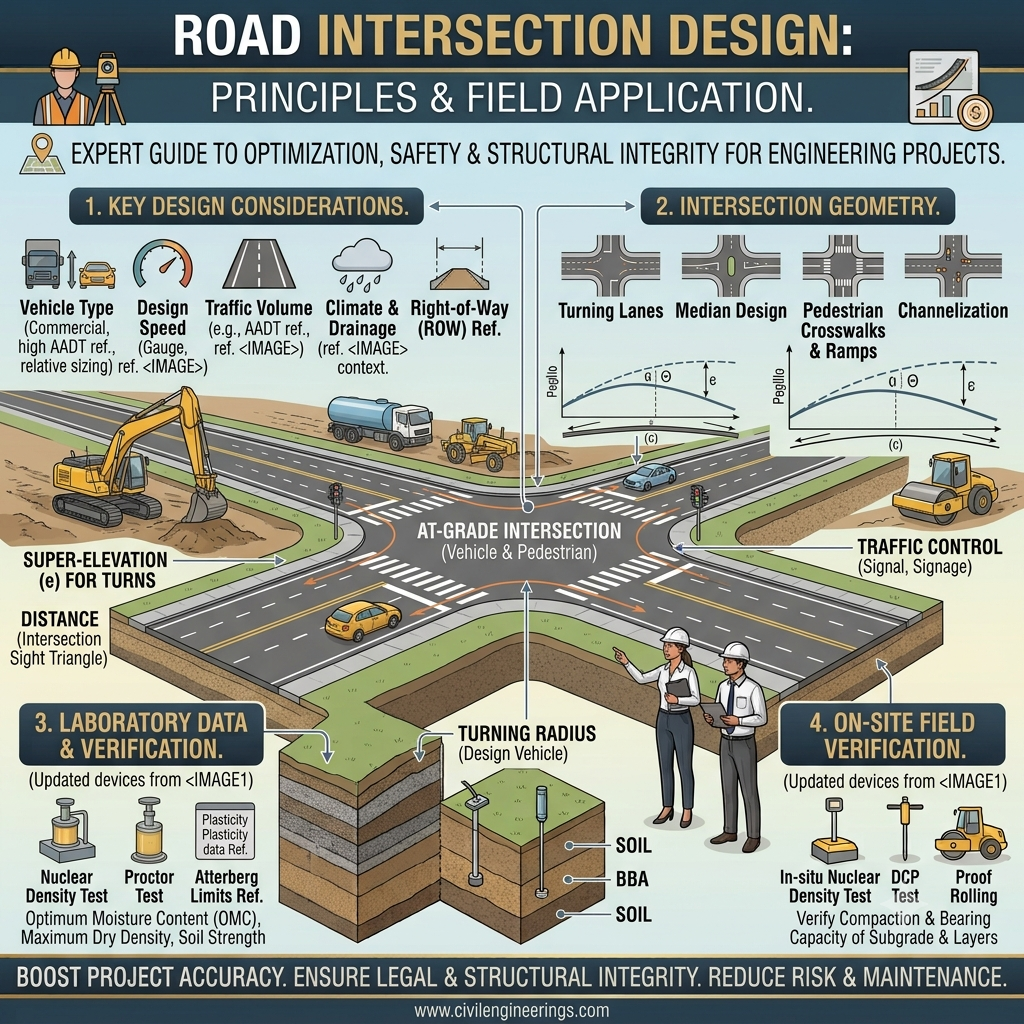
Every road network depends on well-designed intersections to ensure safe, efficient, and uninterrupted traffic movement. An intersection represents the point where two or more roads meet, cross, merge, or diverge. This location experiences frequent vehicle conflicts, making it one of the most critical elements in highway and urban road design.
Intersection Design of Road focuses on creating layouts that reduce traffic conflicts, improve vehicle capacity, enhance pedestrian safety, and minimize travel delays. A well-planned intersection supports smooth traffic flow, lowers accident rates, and reduces vehicle operating costs. Poorly designed intersections often cause congestion, longer travel times, and a higher risk of crashes.
Civil engineers, transportation planners, and highway authorities carefully evaluate traffic demand, vehicle speed, turning movements, road geometry, and safety requirements before selecting the most suitable intersection type. Modern design also considers cyclists, pedestrians, emergency vehicles, and future traffic growth.
This comprehensive guide explains the engineering principles, components, and major types of road intersections while providing practical examples and industry best practices for engineers, contractors, and engineering students.
What is Intersection Design of Road?
Intersection Design of Road is the process of planning, analyzing, and designing the location where two or more roads meet. The design aims to ensure safe, efficient, and convenient movement for vehicles, pedestrians, cyclists, and public transport.
Engineers determine the most suitable intersection layout by studying traffic volumes, turning movements, design speed, road classification, available land, sight distance, and future development.
An effective intersection should:
- Minimize traffic conflicts.
- Improve traffic capacity.
- Reduce delays.
- Enhance road safety.
- Accommodate all road users.
- Support future traffic growth.
A successful design balances safety, operational efficiency, construction cost, and environmental considerations.
Objectives of Intersection Design
Every intersection must achieve specific engineering objectives that improve transportation performance.
1. Improve Road Safety
A good design reduces conflict points between vehicles, pedestrians, and cyclists. Clear lane markings, adequate sight distance, and proper traffic control lower the likelihood of collisions.
2. Ensure Smooth Traffic Flow
Efficient intersections reduce unnecessary stops and delays. Proper lane arrangements and turning facilities allow vehicles to move continuously during peak traffic hours.
3. Increase Capacity
The design should accommodate current traffic volumes while allowing room for future growth. Engineers analyze projected traffic demand before finalizing the layout.
4. Reduce Vehicle Operating Costs
Well-designed intersections decrease fuel consumption, braking, acceleration, and vehicle wear by reducing congestion and unnecessary stopping.
5. Enhance User Comfort
Drivers prefer intersections with simple layouts, clear signs, and predictable traffic movements. Comfortable driving conditions improve overall road performance.
Importance of Proper Intersection Design
Intersections often become bottlenecks within a transportation network. Even a high-capacity highway can experience severe congestion if its intersections perform poorly.
Benefits of Proper Design
- Reduces traffic congestion.
- Improves travel time.
- Lowers accident frequency.
- Increases intersection capacity.
- Supports emergency vehicle movement.
- Enhances pedestrian safety.
- Minimizes environmental impacts through smoother traffic flow.
Practical Example
Consider a busy urban crossroads where vehicles from four directions compete for space. Without dedicated turning lanes and signal coordination, queues quickly develop during peak hours. By adding channelized islands, exclusive right-turn lanes, and optimized traffic signals, engineers can significantly improve traffic efficiency and reduce delays.
Components of a Road Intersection
Each component contributes to the safe and efficient operation of an intersection.
Approach Lanes
Approach lanes carry traffic toward the intersection. Their number and width depend on expected traffic demand and road classification.
Departure Lanes
Departure lanes allow vehicles to leave the intersection smoothly while maintaining safe operating speeds.
Turning Lanes
Dedicated turning lanes separate turning vehicles from through traffic. This arrangement minimizes delays and reduces rear-end collisions.
Medians
Medians divide opposing traffic streams and provide refuge areas for pedestrians crossing wide roads.
Traffic Islands
Traffic islands guide vehicle movements, separate conflicting traffic streams, and improve intersection organization.
Pedestrian Crossings
Clearly marked crossings improve pedestrian safety by providing designated walking paths across the roadway.
Traffic Signals and Signs
Traffic signals, regulatory signs, warning signs, and pavement markings control vehicle movements and communicate traffic rules.
Engineering Principles of Intersection Design
Engineers apply several fundamental principles to create safe and efficient intersections.
Minimize Conflict Points
Every crossing, merging, or diverging movement creates a conflict point. Designers reduce these points by using channelization, roundabouts, or grade separation where appropriate.
Provide Adequate Sight Distance
Drivers must see approaching vehicles, pedestrians, and traffic control devices in sufficient time to make safe decisions.
Maintain Consistent Geometry
Smooth horizontal and vertical alignments improve driver comfort and reduce sudden steering movements.
Accommodate Design Vehicles
Large vehicles such as buses and trucks require greater turning radii. Designers account for these vehicles to prevent operational difficulties.
Balance Capacity and Safety
Increasing traffic capacity should never compromise safety. Engineers evaluate both operational performance and accident risk before selecting a design.
Consider Future Expansion
Traffic volumes usually increase over time. A flexible design allows future widening or signal upgrades without major reconstruction.
Types of Road Intersections
Different traffic conditions require different intersection types. Engineers select the most suitable layout based on traffic demand, available space, road classification, and construction cost.
1. At-Grade Intersections
At-grade intersections allow all roads to meet at the same elevation.
These are the most common intersections used on urban streets and rural highways.
Common Forms
- Four-leg intersection
- T-intersection
- Y-intersection
- Staggered intersection
Advantages
- Lower construction cost
- Simple construction
- Easy maintenance
- Suitable for moderate traffic
Limitations
- Higher number of conflict points
- Greater delay under heavy traffic
- Increased accident potential compared with grade-separated facilities
2. Grade-Separated Intersections
Grade-separated intersections place roads at different elevations using bridges, flyovers, or underpasses.
These intersections eliminate crossing conflicts between major traffic streams.
Common Types
- Diamond interchange
- Cloverleaf interchange
- Trumpet interchange
- Directional interchange
Advantages
- High traffic capacity
- Continuous vehicle movement
- Reduced delays
- Improved safety
- Suitable for expressways and motorways
Limitations
- High construction cost
- Large land requirement
- Complex design and maintenance
3. Channelized Intersections
Channelized intersections use raised islands, medians, and dedicated lanes to guide traffic movements.
Benefits
- Reduces vehicle conflicts.
- Improves turning operations.
- Increases traffic capacity.
- Enhances pedestrian safety.
- Organizes traffic efficiently.
Engineers frequently use this design in busy urban areas with high turning volumes.
4. Roundabouts
Roundabouts direct vehicles around a central island in one direction while requiring entering vehicles to yield to circulating traffic.
Advantages
- Lower vehicle speeds
- Fewer severe collisions
- Reduced traffic delays
- Lower fuel consumption
- Continuous traffic flow
Suitable Locations
- Urban intersections
- Residential areas
- Medium traffic corridors
- Locations with frequent right-angle crashes
Simple Intersection Diagrams
Four-Leg Intersection
           North
             │
             │
West ────────┼──────── East
             │
             │
           South
T-Intersection
             │
             │
─────────────┴────────────
Roundabout
          ↑
      ↗       ↖
←──── ( ○ ) ────→
      ↘       ↙
          ↓
Grade-Separated Interchange (Concept)
=========================
 Main Highway
=========================

        Bridge
-------------------------

Secondary Road
Key Takeaways
The Intersection Design of Road plays a crucial role in improving traffic efficiency, reducing conflicts, and enhancing road safety. A successful design begins with understanding traffic characteristics, selecting the appropriate intersection type, and applying sound geometric design principles. Whether engineers choose an at-grade intersection, a channelized layout, a roundabout, or a grade-separated interchange, the objective remains the same: provide safe, efficient, and reliable movement for all road users. Strong planning and careful engineering decisions during the design stage create intersections that perform effectively today while accommodating future transportation needs.
Design Factors Affecting Intersection Design
Engineers evaluate several technical and operational factors before selecting the most suitable intersection layout. These factors directly influence safety, traffic capacity, construction cost, and long-term performance.
1. Traffic Volume
Traffic volume is the most important design parameter. Engineers analyze current traffic counts, peak-hour traffic, turning movements, and projected growth to determine the required number of lanes and the appropriate traffic control system.
2. Design Speed
The design speed influences curve radius, sight distance, lane width, and turning geometry. Higher design speeds require smoother alignments and larger turning radii to maintain safe vehicle operation.
3. Road Classification
The function of each road determines the intersection design. A junction connecting two national highways requires a different layout than an intersection between local streets.
Common road classifications include:
- Expressways
- National highways
- Arterial roads
- Collector roads
- Local streets
4. Turning Movements
Traffic engineers study left-turn, right-turn, and through movements. Heavy turning volumes often require dedicated turning lanes or channelized islands to reduce delays.
5. Sight Distance
Drivers must clearly see approaching vehicles, pedestrians, and traffic control devices. Inadequate sight distance increases collision risks and reduces driver reaction time.
6. Land Availability
Available right-of-way affects the choice of intersection type. Urban areas often have limited space, while rural locations usually provide greater flexibility.
7. Pedestrian and Cyclist Activity
Modern intersection design accommodates all road users. Engineers include pedestrian crossings, refuge islands, bicycle lanes, and accessible pathways where required.
8. Drainage Conditions
Effective drainage prevents water accumulation that could reduce pavement life, decrease skid resistance, and create hazardous driving conditions.
Step-by-Step Intersection Design Process
A systematic design process helps engineers create intersections that balance safety, capacity, and cost.
Step 1: Traffic Data Collection
Engineers collect:
- Traffic volume
- Vehicle classification
- Turning movement counts
- Pedestrian counts
- Bicycle counts
- Speed data
Reliable traffic data forms the foundation of every design decision.
Step 2: Site Survey
Surveyors gather detailed information about:
- Existing road geometry
- Ground elevations
- Utilities
- Buildings
- Drainage patterns
- Right-of-way limits
Accurate surveys reduce design errors and construction conflicts.
Step 3: Traffic Analysis
Transportation engineers analyze:
- Peak-hour demand
- Capacity
- Delay
- Queue lengths
- Future traffic growth
The analysis identifies whether the existing intersection can accommodate future traffic or requires improvement.
Step 4: Select the Appropriate Intersection Type
Based on traffic studies and site conditions, engineers select the most suitable option, such as:
- T-intersection
- Four-leg intersection
- Roundabout
- Signalized intersection
- Grade-separated interchange
The selected design should satisfy current traffic needs while allowing future expansion.
Step 5: Geometric Design
Engineers prepare the detailed geometric layout, including:
- Lane widths
- Turning radii
- Median openings
- Channelizing islands
- Cross slopes
- Superelevation (where applicable)
- Sight triangles
A well-designed geometry improves safety and driving comfort.
Step 6: Design Traffic Control Measures
Traffic control devices include:
- Traffic signals
- Regulatory signs
- Warning signs
- Direction signs
- Lane markings
- Stop lines
- Pedestrian crossings
These elements guide road users and reduce conflicts.
Step 7: Perform Safety Review
Before final approval, engineers conduct a road safety review to identify potential hazards.
The review examines:
- Visibility
- Conflict points
- Driver expectations
- Pedestrian safety
- Cyclist movements
- Emergency vehicle access
Traffic Control Devices at Intersections
Traffic Signals
Signals allocate right-of-way among conflicting traffic streams and help manage high traffic volumes.
Regulatory Signs
Examples include:
- STOP
- GIVE WAY (YIELD)
- NO ENTRY
- SPEED LIMIT
Warning Signs
Warning signs alert drivers to:
- Intersection ahead
- Sharp turns
- Pedestrian crossings
- Roundabouts
Pavement Markings
Road markings include:
- Center lines
- Lane lines
- Stop lines
- Arrows
- Zebra crossings
Well-maintained markings improve driver guidance, especially at night and during adverse weather.
Capacity and Level of Service (LOS)
Capacity refers to the maximum number of vehicles an intersection can handle within a given period.
Level of Service (LOS) measures the quality of traffic operations, usually ranging from LOS A to LOS F.
| Level | Operating Condition |
|---|---|
| LOS A | Free-flow traffic with minimal delay |
| LOS B | Stable flow with slight restrictions |
| LOS C | Stable flow with moderate delays |
| LOS D | High traffic density with noticeable delays |
| LOS E | Traffic operating at or near capacity |
| LOS F | Congested conditions with long queues |
Transportation engineers use capacity and LOS analysis to determine whether improvements such as additional lanes, signal optimization, or grade separation are required.
Common Mistakes in Intersection Design
Even small design errors can reduce safety and operational efficiency. Common mistakes include:
- Inadequate sight distance.
- Insufficient turning radius for heavy vehicles.
- Poor drainage around the intersection.
- Improper traffic signal timing.
- Lack of pedestrian facilities.
- Confusing lane markings.
- Ignoring future traffic growth.
- Insufficient lighting.
- Incorrect placement of traffic signs.
- Poor maintenance of pavement markings.
Avoiding these issues helps reduce accidents and improves long-term performance.
Best Practices for Intersection Design
- Base design decisions on detailed traffic studies.
- Provide adequate sight distance for all approaches.
- Minimize conflict points through effective channelization.
- Design turning lanes for expected vehicle types.
- Incorporate pedestrian and cyclist facilities.
- Ensure proper surface drainage.
- Install clear signs and durable pavement markings.
- Conduct road safety audits before opening the intersection.
- Plan for future traffic expansion.
- Perform routine inspections and maintenance.
Practical Recommendations
Civil Engineers
- Verify traffic forecasts before selecting the intersection type.
- Coordinate with geotechnical, structural, and traffic engineering teams.
- Use design software to evaluate multiple layout options.
- Review constructability during the design phase.
Contractors
- Follow approved drawings and specifications carefully.
- Maintain geometric accuracy during construction.
- Protect completed pavement markings and traffic control devices.
- Implement effective traffic management during construction.
Engineering Students
- Study geometric design standards thoroughly.
- Practice intersection layout using real traffic data.
- Learn capacity analysis and Level of Service concepts.
- Visit operational intersections to observe traffic behavior.
General Discussion of IRC, AASHTO, and ICE Practices
Leading highway engineering organizations such as the Indian Roads Congress (IRC), the American Association of State Highway and Transportation Officials (AASHTO), and the Institution of Civil Engineers (ICE) promote several common principles for intersection design:
- Design intersections based on projected traffic demand.
- Provide sufficient sight distance for safe decision-making.
- Minimize conflict points wherever practical.
- Ensure adequate accommodation for heavy vehicles.
- Integrate pedestrian and cyclist safety into the design.
- Maintain consistency in geometric layout and traffic control.
- Incorporate effective drainage systems.
- Conduct regular safety audits and performance evaluations.
Following these internationally recognized engineering principles improves safety, efficiency, and long-term infrastructure performance.
Frequently Asked Questions (FAQs)
1. What is the purpose of intersection design?
Intersection design aims to provide safe, efficient, and convenient movement for vehicles, pedestrians, and cyclists while minimizing conflicts and delays.
2. Which factors influence intersection design?
Key factors include traffic volume, design speed, turning movements, road classification, sight distance, land availability, drainage, and future traffic growth.
3. What is the difference between an at-grade intersection and a grade-separated intersection?
An at-grade intersection allows roads to meet at the same elevation, while a grade-separated intersection uses bridges or underpasses to separate traffic streams and eliminate crossing conflicts.
4. Why are roundabouts considered safer?
Roundabouts reduce vehicle speeds and eliminate many severe conflict points, resulting in fewer serious crashes compared with conventional intersections.
5. What are channelized intersections?
Channelized intersections use raised islands, medians, and dedicated lanes to organize traffic movements and improve safety.
6. Why is sight distance important?
Adequate sight distance allows drivers to detect hazards, assess traffic conditions, and make safe driving decisions.
7. What is Level of Service (LOS)?
Level of Service is a performance measure that describes traffic operating conditions based on delay, speed, and traffic density, ranging from LOS A (best) to LOS F (worst).
8. How do traffic signals improve intersection performance?
Traffic signals regulate conflicting traffic movements, improve safety, and increase operational efficiency at busy intersections.
9. What role do pedestrians play in intersection design?
Modern intersection design includes pedestrian crossings, refuge islands, accessible sidewalks, and signal timing to ensure safe and convenient pedestrian movement.
10. Which engineering standards guide intersection design?
Engineers commonly follow national highway design manuals and internationally recognized guidance such as IRC, AASHTO, and ICE recommendations while adapting them to local regulations and project requirements.
Conclusion
Intersection Design of Road plays a fundamental role in creating safe, efficient, and sustainable transportation networks. Every successful intersection begins with careful traffic analysis, detailed geometric planning, and a clear understanding of road user behavior. Engineers must balance traffic capacity, safety, environmental considerations, construction costs, and future growth while selecting the most appropriate intersection type. Features such as adequate sight distance, dedicated turning lanes, effective drainage, clear traffic control devices, and pedestrian facilities significantly improve operational performance and reduce collision risks. Applying proven engineering principles together with guidance from recognized organizations such as IRC, AASHTO, and ICE helps deliver reliable and durable infrastructure. Whether designing a simple T-junction, a modern roundabout, or a complex grade-separated interchange, a systematic approach ensures long-term success. By mastering Intersection Design of Road, engineers, contractors, and students can contribute to safer highways, smoother traffic flow, and more resilient transportation systems.
