
Introduction
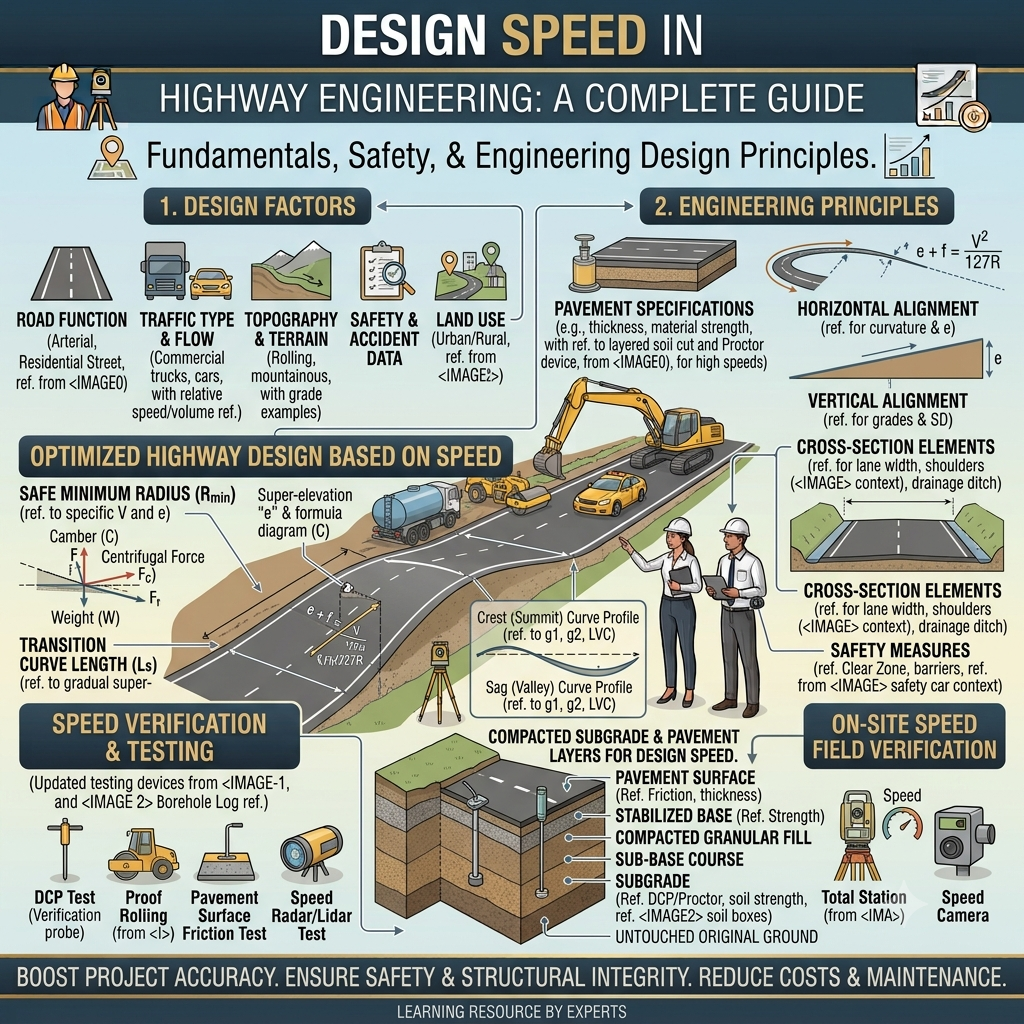
Every safe and efficient highway begins with one critical design decision: Design Speed. This engineering parameter influences nearly every element of road geometry, including horizontal curves, vertical curves, sight distance, lane width, superelevation, gradients, and intersection layout. Engineers establish the design speed during the planning and design stage to create a roadway that supports safe, comfortable, and consistent vehicle movement.
A well-chosen Design Speed improves traffic operations, enhances road safety, reduces crash risks, and extends the service life of highway infrastructure. An unsuitable design speed can create unsafe driving conditions, increase operating costs, and reduce roadway capacity. Therefore, transportation engineers evaluate terrain, traffic demand, road classification, environmental conditions, and future development before selecting an appropriate design speed.
This guide explains the concept of Design Speed, its engineering significance, influencing factors, practical applications, and the relationship between design speed and other highway design parameters. Whether you are a civil engineering student, highway designer, site engineer, or transportation professional, understanding this concept forms the foundation of modern road engineering.
What Is Design Speed?
Design Speed is the selected speed used by highway engineers to determine the geometric features of a road. It represents the maximum safe speed that drivers can maintain under favorable weather, traffic, and road surface conditions.
Engineers use this value as the basis for designing:
- Horizontal curves
- Vertical curves
- Stopping sight distance
- Overtaking sight distance
- Superelevation
- Transition curves
- Lane width
- Shoulder width
- Median layout
- Roadside clear zones
A properly selected design speed creates consistency throughout the roadway and helps drivers anticipate changes in alignment. This consistency improves comfort, reduces sudden braking, and supports safer driving behavior.
Why Design Speed Is Important
Design speed affects almost every aspect of highway engineering. It influences safety, operating efficiency, construction cost, and future traffic performance.
Key Benefits of an Appropriate Design Speed
- Improves driver safety.
- Reduces accident potential.
- Enhances riding comfort.
- Supports smooth traffic flow.
- Increases roadway capacity.
- Improves geometric consistency.
- Reduces vehicle operating costs.
- Extends pavement performance.
When engineers select a design speed that matches road function and terrain, the roadway performs more efficiently throughout its service life.
Objectives of Design Speed
Highway designers establish a design speed to achieve several engineering objectives.
Primary Objectives
- Ensure safe vehicle movement.
- Provide adequate stopping distance.
- Maintain comfortable driving conditions.
- Support efficient traffic operations.
- Reduce conflicts between vehicles.
- Minimize sudden alignment changes.
- Improve long-term roadway performance.
A single design speed creates uniformity across the project and simplifies the design process for every roadway component.
Factors Affecting Design Speed
Selecting an appropriate design speed requires careful evaluation of multiple engineering and environmental factors.
1. Terrain Conditions
Terrain has a significant influence on highway alignment and speed selection.
Plain Terrain
Flat land allows:
- Higher design speeds.
- Longer sight distances.
- Gentler curves.
- Lower construction costs.
Rolling Terrain
Rolling landscapes require:
- Moderate gradients.
- Balanced horizontal curves.
- Controlled earthwork.
Mountainous Terrain
Mountain roads usually require:
- Lower design speeds.
- Sharper curves.
- Steeper grades.
- Additional safety measures.
Diagram: Terrain and Design Speed
Plain Land        Rolling Terrain        Mountain Terrain

High Speed        Medium Speed           Lower Speed
──────────        ~~~~~~~~~~~~           /\/\/\/\/\/\
Straight Road     Gentle Curves          Sharp Curves
2. Road Classification
Road function strongly influences design speed.
Expressways
Engineers select the highest design speeds because these roads provide controlled access and uninterrupted traffic flow.
National Highways
National highways require relatively high design speeds to accommodate long-distance travel.
Urban Roads
Urban streets usually operate at lower design speeds due to intersections, pedestrian activity, and roadside development.
Local Streets
Residential streets prioritize safety over speed, resulting in lower design speeds.
3. Traffic Characteristics
Traffic volume and vehicle composition also influence design speed.
Engineers analyze:
- Average Daily Traffic (ADT)
- Heavy vehicle percentage
- Peak-hour traffic
- Future traffic growth
- Traffic composition
Roads carrying large numbers of heavy trucks often require careful geometric design to maintain safety and operational efficiency.
4. Land Use and Development
Existing and future land development affects highway speed selection.
Examples include:
- Commercial areas
- Residential neighborhoods
- Industrial zones
- School zones
- Tourist destinations
High pedestrian activity generally requires lower design speeds to improve safety.
5. Environmental Conditions
Climate and environmental conditions influence both roadway safety and driver behavior.
Engineers consider:
- Rainfall intensity
- Fog frequency
- Snow or ice (where applicable)
- Wind conditions
- Flood-prone areas
Roads located in regions with frequent adverse weather often require conservative design speeds and enhanced safety features.
6. Construction Cost
Higher design speeds usually require:
- Larger curve radii
- Longer transition curves
- Wider right-of-way
- Larger bridge structures
- Increased earthwork
As design speed increases, construction costs also tend to rise. Engineers therefore balance safety, operational requirements, and available project budgets when selecting a suitable design speed.
Relationship Between Design Speed and Operating Speed
Although these terms sound similar, they represent different concepts in highway engineering.
| Design Speed | Operating Speed |
|---|---|
| Selected during road design | Measured after road construction |
| Controls geometric design | Represents actual driver behavior |
| Based on engineering standards | Influenced by traffic, weather, and road conditions |
| Remains fixed for design | May vary throughout the day |
Practical Example
Suppose engineers design a rural highway with a design speed of 100 km/h. Under favorable conditions, many drivers may travel close to this speed. However, during heavy rain or traffic congestion, the operating speed naturally decreases even though the design speed remains unchanged.
Design Speed for Different Types of Roads
Different roadway categories serve different transportation functions. Consequently, engineers adopt different design speeds based on the road’s purpose and expected traffic conditions.
| Road Type | Typical Design Speed Characteristics |
|---|---|
| Expressway | Highest design speed with controlled access |
| National Highway | High design speed for long-distance travel |
| State or Regional Highway | Moderate to high design speed |
| Urban Arterial Road | Moderate design speed due to intersections |
| Collector Road | Moderate speed with mixed traffic |
| Local Street | Lower design speed emphasizing safety |
Actual design values vary depending on national highway standards, terrain, and project-specific requirements.
Engineering Relationship Between Design Speed and Highway Geometry
The selected design speed directly influences every major geometric element of a roadway.
                  DESIGN SPEED
                        │
 ┌──────────────────────┼──────────────────────┐
 │                      │                      │
 ▼                      ▼                      ▼
Horizontal Curves   Sight Distance     Superelevation
 │                      │                      │
 ▼                      ▼                      ▼
Driver Safety      Vehicle Control     Riding Comfort
This relationship explains why highway engineers determine the design speed before completing geometric design calculations.
Key Takeaways
Design Speed serves as the foundation of highway geometric design. It guides engineers in selecting safe and efficient values for curves, sight distance, gradients, lane dimensions, and other roadway features. Choosing an appropriate design speed requires careful evaluation of terrain, traffic demand, road classification, environmental conditions, and project cost. A balanced approach improves road safety, enhances traffic flow, reduces operating costs, and supports sustainable infrastructure development. Mastering this concept helps engineers create highways that remain safe, reliable, and efficient throughout their design life.
Highway Geometry Influenced by Design Speed
After selecting the appropriate Design Speed, highway engineers determine the geometric elements that create a safe and comfortable driving environment. Every geometric feature must work together to support the chosen speed while maintaining consistency throughout the route.
1. Horizontal Curves
Horizontal curves allow vehicles to change direction safely without sudden steering movements. As Design Speed increases, engineers provide larger curve radii to reduce centrifugal force and improve vehicle stability.
Engineering Considerations
- Larger radius for higher speeds
- Smooth transition curves
- Proper superelevation
- Adequate roadside clearance
2. Vertical Curves
Vertical curves connect different road gradients. Engineers design crest and sag curves to provide sufficient visibility and comfortable vehicle movement.
Objectives
- Improve driving comfort
- Maintain adequate sight distance
- Reduce abrupt grade changes
- Enhance drainage performance
3. Stopping Sight Distance (SSD)
Stopping Sight Distance represents the minimum distance required for a driver to perceive a hazard, react, and stop the vehicle safely.
SSD depends on:
- Design Speed
- Driver reaction time
- Road gradient
- Pavement friction
Higher Design Speed always requires a longer stopping sight distance.
4. Overtaking Sight Distance (OSD)
Engineers provide sufficient overtaking sight distance on two-lane highways where overtaking remains necessary.
Adequate OSD:
- Reduces head-on collision risk
- Improves traffic flow
- Enhances driver confidence
- Increases roadway efficiency
5. Superelevation
Superelevation is the upward slope provided on the outer edge of a horizontal curve.
It helps counteract centrifugal force acting on moving vehicles.
Benefits
- Improves vehicle stability
- Reduces skidding
- Enhances passenger comfort
- Allows safer travel around curves
6. Lane Width
Higher-speed roads generally require wider lanes to provide additional lateral clearance.
Proper lane width:
- Improves driver comfort
- Reduces side-swipe collisions
- Supports heavy vehicles
- Enhances traffic capacity
Engineering Relationship Diagram
                 DESIGN SPEED
                      │
 ┌──────────────┬──────────────┬──────────────┐
 │              │              │
 ▼              ▼              ▼
Curve Radius  Sight Distance Superelevation
 │              │              │
 ▼              ▼              ▼
Driver Safety Riding Comfort Vehicle Stability
                      │
                      ▼
              Efficient Highway Design
This simple relationship shows how one engineering decision influences multiple design elements.
How Engineers Select Design Speed
Selecting the correct Design Speed requires careful evaluation rather than guesswork.
Step 1: Study Road Classification
Engineers first identify whether the facility is:
- Expressway
- National Highway
- Rural Highway
- Urban Arterial
- Collector Road
- Local Street
Step 2: Evaluate Terrain
Terrain determines practical speed limits.
- Plain terrain → Higher speeds
- Rolling terrain → Moderate speeds
- Mountainous terrain → Lower speeds
Step 3: Analyze Traffic Data
Transportation engineers review:
- Average Daily Traffic (ADT)
- Design Year Traffic
- Heavy Vehicle Percentage
- Peak Hour Volume
Step 4: Consider Future Development
A road designed today should continue serving traffic efficiently for many years.
Engineers evaluate:
- Urban expansion
- Industrial development
- Population growth
- Commercial activities
Step 5: Balance Safety and Cost
Higher speeds require:
- Larger curves
- Longer bridges
- More earthwork
- Wider right-of-way
Therefore, engineers balance operational efficiency with economic feasibility.
Practical Engineering Applications
Design speed influences numerous real-world highway projects.
Rural Highways
Higher design speeds support uninterrupted long-distance travel while reducing travel time.
Urban Roads
Lower design speeds improve pedestrian safety and accommodate frequent intersections.
Mountain Roads
Reduced design speeds allow engineers to safely navigate steep slopes and sharp curves.
Expressways
Expressways use consistent, high design speeds combined with controlled access and grade-separated interchanges to achieve efficient traffic flow.
Best Practices for Selecting Design Speed
Experienced highway engineers follow several best practices when establishing design speed.
- Select a speed that matches the road’s function.
- Maintain consistency throughout the alignment.
- Avoid sudden reductions in geometric standards.
- Consider future traffic growth.
- Incorporate adequate drainage into the design.
- Coordinate geometric design with traffic safety measures.
- Review accident data from similar projects.
- Verify all calculations before finalizing drawings.
- Conduct field inspections during planning.
- Update designs when site conditions change.
Common Mistakes to Avoid
Many highway problems originate from poor design decisions during the planning stage.
Avoid these common mistakes:
- Selecting an unrealistic design speed.
- Ignoring terrain limitations.
- Underestimating future traffic growth.
- Providing inadequate sight distance.
- Designing inconsistent horizontal curves.
- Neglecting superelevation requirements.
- Overlooking roadside hazards.
- Ignoring drainage during geometric design.
- Failing to coordinate traffic engineering with roadway geometry.
Preventing these mistakes improves long-term safety and reduces maintenance costs.
Practical Recommendations
Civil Engineers
- Base design decisions on reliable survey and traffic data.
- Review geometric consistency throughout the project.
- Coordinate pavement, drainage, and geometric design.
- Validate calculations before issuing construction drawings.
Contractors
- Construct roadway geometry exactly according to approved drawings.
- Verify elevations and curve layouts before paving.
- Maintain quality during earthwork and compaction.
- Protect finished pavement from construction damage.
Engineering Students
- Learn how design speed influences every geometric element.
- Practice highway design calculations regularly.
- Study completed highway projects in different terrains.
- Understand the relationship between safety, economy, and roadway geometry.
General Discussion of IRC, AASHTO, and ICE Guidance
Highway authorities worldwide recognize Design Speed as one of the most important parameters in geometric road design.
Although specific numerical values vary by country and project conditions, organizations such as IRC (Indian Roads Congress), AASHTO (American Association of State Highway and Transportation Officials), and the Institution of Civil Engineers (ICE) promote several common principles:
- Select a design speed appropriate for the road’s functional classification.
- Maintain geometric consistency throughout the route.
- Provide sufficient sight distance for safe operation.
- Design curves and gradients to match expected vehicle performance.
- Consider terrain, climate, traffic demand, and future expansion.
- Integrate safety features into every stage of roadway design.
- Perform regular design reviews and quality assurance checks.
Following these internationally recognized engineering principles results in safer, more efficient, and more durable highway infrastructure.
Frequently Asked Questions (FAQs)
1. What is Design Speed in highway engineering?
Design Speed is the selected speed used by engineers to determine the geometric design elements of a roadway under favorable conditions.
2. Why is Design Speed important?
It influences road safety, geometric design, vehicle operation, traffic efficiency, and construction cost.
3. What factors affect Design Speed?
Terrain, road classification, traffic volume, land use, environmental conditions, and project budget all influence the selection of Design Speed.
4. Is Design Speed the same as Operating Speed?
No. Design Speed guides roadway design, while Operating Speed represents the actual speed at which drivers travel.
5. How does Design Speed affect horizontal curves?
Higher Design Speed requires larger curve radii and smoother transitions to maintain vehicle stability.
6. Why does Design Speed influence stopping sight distance?
Vehicles traveling at higher speeds need more distance for drivers to perceive hazards and stop safely.
7. Can Design Speed change after construction?
The original Design Speed generally remains fixed. Authorities may change posted speed limits based on operational conditions, but changing the Design Speed usually requires roadway reconstruction.
8. Which professionals determine Design Speed?
Transportation engineers, highway designers, traffic engineers, and road authorities jointly establish Design Speed during the planning and design phases.
9. Does higher Design Speed always improve a highway?
No. An excessively high Design Speed can increase construction costs and create unnecessary design challenges. Engineers select a speed that balances safety, function, and economy.
10. Which standards provide guidance on Design Speed?
Many countries follow guidance published by organizations such as IRC, AASHTO, and ICE, together with their national highway design manuals.
Conclusion
Design Speed forms the foundation of safe, efficient, and sustainable highway design. It influences every major geometric feature, including horizontal curves, vertical curves, sight distance, lane width, and superelevation. Engineers must evaluate terrain, road classification, traffic demand, environmental conditions, and long-term development before selecting an appropriate design speed. A balanced decision improves road safety, supports smooth traffic flow, reduces operating costs, and extends pavement service life. Following recognized engineering practices and maintaining geometric consistency throughout the project enables designers to create highways that meet present and future transportation needs. Whether you are a civil engineer, highway consultant, contractor, or engineering student, understanding Design Speed strengthens your ability to design reliable road infrastructure that performs safely under diverse operating conditions. Sound engineering judgment, supported by accepted highway design principles, always produces better transportation networks and long-term public value.

I like the valuable info you supply on your articles. I will bookmark your
blog and take a look at once more here regularly.
I am slightly certain I’ll learn many new stuff proper here!
Good luck for the next!Vedonlyöntibonukset https://veikkaajille.com/tietoa-meista-yhteys/
http://kokobet-lv.com/
Great blog right here! Also your site a lot up
fast! What web host are you using? Can I
get your associate hyperlink for your host? I want my
web site loaded up as quickly as yours lol