Introduction
Safe highway travel depends on several geometric design elements, and Overtaking Sight Distance for Safe Highway Design ranks among the most critical. Drivers frequently encounter slow-moving vehicles such as trucks, buses, tractors, or construction equipment on two-lane highways. A successful overtaking maneuver requires enough visible roadway ahead to pass safely without colliding with an approaching vehicle.
Highway engineers calculate overtaking sight distance during the design stage to improve traffic flow while maintaining a high level of road safety. A well-designed highway provides drivers with sufficient visibility to assess road conditions, accelerate, overtake another vehicle, and return to their original lane before an opposing vehicle reaches the conflict point.
Understanding overtaking sight distance benefits civil engineers, transportation planners, contractors, highway authorities, and engineering students. It also helps road users appreciate why sharp curves, hills, and poor visibility often carry “No Overtaking” signs. This guide explains the engineering principles, influencing factors, practical applications, and design considerations that make overtaking sight distance an essential component of modern highway engineering.
What Is Overtaking Sight Distance?
Overtaking Sight Distance (OSD) refers to the minimum length of roadway that a driver must see clearly ahead to overtake a slower vehicle and return safely to the original lane before an opposing vehicle arrives.
Highway designers determine this distance during geometric design because safe overtaking depends on clear visibility rather than driver judgment alone.
On two-lane, two-way highways, vehicles moving in opposite directions share the same pavement. Drivers must enter the opposing lane during an overtaking maneuver. This movement creates a temporary conflict zone that demands adequate visible distance.
Definition
Overtaking Sight Distance is the minimum uninterrupted length of visible roadway required for a vehicle to safely pass a slower-moving vehicle without interfering with oncoming traffic.
Objectives of Overtaking Sight Distance
Engineers provide adequate overtaking sight distance to:
- Reduce head-on collision risks.
- Improve traffic efficiency.
- Minimize driver frustration.
- Increase average travel speed.
- Maintain smooth traffic flow.
- Enhance overall highway safety.
Why Overtaking Sight Distance Matters
Every highway contains vehicles traveling at different speeds. Passenger cars usually move faster than heavy trucks, agricultural machinery, buses, or loaded trailers.
Without adequate overtaking distance, impatient drivers may attempt unsafe passing maneuvers that increase the likelihood of severe accidents.
Benefits of Proper Overtaking Sight Distance
A well-designed overtaking zone offers several advantages:
- Safer passing opportunities.
- Reduced traffic congestion.
- Lower accident rates.
- Improved driver confidence.
- Better highway capacity.
- Increased operational efficiency.
Real-World Scenario
Imagine a passenger car traveling at 90 km/h behind a truck moving at 55 km/h. The driver decides to overtake.
The maneuver requires enough visible roadway to:
- Observe approaching traffic.
- Accelerate.
- Pass the truck.
- Return safely to the original lane.
If a hill crest or horizontal curve blocks visibility, the driver may not notice an approaching vehicle until it becomes too late. Proper overtaking sight distance helps eliminate this risk during the design stage.
Engineering Principles Behind Overtaking Sight Distance
Highway engineers base overtaking sight distance on vehicle dynamics, driver behavior, traffic characteristics, and roadway geometry.
Several engineering principles influence the required distance.
Driver Perception and Decision Time
Drivers first recognize a slower vehicle, evaluate traffic conditions, and decide whether overtaking is safe.
This process requires reaction time before acceleration begins.
Vehicle Acceleration
A vehicle needs sufficient distance to accelerate from its current speed to a speed high enough to pass the slower vehicle efficiently.
Engineers consider realistic acceleration capabilities rather than ideal conditions.
Relative Speed Difference
The speed difference between the overtaking vehicle and the slower vehicle directly affects overtaking time.
A greater speed difference usually shortens the maneuver, while a smaller difference increases the required passing distance.
Opposing Traffic
Engineers always account for vehicles approaching from the opposite direction.
Adequate clearance prevents conflicts between opposing vehicles.
Safety Margin
Highway design incorporates an additional safety buffer to accommodate variations in driver behavior, vehicle performance, and environmental conditions.
Components of an Overtaking Maneuver
An overtaking maneuver consists of several consecutive stages. Understanding each stage helps engineers estimate the total distance required for safe passing.
Stage 1 – Decision Phase
The driver:
- Detects a slower vehicle.
- Observes the opposing lane.
- Evaluates available sight distance.
- Decides whether overtaking is safe.
Stage 2 – Acceleration Phase
The driver:
- Moves into the opposing lane.
- Accelerates.
- Closes the gap with the slower vehicle.
Stage 3 – Passing Phase
The overtaking vehicle travels alongside the slower vehicle before moving ahead.
Stage 4 – Return Phase
The driver returns to the original lane with sufficient clearance ahead of the overtaken vehicle while avoiding conflicts with opposing traffic.
Each stage contributes to the total overtaking sight distance.
Factors Affecting Overtaking Sight Distance
Several roadway and traffic conditions influence the required overtaking sight distance.
Design Speed
Higher design speeds increase the distance needed for safe overtaking because vehicles travel farther during the maneuver.
Traffic Volume
Heavy traffic reduces overtaking opportunities and may require additional passing lanes or climbing lanes.
Road Geometry
Visibility decreases on:
- Sharp horizontal curves.
- Crest vertical curves.
- Mountain roads.
- Rolling terrain.
Engineers often prohibit overtaking in these locations.
Vehicle Performance
Acceleration capabilities differ between:
- Passenger cars.
- Heavy trucks.
- Buses.
- Agricultural equipment.
Highway design generally considers the performance of typical passenger vehicles under normal operating conditions.
Driver Behavior
Drivers vary in:
- Reaction time.
- Risk tolerance.
- Decision-making.
- Experience.
Engineers include safety margins to accommodate these differences.
Weather Conditions
Rain, fog, dust, snow, and poor lighting reduce visibility and increase stopping and overtaking distances.
Although design values assume favorable conditions, road signs and pavement markings help manage risks during adverse weather.
Overtaking Process Explained
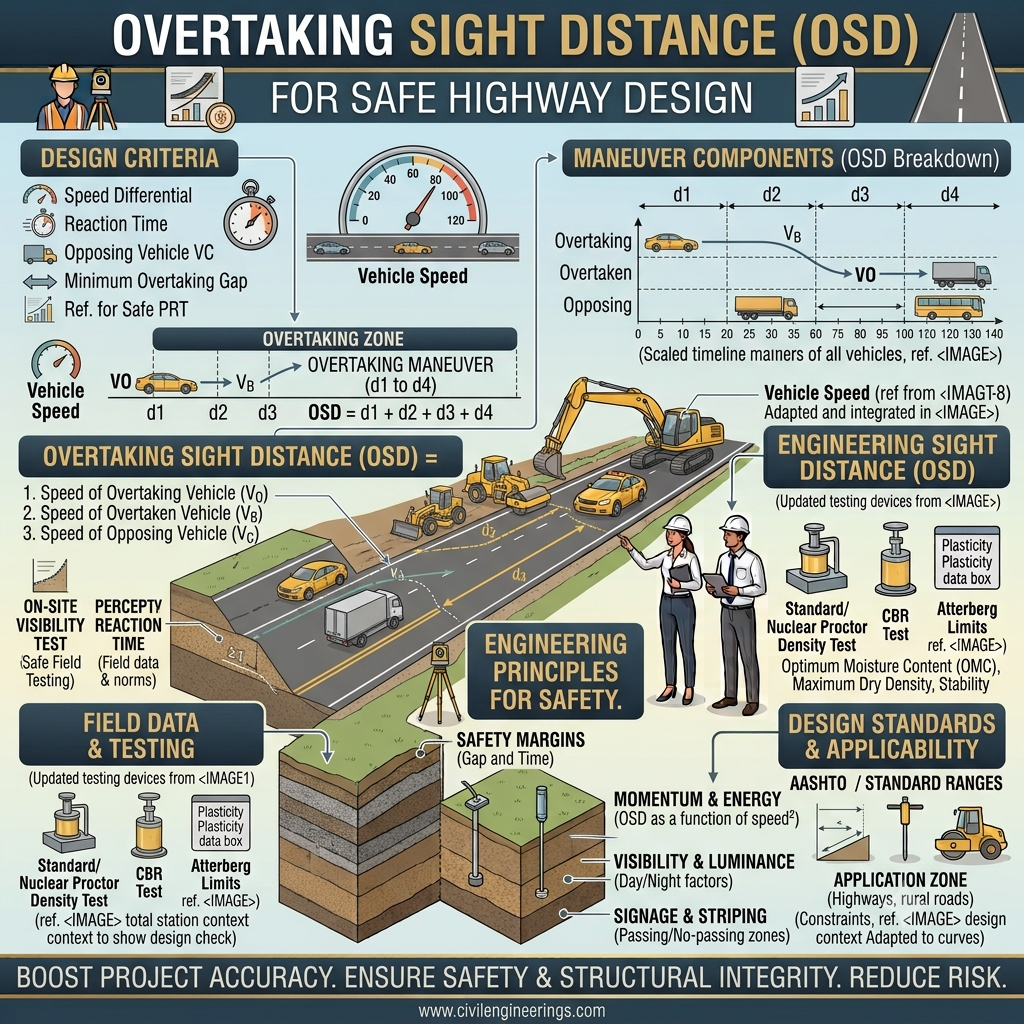
The following simplified diagram illustrates a typical overtaking maneuver on a two-lane highway.
                    Direction of Travel →

------------------------------------------------------------
 Car A (Overtaking)
           \______________________________
            \                             \
             \                             \
 Truck B ------------------------------->   \
                                              \
                                               \__________
------------------------------------------------------------
                              ← Oncoming Vehicle
Diagram Explanation
- Truck B travels at a lower speed.
- Car A checks the opposing lane before moving out.
- The driver accelerates, overtakes the truck, and returns to the original lane.
- The approaching vehicle remains outside the conflict zone because sufficient overtaking sight distance exists.
If the visible roadway were shorter than the required overtaking sight distance, the maneuver would become unsafe.
Practical Engineering Example
A rural two-lane highway carries both passenger cars and heavy commercial vehicles. Traffic studies show that trucks frequently travel at 60 km/h while cars maintain speeds close to 100 km/h.
Engineers reviewing the alignment identify a long straight section with excellent forward visibility. They designate this segment as an overtaking zone because drivers can clearly observe approaching traffic and complete the passing maneuver within the available sight distance.
Farther along the route, the highway approaches a crest vertical curve. The hill limits forward visibility, preventing drivers from seeing opposing vehicles until they reach the summit. Engineers install no-overtaking pavement markings and warning signs in this section to reduce the risk of head-on collisions.
This example demonstrates how geometric design and traffic engineering work together to improve highway safety.
Key Takeaways
Overtaking Sight Distance for Safe Highway Design represents one of the most important visibility criteria in highway engineering. Adequate overtaking sight distance allows drivers to assess road conditions, accelerate safely, pass slower vehicles, and return to their lane without interfering with opposing traffic. Engineers determine these distances by considering driver perception, vehicle acceleration, roadway geometry, traffic conditions, and appropriate safety margins. Properly designed overtaking zones improve traffic efficiency, reduce driver frustration, and significantly decrease the likelihood of head-on collisions on two-lane highways.
Overtaking Sight Distance Calculation
Highway engineers calculate overtaking sight distance (OSD) by considering the total distance required for a driver to safely complete an overtaking maneuver. Instead of relying on a single value, engineers evaluate several distance components that together ensure a safe passing operation.
Components of Overtaking Sight Distance
The total OSD generally consists of four main components:
- Distance covered during perception and reaction time
- Distance traveled while overtaking the slower vehicle
- Distance traveled by an opposing vehicle during the overtaking maneuver
- Safety clearance distance between the overtaking and opposing vehicles
A simplified engineering relationship can be expressed as:
Overtaking Sight Distance (OSD)
= d₁ + d₂ + d₃ + d₄
Where:
- d₁ = Distance during perception and initial acceleration
- d₂ = Distance while passing the slower vehicle
- d₃ = Distance covered by the opposing vehicle
- d₄ = Final safety clearance
Engineering Considerations
When determining OSD, engineers evaluate:
- Design speed
- Vehicle acceleration
- Speed differential
- Driver reaction time
- Opposing traffic speed
- Road gradient
- Pavement condition
Modern highway design software performs these calculations using recognized engineering standards, ensuring that the selected sight distance provides an adequate safety margin.
Highway Design Considerations
Providing sufficient overtaking sight distance requires careful coordination between geometric design and field conditions.
Horizontal Curves
Sharp curves restrict the driver’s line of sight. Engineers often prohibit overtaking on these sections because approaching vehicles remain hidden until the last moment.
Recommended Practice
- Increase curve radius where practical.
- Clear roadside vegetation.
- Install no-overtaking markings if visibility remains insufficient.
Crest Vertical Curves
A crest curve reduces forward visibility because the roadway rises above the driver’s line of sight.
Engineers design crest curves with adequate length to maintain the required overtaking sight distance whenever possible.
Roadside Obstructions
Several roadside objects may reduce visibility, including:
- Buildings
- Trees
- Utility poles
- Noise barriers
- Rock cuttings
- Bridge parapets
Removing unnecessary obstructions can significantly improve overtaking opportunities.
Terrain Conditions
Different terrains require different design approaches.
Plain Terrain
- Better visibility
- More overtaking opportunities
- Lower construction complexity
Rolling Terrain
- Frequent changes in elevation
- Reduced visibility
- Careful alignment design required
Mountainous Terrain
- Limited sight distance
- Sharp curves
- Steep gradients
- Frequent no-passing zones
Overtaking Zones and No-Overtaking Zones
Highway engineers divide road sections into overtaking and restricted zones based on available visibility.
Overtaking Zones
These sections provide sufficient sight distance for safe passing.
Characteristics include:
- Long straight alignment
- Gentle curves
- Adequate forward visibility
- Low roadside obstructions
No-Overtaking Zones
These locations do not provide adequate visibility.
Typical examples include:
- Crest curves
- Sharp bends
- Bridge approaches
- Tunnel entrances
- Railway crossings
- Busy intersections
Road markings, warning signs, and solid center lines clearly indicate these restricted areas.
Common Design Mistakes
Even well-planned highway projects can encounter safety issues if engineers overlook visibility requirements.
Common Errors
- Underestimating future traffic speeds.
- Ignoring roadside vegetation growth.
- Designing short crest curves.
- Allowing roadside structures to block visibility.
- Failing to update pavement markings.
- Inadequate maintenance of overtaking zones.
- Ignoring accident history during redesign.
Avoiding these mistakes improves long-term highway safety and reduces maintenance costs.
Best Practices for Safe Highway Design
Experienced highway engineers follow several proven practices when designing overtaking sections.
- Perform detailed topographic surveys before alignment design.
- Use accurate traffic data and realistic design speeds.
- Maintain clear visibility through vegetation control.
- Design smooth horizontal and vertical alignments.
- Install appropriate pavement markings and traffic signs.
- Conduct periodic safety audits after construction.
- Review accident records to identify hazardous locations.
- Upgrade older highways where visibility no longer meets modern standards.
- Integrate intelligent transportation systems (ITS) where appropriate.
- Consider future traffic growth during the planning stage.
These practices help create safer highways while improving traffic flow and driver confidence.
Practical Recommendations
Civil Engineers
- Verify overtaking sight distance during every geometric design review.
- Coordinate alignment design with drainage, structures, and roadside development.
- Conduct field verification before approving final drawings.
- Prioritize safety over minor construction cost savings.
Contractors
- Construct roadway profiles according to approved design levels.
- Prevent unnecessary roadside obstructions during construction.
- Install traffic signs and pavement markings accurately.
- Protect visibility corridors during landscaping activities.
Engineering Students
- Understand the relationship between design speed and sight distance.
- Practice geometric design calculations using real highway data.
- Visit existing highways to identify overtaking and restricted zones.
- Study highway accident case studies to understand the consequences of inadequate visibility.
General Discussion of IRC, AASHTO, and ICE Guidance
Leading highway engineering organizations such as IRC (Indian Roads Congress), AASHTO (American Association of State Highway and Transportation Officials), and the Institution of Civil Engineers (ICE) emphasize the importance of providing adequate sight distance during highway design.
Although their detailed procedures and recommended values differ, they generally encourage engineers to:
- Base overtaking sight distance on the selected design speed.
- Evaluate both horizontal and vertical alignment together.
- Account for driver perception and reaction time.
- Consider opposing traffic movement.
- Maintain clear visibility by controlling roadside obstructions.
- Incorporate appropriate safety factors into design calculations.
- Perform regular inspections to ensure visibility remains unobstructed throughout the highway’s service life.
These widely accepted engineering principles support consistent, safe, and efficient highway design.
Additional Highway Safety Measures
Adequate overtaking sight distance forms only one part of a comprehensive highway safety strategy.
Other important measures include:
- Proper lane widths
- Shoulder construction
- Road lighting
- Reflective pavement markings
- Crash barriers
- Median protection
- Drainage systems
- Speed management
- Warning signs
- Regular pavement maintenance
When combined, these elements create a safer environment for all road users.
Frequently Asked Questions (FAQs)
1. What is overtaking sight distance in highway engineering?
Overtaking sight distance is the minimum visible roadway length required for a driver to safely overtake a slower vehicle and return to the original lane before an approaching vehicle reaches the same location.
2. Why is overtaking sight distance important?
It reduces the risk of head-on collisions, improves traffic flow, enhances driver confidence, and increases overall highway safety.
3. Which factors influence overtaking sight distance?
Key factors include design speed, vehicle acceleration, driver reaction time, road geometry, traffic conditions, terrain, and roadside visibility.
4. Where should overtaking be prohibited?
Overtaking should be restricted on sharp curves, crest vertical curves, bridge approaches, tunnel entrances, railway crossings, and other locations with inadequate visibility.
5. How does design speed affect overtaking sight distance?
Higher design speeds require longer overtaking sight distances because vehicles travel greater distances during the passing maneuver.
6. What is the difference between stopping sight distance and overtaking sight distance?
Stopping sight distance allows a driver to stop safely before reaching an obstacle, whereas overtaking sight distance provides enough visibility to pass another vehicle safely.
7. How do engineers improve overtaking sight distance?
They optimize highway alignment, increase curve radii where feasible, remove visibility obstructions, design longer crest curves, and install appropriate traffic control devices.
8. Which highway standards discuss overtaking sight distance?
Organizations such as IRC, AASHTO, and ICE include guidance on sight distance as part of their broader highway geometric design recommendations.
9. Can poor maintenance reduce overtaking sight distance?
Yes. Overgrown vegetation, damaged signs, roadside structures, or neglected pavement markings can reduce visibility and compromise safety.
10. Why are overtaking lanes provided on some highways?
Dedicated overtaking or climbing lanes improve traffic flow by allowing faster vehicles to pass slower-moving traffic without entering the opposing lane.
Conclusion
Overtaking Sight Distance for Safe Highway Design remains one of the most important geometric design considerations in modern road engineering. Adequate visibility enables drivers to recognize slower vehicles, assess opposing traffic, complete overtaking maneuvers confidently, and return safely to their lane without creating conflicts. Highway engineers achieve this objective through careful alignment design, accurate traffic analysis, appropriate safety margins, and continuous maintenance of visibility corridors. Recognized engineering organizations such as IRC, AASHTO, and ICE reinforce these principles by emphasizing safe design speeds, proper roadway geometry, and unobstructed sight lines. Engineers, contractors, and transportation authorities who prioritize Overtaking Sight Distance for Safe Highway Design contribute to safer highways, smoother traffic flow, fewer head-on collisions, and longer-lasting transportation infrastructure. Investing in proper sight distance design today creates highways that continue to protect road users for decades.

Kamran Malik is a passionate civil engineering writer and researcher who specializes in construction, transportation, structural engineering, and infrastructure topics. Through his articles on CivilEngineerings.com, he simplifies complex engineering concepts and shares practical insights, industry trends, and educational resources for students, professionals, and engineering enthusiasts.