
Introduction
Transportation infrastructure is evolving rapidly to meet the growing demands of urbanization, traffic congestion, climate resilience, and road safety. Traditional road design methods are no longer sufficient to support modern transportation systems that require real-time communication, intelligent traffic management, and sustainable engineering solutions. This is where Smart Road Design becomes an essential component of modern civil engineering.
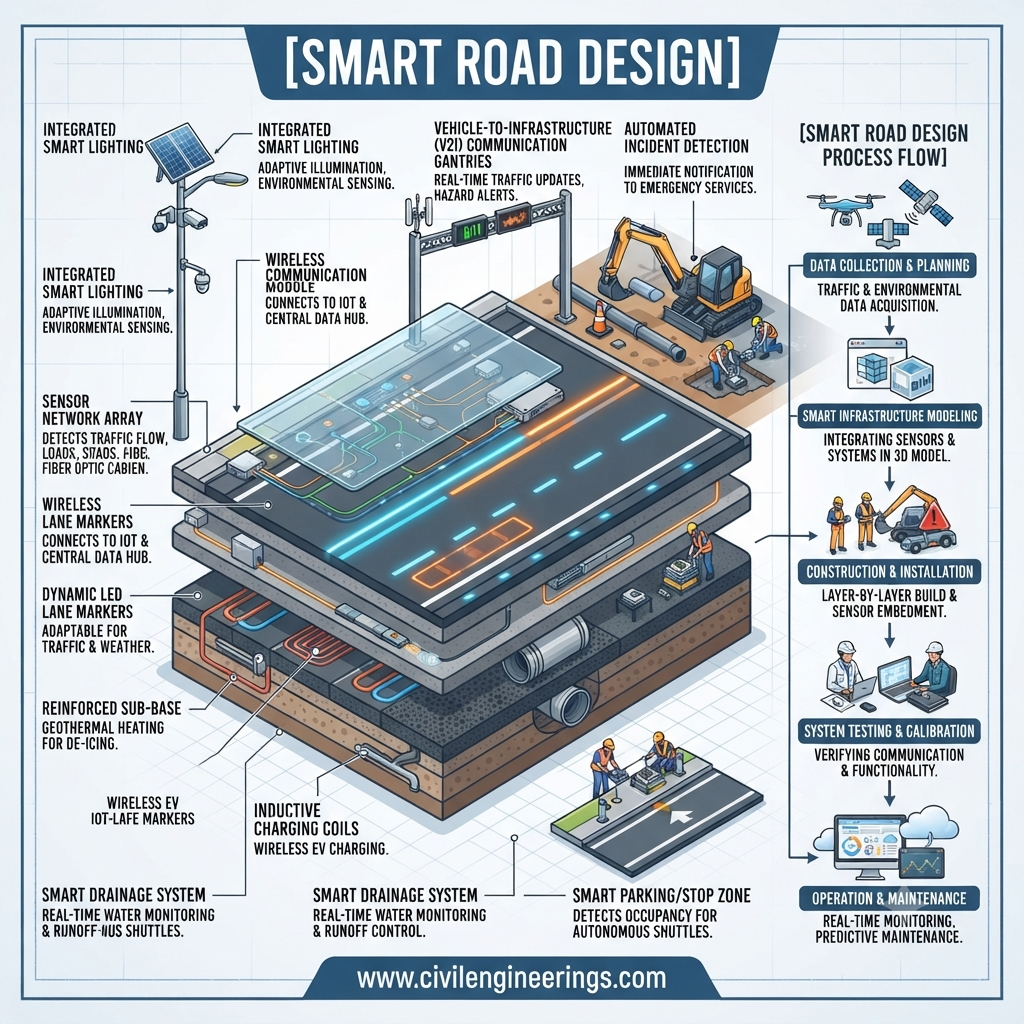
Smart Road Design combines conventional highway engineering principles with advanced digital technologies, intelligent transportation systems (ITS), renewable energy solutions, and connected infrastructure. Instead of simply constructing roads for vehicles, engineers now create intelligent corridors capable of monitoring traffic, communicating with connected vehicles, reducing accidents, improving maintenance efficiency, and minimizing environmental impacts.
Whether you are a civil engineering student, highway engineer, contractor, consultant, researcher, or government official, understanding Smart Road Design is becoming increasingly important. This comprehensive guide explains its principles, technologies, design process, engineering considerations, practical applications, international standards, and future developments. By the end of this article, you will have a strong understanding of how smart roads are transforming transportation networks worldwide.
What is Smart Road Design?
Smart Road Design is the process of planning, designing, and constructing highways and road networks that incorporate intelligent technologies to improve transportation efficiency, road safety, environmental sustainability, and infrastructure management.
Unlike conventional highways that primarily support vehicle movement, smart roads collect, analyse, and exchange information continuously. Sensors, cameras, communication systems, and digital monitoring equipment work together to provide real-time data that helps road authorities make informed decisions.
A smart road functions as an integrated transportation ecosystem where infrastructure, vehicles, and traffic management systems communicate seamlessly.
Simple Definition
Smart Road Design is the integration of civil engineering, intelligent transportation systems, digital technologies, and sustainable infrastructure into modern roadway planning and construction.
Why Smart Road Design Matters
Modern transportation systems face numerous challenges that conventional road infrastructure struggles to address.
Some of the major issues include:
- Rapid urban population growth
- Increasing traffic congestion
- Higher accident rates
- Rising maintenance costs
- Climate change impacts
- Carbon emissions
- Ageing infrastructure
- Demand for autonomous vehicles
Smart Road Design offers practical solutions by introducing technology-driven infrastructure capable of responding dynamically to changing traffic and environmental conditions.
Benefits of Smart Road Design
Improved Road Safety
Real-time monitoring detects accidents, hazardous weather, speeding vehicles, and congestion. Authorities can respond faster, reducing accident severity.
Better Traffic Flow
Adaptive traffic management minimizes delays by adjusting traffic signals according to actual traffic conditions.
Reduced Maintenance Costs
Embedded sensors monitor pavement conditions, allowing preventive maintenance before significant deterioration occurs.
Environmental Sustainability
Smart roads support electric vehicles, renewable energy generation, efficient lighting systems, and reduced fuel consumption through optimized traffic movement.
Enhanced User Experience
Drivers receive accurate travel information, dynamic speed limits, lane guidance, and incident alerts.
Key Objectives of Smart Road Design
Every smart road project aims to achieve several engineering objectives.
1. Improve Transportation Efficiency
Traffic movement should remain smooth while minimizing congestion and travel delays.
2. Increase Road Safety
The design should reduce crash frequency by improving visibility, communication, and hazard detection.
3. Support Connected and Autonomous Vehicles
Future transportation relies on infrastructure capable of communicating directly with intelligent vehicles.
4. Enhance Infrastructure Monitoring
Road authorities should continuously assess pavement performance, bridge health, drainage systems, and structural integrity.
5. Reduce Environmental Impact
Energy-efficient technologies, green construction materials, and sustainable drainage systems help lower the environmental footprint.
6. Improve Asset Management
Continuous monitoring enables engineers to prioritize maintenance based on actual road conditions rather than fixed schedules.
Core Components of Smart Road Infrastructure
Smart roads consist of multiple interconnected systems working together to improve roadway performance.
Intelligent Sensors
Sensors collect information about:
- Traffic volume
- Vehicle speed
- Pavement temperature
- Moisture levels
- Surface conditions
- Structural movement
- Air quality
- Weather conditions
These sensors provide valuable data for maintenance planning and traffic operations.
Internet of Things (IoT)
IoT devices connect various road components through digital communication networks.
Examples include:
- Traffic signal controllers
- Weather stations
- Parking systems
- Roadside monitoring equipment
- Variable message signs
- Surveillance cameras
The collected information is transmitted to centralized traffic management centres for analysis.
Smart Lighting Systems
Traditional streetlights consume significant amounts of electricity.
Modern smart lighting systems use:
- LED technology
- Motion sensors
- Adaptive brightness control
- Solar-powered lighting
- Remote monitoring
These systems improve visibility while reducing operational costs.
Intelligent Traffic Signals
Traffic signals equipped with artificial intelligence continuously evaluate traffic demand.
Instead of using fixed timing schedules, they adjust signal phases dynamically according to:
- Vehicle queues
- Pedestrian movements
- Public transportation priority
- Emergency vehicle access
This reduces unnecessary delays and improves intersection efficiency.
Communication Networks
Reliable communication infrastructure enables information exchange between:
- Roadside equipment
- Traffic control centres
- Connected vehicles
- Emergency services
- Maintenance teams
Common communication technologies include fibre-optic networks, 5G, Dedicated Short-Range Communications (DSRC), and Cellular Vehicle-to-Everything (C-V2X).
Engineering Principles Behind Smart Road Design
Although smart roads rely on advanced technologies, they are still built upon established highway engineering principles.
Geometric Design
Road geometry must provide safe and comfortable vehicle movement.
Engineers consider:
- Design speed
- Horizontal alignment
- Vertical alignment
- Cross slopes
- Sight distance
- Superelevation
- Lane width
- Shoulder width
Smart technologies enhance these features but do not replace sound geometric design.
Pavement Engineering
Pavement structures must withstand traffic loading while accommodating embedded technologies such as sensors and communication conduits.
Both flexible and rigid pavements can be adapted for smart road applications.
Key design considerations include:
- Load distribution
- Material durability
- Thermal performance
- Drainage
- Maintenance accessibility
Drainage Design
Water remains one of the leading causes of pavement deterioration.
Smart drainage systems incorporate:
- Water level sensors
- Automated pumping stations
- Flood monitoring
- Rainfall prediction systems
These features improve resilience during extreme weather events.
Structural Health Monitoring
Bridges, retaining walls, tunnels, and elevated roadways can be equipped with monitoring systems that measure:
- Stress
- Strain
- Deflection
- Vibration
- Crack development
- Temperature changes
This continuous assessment enables engineers to identify potential issues before they become critical.
Smart Road Design Process
Developing intelligent road infrastructure involves a structured engineering approach.
Step 1: Traffic Investigation
Engineers collect information on:
- Existing traffic volume
- Vehicle classification
- Peak-hour demand
- Travel patterns
- Accident history
This data establishes the project’s design requirements.
Step 2: Site Investigation
Comprehensive surveys include:
- Topographic surveys
- Geotechnical investigations
- Utility mapping
- Environmental assessments
- Hydrological studies
Accurate site data supports safe and efficient infrastructure design.
Step 3: Technology Assessment
Engineers identify suitable smart technologies based on:
- Project objectives
- Available budget
- Climate conditions
- Traffic demand
- Future expansion needs
The selected systems must integrate seamlessly with the overall roadway design.
Step 4: Integrated Infrastructure Design
Civil, electrical, communication, and software engineering teams collaborate to design:
- Pavement systems
- Sensor layouts
- Communication networks
- Traffic control systems
- Power supply
- Data centres
- Monitoring facilities
Interdisciplinary coordination ensures reliable performance throughout the infrastructure’s lifecycle.
General Engineering Standards
While Smart Road Design continues to evolve, engineers commonly align projects with recognised guidance and best practices from organisations such as:
- IRC (Indian Roads Congress) for road planning and geometric design guidance.
- AASHTO (American Association of State Highway and Transportation Officials) for highway design, pavement engineering, and transportation standards.
- ICE (Institution of Civil Engineers) for sustainable infrastructure, asset management, and professional engineering practices.
These frameworks help ensure that smart road projects remain safe, durable, efficient, and adaptable to future technological advancements.
Intelligent Transportation Systems (ITS) Integration
Intelligent Transportation Systems (ITS) are the technological backbone of Smart Road Design. They combine communication, sensing, computing, and traffic engineering to create safer and more efficient road networks. By integrating ITS during the design stage, engineers can improve traffic operations while reducing congestion and maintenance costs.
Major ITS Components
Traffic Monitoring Systems
Traffic monitoring systems collect real-time information using:
- CCTV cameras
- Radar detectors
- Inductive loop sensors
- Bluetooth tracking devices
- Automatic Number Plate Recognition (ANPR) cameras
- AI-powered video analytics
The collected data enables authorities to monitor traffic conditions continuously and respond quickly to incidents.
Variable Message Signs (VMS)
Variable Message Signs display dynamic information such as:
- Traffic congestion
- Road closures
- Diversion routes
- Weather warnings
- Construction activities
- Speed advisories
Providing timely information helps drivers make safer decisions and improves traffic flow.
Automatic Incident Detection
Artificial intelligence can detect abnormal traffic behaviour within seconds. Examples include:
- Sudden traffic stoppages
- Vehicle collisions
- Wrong-way driving
- Broken-down vehicles
- Debris on the roadway
Early detection shortens emergency response times and minimises secondary accidents.
Smart Toll Collection
Electronic Toll Collection (ETC) eliminates long vehicle queues by using RFID tags, licence plate recognition, or mobile payment systems. The result is lower fuel consumption, reduced travel time, and smoother traffic movement.
Digital Technologies Used in Smart Road Design
Modern road infrastructure depends on advanced digital technologies that improve planning, construction, operation, and maintenance.
Artificial Intelligence (AI)
Artificial Intelligence analyses vast amounts of transportation data to:
- Predict traffic congestion
- Optimise signal timing
- Forecast maintenance needs
- Improve route planning
- Enhance road safety
AI also supports predictive maintenance by identifying pavement deterioration before visible damage appears.
Building Information Modelling (BIM)
BIM provides a digital representation of road infrastructure throughout its lifecycle.
Benefits include:
- Improved design coordination
- Clash detection
- Accurate quantity estimation
- Better construction planning
- Easier asset management
Many infrastructure agencies now require BIM for large highway projects because it improves collaboration among stakeholders.
Geographic Information Systems (GIS)
GIS helps engineers analyse spatial data during route selection and planning.
Applications include:
- Corridor planning
- Land use analysis
- Terrain assessment
- Utility mapping
- Flood risk evaluation
- Environmental impact assessment
Combining GIS with drone surveys produces highly accurate site information.
Digital Twins
A digital twin is a virtual model of a physical road asset that receives real-time operational data.
Engineers use digital twins to:
- Simulate traffic conditions
- Evaluate pavement performance
- Monitor bridges
- Predict failures
- Test maintenance strategies
This technology supports informed decision-making throughout the infrastructure’s service life.
Sustainable Features in Smart Road Design
Sustainability has become a key objective in modern highway engineering. Smart roads are designed not only for mobility but also for environmental responsibility.
Solar-Powered Roads
Some pilot projects incorporate photovoltaic panels to generate electricity for:
- Street lighting
- Traffic signals
- Charging stations
- Roadside facilities
Although widespread implementation remains technically challenging, solar technologies continue to evolve.
Electric Vehicle Infrastructure
The increasing adoption of electric vehicles requires roads to support charging infrastructure.
Typical provisions include:
- Fast-charging stations
- Wireless charging research corridors
- Smart parking with charging points
- Renewable energy integration
These facilities encourage cleaner transportation.
Smart Drainage Systems
Climate change has increased the frequency of intense rainfall events.
Smart drainage systems use:
- Water-level sensors
- Automated pumps
- Remote monitoring
- Flood warning systems
These features protect pavement structures and improve resilience during storms.
Energy-Efficient Lighting
LED streetlights combined with intelligent control systems offer several advantages:
- Lower electricity consumption
- Longer service life
- Reduced maintenance
- Adaptive brightness
- Improved night-time visibility
Real-World Applications of Smart Road Design
Several countries have implemented smart road technologies to improve transportation efficiency and safety.
The Netherlands
The Netherlands has pioneered innovations such as intelligent LED road markings, adaptive lighting, and connected road infrastructure. These projects demonstrate how technology can enhance safety while reducing energy consumption.
Singapore
Singapore integrates AI-driven traffic management, electronic road pricing, and advanced monitoring systems to optimise urban mobility. Its smart transportation network is widely recognised as one of the most efficient in the world.
United States
Many states have introduced connected vehicle corridors, adaptive signal control, and bridge health monitoring systems. Guidance from AASHTO continues to influence the development of intelligent highway infrastructure.
United Kingdom
The UK has invested in smart motorways featuring variable speed limits, lane management systems, and real-time traffic information to improve capacity and reduce congestion.
Practical Recommendations for
Successful Smart Road Design requires collaboration between multiple engineering disciplines. The following recommendations can help professionals deliver more reliable and future-ready projects.
Highway Engineers
- Integrate ITS requirements during the conceptual design stage.
- Design communication ducts and utility corridors for future expansion.
- Use lifecycle cost analysis rather than focusing only on initial construction costs.
- Consider climate resilience and long-term maintenance strategies.
Site Engineers
- Ensure accurate installation of sensors and communication equipment.
- Coordinate closely with electrical and ICT teams.
- Protect embedded technologies during pavement construction.
- Verify calibration of intelligent monitoring systems before commissioning.
Contractors
- Follow manufacturer specifications for smart infrastructure components.
- Train construction teams in handling sensitive electronic equipment.
- Maintain strict quality control during installation.
- Document all digital assets for future maintenance.
Civil Engineering Students
- Develop a strong understanding of highway engineering fundamentals.
- Learn BIM, GIS, AI, and transportation modelling software.
- Stay updated with emerging ITS technologies.
- Study international standards and successful smart road case studies.
Best Practices in Smart Road Design
To maximise long-term performance, engineers should follow these best practices:
- Design infrastructure with scalability for future technologies.
- Prioritise road safety in every design decision.
- Use durable, high-quality construction materials.
- Integrate environmental sustainability throughout the project lifecycle.
- Conduct regular inspections and preventive maintenance.
- Protect digital infrastructure against cybersecurity threats.
- Encourage collaboration among civil, electrical, software, and transportation engineers.
- Continuously evaluate system performance using real-time data.
Future Trends in Smart Road Design
The future of transportation infrastructure will be shaped by innovation and digital transformation.
Emerging trends include:
- Fully connected vehicle-to-infrastructure (V2I) communication
- Autonomous vehicle corridors
- AI-powered predictive traffic management
- Self-healing pavement materials
- Wireless electric vehicle charging lanes
- Drone-assisted infrastructure inspections
- Carbon-neutral highway projects
- Digital twins for nationwide road networks
- Advanced pavement monitoring using embedded fibre-optic sensors
As these technologies mature, smart roads will become increasingly intelligent, resilient, and sustainable.
Frequently Asked Questions (FAQs)
1. What is Smart Road Design?
Smart Road Design is the integration of intelligent technologies, digital communication, and sustainable engineering practices into road planning, design, construction, and maintenance to improve safety, efficiency, and infrastructure management.
2. Why is Smart Road Design important?
It improves traffic flow, enhances road safety, reduces maintenance costs, supports connected vehicles, and contributes to more sustainable transportation systems.
3. What technologies are commonly used in smart roads?
Common technologies include IoT sensors, Artificial Intelligence, GIS, BIM, CCTV cameras, adaptive traffic signals, digital twins, fibre-optic communication, and Vehicle-to-Infrastructure (V2I) communication systems.
4. How do smart roads improve road safety?
They provide real-time monitoring, incident detection, weather alerts, adaptive speed management, and rapid communication with emergency services, helping reduce both accident frequency and severity.
5. Can existing highways be upgraded into smart roads?
Yes. Many existing highways can be modernised by adding intelligent traffic systems, communication networks, smart lighting, sensors, and digital monitoring equipment without complete reconstruction.
6. What role does Artificial Intelligence play in Smart Road Design?
AI analyses traffic patterns, predicts maintenance requirements, optimises traffic signals, detects incidents, and supports data-driven decision-making for transportation agencies.
7. Which international organisations provide guidance for Smart Road Design?
Engineers often refer to guidance and best practices from organisations such as the Indian Roads Congress (IRC), AASHTO, and the Institution of Civil Engineers (ICE), alongside national transportation authorities.
8. What challenges do smart road projects face?
Key challenges include high initial investment, cybersecurity concerns, technology integration, maintenance of digital assets, data privacy, and the need for skilled professionals.
9. How does Smart Road Design support sustainability?
It reduces emissions through improved traffic management, encourages electric vehicle adoption, uses energy-efficient lighting, integrates renewable energy where feasible, and supports resilient drainage systems.
10. What skills should future highway engineers develop?
Future engineers should strengthen their knowledge of highway engineering while learning BIM, GIS, AI, ITS, transportation modelling, data analytics, and sustainable infrastructure practices.
Conclusion
Smart Road Design is transforming the way transportation infrastructure is planned, constructed, and managed. By combining proven civil engineering principles with intelligent transportation systems, digital technologies, and sustainable practices, engineers can develop roads that are safer, more efficient, and prepared for future mobility demands. From AI-powered traffic management and IoT-enabled monitoring to BIM, GIS, and digital twins, modern road infrastructure is becoming increasingly data-driven and resilient.
For civil engineering students, highway engineers, contractors, consultants, and government agencies, understanding Smart Road Design is no longer optional—it is essential for delivering infrastructure that meets growing traffic demands while addressing environmental and economic challenges. Applying recognised guidance from organisations such as IRC, AASHTO, and ICE, together with continuous innovation and interdisciplinary collaboration, will help create transportation networks that remain reliable for decades. As connected vehicles, autonomous mobility, and smart cities continue to evolve, Smart Road Design will play a central role in building sustainable, intelligent, and future-ready highway systems.
